Antiquities Returning to Mexico Include Mayan Vase Sold for $4 in US Store 

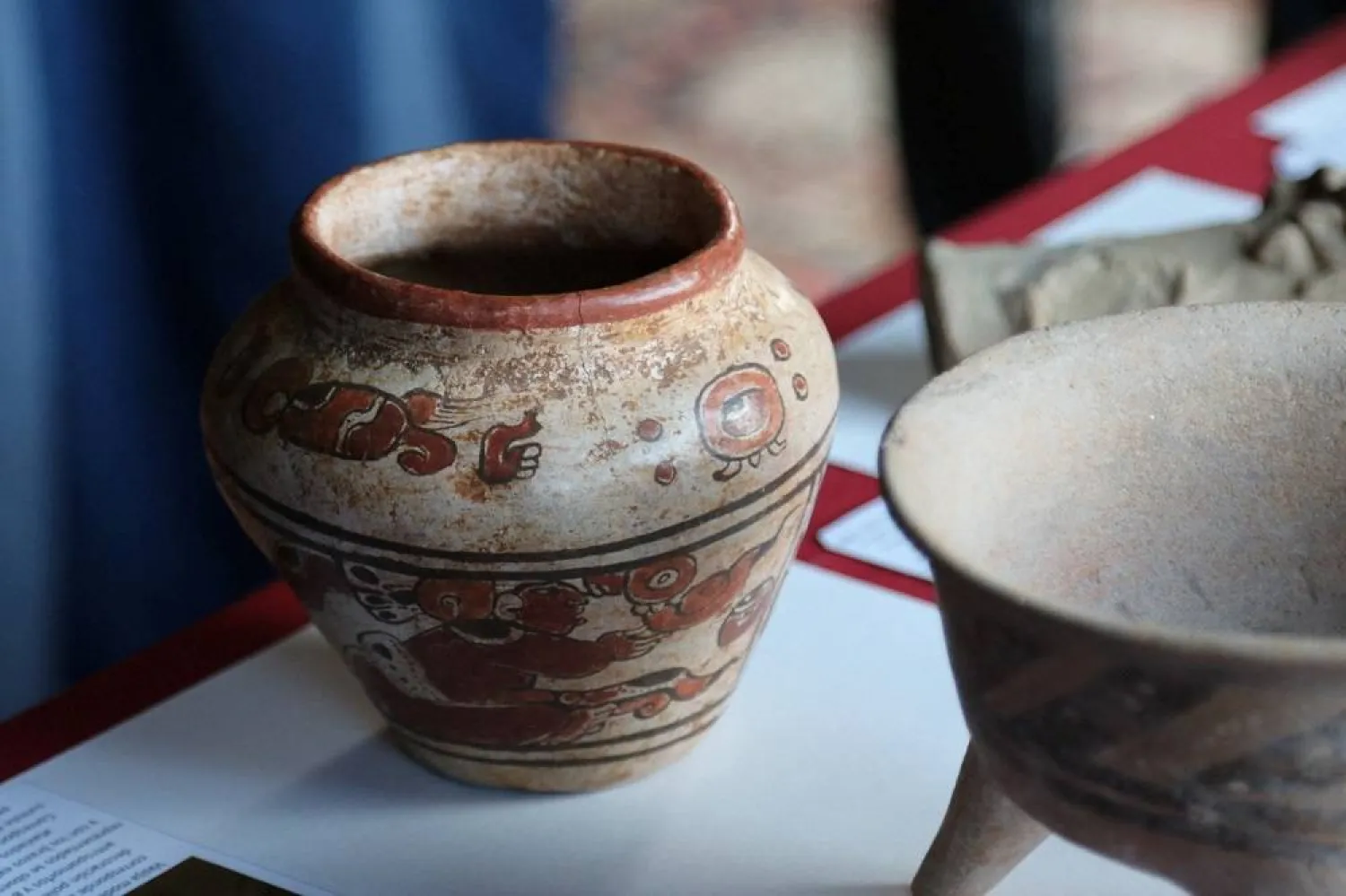
A Mayan vase over 1,000 years old and purchased for about four dollars at a Washington area thrift shop, will return to Mexico along with other cultural artefacts that date to the country's storied ancient past, at the Cultural Institute of Mexico in Washington, DC, US, this handout distributed on June 20, 2024. National Institute of Anthropology and History (INAH)/Handout via Reuters
TT

Antiquities Returning to Mexico Include Mayan Vase Sold for $4 in US Store 

A Mayan vase over 1,000 years old and purchased for about four dollars at a Washington area thrift shop, will return to Mexico along with other cultural artefacts that date to the country's storied ancient past, at the Cultural Institute of Mexico in Washington, DC, US, this handout distributed on June 20, 2024. National Institute of Anthropology and History (INAH)/Handout via Reuters

The Mexican government will welcome back 20 cultural artifacts that date to the country's storied ancient past, all found in the United States including a Mayan vase over 1,000 years old and purchased for about $4 at a Washington area thrift shop.

Mexico's antiquities institute INAH announced the repatriation, which also include centuries-old plates, bowls as well as sculpted figures belonging to the Aztec, Totonac and Teotihuacan cultures, in a statement on Thursday.

The artifacts are set to be returned to Mexico over the next few days.

The reddish-white Mayan vase has stoked particular interest.

According to a Washington D.C. television news report on Monday, local resident Anna Lee Dozier bought the Mayan vase for $3.99 from a clearance rack at a nearby thrift store about five years ago.

Likely made during the Maya civilization's classical zenith between 200-800 A.D., according to INAH, the well-preserved vase is a colorful polychrome vessel painted with ornate glyphs and depicting seated figures in profile gesturing with their hands.

Major Mayan cities grew in prominence beginning some 3,000 years ago across a large swathe of present-day southern Mexico and several Central American nations, during a time of major human achievements in math, astronomy and art.

Earlier this year, following a trip to Mexico City, Dozier notified Mexico's US embassy that she might have a real artifact, instead of the rustic replica she initially thought she had purchased.

Dozier later turned over the vase to Mexican officials in Washington, telling the local television station she believed the historical piece should return to its country of origin.

She also expressed relief that the ancient artifact was no longer at risk at her home from her two young boys.

"I was petrified that after two thousand years I would be the one to wreck it!"


Makkah Quran Museum Displays Rare ‘Blue Quran’ Manuscript

The Blue Quran is regarded as one of the rarest and most luxurious mushafs in Islamic civilization. (SPA)
TT

Makkah Quran Museum Displays Rare ‘Blue Quran’ Manuscript

The Blue Quran is regarded as one of the rarest and most luxurious mushafs in Islamic civilization. (SPA)

The Holy Quran Museum in the Hira Cultural District in Makkah is displaying a rare folio from the famed “Al-Muṣḥaf Al-Azraq” (Blue Quran), featuring verses from Surah Al-Baqarah, from the end of verse 37 to the beginning of verse 42, reported the Saudi Press Agency on Monday.

The exhibit highlights the richness of Islamic Quranic heritage and its ancient artistic legacy.

The Blue Quran is regarded as one of the rarest and most luxurious mushafs in Islamic civilization. It was written in pure gold ink in early Kufic script on a deep blue background, reflecting a distinctive artistic style that underscores early Muslims’ reverence for the Quranic text and their dedication to the aesthetics of its calligraphy.

Dating back to the 9th century, the manuscript holds exceptional historical and scholarly value. It stands as a testament to the development of Arabic calligraphy and illumination during the early Islamic period.

Surviving pages of the Blue Quran are extremely rare and are now dispersed among a limited number of museums and private collections worldwide.

The display forms part of the museum’s efforts to introduce visitors to the history of the mushaf and the artistic stages of its transcription, offering access to extraordinary examples of Quranic manuscripts.

The initiative aims to deepen cultural awareness and enrich the experience of visitors to the Hira Cultural District from within the Kingdom and abroad.

The Holy Quran Museum serves as a cultural and educational landmark, highlighting the history of the Quran and its journey since the revelation. It houses rare manuscripts and historic copies of the Quran, alongside interactive exhibits and modern technologies that reflect Muslims’ enduring devotion to the Quran throughout the centuries, in a location closely associated with the dawn of the Islamic message.


Riyadh Art Unveils Tuwaiq Sculpture 2026

The exhibition site on Tahlia Street was strategically chosen for its historical legacy of innovation to provide a conceptual framework for the works. SPA
TT

Riyadh Art Unveils Tuwaiq Sculpture 2026

The exhibition site on Tahlia Street was strategically chosen for its historical legacy of innovation to provide a conceptual framework for the works. SPA

The Royal Commission for Riyadh City, via its Riyadh Art program, has launched the Tuwaiq Sculpture 2026 exhibition on Prince Mohammed bin Abdulaziz Street (Tahlia).

Open to the public from February 9 to 22, the exhibition showcases 25 new artworks themed "Traces of What Will Be," exploring transformation and urban renewal.

The sculptures were crafted during a live phase from January 10 to February 5, during which artists from 18 countries used local stone and recycled metals, allowing the public to witness the creative process firsthand.

The exhibition site on Tahlia Street was strategically chosen for its historical legacy of innovation to provide a conceptual framework for the works.

Overseen by a panel of international experts, the exhibition serves as an interactive cultural platform featuring workshops and panel discussions to foster community engagement.

All 2026 pieces will join Riyadh Art's permanent collection, which has hosted over 170 artists since 2019 and already installed more than 60 sculptures across the city to integrate contemporary art into Riyadh's urban fabric.


Syrian Culture Minister Applauds Saudi Pavilion at Damascus Book Fair

The 2026 Damascus International Book Fair is held from February 6 to 16 - SPA
TT

Syrian Culture Minister Applauds Saudi Pavilion at Damascus Book Fair

The 2026 Damascus International Book Fair is held from February 6 to 16 - SPA

Syrian Minister of Culture Mohammed Yassin Saleh visited the Kingdom’s pavilion at the 2026 Damascus International Book Fair, held from February 6 to 16, where the Kingdom is serving as the Guest of Honor.

He commended the efforts of the Literature, Publishing and Translation Commission in showcasing the rich diversity of the Saudi cultural and literary scene. The pavilion features exhibitions of manuscripts, a Saudi fashion corner, and archaeological replicas, SPA reported.

The minister reviewed the commission's Tarjim translation initiative and Saudi literature comics.

This participation at the 2026 Damascus International Book Fair showcases Saudi creativity and fosters cultural dialogue, supporting Saudi Vision 2030’s goals of knowledge exchange and cultural leadership.