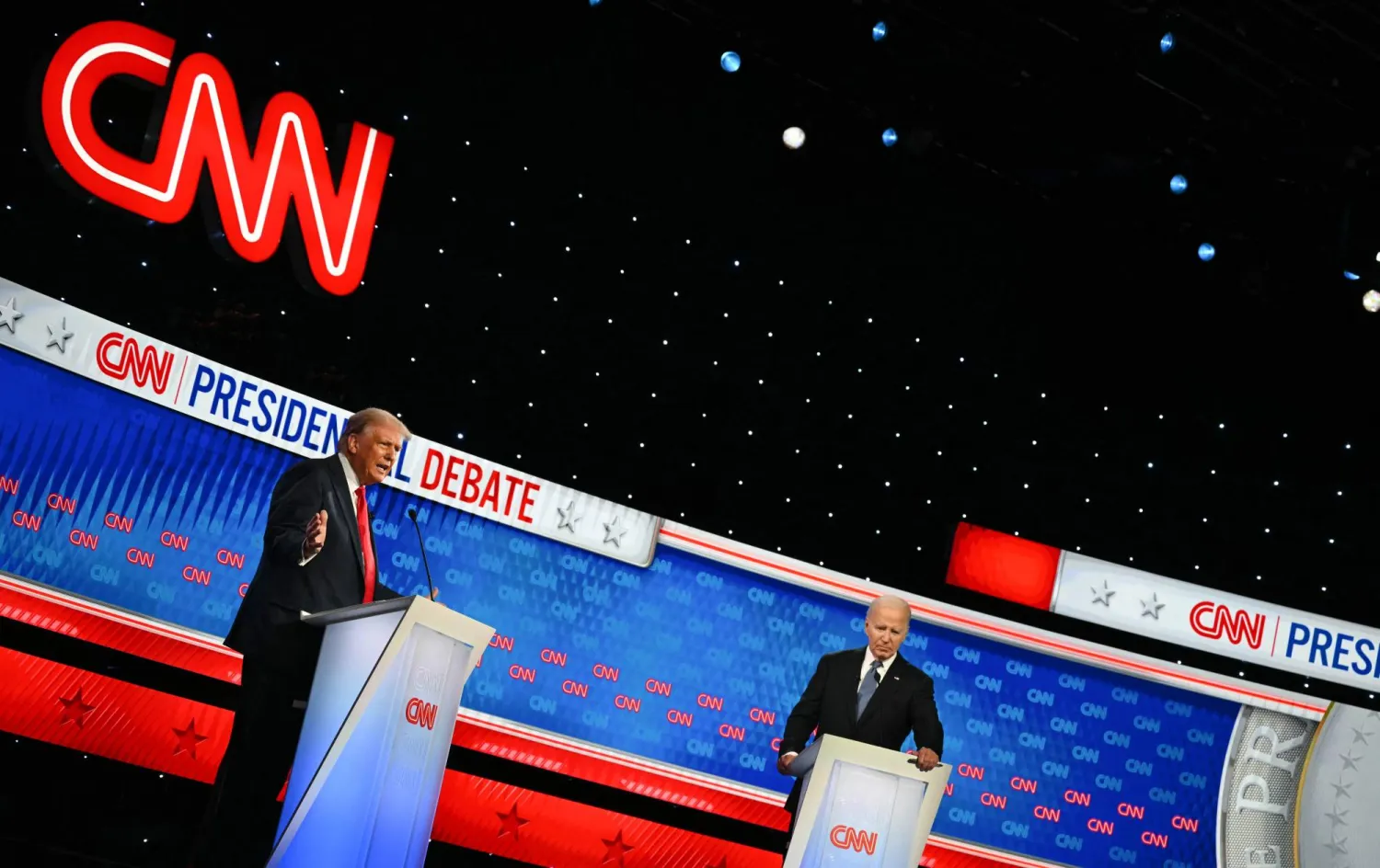
Biden, Trump Point Fingers at Each Other on Inflation During Debate

US President Joe Biden and former US President and Republican presidential candidate Donald Trump participate in the first presidential debate of the 2024 elections at CNN's studios in Atlanta, Georgia, on June 27, 2024. (Photo by ANDREW CABALLERO-REYNOLDS / AFP)
TT

Biden, Trump Point Fingers at Each Other on Inflation During Debate

US President Joe Biden and former US President and Republican presidential candidate Donald Trump participate in the first presidential debate of the 2024 elections at CNN's studios in Atlanta, Georgia, on June 27, 2024. (Photo by ANDREW CABALLERO-REYNOLDS / AFP)

US President Joe Biden and his Republican rival Donald Trump both took credit for what they said was a strong economy under their watch and blamed the other for punishing inflation as they battled on the debate stage before the Nov. 5 election.
"He's done a poor job and inflation is killing our country. It is absolutely killing us," said Trump, who was president from 2017-2021. Under his own watch, Trump said, "everything was rocking good."
Biden pinned inflation, which peaked at 9% two years ago and has since dropped to 3.25%, on Trump's handling of the COVID-19 pandemic, along with corporate greed, Reuters said.
"The economy collapsed" under Trump, Biden said, and when he came into office "what we had to do is try to put things back together again."
Massive disruptions from the COVID-19 pandemic, which began in March 2020, make comparing the economic records of the two rivals difficult.
But one thing is certain - inflation has been far higher under Biden than it was under Trump. There was not a single month under Trump in which consumer price inflation exceeded 3%, and for most of that time, the Federal Reserve - whose job it is to maintain stable prices - worried that inflation was too low.
Under Biden, inflation has been above 3% for all but his first three months in office, and was above 5% for more than half his term so far.
The damage from higher prices has been significant: even though wages have risen, the bigger weekly paychecks American workers take home buy less than they did when Biden came into office in 2021.
When inflation first began to take off in the spring of 2021, most analysts and policymakers at the Fed thought it would be transitory. But by late 2021, almost nobody thought so.
The Fed, in response, increased borrowing costs aggressively to bring down inflation, and prices are now no longer rising as fast as they were.
Despite higher interest rates, usually expected to cool economic growth, the labor market has been tight, with the unemployment rate at or below 4% for the last two years, the longest such run since the 1960s.
As inflation has fallen, average wage growth in the US has exceeded inflation for more than a year now, with lower income workers - such those in the leisure and hospitality sectors - among those whose real wages have risen the most.
Economists blame the inflation surge on a broad set of factors, including surging demand after the pandemic shutdowns, households flush with cash from pandemic-era stimulus delivered under both Trump and Biden, and lingering disruptions to trade and supply chains from both the pandemic and Russia's invasion of Ukraine.
Quarterly economic growth during Trump’s first three years, and during Biden’s term beginning in 2021, each compounded at an almost identical rate that annualizes to around 2.7%.



Ukraine’s New Defense Minister Reveals Scale of Desertions as Millions Avoid the Draft

Ukraine's newly appointed Defense Minister Mykhailo Fedorov attends a parliamentary session in Kyiv, Ukraine, 14 January 2026. (EPA)
TT

Ukraine’s New Defense Minister Reveals Scale of Desertions as Millions Avoid the Draft

Ukraine's newly appointed Defense Minister Mykhailo Fedorov attends a parliamentary session in Kyiv, Ukraine, 14 January 2026. (EPA)

Wide-scale desertions and 2 million draft-dodgers are among a raft of challenges facing Ukraine's military as Russia presses on with its invasion of its neighbor after almost four years of fighting, the new defense minister said Wednesday.

Mykhailo Fedorov told Ukraine's parliament that other problems facing Ukraine’s armed forces include excessive bureaucracy, a Soviet-style approach to management, and disruptions in the supply of equipment to troops along the about 1,000-kilometer (600-mile) front line.

“We cannot fight a war with new technologies but an old organizational structure,” Fedorov said.

He said the military had faced some 200,000 troop desertions and draft-dodging by around 2 million people.

President Volodymyr Zelenskyy appointed 34-year-old Fedorov at the start of the year. The former head of Ukraine’s digital transformation policies is credited with spearheading the army's drone technology and introducing several successful e-government platforms.

His appointment was part of a broad government reshuffle that the Ukrainian leader said aimed to sharpen the focus on security, defense development and diplomacy amid a new US-led push to find a peace settlement.

Fedorov said the defense ministry is facing a shortfall of 300 billion hryvnia ($6.9 billion) in funding needs.

The European Union will dedicate most of a massive new loan program to help fund Ukraine’s military and economy over the next two years, European Commission President Ursula von der Leyen said Wednesday.

Fedorov said Ukraine’s defense sector has expanded significantly since Russia’s full-scale invasion in February 2022. At the start of the war, he said, the country had seven private drone companies and two firms developing electronic warfare systems. Today, he said, there are nearly 500 drone manufacturers and about 200 electronic warfare companies in Ukraine.

He added that some sectors have emerged from scratch, including private missile producers, which now number about 20, and more than 100 companies manufacturing ground-based robotic systems.


France Explores Sending Eutelsat Terminals to Iran Amid Internet Blackout

 Protesters hold up placards with pictures of victims as they demonstrate in support of anti-government protests in Iran, outside Downing Street, in London, Wednesday, Jan. 14, 2026. (AP)
Protesters hold up placards with pictures of victims as they demonstrate in support of anti-government protests in Iran, outside Downing Street, in London, Wednesday, Jan. 14, 2026. (AP)
TT

France Explores Sending Eutelsat Terminals to Iran Amid Internet Blackout

 Protesters hold up placards with pictures of victims as they demonstrate in support of anti-government protests in Iran, outside Downing Street, in London, Wednesday, Jan. 14, 2026. (AP)
Protesters hold up placards with pictures of victims as they demonstrate in support of anti-government protests in Iran, outside Downing Street, in London, Wednesday, Jan. 14, 2026. (AP)

France is looking into sending Eutelsat satellite terminals to Iran to help citizens after Iranian authorities imposed a blackout of internet services in a bid to quell the country's most violent domestic unrest in decades.

"We are exploring all options, and the one you have mentioned is among them," French Foreign Minister Jean-Noel Barrot said on Wednesday in ‌the lower house ‌after a lawmaker asked whether France ‌would ⁠send Eutelsat ‌gear to Iran.

Backed by the French and British governments, Eutelsat owns OneWeb, the only low Earth orbit constellation, or group of satellites, besides Elon Musk's Starlink.

The satellites are used to beam internet service from space, providing broadband connectivity to businesses, governments and consumers in underserved areas.

Iranian authorities in recent days have ⁠launched a deadly crackdown that has reportedly killed thousands during protests against clerical rule, ‌and imposed a near-complete shutdown of internet ‍service.

Still, some Iranians have ‍managed to connect to Starlink satellite internet service, three people ‍inside the country said.

Even Starlink service appears to be reduced, Alp Toker, founder of internet monitoring group NetBlocks said earlier this week.

Eutelsat declined to comment when asked by Reuters about Barrot's remarks and its activities in Iran.

Starlink’s more than 9,000 satellites allow higher speeds than Eutelsat's fleet of over 600, ⁠and its terminals connecting users to the network are cheaper and easier to install.

Eutelsat also provides internet access to Ukraine's military, which has relied on Starlink to maintain battlefield connectivity throughout the war with Russia.

Independent satellite communications adviser Carlos Placido said OneWeb terminals are bulkier than Starlink’s and easier to jam.

"The sheer scale of the Starlink constellation makes jamming more challenging, though certainly not impossible," Placido said. "With OneWeb it is much easier to predict which satellite will become online over a given ‌location at a given time."


China Says It Opposes Outside Interference in Iran’s Internal Affairs

Iranians walk next to a billboard reading "Iran is our Homeland" at Enqelab Square in Tehran, Iran, 13 January 2026. (EPA)
TT

China Says It Opposes Outside Interference in Iran’s Internal Affairs

Iranians walk next to a billboard reading "Iran is our Homeland" at Enqelab Square in Tehran, Iran, 13 January 2026. (EPA)

China opposes any outside interference in Iran's ​internal affairs, the Chinese foreign ministry said on Wednesday, after US President Donald Trump warned that Washington ‌would take "very ‌strong action" ‌against Tehran.

China ⁠does ​not ‌condone the use or the threat of force in international relations, Mao Ning, spokesperson at ⁠the Chinese foreign ministry, said ‌at a ‍regular ‍news conference when ‍asked about China's position following Trump's comments.

Trump told CBS News in ​an interview that the United States would take "very ⁠strong action" if Iran starts hanging protesters.

Trump also urged protesters to keep protesting and said that help was on the way.