Nigerians Strive to Bring Mangrove Forests Back to Life

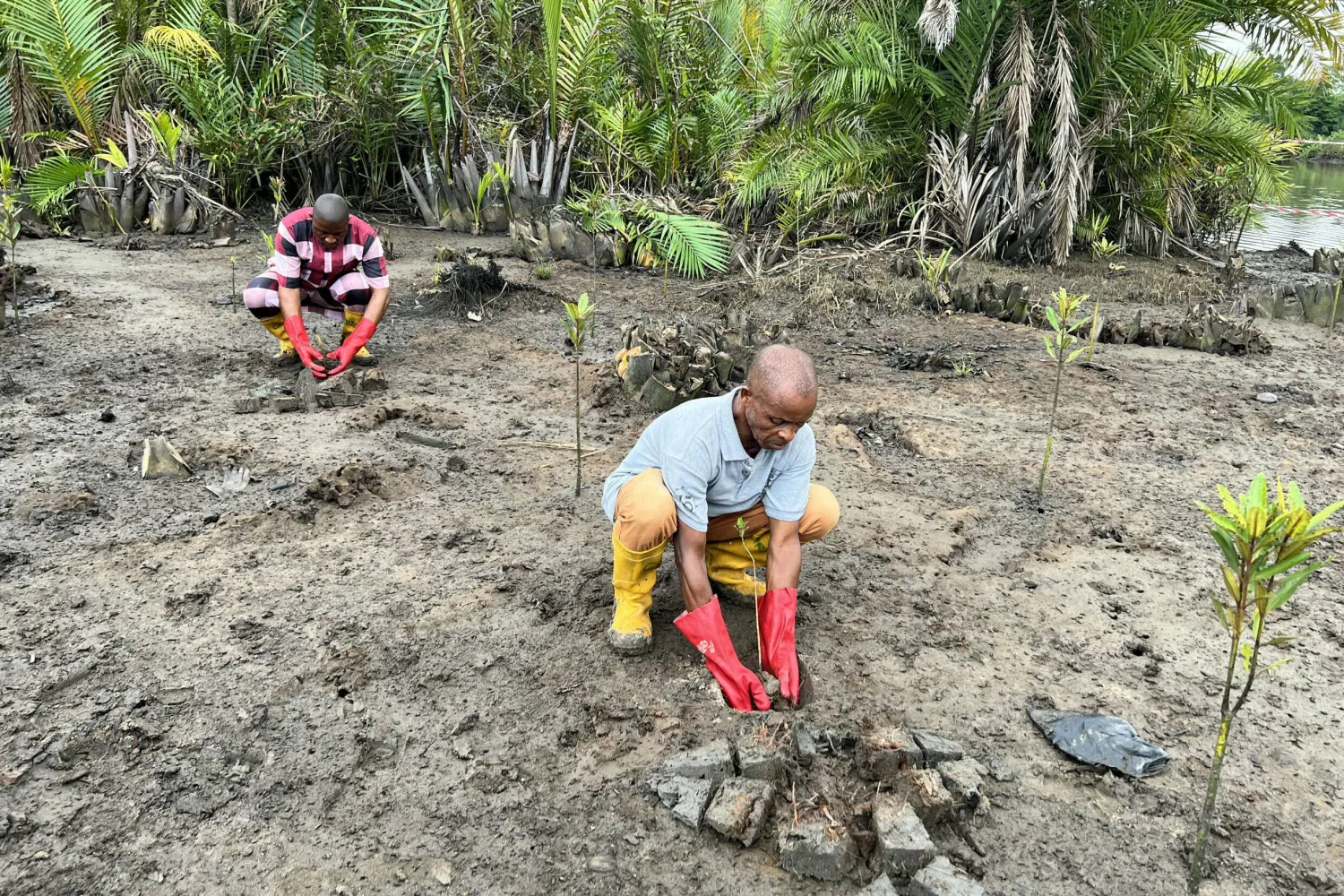
A local community leader is pushing ahead with a project to restore the spoiled forests. Kadiatou Sakho / AFP
TT

Nigerians Strive to Bring Mangrove Forests Back to Life

A local community leader is pushing ahead with a project to restore the spoiled forests. Kadiatou Sakho / AFP

On a riverbank in the Niger Delta, a group of residents in rubber boots has been working to restore one of Nigeria's most precious and damaged ecosystems -- its mangrove forests.
The team members plunge their shovels into the mud and slot in saplings at the site in Bundu, a shanty town on the outskirts of the southern oil city Port Harcourt, AFP said.
In recent years, human activity has destroyed swathes of the world's mangrove forests, which form a vital barrier against the tides and a sanctuary for wildlife.
But in this part of the Delta -- plagued by leaks from multinational oil company pipelines and a host of other threats -- a local community leader is pushing ahead with a project to restore the spoiled forests.
"We're going to bring our mangroves back to life," said fisherman David Oba, 53, who represents around 10,000 people in the town.
'Refuge'
Mangrove forests are a biodiversity paradise. The specialist saltwater trees' huge root networks provide nurseries for juvenile fish, which are crucial to supporting stocks.
The forests teeming with life above water too -- they are "refuges" for an array of birds that nest in their branches, explained Ijeoma Vincent-Akpu, a professor at the University of Port Harcourt.
Vincent-Akpu said the trees also protect against coastal erosion, storms and flooding, providing a key shield in the face of climate change.
Nigeria boasts some of the highest mangrove coverage in the world and more than anywhere else in Africa -- but its forests are shrinking.
The country had around 8,442 square kilometers (3,259 square miles) of mangrove forest in 2020, according to the monitoring platform Global Mangrove Watch.
Between 1996 and 2020 it lost 161.9 square kilometers of mangroves, the group said -- around two percent of the total and an area equal to more than 22,500 football pitches.
Experts say this is mainly due to human activity in the continent's most populous country.
Oil pollution
In Bundu, around 30 people have learned how to restore mangrove ecosystems with the help of a Nigerian NGO, the Centre for Environment, Human Rights and Development.
They have been through several weeks' training, said Nabie Nubari Francis, coordinator of the NGO, which has been running the project in three other communities in the Delta for nearly 15 years.
Priority is given to training community leaders so they can pass on their skills. David Oba said he had trained 70 people in Bundu since starting the project there several months ago.
One of the greatest threats to the mangroves is pollution from the multinational oil industry in the Delta. Residents say whole areas have been wiped out by spills.
Oil spills are frequent in the region due to a lack of pipeline maintenance as well as vandalism. Over the last five years, the National Oil Spill Detection and Response Agency has recorded almost 3,870 spills in Nigeria, mainly in the Niger Delta.
Kwani Dick Velvet, a retired journalist, recalled the first sapling he planted in his community, bought from a nearby nursery.
"If it was not for the fact that people came and planted some mangroves, this place would have been a very open field," he said, pointing to an area that he said was hit by an oil spill in 2020.
Residents said the spill was caused by vandals targeting an oil pipeline.
"When the spillage occurs, we cannot fish," 38-year-old fisherman Peter Opugulaya told AFP.
- Invasive palms -
Oil is not the only problem. Nigeria's mangroves are being damaged by illegal logging, waste dumping and urban expansion.
They face another threat, too -- the spread of Nipa palms, an invasive species that has muscled in among the mangroves.
Imported from South Asia and Oceania, the palms are used for baskets and roofing, but do not provide shelter for fish like the mangroves' arched roots.
Colin Love, from Kono village around 70 kilometers (over 40 miles) from Port Harcourt, complained the palms had taken root "everywhere".
The 40-year-old said he was planting mangroves "so that the fish will still come back for us."
On a visit to the Delta earlier this year, Nigeria's environment minister promised to work with local authorities to protect mangroves and mitigate the effects of climate change.
Four years earlier, the government announced its intention to launch a national mangrove restoration plan, but it was never implemented.
Residents said the government has been slow to act, prompting them to take measures into their own hands.
"We are helping each other," said 48-year-old driver and Kono resident Prince Nwilee, saying that communities were ready to share saplings with their neighbors.
"We are not sitting by and doing nothing," he said.



Astronomers Spot White Dwarf Star Creating a Colorful Shockwave

The central square image, taken with the MUSE instrument on ESO's Very Large Telescope, shows shock waves around the dead star RXJ0528+2838. (European Southern Observatory (ESO)/K. Ilkiewicz and S. Scaringi et al./Handout via Reuters)
TT

Astronomers Spot White Dwarf Star Creating a Colorful Shockwave

The central square image, taken with the MUSE instrument on ESO's Very Large Telescope, shows shock waves around the dead star RXJ0528+2838. (European Southern Observatory (ESO)/K. Ilkiewicz and S. Scaringi et al./Handout via Reuters)

Astronomers have observed a white dwarf - a highly compact Earth-sized stellar ember - that is creating a colorful shockwave as it moves through space, leaving them searching for an explanation.

The highly magnetized white dwarf is gravitationally bound to another star in what is called a binary system. The white dwarf is siphoning gas from its companion as the two orbit close to each other. The system is located in the Milky Way about 730 light-years from Earth - relatively nearby in cosmic terms - in the constellation Auriga.

A light-year is the distance light travels in a year, 5.9 trillion miles (9.5 trillion km).

The shockwave - more specifically a bow shock - caused by the white dwarf was observed using the European Southern Observatory's Chile-based Very Large Telescope. The shockwave was seen in an image released by the scientists glowing in various colors produced when material flowing outward from the white dwarf collided with interstellar gas.

"A shockwave ‌is created when ‌fast-moving material plows into surrounding gas, suddenly compressing and heating it. A ‌bow shock ⁠is the curved ‌shock front that forms when an object moves rapidly through space, similar to the wave in front of a boat moving through water," said astrophysicist Simone Scaringi of Durham University in England, co-lead author of the study published on Monday in the journal Nature Astronomy.

"The colors come from interstellar gas that is being heated and excited by the shock. Different chemical elements glow at specific colors when this happens," Scaringi added.

In this shockwave, a red hue represented hydrogen, green represented nitrogen and blue represented oxygen residing in interstellar space.

A handful of other white dwarfs have been observed creating shockwaves. But all of those were ⁠surrounded by disks of gas siphoned from a binary partner. Although this white dwarf is siphoning gas from its companion, it lacks any such disk and ‌is releasing gas into space for unknown reasons.

White dwarfs are among the ‍universe's most compact objects, though not as dense as ‍black holes.

Stars with up to eight times the mass of the sun appear destined to end up as ‍a white dwarf. They eventually burn up all the hydrogen they use as fuel. Gravity then causes them to collapse and blow off their outer layers in a "red giant" stage, eventually leaving behind a compact core - the white dwarf.

"There are plenty of white dwarfs out there, as these are the most common endpoints of stellar evolution," Scaringi said.

The sun appears fated to end its existence as a white dwarf, billions of years from now.

This white dwarf has a mass comparable to the sun contained in a body slightly larger than Earth. Its binary companion is ⁠a type of low-mass star called a red dwarf that is about a tenth the mass of the sun and thousands of times less luminous. It orbits the white dwarf every 80 minutes, with the two extremely close to each other - approximately the distance between the moon and Earth.

The gravitational strength of the white dwarf is pulling gas off the red dwarf. This siphoned material is being pulled into the white dwarf along its strong magnetic field, eventually landing at its magnetic poles. While this process releases energy and radiation, it cannot account for the outflow of material needed to produce the observed shockwave, Scaringi said.

"Every mechanism with outflowing gas we have considered does not explain our observation, and we still remain puzzled by this system, which is why this result is so interesting and exciting," Scaringi said.

"The shape and length of the (shockwave) structure show that this process has been ongoing for at least about 1,000 years, making it long-lived rather than a one-off event," Scaringi added.

The ‌researchers took note of the aesthetics of the colorful shockwave.

"Beyond the science, it's a striking reminder that space is not empty or static as we may naively imagine it: it's dynamic and sculpted by motion and energy," Scaringi said.


Australian Firefighters Warn of ‘High-Risk’ Bushfire Season

Country Fire Authority (CFA) crew fill up tankers in the bushfire affected town of Ruffy, Victoria, Australia, 12 January 2026. (EPA)
TT

Australian Firefighters Warn of ‘High-Risk’ Bushfire Season

Country Fire Authority (CFA) crew fill up tankers in the bushfire affected town of Ruffy, Victoria, Australia, 12 January 2026. (EPA)

Australian firefighters warned people on Monday to prepare for more bushfires in a "high-risk" summer, after blazes killed one person and incinerated more than 350 buildings in the southeast.

Weather conditions have eased since strong winds and temperatures topping 40C fed dozens of wildfires in southeastern Australia's Victoria, which declared a state of disaster on Saturday.

But officials said 12 major fires were still burning across the state.

Country Fire Authority chief officer Jason Heffernan said another "heating event" was expected towards the end of January, though its intensity was uncertain.

"We are early in the high-risk weather season," Heffernan told a news conference.

"There's been a lot of fire in the landscape. Much work will be done between now and then to contain these fires," he said.

"Whilst we join with community in the rebuilding and the relief and recovery of the fires that have been, we need to turn our minds to the fires that could be as the season continues."

More than 350 structures -- including over 65 homes -- have been lost so far in the state, officials said, with the number likely to rise as fire damage is assessed.

One person died in a fire near the town of Longwood, about two hours' drive north of state capital Melbourne, police say.

Emergency Management Commissioner Tim Wiebusch said weather conditions had become more favorable for firefighters.

"But that doesn't mean that the risk is over," he said.

"Whilst the conditions are easing in some parts of the state, even the slightest of winds are still causing those fires to move around."

High temperatures and dry winds combined last week to form some of the most dangerous bushfire conditions since the "Black Summer" blazes.

The Black Summer bushfires raged across Australia's eastern seaboard from late 2019 to early 2020, razing millions of hectares, destroying thousands of homes and blanketing cities in noxious smoke.

Australia's climate has warmed by an average of 1.51C since 1910, researchers have found, fueling increasingly frequent extreme weather patterns over both land and sea.


Some Supplements Can Make Your Medication Less Effective

Some vitamin and mineral supplements can interfere with absorption of medications (Oklahoma State University) 
TT

Some Supplements Can Make Your Medication Less Effective

Some vitamin and mineral supplements can interfere with absorption of medications (Oklahoma State University) 

Health experts warned that some supplements can interact with certain medications and reduce their effectiveness, according to Eating Well website.

While these supplements are usually sold over-the-counter, taking them without asking a health care provider can have dangerous impact on your health.

Naturopathic doctor Jacob Wolf said that for instance, some vitamin and mineral supplements can interfere with absorption of medications.

Other supplements can bind with medications, preventing the drug from being utilized in the body, or they may be metabolized by the same or similar pathways as medications, explains Wolf. That can have a dangerous impact on your health.

Top offenders include calcium, magnesium, iron, fiber, activated charcoal and vitamins C and K.

Minerals like calcium, magnesium and iron can bind with medications, especially levothyroxine, a drug used to treat hypothyroidism, said Wolf.

“This can impact how levothyroxine is utilized in the body, adversely affecting treatment,” he explained.

These minerals can also interact with antibiotics in the tetracycline and fluoroquinolone class, said pharmacist Amanda Corbett.

Taking these mineral supplements at the same time as antibiotics may reduce the bioavailability of the antibiotic, creating risks like bacterial resistance or ineffective treatment.

And while scientists affirm fiber is an important nutrient for digestive regularity, healthy cholesterol levels and blood sugar management, supplementing isn’t always a great idea, as large doses can impact the absorption of certain medications.

Fiber-rich foods are a cornerstone of blood sugar management, even for those taking blood sugar–lowering medications, like metformin.

Fiber may also impair the effectiveness of other drugs, including digoxin (which treats certain heart conditions) and levothyroxine for hypothyroidism, Wolf said.

Therefore, if you do choose to take a fiber supplement, Wolf recommended speaking with your health care provider about spacing out your fiber and medication doses.

As for activated charcoal, it is a form of carbon that is used in the emergency room to treat the ingestion of toxic drugs and poisons.

“Activated charcoal acts like a sponge and can bind to many medications. It is best to completely avoid activated charcoal if on any life-critical medication,” said Wolf.

For Vitamin C, it is an important antioxidant that protects cells from free radical damage and supports proper immune system function.

However, if you are undergoing chemotherapy treatment for cancer, experts strongly caution against taking vitamin C supplements.

“Vitamin C can lead to certain chemotherapies being less effective or ineffective in treating cancer,” said Corbett.

Vitamin E, another antioxidant, can also interfere with chemotherapy’s effectiveness.

If taking Vitamin K, which is a fat-soluble vitamin that helps blood clot and shores up bone health, you should know that it can reduce the effectiveness of a blood-thinning medication called warfarin (Coumadin).

That, in turn, can make blood more likely to clot, which can lead to a heart attack or stroke.

If you are taking warfarin, you don’t necessarily need to avoid vitamin K, but it is critical to keep the amount you consume—from both foods and supplements—consistent to avoid clotting problems.

Experts advise that to take supplements safely, consult with your health care provider.

Many supplements can interact with medications, and so it’s critical to connect with your prescribing health care provider to make sure that the supplements you’re taking play nice with your medications.

Also, look for those that have been independently tested in a laboratory, recommended Corbett.

Experts say you should also know how much to take. Supplement dosages are listed on the label, but they aren’t standardized.

That means they can vary from product to product, and may far exceed safe levels.