


California’s Largest Wildfire Explodes in Size as Fires Rage across US West

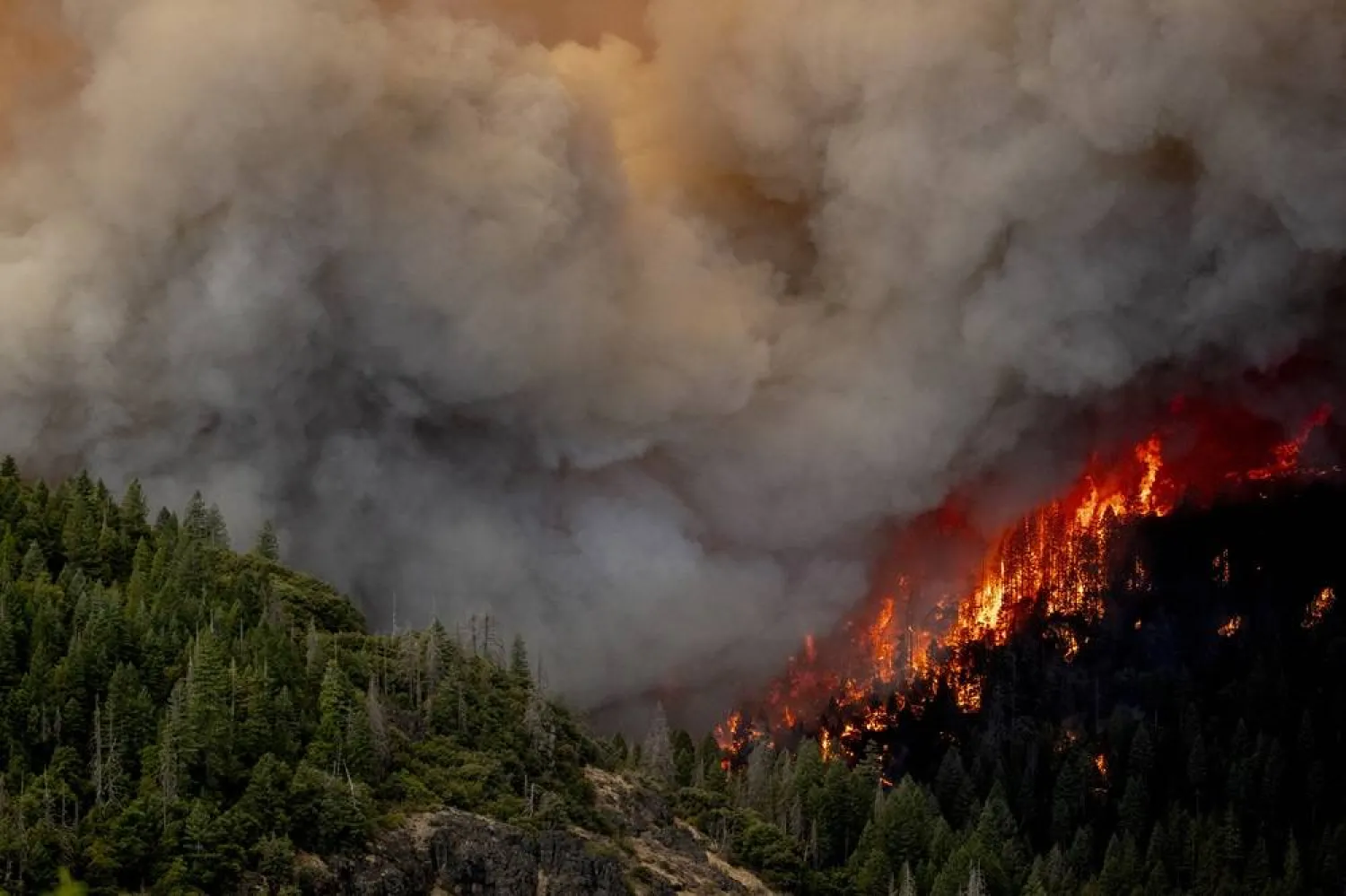
 A column of flame burns on a hillside during the Park Fire near Lomo, Calif., Friday, July 26, 2024. (Stephen Lam/San Francisco Chronicle via AP)
A column of flame burns on a hillside during the Park Fire near Lomo, Calif., Friday, July 26, 2024. (Stephen Lam/San Francisco Chronicle via AP)
TT

California’s Largest Wildfire Explodes in Size as Fires Rage across US West

 A column of flame burns on a hillside during the Park Fire near Lomo, Calif., Friday, July 26, 2024. (Stephen Lam/San Francisco Chronicle via AP)
A column of flame burns on a hillside during the Park Fire near Lomo, Calif., Friday, July 26, 2024. (Stephen Lam/San Francisco Chronicle via AP)

California's largest active fire exploded in size on Friday evening, growing rapidly amid bone-dry fuel and threatening thousands of homes as firefighters scrambled to meet the danger.

The Park Fire's intensity and dramatic spread led fire officials to make unwelcome comparisons to the monstrous Camp Fire, which burned out of control in nearby Paradise in 2018, killing 85 people and torching 11,000 homes.

More than 130 structures have been destroyed by this fire so far, and thousands more are threatened as evacuations were ordered in four counties — Butte, Plumas, Tehama and Shasta. It stood at 374 square miles (967 square kilometers) on Friday night and was moving quickly north and east after igniting Wednesday when authorities said a man pushed a burning car into a gully in Chico and then calmly blended in with others fleeing the scene.

"There’s a tremendous amount of fuel out there and it’s going to continue with this rapid pace," Cal Fire incident commander Billy See said at a briefing. He said the fire was advancing up to 8 square miles (21 square kilometers) an hour on Friday afternoon.

Officials at Lassen Volcanic National Park evacuated staff from Mineral, a community of about 120 people where the park headquarters are located, as the fire moved north toward Highway 36 and east toward the park.

Communities elsewhere in the US West and Canada were under siege Friday, from a fast-moving blaze sparked by lightning sent people fleeing on fire-ringed roads in rural Idaho to a new blaze that was causing evacuations in eastern Washington.

In eastern Oregon, a pilot was found dead in a small air tanker plane that crashed while fighting one of the many wildfires spreading across several Western states.

More than 110 active fires covering 2,800 square miles (7,250 square kilometers) were burning in the US on Friday, according to the National Interagency Fire Center. Some were caused by the weather, with climate change increasing the frequency of lightning strikes as the region endures record heat and bone-dry conditions.

The fire in eastern Washington was threatening homes, the railroad, Interstate 90 and the community of Tyler, which was evacuated Friday. The Columbia Basin fire in Spokane County closed part of Highway 904 between the interstate and Cheney. Multiple planes, helicopters and fire personnel were working hard to contain the fire, according to the Washington State Patrol.

In Chico, California, Carli Parker is one of hundreds who fled their homes as the Park Fire pushed close. Parker decided to leave her Forest Ranch residence with her family when the fire began burning across the street. She has previously been forced out of two homes by fire, and she said she had little hope that her residence would remain unscathed.

"I think I felt like I was in danger because the police had come to our house because we had signed up for early evacuation warnings, and they were running to their vehicle after telling us that we need to self-evacuate and they wouldn’t come back," said Parker, a mother of five.

Ronnie Dean Stout, 42, of Chico, was arrested early Thursday in connection with the blaze and held without bail pending a Monday arraignment, officials said. There was no reply to an email to the district attorney asking whether the suspect had legal representation or someone who could comment on his behalf.

Fire crews were making progress on another complex of fires burning in the Plumas National Forest near the California-Nevada line, said Forest Service spokesperson Adrienne Freeman. Most of the 1,000 residents evacuated by the lightning-sparked Gold Complex fires were returning home Friday. Some crews were peeling off to help battle the Park Fire.

"As evidenced by the (Park) fire to the West, some of these fires are just absolutely exploding and burning at rates of spread that it is just hard to even imagine," Tim Hike, Forest Service incident commander of the Gold Complex fire about 50 miles (80 km) northwest of Reno, said Friday. "The fire does not look that bad right up until it does. And then that just might be too late."

Forest Ranch evacuee Sherry Alpers, fled with her 12 small dogs and made the decision to stay in her car outside a Red Cross shelter in Chico after learning that animals would not be allowed inside. She ruled out traveling to another shelter after learning the dogs would be kept in cages, since her dogs have always roamed free at her home.

Alpers said she doesn’t know whether the fire spared her home or not, but she said that as long as her dogs are safe, she doesn't care about the material things.

"I’m kind of worried, but not that much," she said. "If it’s gone, it’s gone."

Brian Bowles was also staying in his car outside the shelter with his dog Diamon. He said he doesn't know if his mobile home is still standing.

Bowles said he only has a $100 gift card he received from United Way, which handed them out to evacuees.

"Now the question is, do I get a motel room and comfortable for one night? Or do I put gas in the car and sleep in here?" he said. "Tough choice."

In Oregon, a Grant County Search and Rescue team on Friday morning located a small single-engine air tanker that had disappeared while fighting the 219-square-mile (567 square kilometers) Falls Fire burning near the town of Seneca and the Malheur National Forest. The pilot died, said Bureau of Land Management information officer Lisa Clark. No one else was aboard the bureau-contracted aircraft when it went down in steep, forested terrain.

The most damage so far has been to the Canadian Rockies’ Jasper National Park, where a fast-moving wildfire forced 25,000 people to flee and devastated the park’s namesake town, a World Heritage site.

In Idaho, lightning strikes sparked fast-moving wildfires and the evacuation of multiple communities. The fires were burning on about 31 square miles (80 square kilometers) Friday afternoon.

Videos posted to social media include a man who said he heard explosions as he fled Juliaetta, about 27 miles (43 kilometers) southeast of the University of Idaho’s campus in Moscow. The town of just over 600 residents was evacuated Thursday just ahead of roaring fires, as were several other communities near the Clearwater River and the Nez Perce Tribal Hatchery Complex, which breeds salmon.

There’s no estimate yet on the number of buildings burned in Idaho, nor is there information about damage to urban communities, officials said Friday morning.

Oregon still has the biggest active blaze in the United States, the Durkee Fire, which combined with the Cow Fire to burn nearly 630 square miles (1,630 square kilometers). It remains unpredictable and was only 20% contained Friday, according to the government website InciWeb.

The National Interagency Fire Center said more than 27,000 fires have burned more than 5,800 square miles (15,000 square kilometers) in the US this year, and in Canada, more than 8,000 square miles (22,800 square kilometers) have burned in more than 3,700 fires so far, according to its National Wildland Fire Situation Report issued Wednesday.



Riyadh Becomes First City in Region to Receive Global Active City Certification

General view of Riyadh, Saudi Arabia. (SPA)
TT

Riyadh Becomes First City in Region to Receive Global Active City Certification

General view of Riyadh, Saudi Arabia. (SPA)

The Royal Commission for Riyadh City (RCRC) announced that the capital has been awarded the Global Active City (GAC) certification, becoming the first city in the Middle East to attain this designation, in recognition of its efforts to promote healthy lifestyles, physical activity, and community well-being for all.

According to a press release issued by the commission Monday, CEO of the RCRC Eng. Ibrahim bin Mohammed Al-Sultan explained that this achievement reflects the continued support and ambitious vision of the Kingdom’s leadership, which has enabled Riyadh to make significant progress in improving quality-of-life indicators across the city, in line with the targets of Saudi Vision 2030, SPA reported.

Eng. Al-Sultan expressed appreciation to the main partners, Ministry of Sport and Saudi Sports for All Federation, whose active contributions played a vital role in securing this international recognition. He also acknowledged the efforts of relevant entities, noting that their collaboration highlights the Kingdom’s regional and global leadership in enhancing quality of life.

The release added that the Active Well-being Initiative, founded by Association for International Sport for All (TAFISA) and Evaleo Organization, and supported by the International Olympic Committee (IOC), awards the Global Active City certification to cities that excel in creating active living opportunities and implementing targeted systems and standards aimed at encouraging physical activity across all segments of society.

This achievement reaffirms RCRC’s commitment to transforming the capital into a city that enables residents and visitors to live healthier, more active lifestyles. This approach aligns with the goals of Saudi Vision 2030 and the Quality of Life Program through an integrated, citywide strategy that expands access to public spaces, walking and cycling paths, sports facilities, and community programs that inspire active living.

Riyadh’s approach brings together the sport, health, transport, education, and urban planning sectors to build a supportive urban environment that enhances well-being and ensures inclusivity for all members of the community.

The certification process was led by RCRC, with the support and participation of Ministry of Sport, Saudi Sports for All Federation, and more than 20 relevant entities. This collaborative effort has made physical activity an essential and accessible part of Riyadh’s urban vision.

The Global Active City classification reflects Riyadh’s progress in infrastructure, programs, governance systems, and policy frameworks dedicated to improving quality of life, strengthening community participation, and supporting sustainable well-being. It also recognizes the city’s measurable advancements in promoting physical activity and public health.


Interstellar Comet Keeps Its Distance as It Makes Its Closest Approach to Earth

This image, provided by NASA, shows the interstellar comet 3I/Atlas captured by the Hubble Space Telescope on Nov. 30, 2025, about 178 million miles (286 million kilometers) from Earth. (NASA, ESA, STScI, D. Jewitt (UCLA), M.-T. Hui (Shanghai Astronomical Observatory), J. DePasquale (STScI) via AP)
TT

Interstellar Comet Keeps Its Distance as It Makes Its Closest Approach to Earth

This image, provided by NASA, shows the interstellar comet 3I/Atlas captured by the Hubble Space Telescope on Nov. 30, 2025, about 178 million miles (286 million kilometers) from Earth. (NASA, ESA, STScI, D. Jewitt (UCLA), M.-T. Hui (Shanghai Astronomical Observatory), J. DePasquale (STScI) via AP)

A stray comet from another star swings past Earth this week in one last hurrah before racing back toward interstellar space.

Discovered over the summer, the comet known as 3I/Atlas will pass within 167 million miles (269 million kilometers) of our planet on Friday, the closest it gets on its grand tour of the solar system.

NASA continues to aim its space telescopes at the visiting ice ball, estimated to be between 1,444 feet (440 meters) and 3.5 miles (5.6 kilometers) in size. But it’s fading as it exits, so now’s the time for backyard astronomers to catch it in the night sky with their telescopes, The AP news reported.

The comet will come much closer to Jupiter in March, zipping within 33 million miles (53 million kilometers). It will be the mid-2030s before it reaches interstellar space, never to return, said Paul Chodas, director of NASA’s Center for Near Earth Object Studies.

It’s the third known interstellar object to cut through our solar system. Interstellar comets like 3I/Atlas originate in star systems elsewhere in the Milky Way, while home-grown comets like Halley's hail from the icy fringes of our solar system.

A telescope in Hawaii discovered the first confirmed interstellar visitor in 2017. Two years later, an interstellar comet was spotted by a Crimean amateur astronomer. NASA’s sky-surveying Atlas telescope in Chile spotted comet 3I/Atlas in July while prowling for potentially dangerous asteroids.

Scientists believe the latest interloping comet, also harmless, may have originated in a star system much older than ours, making it a tantalizing target.


Japan’s Only Two Pandas to Be Sent Back to China 

Giant panda Lei Lei eats bamboo at Ueno Zoological Gardens in Tokyo, Japan, 28 November 2025. (EPA)
TT

Japan’s Only Two Pandas to Be Sent Back to China 

Giant panda Lei Lei eats bamboo at Ueno Zoological Gardens in Tokyo, Japan, 28 November 2025. (EPA)

Two pandas at a Tokyo zoo will be returned to China in January, the Tokyo government said on Monday, potentially leaving Japan without the beloved animals for the first time in half a century.

Loaned out as part of China's "panda diplomacy" program, the distinctive black-and-white animals have symbolized friendship between Beijing and Tokyo since the normalization of diplomatic ties in 1972.

Japan currently has only two pandas, Lei Lei and Xiao Xiao, at Tokyo's Zoological Gardens in the Ueno neighborhood.

But the twins are now set to be repatriated a month before their loan period expires in February, said Tokyo Metropolitan Government, which operates the Ueno zoo.

Tokyo's regional government has been asking for the immensely popular mammals to remain at the zoo -- where they attract huge crowds -- but China didn't agree, according to the Nikkei business daily.

In September last year, animal lovers in Tokyo bid farewell to the parents of Lei Lei and Xiao Xiao who returned home.

Just before they left, thousands of tearful fans came out to catch a final glimpse and take photographs of the beloved bears.

The Asahi Shimbun reported that Tokyo is seeking the loan of a new pair, although their arrival before the return of Lei Lei and Xiao Xiao is seen as unlikely.

Ties between Asia's two largest economies are fast deteriorating after Japan's conservative premier Sanae Takaichi hinted that Tokyo could intervene militarily in the event of any attack on Taiwan.

Her comment provoked the ire of Beijing, which regards the island as its own territory.

Japan's top government spokesman Minoru Kihara said pandas have helped ties with China.

"Exchanges through pandas have contributed to improving the feelings between the people of Japan and China. We hope such exchanges will continue," Kihara told a regular press briefing.

He said that "several local governments and zoos have expressed interest in receiving pandas on loan" but did not state whether the national government was asking China for new animals.

The Ueno zoo has long been the beneficiary of panda diplomacy, having cooperated with facilities in China and the United States to successfully breed giant pandas.

Lei Lei and Xiao Xiao were delivered in 2021 by their mother Shin Shin, who arrived in 2011 and was returned to China last year.

Breeding pandas in a zoo environment is fiendishly tricky due to their difficulties mating, false pregnancies and high mortality rates of newborn cubs.