


Vietnam Typhoon Death Toll Rises to 233 as More Bodies Found in Areas Hit by Landslides and Floods 

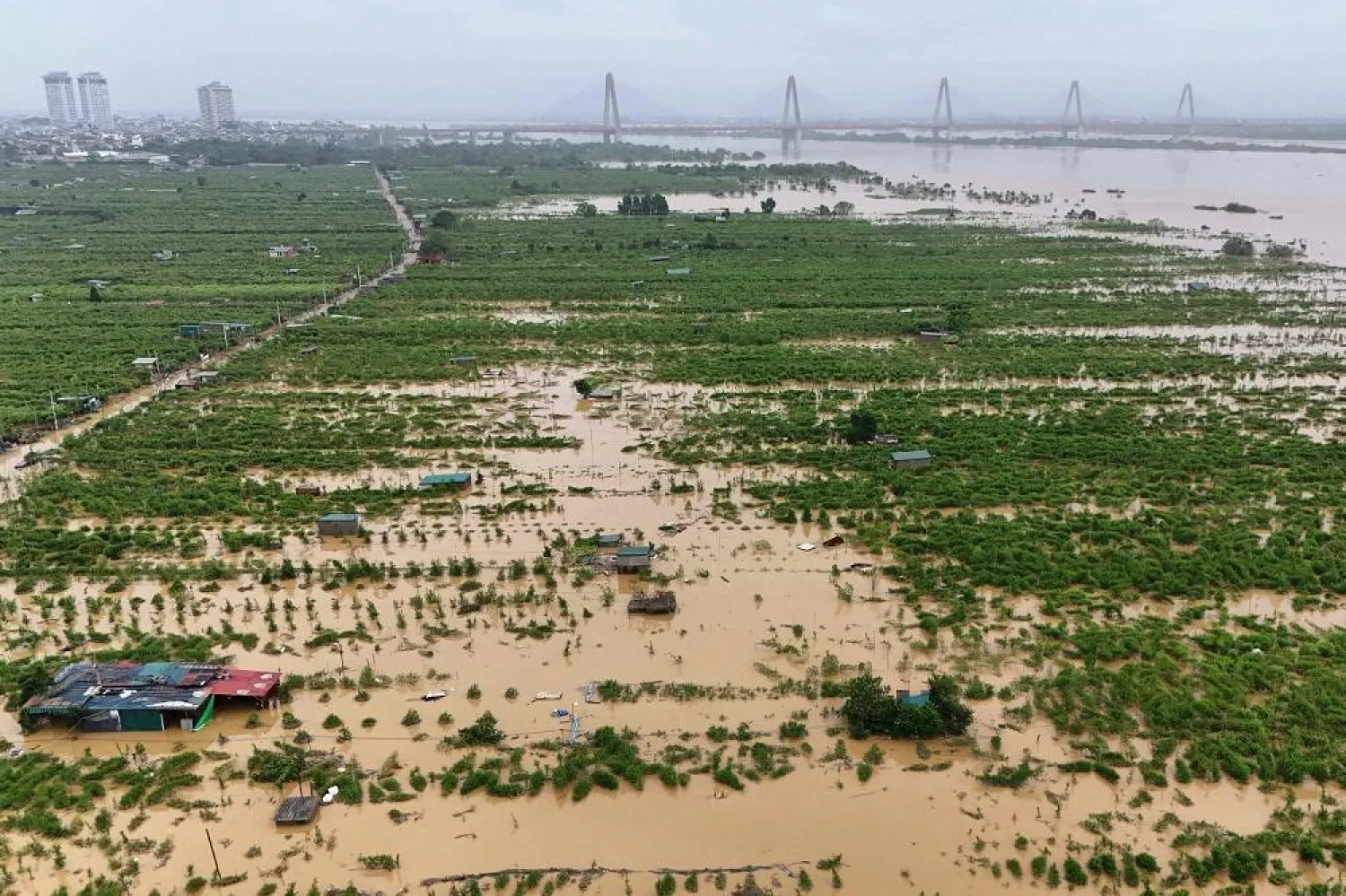
This aerial view shows flooded farms and fields in Hanoi on September 12, 2024. (AFP)
TT

Vietnam Typhoon Death Toll Rises to 233 as More Bodies Found in Areas Hit by Landslides and Floods 

This aerial view shows flooded farms and fields in Hanoi on September 12, 2024. (AFP)

The death toll in the aftermath of a typhoon in Vietnam climbed to 233 on Friday as rescue workers recovered more bodies from areas hit by landslides and flash floods, state media reported.

Flood waters from the swollen Red River in the capital, Hanoi, were beginning to recede somewhat, but many neighborhoods remained inundated and farther north experts were predicting it could still be days before any relief was in sight.

Typhoon Yagi made landfall Saturday, starting a week of heavy rains that have triggered flash floods and landslides, particularly in Vietnam's mountainous north.

Across Vietnam, 103 people are still listed as missing and more than 800 have been injured.

Most fatalities have come in the province of Lao Cai, where a flash flood swept away the entire hamlet of Lang Nu on Tuesday. Eight villagers turned up safe on Friday morning, telling others that they had left before the deluge, state-run VNExpress newspaper reported, but 48 others from Lang Nu have been found dead, and another 39 remain missing.

Roads to Lang Nu have been badly damaged, making it impossible to bring in heavy equipment to aid in the rescue effort.

Some 500 personnel with sniffer dogs are on hand, and in a visit to the scene on Thursday, Prime Minister Pham Minh Chinh promised they would not relent in their search for those still missing.

“Their families are in agony,” Chinh said.

Coffins were stacked near the disaster site in preparation for the worst, and villager Tran Thi Ngan mourned at a makeshift altar for family members she had lost.

“It's a disaster,” she told VTV news. “That's the fate we have to accept.”

In Cao Bang, another northern province bordering China, 21 bodies had been recovered by Friday, four days after a landslide pushed a bus, a car and several motorcycles into a small river, swollen with floodwaters. Ten more people remain missing.

In the aftermath of Yagi, the strongest typhoon to hit the Southeast Asian country in decades, Australia has already begun delivering humanitarian aid supplies as part of $2 million in assistance.

South Korea has also pledged $2 million in humanitarian aid, and the US Embassy said Friday it would provide $1 million in support through the US Agency for International Development, or USAID.

“With more heavy rain forecast in the coming days, USAID’s disaster experts continue to monitor humanitarian needs in close coordination with local emergency authorities and partners on the ground,” the embassy said in a statement. “USAID humanitarian experts on the ground are participating in ongoing assessments to ensure US assistance rapidly reaches populations in need.”

Experts say storms like Typhoon Yagi are getting stronger due to climate change, as warmer ocean waters provide more energy to fuel them, leading to higher winds and heavier rainfall.

The typhoon and ensuing heavy rains have damaged factories in northern provinces like Haiphong, home to electric car company VinFast, Apple parts suppliers and other electronic manufacturers, which could affect international supply chains, the Center for Strategic and International Studies said in a research note.

“Though 95 percent of businesses operating in Haiphong were expected to resume some activity on September 10, repair efforts will likely lower output for the next weeks and months,” CSIS said.



Magnitude 5.8 Earthquake Hits off Cuba

A woman holds a flashlight while walking with a man on a street during a blackout in Havana on March 16, 2026. (AFP)
TT

Magnitude 5.8 Earthquake Hits off Cuba

A woman holds a flashlight while walking with a man on a street during a blackout in Havana on March 16, 2026. (AFP)

A 5.8-magnitude earthquake struck off the coast of Cuba early Tuesday, the United States Geological Survey (USGS) said.

The quake hit at a depth of 11.6 kilometers (7.2 miles) about 49 kilometers south-southwest of Cuba's easternmost municipality of Maisi at 12:28 am (0428 GMT), according to the USGS.

There were no immediate reports of casualties or damage.

Cuba is trying to restore electricity following a total power blackout on Monday, as the United States pursues its oil blockade against the island's communist government.

The USGS put the alert level for shaking-related fatalities and economic losses at green, meaning "low likelihood for casualties and damage".

The quake was first reported by the European-Mediterranean Seismological Center, which also logged aftershocks of up to 4.7-magnitude.

Cuba's seismological service said it received perceptibility reports from the Santiago de Cuba and Guantanamo provinces. The epicenter was around 95 kilometers from Guantanamo.

US President Donald Trump vowed on Monday to "take" Cuba, with his administration reportedly signaling to Cuban officials that Washington wants President Miguel Diaz-Canel to be removed from power.

On March 6, a 5.0-magnitude quake was recorded off the coast of Cuba, according to the USGS.


Israel Says Ali Larijani, Top Iranian Security Official, Killed by Israel in Strike

People walk in front of a mural depicting the late Iranian revolutionary founder Khomeini, right, members of the Basij paramilitary force and Supreme Leader Ali Khamenei along Enqelab-e-Eslami Street in Tehran, Iran, Sunday, Jan. 25, 2026. (AP Photo/Vahid Salemi)
TT

Israel Says Ali Larijani, Top Iranian Security Official, Killed by Israel in Strike

People walk in front of a mural depicting the late Iranian revolutionary founder Khomeini, right, members of the Basij paramilitary force and Supreme Leader Ali Khamenei along Enqelab-e-Eslami Street in Tehran, Iran, Sunday, Jan. 25, 2026. (AP Photo/Vahid Salemi)

The Israeli defense minister said Tuesday that the Israeli military killed top Iranian security official Ali Larijani in an overnight strike. 

Israel Katz made the announcement. 

The Israeli military also announced it killed Gholam Reza Soleimani, the head of the Revolutionary Guard’s all-volunteer Basij force, The Associated Press said. 

The killings again strip away top leaders from the Iranian theocracy after the Feb. 28 strike that killed 86-year-old Supreme Leader Ali Khamenei, 

The announcement came as Gulf Arab nations came under renewed missile and drone fire from Iran. 

Dubai, a major transit hub for international travel, briefly shut its airspace as the military said it was “responding to incoming missile and drone threats” around the city, and a man was killed by the debris of a missile intercepted over Abu Dhabi. 

The Israeli military also said early Tuesday it had begun a “wide-scale wave of strikes” across Iran’s capital and was stepping up strikes on Iran-backed Hezbollah militants in Lebanon. Israel also reported two incoming salvos before dawn from Iran at Tel Aviv and elsewhere, and said Hezbollah targeted Israel’s north. 

Israel says it has killed head of Iranian militia force  

The Israeli military said a strike Monday killed Basij head Gen. Gholam Reza Soleimani but Iran did not immediately acknowledge the militia leader's death. 

“The Basij forces are part of the armed apparatus of the Iranian terror regime,” the Israeli military said in its statement. “During internal protests in Iran, particularly in recent periods as demonstrations intensified, Basij forces under Soleimani’s command led the main repression operations, employing severe violence, widespread arrests and the use of force against civilian demonstrators.” 

The US Treasury lists Soleimani as having been born in 1965. He has been sanctioned by the US, the European Union and other nations over his role in helping suppress dissent for years through the Basij. 

Since the war began Feb. 28, Israel has launched specific attacks targeting Iran’s leadership, killing 86-year-old Supreme Leader Ali Khamenei and other military commanders. 

Killing Soleimani would likely further strain the command and control of the Basij, which would be crucial in putting down any uprising against the theocracy. The Basij and other internal security forces have been a target of attack by both the Americans and the Israelis so far. 

Iranian strikes pressure neighbors and oil markets  

Iran kept up the pressure on the energy infrastructure of its Gulf Arab neighbors, hitting an oil facility in Fujairah, a UAE emirate on the country’s east coast with the Gulf of Oman that has been repeatedly targeted. State-run WAM news reported that no one had been injured in the blast from the drone strike. 

The man killed by falling debris from an intercepted missile was the eighth person to die in the UAE since the start of the war, authorities said. 

Iran's attacks on Gulf nations and its grip on the Strait of Hormuz, through which a fifth of the world's oil is transported, has given rise to increasing concerns of a global energy crisis. Early Tuesday it hit a tanker anchored off the coast of Fujairah, one of about 20 vessels hit since Israel and the United States started the war with an attack on Iran on Feb. 28. 

Iran's parliamentary speaker, Mohammad Bagher Qalibaf, said his country had been given no choice but to keep up its pressure on shipping traffic in the strait. 

“They are flying, launching missiles, should we just sit back and do nothing in response?" he said in an interview on state television. 

With Washington under increasing pressure over rising oil prices, Brent crude, the international standard, remained over $100 a barrel, up more than 40% since the war started. 

US President Donald Trump said he had demanded that roughly a half-dozen countries send warships to keep the Strait of Hormuz open. But his appeals brought no immediate commitments, with many saying they are hesitant to get involved in a war with no defined exit plan and skeptical that they could do more than the US Navy. 

UAE briefly closes airspace as Iran launches new attacks on Gulf neighbors 

The UAE shut down its airspace early Tuesday as its military reported it was “responding to missile and drone threats from Iran." The closure was soon lifted, and not long after the sounds of explosions could be heard as the military worked to intercept incoming fire. 

The snap announcement on its airspace showed the balancing act Emirati authorities face in trying to keep their long-haul carriers, Emirates and Etihad, flying as Iranian attacks continue to target the country. 

Saudi Arabia’s Defense Ministry reported intercepting a dozen drones Tuesday morning over the country’s vast Eastern Province, home to oil infrastructure. 

In Qatar, the sounds of explosions boomed over the capital early in the day as defenses worked to intercept incoming fire. Qatar's Defense Ministry said later that it had successfully thwarted a missile attack on the city, though a fire broke out in an industrial area from a downed projectile. 

Attacks from Iran-linked proxy forces continued in Iraq, as the US Embassy in Baghdad was hit with shrapnel from drones that had been intercepted. 

The embassy's air defenses were able to shoot down all four drones targeting the facility, according to two Iraqi security officials, speaking on condition of anonymity to discuss intelligence matters. 

A separate strike targeted a house in the heavily fortified Presidential Compound in Baghdad’s al-Jadriya area, the officials said. It wasn’t clear who carried out either attack but Iran-allied militias have regularly been attacking American targets inside Iraq since the conflict began. 

Israel launches new attacks on Tehran and steps up strikes on Beirut  

The Israeli military early Tuesday said it had launched new attacks across Tehran in addition to the Lebanese capital targeting Hezbollah militants. 

In Iran, it said it hit command centers, missile launch sites and air defense systems. There was no immediate confirmation from Iran, where little information has been coming out due to internet outages, round-the-clock airstrikes and tight restrictions on journalists. 

Israel did not immediately release details of its attacks on Lebanon, but the Lebanese army said two of its soldiers were seriously wounded in an airstrike on the village of Kfar Sir. 

More than 1,300 people have been killed in Iran since the start of the conflict, according to the Iranian Red Crescent. 

Israel’s strikes have also displaced more than 1 million Lebanese — or roughly 20% of the population — according to the Lebanese government, which says some 850 people have been killed. 

Some Israeli troops have pushed into southern Lebanon, and there are fears Israel is preparing a large-scale invasion. 

The military's chief of staff, Lt. Gen. Eyal Zamir, said Monday on a visit to the northern border that Israel's army is “determined to deepen the operation until all of our objectives are achieved” and that the military's Northern Command is being reinforced with additional soldiers. 

Israel reported two Iranian salvos early Tuesday fired toward Tel Aviv and an area south of the Sea of Galilee. More launches from Lebanon were also reported. 

In Israel, 12 people have been killed by Iranian missile fire. At least 13 US military members have been killed. 

Closure of Strait of Hormuz pressures oil shipping  

The virtual shutdown of the Strait of Hormuz is unnerving the world economy, driving up energy prices, threatening food shortages in poor countries, destabilizing fragile states and complicating efforts by central banks to drive down prices for consumers. 

There have been a handful of ships getting through, primarily Iranian but also from other countries including India and Türkiye, and Iran has said it technically remains open — just not for the United States, Israel and its allies. Iraq said Tuesday it was in talks with Iran about allowing passage for its ships. 

Underscoring the danger of even getting close to the strait, a tanker anchored off the eastern coast of the United Arab Emirates was hit by a projectile early Tuesday morning and sustained minor damage, according to the United Kingdom Maritime Trade Operations center, run by the British military. 


China Says Takes Note of US ‘Clarifications’ on Possible Trump Visit Delay

US President Donald Trump and Chinese President Xi Jinping talk as they leave after a bilateral meeting at Gimhae International Airport, on the sidelines of the Asia-Pacific Economic Cooperation (APEC) summit, in Busan, South Korea, October 30, 2025. (Reuters)
TT

China Says Takes Note of US ‘Clarifications’ on Possible Trump Visit Delay

US President Donald Trump and Chinese President Xi Jinping talk as they leave after a bilateral meeting at Gimhae International Airport, on the sidelines of the Asia-Pacific Economic Cooperation (APEC) summit, in Busan, South Korea, October 30, 2025. (Reuters)

China said on Tuesday it had "noted" clarifications from the United States about the reasons for a possible delay to a planned visit to Beijing by President Donald Trump.

Trump had planned to visit at the end of March, according to the White House, but said on Monday he had asked China to delay his summit with Xi Jinping by around a month while he deals with the war in the Middle East.

"We have noted that the US side has publicly clarified these false reports by the media, stating that the relevant reports are completely wrong, and emphasized that the visit has nothing to do with the issue of the open navigation of the Strait of Hormuz," Chinese foreign ministry spokesman Lin Jian said during a news briefing Tuesday.

"Both China and the US are maintaining communications on Trump's visit to China," he said, without providing further details.

Trump suggested on Sunday his visit could depend on how China responds to his request for it and other countries to help reopen the Strait of Hormuz, the vital maritime passage that has been effectively closed by Iran in retaliation for US and Israeli strikes.

However, US Treasury Secretary Scott Bessent rowed back that assertion on Monday, saying that linking the meeting to Trump's demand for China to help reopen the waterway was a "false narrative".

About a fifth of global oil supplies normally pass through the Strait of Hormuz, and its closure has sent oil prices soaring above $100 a barrel.

Washington has said Trump would visit China from March 31 to April 2 to reset ties and extend a US-China trade truce, although Beijing has not confirmed those dates in line with its usual practice.