Lebanon’s Economy in the Grip of War: From Int’l Support in 2006 to Financial Disaster in 2024

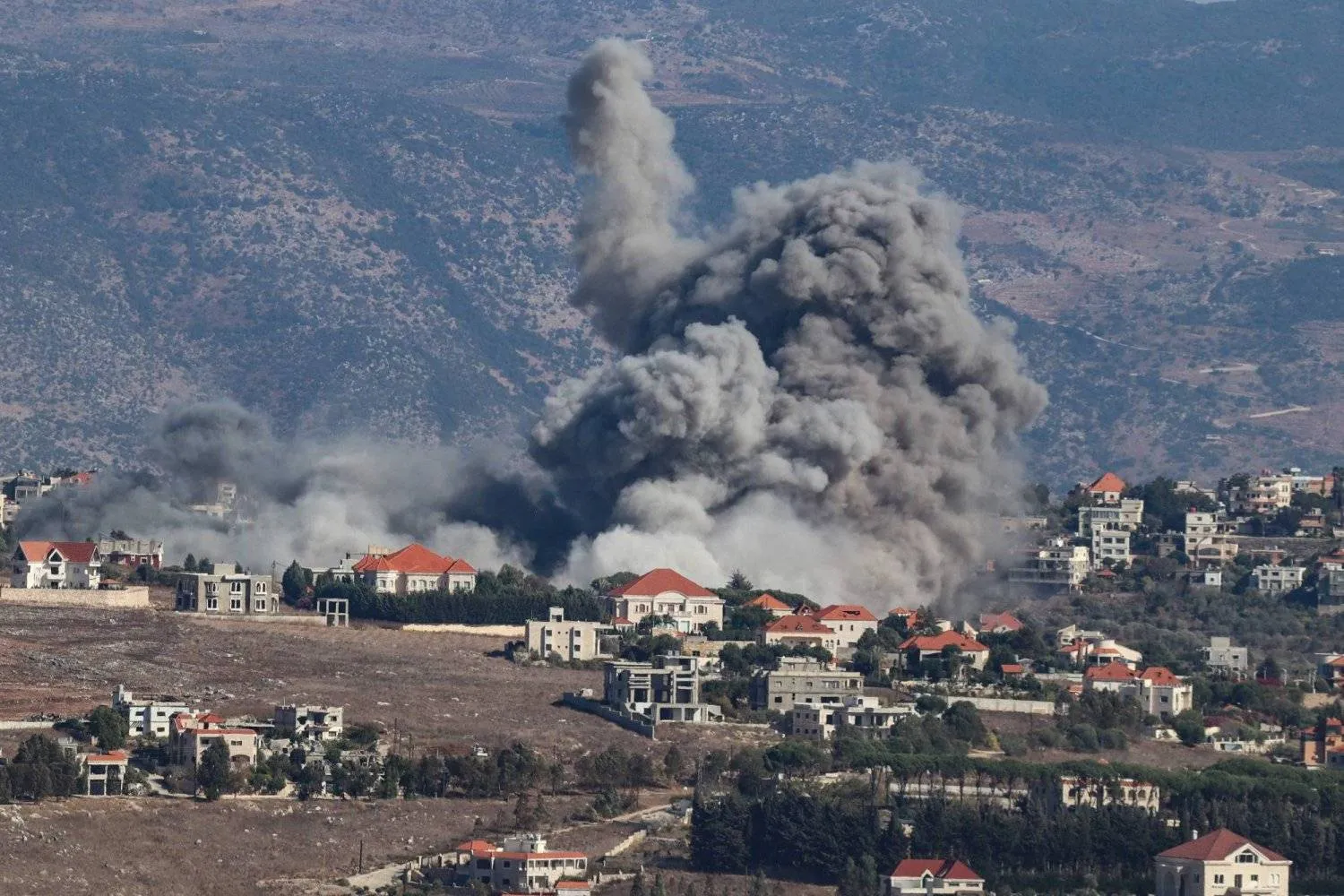
Smoke rises from the site of an Israeli airstrike targeting the southern village of Khiam. AFP
TT

Lebanon’s Economy in the Grip of War: From Int’l Support in 2006 to Financial Disaster in 2024

Smoke rises from the site of an Israeli airstrike targeting the southern village of Khiam. AFP

Lebanon has experienced several devastating wars throughout its modern history, which have left catastrophic impacts on its economy and social stability. One of the most notable was the July 2006 war between Israel and Hezbollah. Today, a similar conflict is unfolding between the two sides, but under vastly different economic and institutional circumstances.

During the 33-day war in 2006, Lebanon had a functioning president and government, and its economy was on a promising trajectory, with expected growth rates of 4 to 5 percent. Large-scale investments had helped the balance of payments generate a financial surplus, and the banking sector played a key role in bolstering confidence in Lebanon's economy. Additionally, the financial markets benefited from a surge in Gulf investments, driven by rising oil prices.

During that war, Arab countries, particularly in the Gulf, rushed to help. In 2006, Lebanon received a total of $1.174 billion in aid from friendly countries, international organizations, and Arab donors.

The Central Bank was able to intervene to protect the Lebanese lira and stabilize its exchange rate. Shortly after the war began, Lebanon's Central Bank received a $1.5 billion deposit from Kuwait and Saudi Arabia. International donor conferences, such as the August 2006 Stockholm Conference and Paris III in January 2007, generated significant support from the international community, alleviating the pressure on Lebanon’s public finances. The Paris III conference provided Lebanon with $7.6 billion in grants and soft loans, aimed at revitalizing the private sector after the war and implementing the economic reform plan set by the Lebanese government.

Today, however, Lebanon faces unprecedented economic challenges as it enters the 2024 war. The country is grappling with a severe financial crisis. The Lebanese lira has collapsed, losing more than 90% of its purchasing power, while inflation has skyrocketed. Crucially, Beirut now lacks the international and Arab financial support it once had. The Central Bank's reserves have dwindled significantly, the banking sector has suffered losses exceeding $70 billion, and the GDP has contracted by 50%, leaving 80% of the population living below the poverty line.

Since the beginning of the conflict on Oct. 7, fear has gripped the country’s tourism and services sectors, which were preparing to welcome expatriates. The number of arrivals at the airport has dropped by 33%, while departures have risen by 28%. According to the International Organization for Migration, around 29,000 people have been displaced from South Lebanon.

As the war enters its second month, S&P Global predicted that the decline in tourism could result in a loss of up to 23% of Lebanon's GDP. The World Bank also projected that the economy would slip back into recession, after initially forecasting slight growth of 0.2% for this year. In December, the United Nations Development Programme warned that the country could lose between 2% and 4% of its GDP due to the conflict. The private sector’s economy has been negatively impacted, with the Purchasing Managers' Index (PMI) dropping to 49.1. In October 2023, real estate transactions saw a 60% decline compared to the previous year.

In June, BMI Research, part of Fitch Ratings, revised Lebanon’s economic contraction forecast to around 1.5%, citing a significant drop in tourism revenue compared to the 2006 war, where losses were estimated at around $3 billion. According to the Arab Monetary Fund, every 1% increase in tourism revenues contributes to a 0.36% rise in GDP, meaning that Lebanon, whose GDP currently stands at just $20 billion, is losing a critical opportunity to boost its economy.

Recent data from August indicated that the war has prevented farmers from cultivating 17 million square meters of agricultural land. The industrial sector is also expected to see a contraction exceeding 50%, resulting in losses estimated at around $2 billion. Furthermore, disruptions at the ports will exacerbate the living crisis, leading to additional losses estimated at $1.5 billion.

Although there are no precise data on the devastating losses from the ongoing conflict, it is certain that the true cost far exceeds current estimates. The complete paralysis of essential economic sectors threatens the collapse of Lebanon’s infrastructure and is pushing the economy toward the brink. Preliminary estimates suggest that the losses have already surpassed $10 billion, an amount that represents more than half of Lebanon’s total GDP.


World Food Prices Dip in October, but Remain Higher Than a Year Ago

A worker carries loaves of bread for sale at a bakery in the capital city of Cairo, Egypt November 4, 2026. (Reuters)
TT

World Food Prices Dip in October, but Remain Higher Than a Year Ago

A worker carries loaves of bread for sale at a bakery in the capital city of Cairo, Egypt November 4, 2026. (Reuters)

World food prices edged lower in October as weaker import demand contributed to monthly declines in cereal, dairy and meat prices, but were still nearly 6% higher than a year earlier, the United Nations' Food and Agriculture Organization said on Friday.

The FAO Food Price Index, which tracks monthly changes in international prices for a basket of food commodities, ‌averaged 133.9 points ‌in October, down from a revised ‌135.6 ⁠in September.

The index ⁠was 5.9% higher than a year earlier, but remained 16.4% below its March 2022 peak.

FAO's cereal price index fell 4.5% from September and was 12.6% lower than a year ago, as wheat and maize quotations declined. Wheat prices eased on weak import demand ⁠and improved production prospects, especially in Argentina.

"Expectations of ‌easing constraints on Black ‌Sea export flows added to the downward pressure on prices, ‌although continued disruptions to Black Sea logistics limited the decline," ‌FAO said in a statement.

Maize prices also eased after reaching a three-year high in September, pressured by the US harvest, expectations of ample supplies in South America and renewed ‌prospects of easing tensions in the Black Sea region.

Vegetable oil prices edged up 0.3%, ⁠as ⁠higher soybean and sunflower oil prices more than offset a fall in rapeseed oil prices.

Sugar prices rose 6.6%, their fourth straight monthly increase, to the highest level since December 2024, after rainfall disrupted harvesting in Brazil. They were now 28.8% above a year ago.

The dairy index fell 1.1%, as lower butter and cheese prices linked to ample supplies and subdued demand outweighed gains in milk powder.

The meat index declined 1.2%, while still slightly above its year-earlier level, as ovine and bovine meat prices fell.


Copper Falls, Set for Worst Week Since March on AI Rout

Copper at the Aurubis copper smelting and refining plant in Hamburg, Germany. (Reuters)
TT

Copper Falls, Set for Worst Week Since March on AI Rout

Copper at the Aurubis copper smelting and refining plant in Hamburg, Germany. (Reuters)

Copper dropped on Friday and was set for its biggest weekly drop in London since March, as a rout in technology stocks battered markets.

Benchmark three-month copper on the London Metal Exchange was down 1.3% at $13,663 a metric ton by 0700 GMT. That placed it on track to fall 3.44% in the week, Reuters said.

The most-traded copper contract on the Shanghai Futures Exchange fell 1.08% to 106,830 yuan ($16,018.17) a ton.

The weakness reflects worries over AI investment, ‌with copper increasingly ‌influenced by "sentiment towards data center expansion," said ‌Craig ⁠Lang, principal analyst ⁠at CRU.

Technology shares were battered after Democratic wins in the US midterms fueled concerns that new regulatory oversight could cap the AI buildout.

On the other hand, supply constraints cushioned copper's decline.

"I would be cautious about calling this a sustained correction, given ongoing mine supply challenges and exceptionally tight ⁠metal availability outside the US," Lang said.

Copper stocks ‌in SHFE-monitored warehouses <CU-STX-SGH> fell by ‌over 24% this week to just 33,848 tons — the lowest ‌in almost three years. The closely watched Yangshan copper ‌premium <SMM-CUYP-CN>, a gauge of appetite for imports into key consumer China, increased to $210 a ton on Thursday, matching its record high.

Smelters in the country are facing a double squeeze of negative treatment ‌charges and lower sulfuric acid prices.

Meanwhile, warehouse inventories outside the US have been drawn ⁠down as ⁠material was pulled into the country ahead of a potential tariff on imports of refined copper.

"These physical constraints should provide some support against weaker investor sentiment," Lang said.

Among LME metals, aluminium lost 0.54%, zinc lost 1.42%, lead lost 0.45%, nickel dipped 0.23% and tin gained 0.83%.

On the SHFE, aluminium nudged down only 0.04%, zinc lost 1.35%, lead was little changed, down only 0.03%, nickel rose 2.14% and tin dropped 3.45%.

SHFE inventories were down across the board this week, led by sharp drops in aluminium <AL-STX-SGH> and lead <PB-STX-SGH>.


Emerging Economies Set to Match Advanced Nations’ Renewable Capacity Additions, IEA Says

Workers walk at Kalyon Karapinar solar power plant in Karapinar, Konya province, Türkiye, Oct. 14, 2026. (AP)
TT

Emerging Economies Set to Match Advanced Nations’ Renewable Capacity Additions, IEA Says

Workers walk at Kalyon Karapinar solar power plant in Karapinar, Konya province, Türkiye, Oct. 14, 2026. (AP)

Emerging ‌and developing economies outside China are expected to add as much new renewable energy capacity as advanced economies for the first time over the next five years, driven by the current energy crisis, the International Energy Agency said on Friday.

Gas and oil prices have soared this year as the US-Iran war disrupts traffic through the Strait of Hormuz, a key route for global oil and gas trade.

Global renewable energy ‌capacity is forecast ‌to increase by almost 4,800 gigawatts ‌between ⁠2026 and 2031, ⁠the IEA said in its annual outlook.

Emerging and developing economies are expected to add about 1,100 GW, roughly the same as advanced economies, with China adding around 2,550 GW, the agency said.

Capacity growth in Southeast Asia, Africa and the Middle East is ⁠expected to triple over the period, ‌led mainly by solar installations, ‌the IEA said.

China will remain the biggest contributor to ‌global renewable energy growth, although its share is ‌forecast to fall to 53% by 2031 from 60% in 2025.

India is emerging as the world's second-fastest deployer of renewables and is expected to more than double its contribution ‌to global growth by 2031 to nearly 8.5%.

Grid connection delays remain ⁠a major ⁠challenge, with projects awaiting connections worldwide rising 60% over the past year, equivalent to four times the wind and solar capacity connected to grids during the same period.

Grid constraints are expected to slow growth in advanced economies, with annual additions in Europe through 2031 forecast to remain broadly in line with 2025 levels.

Renewable energy is expected to meet 6% of global transport energy demand by 2031, while higher fuel-blending mandates prompted the IEA to raise its biofuels forecast by 40% from last year's report.