

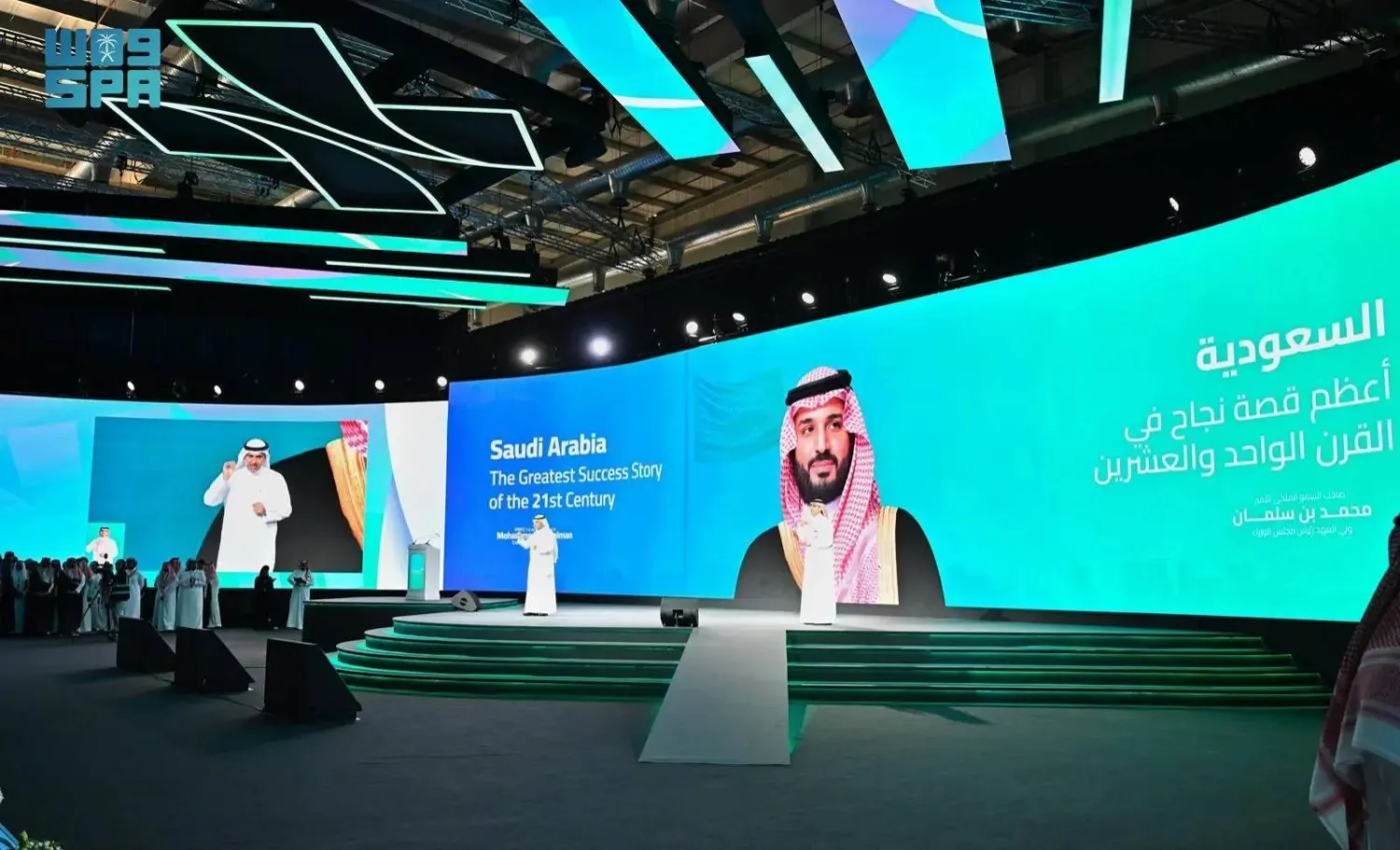

Global Health Exhibition 2024 Kicks off in Riyadh with SAR50 Billion in Investments

The seventh edition of the Global Health Exhibition kicked off in Riyadh on Monday. (SPA)
TT

Global Health Exhibition 2024 Kicks off in Riyadh with SAR50 Billion in Investments

The seventh edition of the Global Health Exhibition kicked off in Riyadh on Monday. (SPA)

The seventh edition of the Global Health Exhibition kicked off in Riyadh on Monday.

Held under the slogan "Invest in Health", the exhibition was held under the auspices of the Ministry of Health, supported by the Health Sector Transformation Program, and organized by Tahaluf, a joint venture between Informa PLC, the Saudi Arabian Federation for Cybersecurity, Programming, and Drones (SAFCSP), and the Event Investment Fund (EIF).

At the opening ceremony, Minister of Health Fahad Al-Jalajel highlighted the significance of health transformation in the sector.

"Our goal is for the Kingdom of Saudi Arabia to serve as a hub for addressing the current and future major global challenges by establishing a unified government approach under Vision 2030, in accordance with the principle of health in all policies," he stressed.

"This will be achieved by fostering the development of procedures that support investment in innovation, constructing a health system that leverages the power of digital solutions and artificial intelligence, developing a local health workforce, and attracting the best talents from around the world," he added.

"These are the motivations that drive us to advance our health transformation with practical steps and concrete actions," he went on to say.

"We are proud that the World Health Organization (WHO) has recognized Saudi Arabia's food products as being free of trans fats, placing the Kingdom at the forefront among countries receiving this recognition," he remarked.

The WHO also announced that the Kingdom, represented by the Saudi Food and Drug Authority (SFDA), is the first country in the region to achieve the fourth maturity level in the regulation of medicines and vaccines, which is the highest level in the organization's classification.

Al-Jalajel also noted the expansion of Saudi Board Programs to 170 health programs, which have now been adopted by 3,000 international practitioners.

He announced the launch of the second generation of Taakkad Centers and the digital twin, which will be part of the Sehhaty application. Additionally, he mentioned that the Seha Virtual Hospital has been registered in the Guinness Book of Records as the largest virtual health hospital in the world, and that several distinguished global medical talents have been granted premium residency opportunities.

The exhibition, which runs through October 21 to 23, announced projects valued at over SAR 50 billion, including several key initiatives. Among the most prominent was the announcement of a SAR 4 billion pharmaceutical manufacturing deal among NUPCO, Novo Nordisk, and Sanofi.

Other major projects included SAR 5 billion expansions at Fakeeh Care Group, the establishment of five primary care centers and two hospitals by Almoosa Health Group valued at SAR 3 billion, the acquisition of Al-Salam and Al-Ahsa hospitals in the Eastern Province by Dallah Health, with a total capacity of 749 beds, and the construction of Dallah Hospital in Riyadh with a capacity of 250 beds and the potential for expansion, valued at SAR 4 billion.

Several agreements and partnerships were signed on the sidelines of the exhibition, including a partnership between the Council of Health Insurance and Alfaisal University, a memorandum of understanding (MoU) between Imam Abdulrahman Bin Faisal University and the National Institute for Health and Care Research, and an MoU between the Ministry of Health, represented by the Agency of Engineering Affairs and Supply, and the National Center for Vegetation Development and Combating Desertification.



Saudi E-Commerce Hits Record Monthly Sales over SAR30.7 Billion in October

A view of Riyadh, Saudi Arabia. (SPA file)
TT

Saudi E-Commerce Hits Record Monthly Sales over SAR30.7 Billion in October

A view of Riyadh, Saudi Arabia. (SPA file)

E-commerce sales in Saudi Arabia via "mada" cards soared to an all-time monthly high in October 2025, surpassing SAR30.7 billion.

The surge in sales represents a 68% year-on-year increase, totaling about SAR12.4 billion more than the SAR18.3 billion recorded in October 2024, according to the Saudi Central Bank (SAMA) statistical bulletin on Wednesday.

E-commerce sales for the third quarter (Q3) of 2025 hit SAR88.3 billion, up 15.2% from the previous quarter, representing an increase of about SAR11.6 billion over the SAR76.6 billion recorded in Q2.

On a monthly basis, e-commerce sales in October rose 6%, gaining approximately SAR1.6 billion over September’s total of SAR29.1 billion.

From January to October, "mada" data showed e-commerce sales grew 47.3%, rising by around SAR9.9 billion over the SAR20.9 billion recorded in January.

These figures cover transactions made via "mada" cards on e-commerce websites, apps, and digital wallets, and do not include credit-card payments.


Jeddah's King Abdulaziz Airport Launches First Direct Flight to Moscow

The expansion supports Jeddah Airports Company’s goal of broadening travel options and increasing air traffic revenue, leveraging the Kingdom's strategic location. (SPA)
TT

Jeddah's King Abdulaziz Airport Launches First Direct Flight to Moscow

The expansion supports Jeddah Airports Company’s goal of broadening travel options and increasing air traffic revenue, leveraging the Kingdom's strategic location. (SPA)

Jeddah's King Abdulaziz International Airport (KAIA) celebrated the launch of its first direct flynas flight to Moscow, operating three weekly flights between Jeddah and Vnukovo International Airport.

This initiative, in partnership with the Saudi Tourism Authority and the Air Connectivity Program, boosts air links between Saudi Arabia and Russia.

It marks KAIA's third direct Russian destination, following Makhachkala and Mineralnye Vody, which were inaugurated earlier this month by Azimuth Airlines.

The expansion supports Jeddah Airports Company’s goal of broadening travel options and increasing air traffic revenue, leveraging the Kingdom's strategic location.


China Widens Foreign Investment Incentive List to Stem Falling Inflows

People visit a shopping center in Beijing on December 20, 2025. (AFP)
TT

China Widens Foreign Investment Incentive List to Stem Falling Inflows

People visit a shopping center in Beijing on December 20, 2025. (AFP)

China on Wednesday listed more sectors eligible for foreign investment incentives, from tax breaks to preferential ​land use, in its latest effort to stem a prolonged decline in overseas capital inflows.

Under the 2025 edition of the catalogue of industries for encouraging foreign investment, China added more than 200 and revised about 300, with a ‌focus on ‌advanced manufacturing, modern services and ‌green ⁠and ​high-tech ‌sectors, the list jointly issued by the National Development and Reform Commission and the commerce ministry showed.

The new catalogue, which takes effect on February 1, 2026, replaces the 2022 version and continues a policy framework ⁠that offers foreign-invested enterprises tariff exemptions on imported equipment, preferential ‌land pricing, reduced corporate income ‍tax rates in ‍designated regions and tax credits for reinvestment ‍of profits.

The catalogue also extends incentives to central and western regions, as well as the northeast and Hainan, as Beijing seeks to attract ​more foreign investment into less developed areas.

China has in recent months ⁠taken a raft of measures to boost foreign investment, including pilot programs in Beijing, Shanghai and other regions to expand market access in services such as telecoms, healthcare and education, amid trade tensions with the United States.

Foreign direct investment in China totaled 693.2 billion yuan ($98.84 billion) from January to November this year, down 7.5% from the ‌same period last year, data from the commerce ministry showed.