Preoccupied with its Troops in Russia, North Korea Unlikely to Embrace Trump’s Overture Soon 

This picture taken on January 27, 2025 and released from North Korea's official Korean Central News Agency (KCNA) via KNS on January 29, 2025 shows North Korea's leader Kim Jong Un attending the 30th expanded conference of the 8th General Secretary of the Workers' Party of Korea, at the party's Central Committee headquarters in Pyongyang. (KCNA via KNS / AFP)
TT

Preoccupied with its Troops in Russia, North Korea Unlikely to Embrace Trump’s Overture Soon 

This picture taken on January 27, 2025 and released from North Korea's official Korean Central News Agency (KCNA) via KNS on January 29, 2025 shows North Korea's leader Kim Jong Un attending the 30th expanded conference of the 8th General Secretary of the Workers' Party of Korea, at the party's Central Committee headquarters in Pyongyang. (KCNA via KNS / AFP)

In its first direct criticism of the Trump administration, North Korea lashed out at US Secretary of State Marco Rubio for calling it a “rogue” state and warned Monday that such “coarse and nonsensical remarks” will never contribute to US interests.

The statement is the latest in a series of North Korean signals that it's not interested in resuming diplomacy with the United States anytime soon, though Trump has said he'll reach out to its leader Kim Jong Un.

Many experts say that Kim, preoccupied with his deployment of troops to Russia, is likely concentrating on developments in the Russia-Ukraine war for now. But they say Kim would eventually seriously consider Trump's overture if he assessed he cannot maintain the current solid partnership with Russia after the war ends.

“Now, Kim Jong Un is desperate to maintain the unshakable alliance with Russia, but it remains to be seen whether Russia would do so as he wishes,” said Moon Seong Mook, an analyst for the Seoul-based Korea Research Institute for National Strategy.

Here's a look at prospects for a possible restart of the Trump-Kim diplomacy:

Trump hints at return to negotiations with Kim

During his first term, Trump met Kim three times in 2018-19, becoming the first sitting US president to hold a summit with a North Korean leader. The negotiations over North Korea's nuclear program eventually fell apart, but Trump's return spawned speculation that a fresh round of talks could begin soon.

On his inauguration day, Trump, speaking to US troops in South Korea via video, bragged of his personal ties with Kim.

“You have somebody with pretty bad intentions, I guess,” Trump said. “You would say that although I developed a pretty good relationship with him but he’s a tough cookie.”

During a Fox News interview broadcast on Jan. 23, Trump called Kim “a smart guy” and “not a religious zealot.” Asked whether he will reach out to Kim again, Trump replied, “I will, yeah.”

North Korea keeps up its hostility against the US

North Korea hasn't directly responded to Trump's overture but has pressed ahead with its weapons testing activities and bellicose rhetoric against the US. In December, Kim vowed to implement the “toughest” anti-US policy.

Kim likely doubts what concessions he could wrest from Trump, given their previous talks collapsed in Vietnam after the American president rebuffed Kim's offer to dismantle his main nuclear complex, a limited denuclearization step, in return for broad sanctions relief. The breakdown was probably a setback for Kim domestically though the summits provided him with the badly needed diplomatic recognition on the world stage.

“Kim personally suffered huge humiliation due to a no-deal in Hanoi,” said Kwak Gil Sup, head of One Korea Centre, a website specializing in North Korean affairs. “I don't think he would promptly respond to Trump's overture."

Kim said in November that the negotiations with the United States only confirmed Washington’s “unchangeable” hostility toward his country and described his nuclear buildup as the only way to counter external threats. Kwak said North Korea will still likely avoid high-profile provocations like a nuclear test, knowing that Trump focuses more on other issues like tariff wars and China.

On Monday, North Korea's Foreign Ministry said that Rubio's comments reaffirmed that the US hostile policy remains unchanged. It likely referred to Rubio’s appearance on “The Megyn Kelly Show” on Jan. 30, in which he called North Korea and Iran “rogue states” while addressing foreign policy challenges.

For now, Kim is focused on the Russia-Ukraine war

Kim's priority seems to be an estimated 10,000-12,000 North Korean troops sent to support Russia's three-year war efforts against Ukraine, the North's first major participation in a foreign war. North Korea has supplied a vast amount of artillery and other conventional weapons to Russia as well.

In return, North Korea appears to be receiving economic and military assistance from Russia. Last June, Kim and Russian President Vladimir Putin signed a landmark pact vowing mutual military assistance if either country is attacked. Seoul, Washington and their partners worry Putin might give Kim sophisticated technologies that can sharply enhance his nuclear missile programs.

The booming ties with Russia have helped Kim bear the brunt of the US-led pressure campaign on North Korea. But it's not clear if the two countries would maintain the same level of relationship after the war's end.

“When the war is over, Kim may not be such a vital partner for Putin any longer,” Moon said. “Given that, if Kim fails to win what he wants from Putin, he could switch his diplomatic policy focus to the United States.”


How Could Growing Egypt-Türkiye Ties Shape Regional Conflicts?

Egyptian President Abdel Fattah El-Sisi and Turkish President Recep Tayyip Erdogan sign a military cooperation agreement in Cairo on Feb. 4. (Turkish Presidency)
TT

How Could Growing Egypt-Türkiye Ties Shape Regional Conflicts?

Egyptian President Abdel Fattah El-Sisi and Turkish President Recep Tayyip Erdogan sign a military cooperation agreement in Cairo on Feb. 4. (Turkish Presidency)

A series of high-level meetings between Egypt and Türkiye has culminated in the first visit by an Egyptian defense minister to Ankara in 13 years, raising questions about whether the two countries’ rapidly expanding ties could help ease conflicts across the Middle East.

The visit, which began Sunday, included the signing of a letter of intent on defense cooperation.

Experts interviewed by Asharq Al-Awsat differed, however, on the extent to which the rapprochement has translated into tangible gains. While some argued it has helped reduce tensions, particularly in Libya, others said it has yet to produce meaningful progress in the region’s major crises.

Türkiye and Egypt signed the defense cooperation letter on Monday following talks in Ankara between Turkish Defense Minister Yasar Guler and his Egyptian counterpart, Ashraf Salem Zaher.

The visit followed the conclusion of the Anatolian Eagle 2026 joint air exercise, which brought together the Egyptian, Turkish and Azerbaijani air forces, with the participation of a NATO airborne early warning aircraft. It also came after the fifth meeting of the Egyptian-Turkish Joint Military Committee.

The two countries held the inaugural meeting of their High-Level Strategic Cooperation Council during Egyptian President Abdel Fattah El-Sisi’s visit to Ankara in September 2024, after reviving the mechanism during Turkish President Recep Tayyip Erdogan’s visit to Cairo earlier that year.
A second council meeting in Cairo last February produced a joint statement highlighting closer positions on the Palestinian issue and the crises in Syria, Lebanon, Sudan, Somalia and the Sahel, as well as counterterrorism.

Bashir Abdel Fattah, a Türkiye affairs specialist at the Al-Ahram Center for Political and Strategic Studies, said the rapprochement had at least prevented confrontation in Libya, where Cairo and Ankara once backed rival interests.

He noted that the growing political understanding between the two countries has helped de-escalate the conflict and support efforts toward a political settlement that preserves Libya’s territorial integrity.

Türkiye analyst Mahmoud Alloush shared that assessment, describing Egyptian-Turkish coordination as a turning point in Libya and noting parallel efforts involving Saudi Arabia to advance a political solution.

Not everyone is convinced. Rokha Ahmed Hassan, a member of the Egyptian Council for Foreign Affairs, said expectations that Egyptian-Turkish understandings would help resolve Libya’s crisis have yet to be realized, largely because of divisions among Libyan parties.

He argued that while bilateral coordination has strengthened political dialogue across the Middle East and the Horn of Africa, it has not yet delivered concrete results.

On July 11, Egyptian Foreign Minister Badr Abdelatty and Turkish Foreign Minister Hakan Fidan agreed during a phone call to continue consultations on shared security concerns and work to prevent further military escalation in the region.

On Syria, Abdel Fattah said Cairo and Ankara agree on preserving the country’s unity despite differences over Türkiye’s military presence.

He stressed that expanding political and military coordination is creating the trust needed to address contentious issues, including Israeli actions in Syria, reconstruction and burden-sharing.

Hassan, however, said the rapprochement has yet to produce a positive impact on Syria because Cairo and Ankara continue to differ over Türkiye’s approach to Islamist groups.

The two countries are more closely aligned on Somalia. Hassan emphasized that their shared support for Somalia’s territorial integrity has had positive, albeit gradual, effects, though significant security challenges remain.

Alloush described Somalia as an example of “competitive cooperation,” arguing that managed competition between Egypt and Türkiye could ultimately strengthen stability there.

Abdel Fattah, for his part, noted that the emerging partnership provides a solid strategic framework that could help cool regional conflicts. He called for broader coordination with Saudi Arabia and Pakistan to curb destabilizing external interference and establish a regional order that better serves the interests of Middle Eastern states.

On June 21, El-Sisi called for institutionalizing the consultative mechanism bringing together Egypt, Saudi Arabia, Türkiye and Pakistan, which was launched three weeks after the outbreak of the US-Iran war in late February.


Ticking Time Bomb? Europe’s Ageing Population Brings Challenges

 A resident of a nursing home eats fruit to beat the heat in Munich, Germany, July 14, 2026. (Reuters)
A resident of a nursing home eats fruit to beat the heat in Munich, Germany, July 14, 2026. (Reuters)
TT

Ticking Time Bomb? Europe’s Ageing Population Brings Challenges

 A resident of a nursing home eats fruit to beat the heat in Munich, Germany, July 14, 2026. (Reuters)
A resident of a nursing home eats fruit to beat the heat in Munich, Germany, July 14, 2026. (Reuters)

The population of the 27-nation European Union will peak in 2029 before falling in the coming decades, according to a report published Tuesday that spotlights the major challenges the bloc faces from an ageing population.

Today there are 450.6 million people, but researchers say this will peak at 453.3 million in 2029 before a slow long-term decline.

The population will fall to 398.8 million people by 2100, an overall drop of 11.7 percent and a level that was last experienced in the 1970s.

Europeans are living longer than ever before thanks to vastly improved healthcare, and better life and social conditions.

But an ageing population poses challenges for society and the EU economy, and while migration could help, it's not the fix Europe might hope for.

The EU executive's Joint Research Center said life expectancy at birth reached 81.5 years in 2024.

By 2050, nearly one in three EU residents will be aged 65 or older, compared to one in five today, the center said.

By 2100, life expectancy could exceed 90 years for women and 86 for men.

Such trends present "significant challenges", the EU said, including labor shortages, strained public budgets, and pressure on care and education systems.

It is, however, not all negative as the report points to the rise of the "silver economy" -- a growing market for goods and services for older citizens.

- 'Migration is a necessity' -

Migration can help offset some effects of Europe's demographic change, the researchers said, but it would have a limited impact on "fully" addressing the challenges posed by an ageing population.

But as fertility rates fall, migration counterbalances the negative effects of an ageing population and labor force contraction, the report said.

"Migration is a necessity," EU commissioner Dubravka Suica told reporters.

Fewer babies are being born to each woman in Europe, a decline that has been steady since the 1960s.

The fertility rate fell to 1.34 children per woman in 2024, well below the replacement level of 2.1 needed to keep the population stable without migration.

The median age of a European was 44.9 in 2025, and there are major disparities between EU countries. Ireland is relatively young with a median age of 39.6 years while Italy's was 49.1.

"We are living longer, healthier lives than ever before -- one of our greatest achievements. But demographic change is reshaping our societies, our economies and our labor markets," Suica said in a statement.

"We must act now to turn this transformation into an opportunity," she added.

The EU insists the bloc must boost productivity and cut unemployment to offset the effects of a shrinking workforce.

Currently around 20 percent of working-age Europeans are outside the labor force, the report said, while some eight million young people are neither in employment, education nor training.

The situation is particular to Europe as the global population is not falling.

Population growth is increasingly concentrated in parts of Sub-Saharan Africa, South Asia and some Middle Eastern countries, the report said.


Atef Najib in Court: Reconstructing the Story of the ‘First Spark’ in Syria’s Uprising

Atef Najib at the Damascus courthouse on April 26, 2026. (Reuters)
TT

Atef Najib in Court: Reconstructing the Story of the ‘First Spark’ in Syria’s Uprising

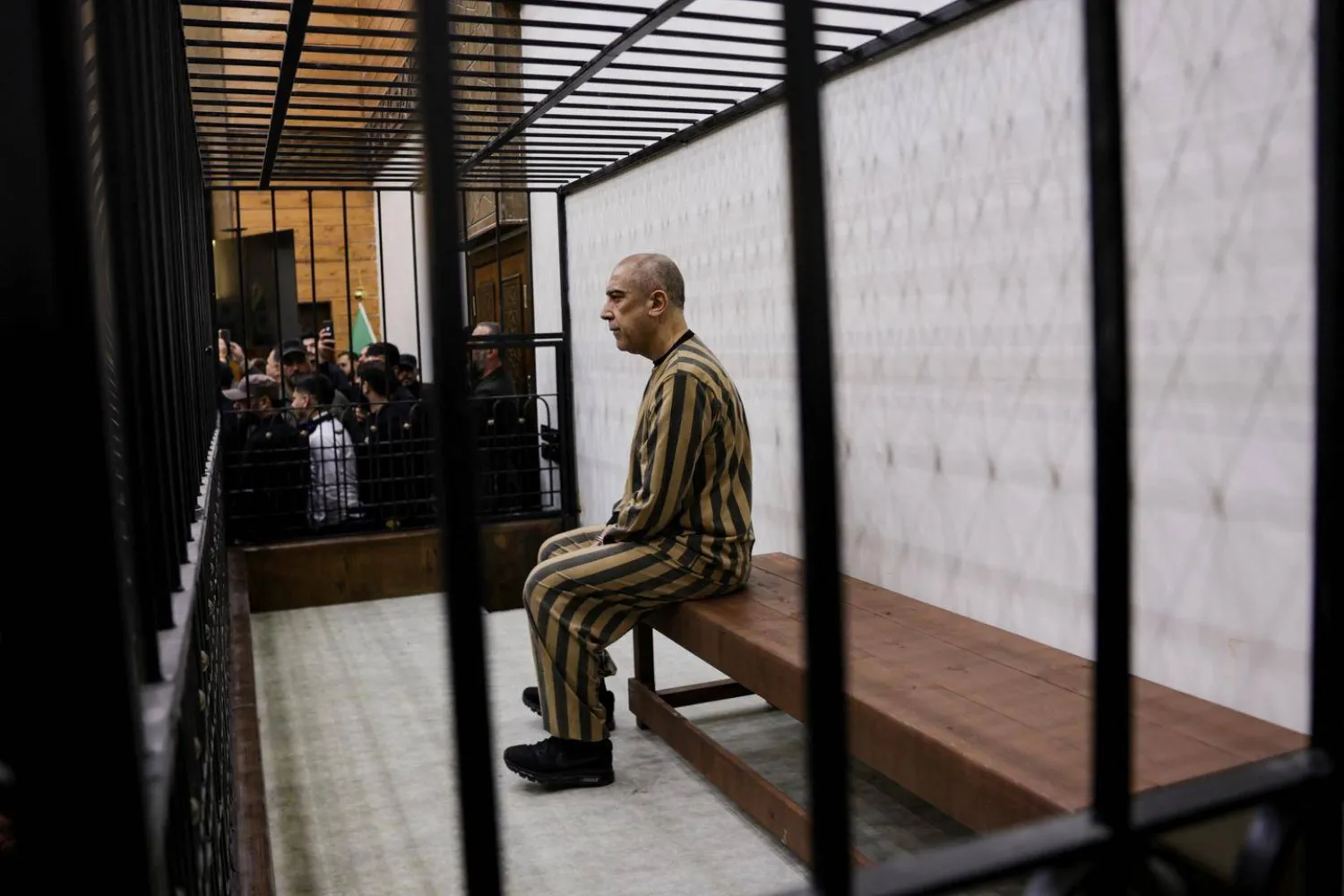
Atef Najib at the Damascus courthouse on April 26, 2026. (Reuters)

The arrest of schoolchildren in the southern Syrian city of Daraa in March 2011 is widely regarded as the spark that ignited the Syrian uprising. What began as a local incident evolved into nationwide protests and, eventually, a devastating civil war.

Fifteen years later, the case has resurfaced as Syrian authorities pursue accountability for abuses committed under Bashar al-Assad's regime, placing former Daraa Political Security Department chief Atef Najib at the center of one of the conflict’s defining episodes.

As transitional justice efforts gather pace under President Ahmed al-Sharaa’s government, the “Daraa children case” has become a key test of whether Syria’s judicial institutions can confront the legacy of arbitrary detention, systematic torture, and repression.

Asharq Al-Awsat interviewed two of the children detained at the time, now adults, whose testimonies revisit the events behind the slogan, “It’s your turn, Doctor”—a reference to Assad—that was scrawled by children on a school wall and became synonymous with the uprising’s beginning.

Fifteen years later, they said that the central question is no longer who wrote the slogan, but how it became the pretext for mass arrests and the torture of children.

Their accounts reconstruct the sequence of events while reinforcing the broader conclusion that what happened inside Syria’s security branches transformed a local incident into a turning point in the country’s history.

Naif Abazeed: Childhood in the interrogation cells

Naif Abazeed was 13 when he was arrested. His name has long been associated with writing the famous phrase, but he firmly rejects that claim.

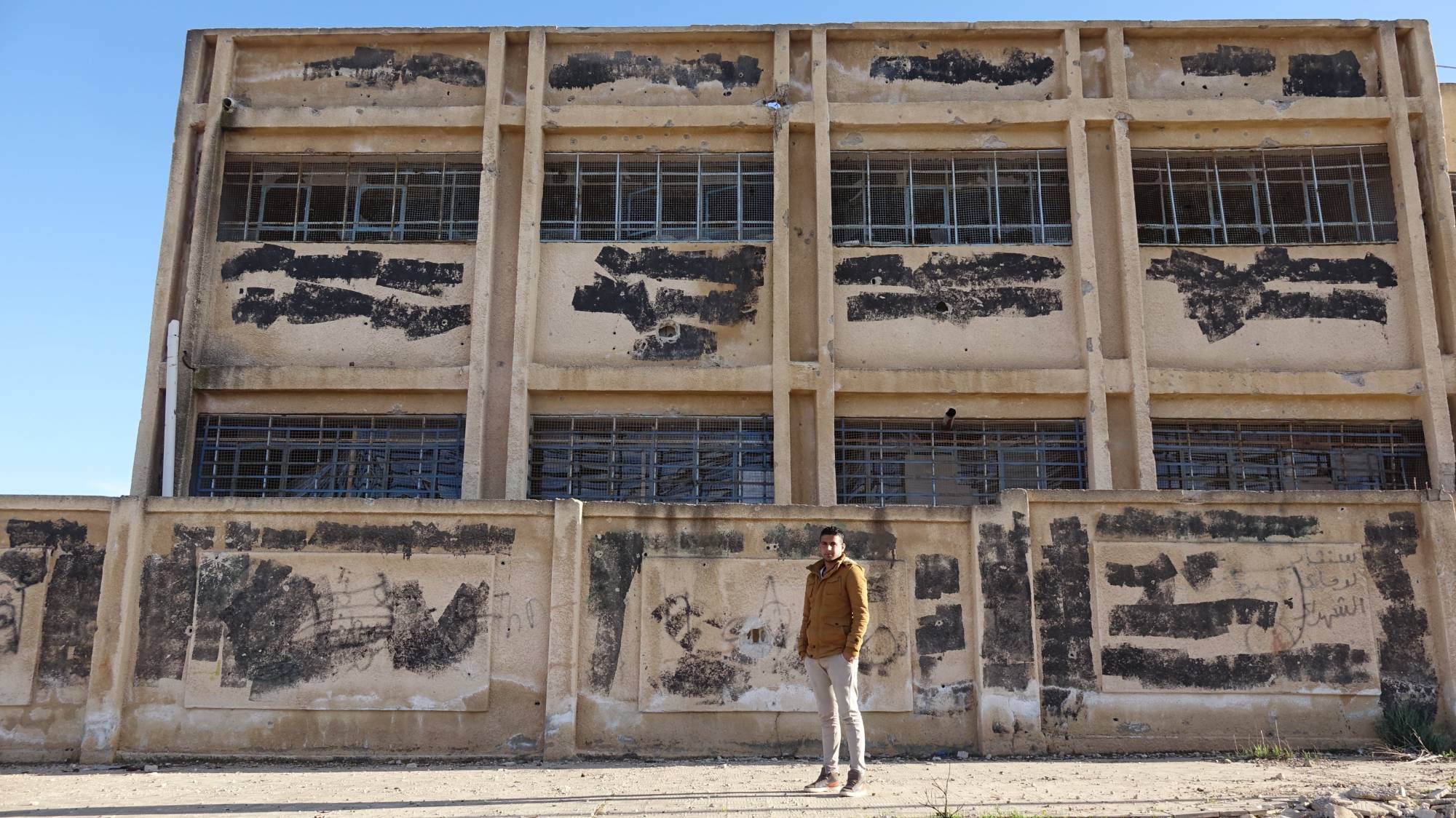
He told Asharq Al-Awsat that the only graffiti he ever wrote was his own name and that of a friend on a wall at Daraa al-Balad Preparatory School in 2009.

He also disputed the widely circulated account placing the graffiti at Al-Arbaeen School, saying others appropriated his story while changing the location and timeline.

Abazeed said he never met Atef Najib. Instead, he identifies then-Col. Louay al-Ali as the officer who interrogated and tortured him.

While his testimony shifts attention to al-Ali’s direct role during the investigation, it does not absolve Najib. Rather, it distinguishes between the officer who conducted the interrogations and the security chief who commanded the apparatus responsible for the children’s detention.

Under international law, command responsibility extends beyond those who personally commit abuses to include superiors who knew, or should have known, about the violations and failed to prevent or punish them.

One of the children, now an adult, seen at the Al-Arbaeen School. (Getty Images)

Arrested at school

Abazeed recalled security officers arriving at his school after police had searched his home earlier that morning.

Al-Ali introduced himself as an education official investigating graffiti supposedly bearing the student’s name alongside that of a girlfriend.

Instead, the interrogation centered on the phrase, “It’s your turn, Doctor,” which had already been erased.

The boy was told he would be questioned briefly. Instead, he was taken to a Political Security Branch detention facility, where he said he was confronted with instruments of torture, beaten with cables and sticks, suspended, and forced into the “tire” stress position.

“I told them I had written nothing except my name in 2009,” he said. “The officer insisted I had written something else.”

Unable to withstand the abuse, Abazeed said he eventually confessed to something he had not done. He added that he only learned after his release that another student had actually written the phrase.

He also recounted being handed paper and ordered to write down everything that had appeared on the school walls. When the phrase was missing, the interrogator allegedly dictated it word by word while continuing to beat him until he repeated it in full. Only then did he understand that “Doctor” referred to President Bashar al-Assad.

The interrogation did not end there. Abazeed revealed that he was pressured to identify accomplices and, under torture, named classmates and neighbors, drawing more children into the investigation.

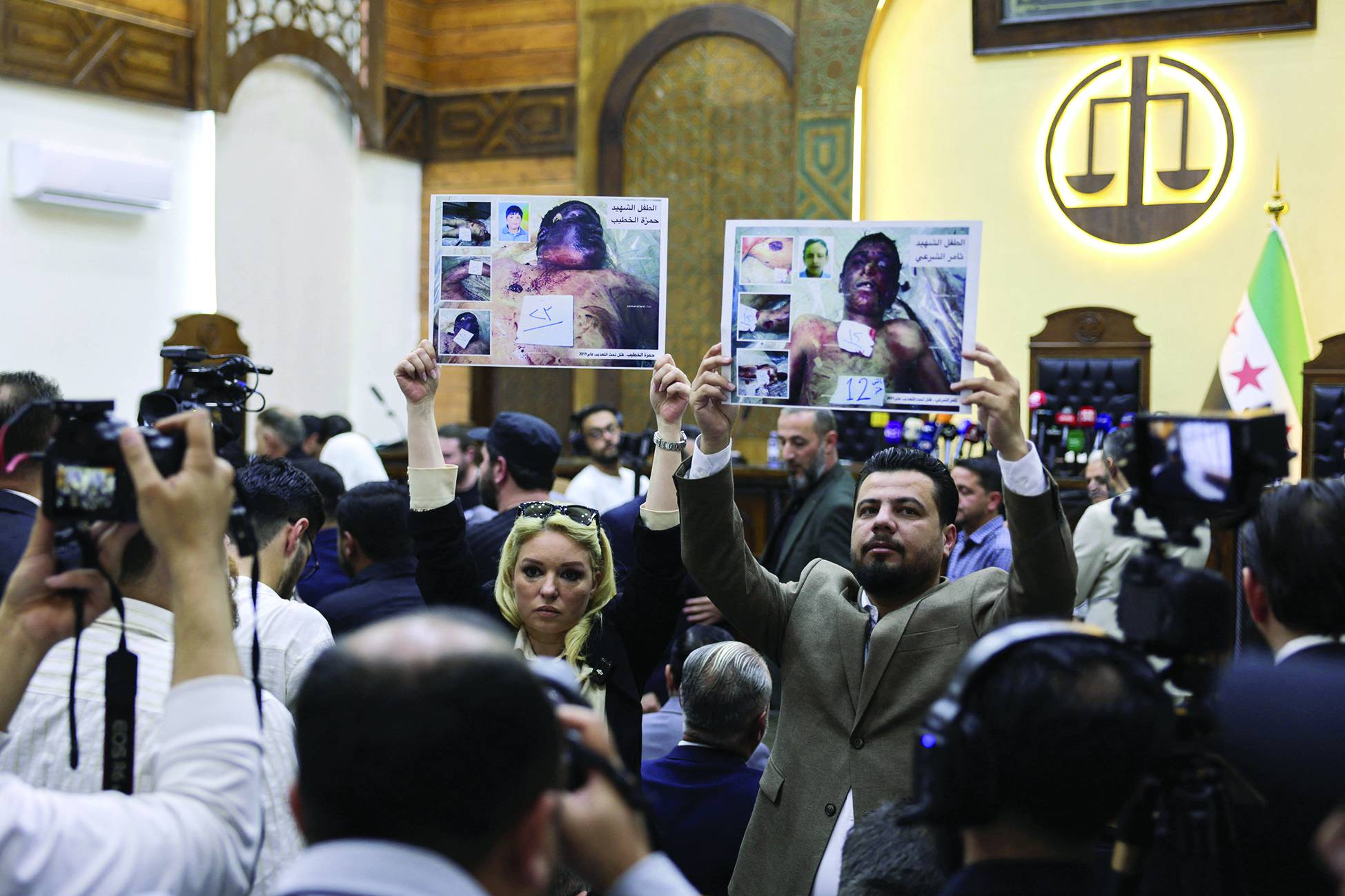
Demonstrators hold posters on the day Atef Najib, a brigadier general and former head of the Political Security Department in Daraa during Syria's ousted President Bashar al-Assad's rule, who is accused of committing war crimes, attends a trial session at the Palace of Justice, in Damascus, Syria, April 26, 2026. (Reuters)

Another victim’s testimony

Samer Ali al-Sayasneh, another child detained in 2011 after being accused of burning a police kiosk near Al-Arbaeen School, has also testified against Najib in court.

He holds Najib fully responsible for the escalation in Daraa, from arbitrary arrests to orders that led to the deadly shootings at Omari Mosque and a nearby gas station.

According to al-Sayasneh, no security branch would have acted without Najib’s authorization, making any attempt to exonerate him implausible.

The legal case

Lawyer Noha al-Masri told Asharq Al-Awsat that prosecutors are relying primarily on Syrian law, including Law No. 16 of 2022, provisions of the Syrian Penal Code, and Legislative Decree No. 20 of 2013.

She said the abuses committed in Daraa in March 2011 could also meet the international definition of crimes against humanity because they formed part of a widespread and systematic attack against civilians.

Al-Masri stressed that criminal responsibility extends beyond direct perpetrators to those who planned, ordered, supervised, or knowingly allowed the abuses to occur, reflecting the established principle of command responsibility under international humanitarian law.

She added that victims’ testimony, videos, medical reports, and official documents together could provide the foundation for one of the most significant trials in modern Syrian history - one likely to shape future accountability cases.

Syrian law also allows victims to seek compensation for the physical, psychological, material, and moral harm they suffered.

Strengthening the evidentiary record, she underlined, depends on corroborating witness testimony with videos, official documents, and medical and human rights reports.