


Sudan, Russia Agree on Port Sudan Naval Base

Russian Foreign Minister Sergei Lavrov (R) and his Sudanese counterpart Ali Yusuf al-Sharif shake hands during press conference in Moscow, on February 12, 2025. (Photo by Maxim Shemetov / POOL / AFP)
TT

Sudan, Russia Agree on Port Sudan Naval Base

Russian Foreign Minister Sergei Lavrov (R) and his Sudanese counterpart Ali Yusuf al-Sharif shake hands during press conference in Moscow, on February 12, 2025. (Photo by Maxim Shemetov / POOL / AFP)

Sudan and Russia have reached a final agreement on the establishment of a Russian naval base in Port Sudan on the Red Sea, Sudanese Foreign Minister Ali Yusuf al-Sharif announced on Wednesday.

The plan has been discussed for years but never materialized due to the volatile security situation in Sudan.

The deal allows Russia to set up a naval base with up to 300 Russian troops, and to simultaneously keep up to four navy ships, including nuclear-powered ones, in the strategic Port Sudan.

“There are no obstacles, we are in complete agreement,” Sharif said following talks in Moscow with his Russian counterpart, Sergei Lavrov.

He did not elaborate on the terms of the current agreement, and whether the two sides had introduced new amendments to the deal reached between the two countries in 2017.

Lavrov avoided mentioning the military base, but said that during the meeting with Sharif, both sides paid special attention to the war in Sudan.

“We are interested in normalizing the situation in this friendly country, our good traditional partner in Africa, as soon as possible,” the Russian FM said.

“We reaffirmed our principled position on the need for an early cessation of hostilities along with the launch of a national dialogue, which should include representatives of all political, ethnic and religious groups in Sudan,” Lavrov said.

He noted that according to Sharif, the Sudanese leadership published two days ago a roadmap that should pave the way for progress in this direction.

Last December, Russia's embassy in Sudan refuted media reports alleging that the Sudanese authorities refused to host a Russian naval logistics support base.

Earlier in June, Mohamed Siraj, Sudan’s Ambassador to Russia, reaffirmed his country’s dedication to constructing a Russian naval base on the Red Sea.

In 2017, Khartoum and Moscow agreed during a visit by Sudan's ousted former president Omar al-Bashir to Moscow, to establish the base. But in 2021, weeks after Khartoum decided to freeze the deal, Moscow rushed to approve the binding agreement to establish the base in Sudan by passing it through all the legal mechanisms.

Russian President Vladimir Putin referred the agreement to the State Duma for ratification, in the second step of the final approval of the agreement after the Russian government formally ratified it a week earlier.

The Sudanese leadership had informed Moscow of its official position to freeze the deal through military and diplomatic channels.

A Russian source told Asharq Al-Awsat at the time that after referring the document to the Duma and Senate, Moscow is seeking to give it full legal force. This will allow Russia to negotiate later with Sudan to introduce some amendments.

Meanwhile in the Sudanese capital, Chief of Staff of the Armed Forces Mohamed Othman al-Hussein said that “Khartoum intends to review the agreement,” noting that it was approved by the previous government and not the parliament.

Despite Sudan’s position, the Russian Foreign Ministry announced that the agreement remains binding for both parties because it was signed on July 23, 2019, by the representative of the Transitional Military Council, that is, after the change of the political system in Sudan.

Ministry spokeswoman Maria Zakharova noted that the document has not yet been ratified by the Sudanese party because there is currently no legislative authority in the country with such powers.
Zakharova hinted at Russia’s readiness to show flexibility in revising the text of the agreement and said Moscow was interested in strengthening cooperation with Khartoum.
She explained that even before the agreement enters into force, changes can be introduced to its text at the discretion of both parties.

The agreement stipulates establishing a logistics center for the Russian fleet on the coast of Sudan in the Red Sea. It grants Russia the right to use an operational logistic center in Port Sudan, provided that the maximum number of working personnel does not exceed 300 soldiers, and no more than four Russian warships will be able to stay there at one time.
The agreement is valid for 25 years, with the possibility of extension.


Israel Says Killed Hamas Operative Responsible for 2004 Bus Bombings

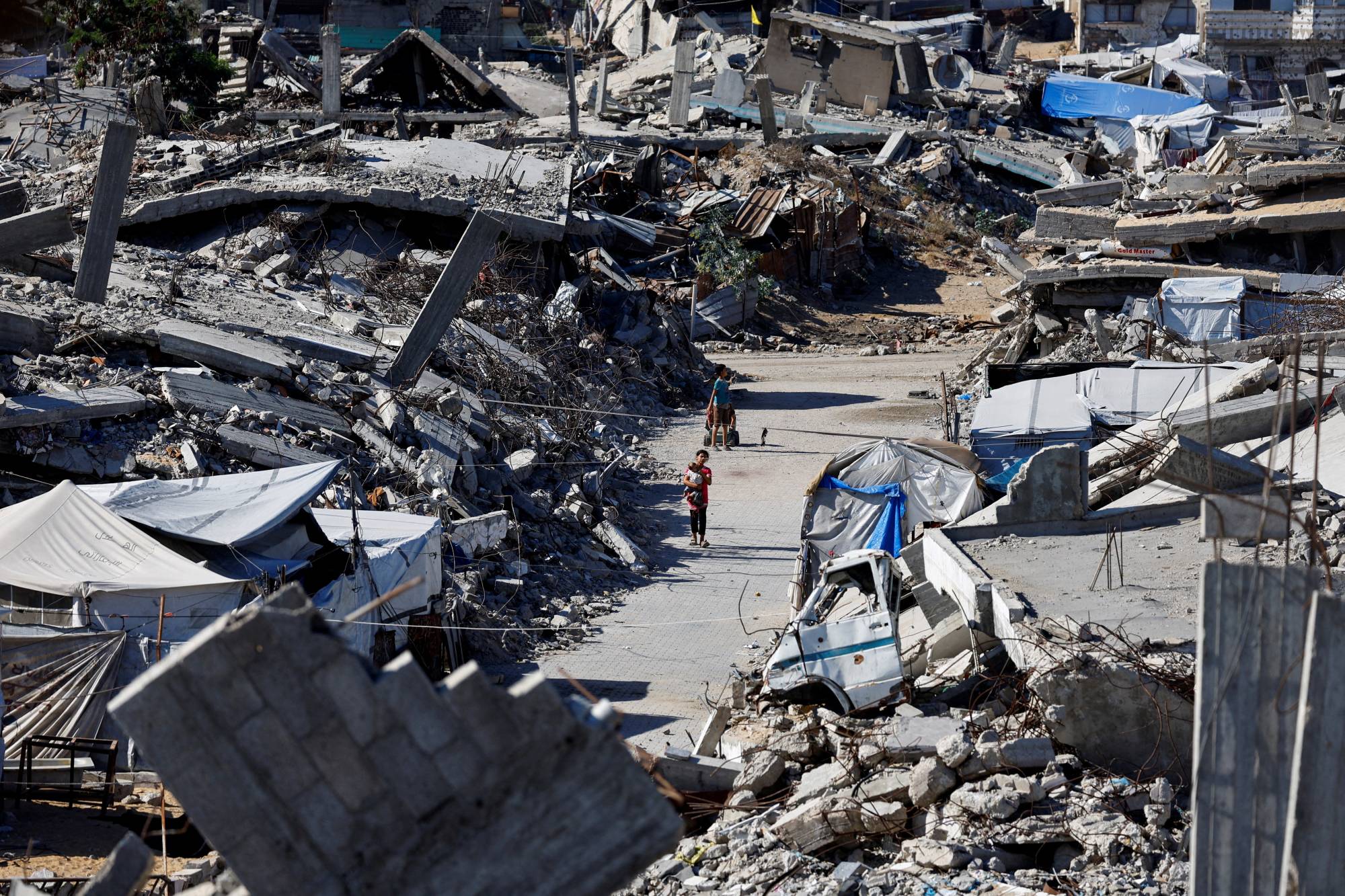
Destroyed buildings are pictured in the Jabalia camp for Palestinian refugees in the northern Gaza Strip on February 8, 2026. (AFP)
TT

Israel Says Killed Hamas Operative Responsible for 2004 Bus Bombings

Destroyed buildings are pictured in the Jabalia camp for Palestinian refugees in the northern Gaza Strip on February 8, 2026. (AFP)

The Israeli military said on Wednesday it killed a senior Hamas operative who had been convicted of orchestrating two bus bombings in 2004 that left 16 civilians dead and dozens more wounded.

The bombings were among the deadliest attacks during the second intifada, the Palestinian uprising of the early 2000s.

In a joint statement, the military and the Shin Bet domestic security agency said their forces killed Bassem Hashem Al-Haymouni in a strike in the Gaza Strip last week.

They described him as "a senior operative" for Hamas who "had been active since 2004" as part of a cell responsible for carrying out deadly attacks in Israel.

They identified him as the mastermind of an August 2004 attack in the southern Israeli city of Beer Sheva, in which suicide bombers blew up two buses.

He "dispatched several suicide bombers to carry out a coordinated attack on two buses in Beer Sheva, in which 16 Israeli civilians were murdered and approximately 100 others were injured", the statement said.

Haymouni was apprehended and sentenced, but was released in 2011 as part of the so-called "Shalit deal", in which Israel freed more than 1,000 Palestinian prisoners in exchange for the release of soldier Gilad Shalit.

Palestinian fighters had seized Shalit in 2006 during a cross-border raid near the Kerem Shalom crossing and held him hostage for five years.

His case became a major national issue in Israel.

The military and Shin Bet statement said that after Haymouni was released, he "resumed recruiting attackers and directing terrorist activity".

It added that the strike on Haymouni was also in response to violations of the ongoing ceasefire in Gaza.

"During the war he was involved in the production and placement of explosive devices intended to harm Israeli troops," it said, referring to the war in Gaza sparked by Hamas's October 7, 2023 attack on Israel.

The US-brokered Gaza ceasefire entered its second phase last month, and foresees a demilitarization of the territory -- including the disarmament of Hamas -- along with a gradual withdrawal of Israeli forces.

Hamas has said that disarmament is a red line, although it has indicated it could consider handing over its weapons to a future Palestinian governing authority.

A Palestinian technocratic committee has been set up with a goal of taking over day-to-day governance in the Strip, but it remains unclear whether, or how, it will address the issue of demilitarization.


Somali President to Asharq Al-Awsat: Working with Saudi-led Partners to Void Israel’s Somaliland Recognition

Prince Mohammed bin Salman, Crown Prince and Prime Minister meets with Somali President Hassan Sheikh Mohamud Makkah. (SPA file)
TT

Somali President to Asharq Al-Awsat: Working with Saudi-led Partners to Void Israel’s Somaliland Recognition

Prince Mohammed bin Salman, Crown Prince and Prime Minister meets with Somali President Hassan Sheikh Mohamud Makkah. (SPA file)

Somali President Hassan Sheikh Mohamud unveiled a three-pronged political and legal strategy to nullify what he described as Israeli recognition of the breakaway region of Somaliland, warning that such a move threatens Somalia’s sovereignty and regional stability.

Speaking to Asharq Al-Awsat, Mohamud said his government is acting in close coordination with partners led by Saudi Arabia to safeguard stability and shield the Horn of Africa from what he called “reckless escalation.”

Without naming specific countries, the Somali leader said some regional states may see the Israeli recognition as an opportunity to pursue “narrow, short-term interests at the expense of Somalia’s unity and regional stability.”

“I do not wish to name any particular country or countries,” he said. “But it is clear that some may view this recognition as a chance to achieve limited gains.”

He stressed that Somalia’s unity is a “red line,” adding that Mogadishu has taken firm positions to protect national sovereignty. “We warn against being misled by reckless Israeli adventurism,” he said.

Three parallel steps

Mohamud was referring to recognition announced by Israeli Prime Minister Benjamin Netanyahu of the self-declared Republic of Somaliland as an independent state.

“I affirm with the utmost clarity and firmness that any recognition of Somaliland as an independent state constitutes a blatant violation of the sovereignty and unity of the Federal Republic of Somalia,” he said.

He described the move as a grave breach of international law, the UN Charter, and African Union resolutions that uphold respect for inherited African borders.

On that basis, Somalia has adopted and will continue to pursue three parallel measures, he revealed.

The first involves immediate diplomatic action through the UN, African Union, and Organization of Islamic Cooperation to reject and legally and politically invalidate the recognition.

Mohamud said Somalia called for and secured a formal session at the UN Security Council to address what he termed a “flagrant Israeli violation” of Somalia’s sovereignty and territorial integrity.

The session, he said, marked a significant diplomatic victory for Mogadishu, particularly given Somalia’s current membership on the council.

He expressed “deep appreciation” for statements of solidarity and condemnation issued by the African Union, Arab League, OIC, Gulf Cooperation Council, Intergovernmental Authority on Development (IGAD), and the EU, among others.

The second step centers on coordinating a unified Arab, Islamic, and African position. Mohamud praised Saudi Arabia for being among the first to issue a clear statement rejecting any infringement on Somalia’s unity.

He said the Saudi position reflects the Kingdom’s longstanding commitment to state sovereignty and territorial integrity, reinforced by the Saudi cabinet’s “firm and principled” support for Somalia during what he described as a delicate moment.

The third step focuses on strengthening internal national dialogue to address political issues within the framework of a single Somali state, free from external interference or dictates.

Regional security

Mohamud warned that if left unchecked, the recognition could set a “dangerous precedent and undermine regional and international peace and security.”

He said it could embolden separatist movements not only in the Horn of Africa but across Africa and the Arab world, citing developments in countries such as Sudan and Yemen as evidence of the high cost of state fragmentation.

“This concerns a vital global shipping artery and core Arab national security,” he said, referring to the Red Sea.

“Any political or security tension along Somalia’s coast will directly affect international trade and energy security.”

He added that instability would impact Red Sea littoral states, particularly Saudi Arabia, Egypt, Sudan, Eritrea, Yemen, and Jordan. “Preserving Somalia’s unity is a cornerstone of collective Red Sea security,” he said.

Strategic foothold

Mohamud argued that Israel’s objective goes beyond political recognition.

“We believe the goal extends beyond a political gesture,” he told Asharq Al-Awsat. “It includes seeking a strategic foothold in the Horn of Africa near the Red Sea, enabling influence over the Bab al-Mandeb Strait and threatening the national security of Red Sea states.”

He described the move as a test of Somali, Arab, and African resolve on issues of sovereignty and territorial unity, emphasizing that Somalia’s opposition to secession is a principled and enduring national stance supported widely in the Arab and African worlds, “foremost by Saudi Arabia.”

He rejected any attempt to turn Somalia into a battleground for regional or international rivalries. “We will not allow Somalia to become an arena for settling conflicts that do not serve our people’s interests or our region’s security,” he declared.

Saudi ties

Regarding Saudi-Somali relations, Mohamud described the partnership as “deep-rooted and strategic, rooted in shared history, religion, and a common destiny.” Saudi Arabia, he said, “remains a central partner in supporting Somalia’s stability, reconstruction, development, and Red Sea security.”

He voiced admiration for Saudi Arabia’s Vision 2030 and the economic and development gains achieved under the leadership of Custodian of the Two Holy Mosques King Salman bin Abdulaziz and Prince Mohammed bin Salman, Crown Prince and Prime Minister.

Asked about the recent Saudi Cabinet decision rejecting any attempt to divide Somalia, Mohamud said the federal government received it with “great appreciation and relief.”

He said the position extends the Kingdom’s historic support for Somalia’s territorial unity and sovereignty, reinforces regional stability, and sends an important message to the international community on the need to respect state sovereignty and refrain from interference in internal affairs.


RSF Drone Strike on Mosque Kills 2 Children in Sudan’s Kordofan Region

Displaced Sudanese gather near a food distribution point at the Abu al-Naga displacement camp in the Gedaref State, some 420km east of the capital Khartoum on February 6, 2026. (AFP)
TT

RSF Drone Strike on Mosque Kills 2 Children in Sudan’s Kordofan Region

Displaced Sudanese gather near a food distribution point at the Abu al-Naga displacement camp in the Gedaref State, some 420km east of the capital Khartoum on February 6, 2026. (AFP)

A drone strike at a mosque killed two children and injured 13 others in Sudan ’s central region of Kordofan early Wednesday, a local doctors group said, as the country's civil war continues. 

The Sudan Doctors Network, which monitors the conflict, said the paramilitary Rapid Support Forces, which are fighting the army, carried out the strike in al-Rahad city in North Kordofan. 

Network spokesperson Mohamed Elsheikh told The Associated Press that the children had been attending a Quran lesson at dawn. 

Targeting children inside mosques "represents a dangerous escalation in the pattern of repeated violations against civilians,” the network added. 

There was no immediate RSF comment. 

The war between the RSF and the military began in 2023, when tensions erupted between the two former allies that were meant to oversee a democratic transition after a 2019 uprising. The World Health Organization says the fighting has killed at least 40,000 people and displaced 12 million. 

Aid groups say the true death toll could be many times higher, as the fighting in vast and remote areas impedes access. 

The Sudan Doctors Network called attacks on places of worship part of a “systematic pattern” that undermines the sanctity of religious sites. 

More than 15 mosques have been damaged, burned or bombed partially or completely and over 165 churches have been destroyed or closed throughout the war, according to figures reported last year. 

Drone attacks have been common. 

On Saturday, a drone attack by the RSF hit a vehicle carrying displaced families in central Sudan, killing at least 24 people, including eight children, according to the Sudan Doctors Network. 

The United Nations High Commissioner for Human Rights has said the Kordofan region remains “volatile and a focus of hostilities” as the warring parties vie for control of strategic areas.
