In Japan Grand Prix town, Artist Hopes F1 can Revive Ancient Craft

Formula One paper model made with Ise Katagami by Kenji Tanaka is pictured at his house in Suzuka, Japan March 27, 2024. REUTERS/Irene Wang Purchase Licensing Rights
TT

In Japan Grand Prix town, Artist Hopes F1 can Revive Ancient Craft

Formula One paper model made with Ise Katagami by Kenji Tanaka is pictured at his house in Suzuka, Japan March 27, 2024. REUTERS/Irene Wang Purchase Licensing Rights

Across town from Japan's Suzuka Circuit, host to this week's Grand Prix, Kenji Tanaka has been perfecting his latest Formula One paper model that he hopes will draw international interest to a centuries-old craft.

Born in the town of Suzuka, where the racing event was first held in 1987, Tanaka has for the last nine years been making intricate models of cars, steering wheels and trophies, and giving some of them to drivers.

He uses a method of paper stencilling called Ise Katagami that began in the region more than 1,000 years ago as a way to print elaborate patterns on kimonos, the national dress of Japan.

New technology and waning demand for kimonos mean the few craftsmen who practise the traditional methods are seeking new ways to promote the art form, Reuters reported.

"I always go to see F1 every year. In 2015 I wanted to carve portraits into Ise Katagami and give them to F1 drivers as gifts. That’s how I started it," said Tanaka from his home, a few kilometres from the famous track.

Some of his artwork and a picture of former world champion Sebastian Vettel clutching one of his model trophies are on display in the town hall. This year, he plans to give a model steering wheel to Alpine driver Esteban Ocon.

Other local craftsmen have been trying different ways to promote Ise Katagami, such as making patterned light fittings.

"While we value the technique itself, we also need to think of new ways to use it, otherwise it will not survive," said Mitsuru Kobayashi, head of the Ise Katagami Cooperative Association.


Just Days Before Cesar Awards, French Movie Stars Warn AI Plundering Industry

An expressive image of the debate between French cinema industry and AI (Shutterstock)
TT

Just Days Before Cesar Awards, French Movie Stars Warn AI Plundering Industry

An expressive image of the debate between French cinema industry and AI (Shutterstock)

Just days before France’s version of the Oscars, thousands of French actors and filmmakers have warned that AI tools are “plundering” talent across the industry.

“We are facing a profound upheaval in our profession with the arrival of artificial intelligence,” said the op-ed in Le Parisien, which was signed by some 4,000 artists.

The petition stated that the industry has already been struggling with unauthorized voice cloning, image scraping and undervalued AI licensing deals for some time.

Signatories included many French movie stars, such as Berenice Bejo, Léa Drucker, Swann Arlaud, José Garcia, Karin Viard, Franck Dubosc and Elodie Bouchez.

The op-ed, released ahead of the 51st edition of the French film industry’s Cesar Awards, warned of the rise of “unauthorized voice cloning,” which has taken the industry by storm.

“This tool, extraordinarily valuable for certain professions, is also a devouring hydra for the artists that we are,” the op-ed said, adding that “Not a week goes by without an artist sounding the alarm over the brutal competition AI is inflicting on their work.”

It stated that just recently, “an actor was offered a contract to use his image by AI for the creation of a new commercial for a major French group, simply replacing two days of filming. A Faustian pact... paid 250 euros!”

The op-ed also pointed to the hundreds of lesser-established actors, often lacking leverage, and who feel pressured to sign contracts granting AI rights, “despite the risks to their image and their future.”

As such, French actors said they demand “guarantees that no artist will be forced to give up their digital identity.”

“This organized plundering is not hypothetical — it’s happening here and now. It’s intolerable, and it’s taking place before our very eyes.” The artists called for a clear “legal framework” so that AI can “coexist with artistic work, with the protection of copyright and related rights.”

In recent months, the industry has introduced various initiatives to tackle the threat posed by AI and the flood of content replicating artists and their voices almost perfectly.

In January, eight French voice actors sent formal notices to two US companies that had cloned their voices without consent. Actors have also taken to the streets of Paris under the slogan “Touche pas à ma VF” (Hands off my French dub).

The debate goes far beyond France. Last week, Hollywood heavyweights accused the Chinese software Seedance 2.0, built by TikTok owner ByteDance, of copyright infringement after AI-generated videos, including of Tom Cruise brawling with Brad Pitt, went viral.


Two Holy Mosques Exhibition Welcomes Visitors for Founding Day Celebrations

The exhibition is open daily from 10:00 a.m. to 1:30 a.m - SPA
TT

Two Holy Mosques Exhibition Welcomes Visitors for Founding Day Celebrations

The exhibition is open daily from 10:00 a.m. to 1:30 a.m - SPA

In celebration of the Kingdom’s Founding Day, the Exhibition of the Two Holy Mosques Architecture in Makkah is welcoming visitors to explore a comprehensive historical journey.

The exhibition presents the evolution of the Two Holy Mosques through rare artifacts, historical photographs, and documentation of successive Saudi expansions, according to SPA.

The halls highlight the Kingdom’s long-standing dedication to serving the Two Holy Mosques. They combine heritage and modern technology to present the architectural development of Islam’s holiest sites.

The exhibition is open daily from 10:00 a.m. to 1:30 a.m.


Photos Show Filming of Ramadan TV Drama Series on the War-scarred Streets of Syria's Aleppo

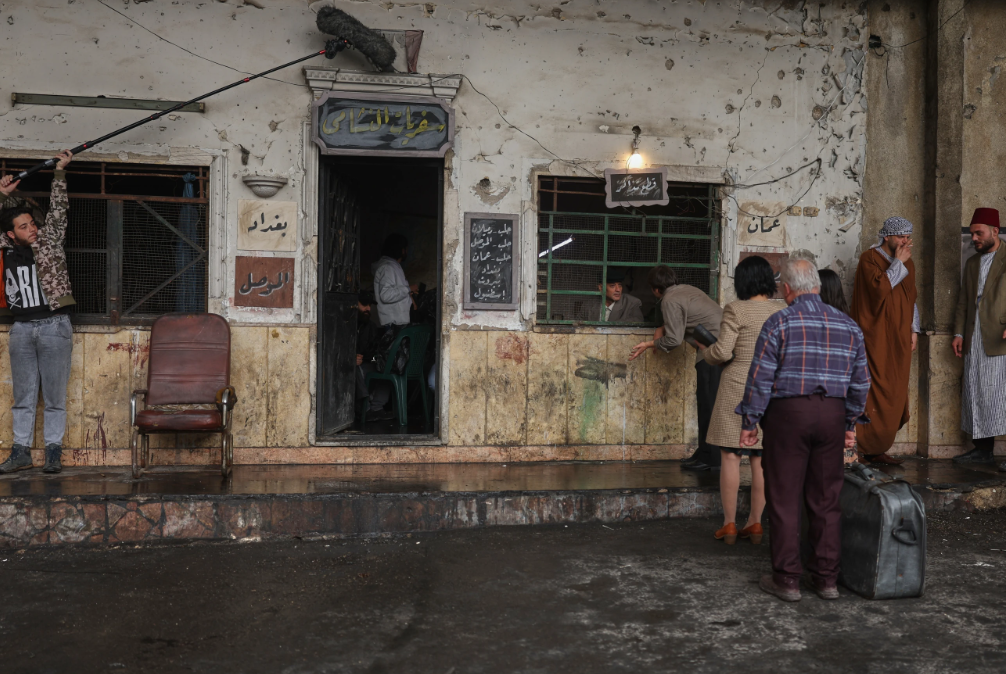
Extras stand by as a television crew films an episode of the TV series “Al-Souriyoun al-Aada” (“The Syrian Enemies”), based on a novel of the same name that was banned under Bashar Assad, along a transformed street in central Aleppo, Syria, Friday, Feb. 13, 2026. (AP Photo/Ghaith Alsayed)
TT

Photos Show Filming of Ramadan TV Drama Series on the War-scarred Streets of Syria's Aleppo

Extras stand by as a television crew films an episode of the TV series “Al-Souriyoun al-Aada” (“The Syrian Enemies”), based on a novel of the same name that was banned under Bashar Assad, along a transformed street in central Aleppo, Syria, Friday, Feb. 13, 2026. (AP Photo/Ghaith Alsayed)

Ramadan in the Arab world is a month of fasting and prayer by day — and television by night. For decades, families have gathered after the iftar, the evening meal that breaks the daytime fast, to follow the season’s highly anticipated drama series, produced specially to air during the Islamic holy month.

In the week before Ramadan, a television crew in central Aleppo was busy preparing one of those productions, with a battered street in the historic city transformed into a scene from decades past.

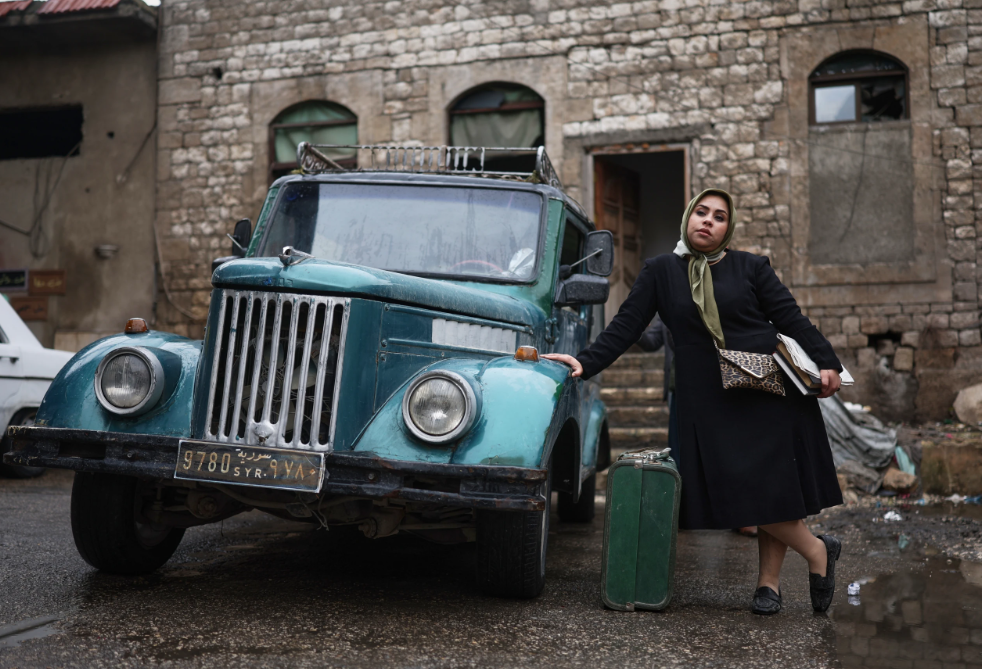
Lamees Al-Ali, an extra in the series, poses for a photograph during the filming of an episode of the TV series “Al-Souriyoun al-Aada” (“The Syrian Enemies”), based on a novel of the same name that was banned under Bashar Assad, along a transformed street in central Aleppo, Syria, Friday, Feb. 13, 2026. (AP Photo/Ghaith Alsayed)

Classic 1970s cars lined the curb. A horse-drawn cart rolled through the frame. A vendor in a red tarboush, a brimless cone-shaped hat, stood beside steaming pots of sahlep — a sweet, thickened milk drink flavored with spices and associated with winter evenings.

Just outside the camera’s view stood a stark reminder of Syria's more recent history. Collapsed buildings and damaged facades testified to Aleppo’s role as a major battleground during the country's civil war. However, with costumes, props and careful framing, the production temporarily carried the street back to what it portrays as a more innocent era, according to The AP news.

A television crew films an episode of the TV series “Al-Souriyoun al-Aada” (“The Syrian Enemies”), based on a novel of the same name that was banned under Bashar Assad, along a transformed street in central Aleppo, Syria, Friday, Feb. 13, 2026.(AP Photo/Ghaith Alsayed)

The series being filmed — “Al-Souriyoun al-Aada,” or “The Syrian Enemies” — is based on a novel that was banned during the rule of former President Bashar Assad. The story examines painful chapters of Syria’s past, including the 1982 events in Hama, when government forces crushed an uprising led by the Muslim Brotherhood, killing or disappearing an estimated 10,000 to 40,000 people and leaving the city in ruins.

As filming continues into Ramadan, the production reflects both a cherished seasonal tradition and Syria’s complex, layered history.