Saudi Film Commission Set to Participate in the Shanghai International Film Festival 2024

Saudi Film Commission Set to Participate in the Shanghai International Film Festival 2024
TT

Saudi Film Commission Set to Participate in the Shanghai International Film Festival 2024

Saudi Film Commission Set to Participate in the Shanghai International Film Festival 2024

The Saudi Film Commission (SFC) has announced its participation in the Shanghai International Film Festival 2024, taking place from June 13 to 22 in Shanghai, China. Established in October 1993, the festival has been a cornerstone in the global film industry and is the only Chinese film festival accredited by the International Federation of Film Producers Associations (FIAPF), SPA reported.
SFC’s participation is a strategic move to establish the Kingdom as a global cinematic hub. The Commission aims to enhance the international presence and representation of the Saudi film industry while promoting the vast potential of Saudi filmmaking. At the festival, SFC will feature a pavilion showcasing its vision, goals, and strategies for sector development, highlighting the remarkable capabilities of the Saudi film industry, offering support and resources for potential investors, and raising awareness of the Kingdom’s cinematic achievements. This initiative fosters cultural exchange and cooperation. Additionally, the Red Sea Film Foundation, a private sector partner in the film industry, will also participate in the Saudi pavilion.
The festival is renowned for its diverse array of film screenings, workshops, and professional training sessions. It also hosts numerous industry discussions, connecting artists from around the world to celebrate the art of cinema and exchange invaluable experiences. Among its highlights, the festival will premiere several new films, adding to its vibrant lineup of events.
Saudi Arabia’s participation in the Shanghai International Film Festival represents an opportunity to solidify its presence on the global cinematic map. This engagement aligns with the significant renaissance in the Chinese film industry, underscoring the Kingdom’s ambition to become a leading cinematic destination. By interacting and collaborating with major creative centers, the Kingdom aims to enhance cultural and artistic communication with China, positively impacting the development of its film industry and expanding its horizons both locally and internationally.



Warsaw’s Celebrity Birds on Perilous Urban Quest

 A common merganser (Mergus merganser) mother nicknamed Janina leads her ducklings from Lazienkowski Park in central Warsaw towards the Vistula River under the watchful eyes of volunteers and city parks department employees on April 28, 2026 in Warsaw, Poland. (AFP)
A common merganser (Mergus merganser) mother nicknamed Janina leads her ducklings from Lazienkowski Park in central Warsaw towards the Vistula River under the watchful eyes of volunteers and city parks department employees on April 28, 2026 in Warsaw, Poland. (AFP)
TT

Warsaw’s Celebrity Birds on Perilous Urban Quest

 A common merganser (Mergus merganser) mother nicknamed Janina leads her ducklings from Lazienkowski Park in central Warsaw towards the Vistula River under the watchful eyes of volunteers and city parks department employees on April 28, 2026 in Warsaw, Poland. (AFP)
A common merganser (Mergus merganser) mother nicknamed Janina leads her ducklings from Lazienkowski Park in central Warsaw towards the Vistula River under the watchful eyes of volunteers and city parks department employees on April 28, 2026 in Warsaw, Poland. (AFP)

Waddling across a Warsaw expressway, a brood of wild sea ducks brought traffic to a halt as volunteers held motorists at bay -- an annual ritual to protect the bustling Polish capital's famous ducklings.

Every spring, dozens of days-old ducklings must make the risky trek from a centrally located park where they hatch to the Vistula river.

Local volunteers are mobilized to help ensure their safe passage, scrambling in hi-vis vests to stop cars and shepherd the birds across one of Warsaw's busiest roads.

Waddling through the city of 1.8 million people, the groups of mergansers -- fish-eating sea ducks -- are led by their silver-feathered mothers, with their distinctive brown head crests.

"We call mergansers ambassadors of Warsaw's wildlife -- or our celebrities," said Barbara Rozalska from the city parks department.

She was speaking over the rumble of the six-lane expressway -- "one of the biggest threats" for the wild birds on their kilometer-long journey.

Rozalska is in charge of coordinating the volunteers, who, through April and May, monitor the park and tree cavities where ducks lay their eggs and the possible routes they may take towards the river.

Around 30 people -- trained by the city's ornithologist -- take turns to stay alert for any sighting of the mergansers.

"It's a bit like being on call at the accident and emergency department -- you get a call and you have to go, no matter if it's at dawn or in the afternoon," Rozalska told AFP.

The array of threats is not limited to road traffic.

"There are seagulls and crows, which can snatch a chick that gets away from its mother for a moment. There are also predatory fish that can drag a chick underwater," she said.

- No honking -

One of the first merganser mums to cross this season took almost 24 hours to make it from the park to the river, testing the patience of the volunteers monitoring their every step and stumble.

That included the 11 hours the birds spent nestled in the roadside greenery, waiting for their moment.

Daria Grzesiek, 38, on duty, called it a "very difficult day" for her team.

"But once she set off and began making her way towards the Vistula... the fatigue was gone. There was only the satisfaction of having successfully guided her safely along the way," Grzesiek told AFP.

The volunteers' job involves asking passersby to keep their distance and put their dogs on a leash.

They also take on the task of explaining to drivers why the traffic needs to be stopped -- normally only for a few minutes.

As their efforts have gained traction and the birds have shot to local fame, there is more understanding among those sat behind the wheel, Grzesiek said.

One person, she recounted, "was getting upset that we stopped traffic".

But "the other drivers simply explained to him that he should calm down -- because mergansers are coming".


Robot Recovers Artifacts From 500-Year-Old Shipwreck

This photograph shows a screen displaying live footage of the CAMARA 4 wreck and its cargo, transmitted by the “ROV C 4000”, a remotely operated vehicle manufactured by the French company LD Travocean and designed for seabed exploration, during an archaeological mission on the CAMARA 4 wreck from the bridge of the (BSAA) Jason, off the coast of Ramatuel, in southeastern France on April 7, 2026.  (Photo by Thibaud MORITZ / AFP)
This photograph shows a screen displaying live footage of the CAMARA 4 wreck and its cargo, transmitted by the “ROV C 4000”, a remotely operated vehicle manufactured by the French company LD Travocean and designed for seabed exploration, during an archaeological mission on the CAMARA 4 wreck from the bridge of the (BSAA) Jason, off the coast of Ramatuel, in southeastern France on April 7, 2026. (Photo by Thibaud MORITZ / AFP)
TT

Robot Recovers Artifacts From 500-Year-Old Shipwreck

This photograph shows a screen displaying live footage of the CAMARA 4 wreck and its cargo, transmitted by the “ROV C 4000”, a remotely operated vehicle manufactured by the French company LD Travocean and designed for seabed exploration, during an archaeological mission on the CAMARA 4 wreck from the bridge of the (BSAA) Jason, off the coast of Ramatuel, in southeastern France on April 7, 2026.  (Photo by Thibaud MORITZ / AFP)
This photograph shows a screen displaying live footage of the CAMARA 4 wreck and its cargo, transmitted by the “ROV C 4000”, a remotely operated vehicle manufactured by the French company LD Travocean and designed for seabed exploration, during an archaeological mission on the CAMARA 4 wreck from the bridge of the (BSAA) Jason, off the coast of Ramatuel, in southeastern France on April 7, 2026. (Photo by Thibaud MORITZ / AFP)

Deep in the Mediterranean Sea off the French coast, the pincer of a remotely guided underwater robot closed around a centuries-old jug resting near the wreck of a 16th-century merchant ship.

A French navy officer identified only as Sebastien, who did not disclose his full identity for security reasons, said handling the site requires extreme precision to avoid damaging the wreck or stirring up sediment that could impair visibility.

According to CBS News, Sebastien is overseeing the first mission in a series of archaeological explorations at what is considered the deepest shipwreck in French territorial waters, located about two hours from the French Riviera.

The shipwreck was discovered by chance last year during a routine military seabed survey off Ramatuelle, near Saint-Tropez. Archaeologists believe the vessel was sailing from northern Italy, carrying ceramics and metal ingots, before sinking.

The French navy has now returned, in cooperation with the culture ministry’s underwater archaeology department, to examine artifacts preserved at a depth of more than 1.5 miles below the surface.

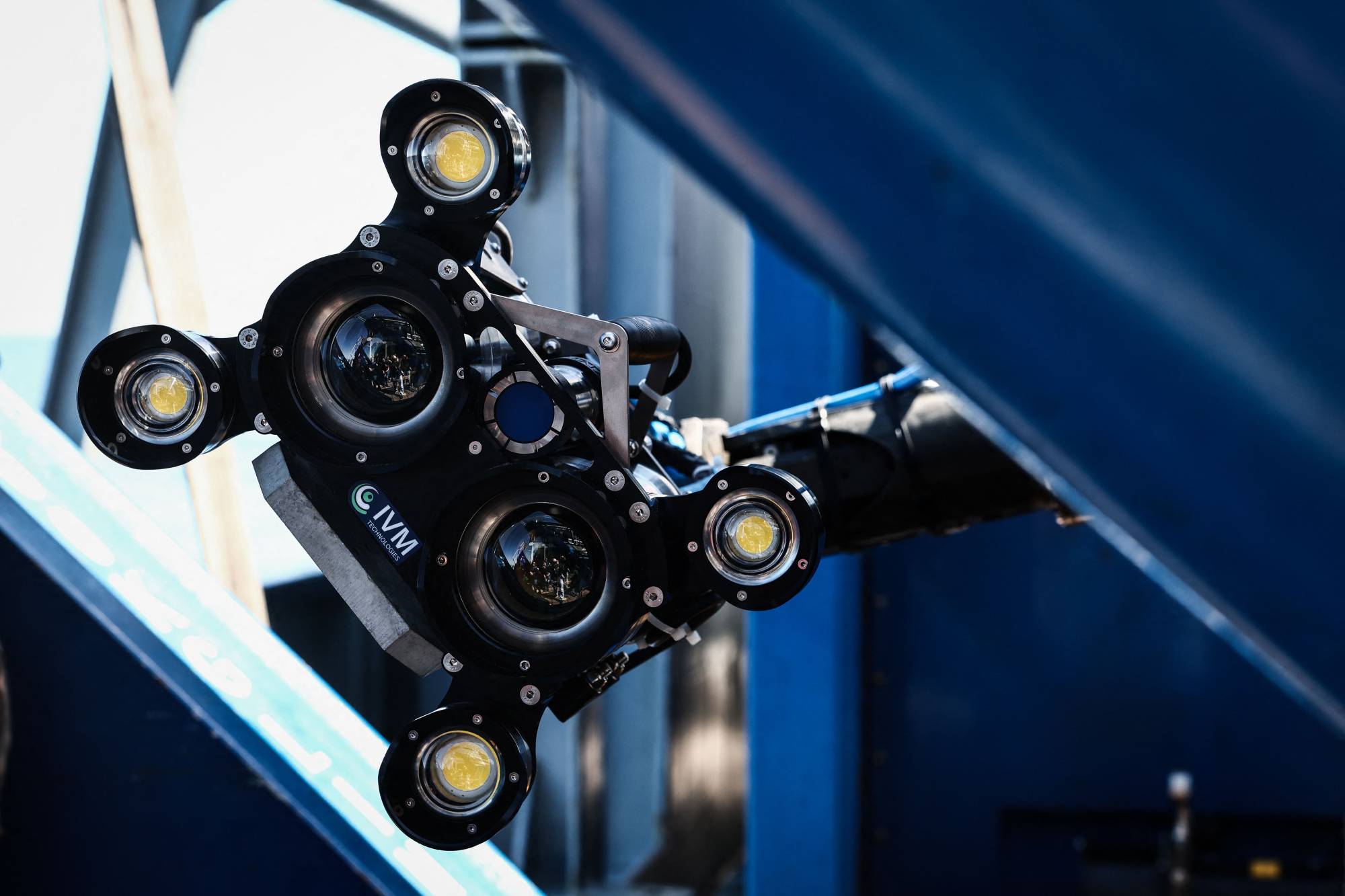
This photograph shows an underwater stereoscopic photogrammetry camera on the articulated arm of the “ROV C 4000,” a remotely operated vehicle manufactured by the French company LD Travocean and designed for seabed exploration, on the deck of the (BSAA) Jason, chartered for an archaeological mission on the wreck of the CAMARA 4 off the coast of Ramatuel, in southeastern France on April 7, 2026. (Photo by Thibaud MORITZ / AFP)

Cannons and Ceramic Jugs on the Seabed

The navy is keeping the wreck’s location confidential, referring to it as “Camarat 4,” despite the fact that reaching it requires advanced technical capabilities due to its depth.

At dawn, a mission vessel arrived at the site carrying a remotely operated underwater robot, along with two large containers serving as field laboratories for marine archaeologists.

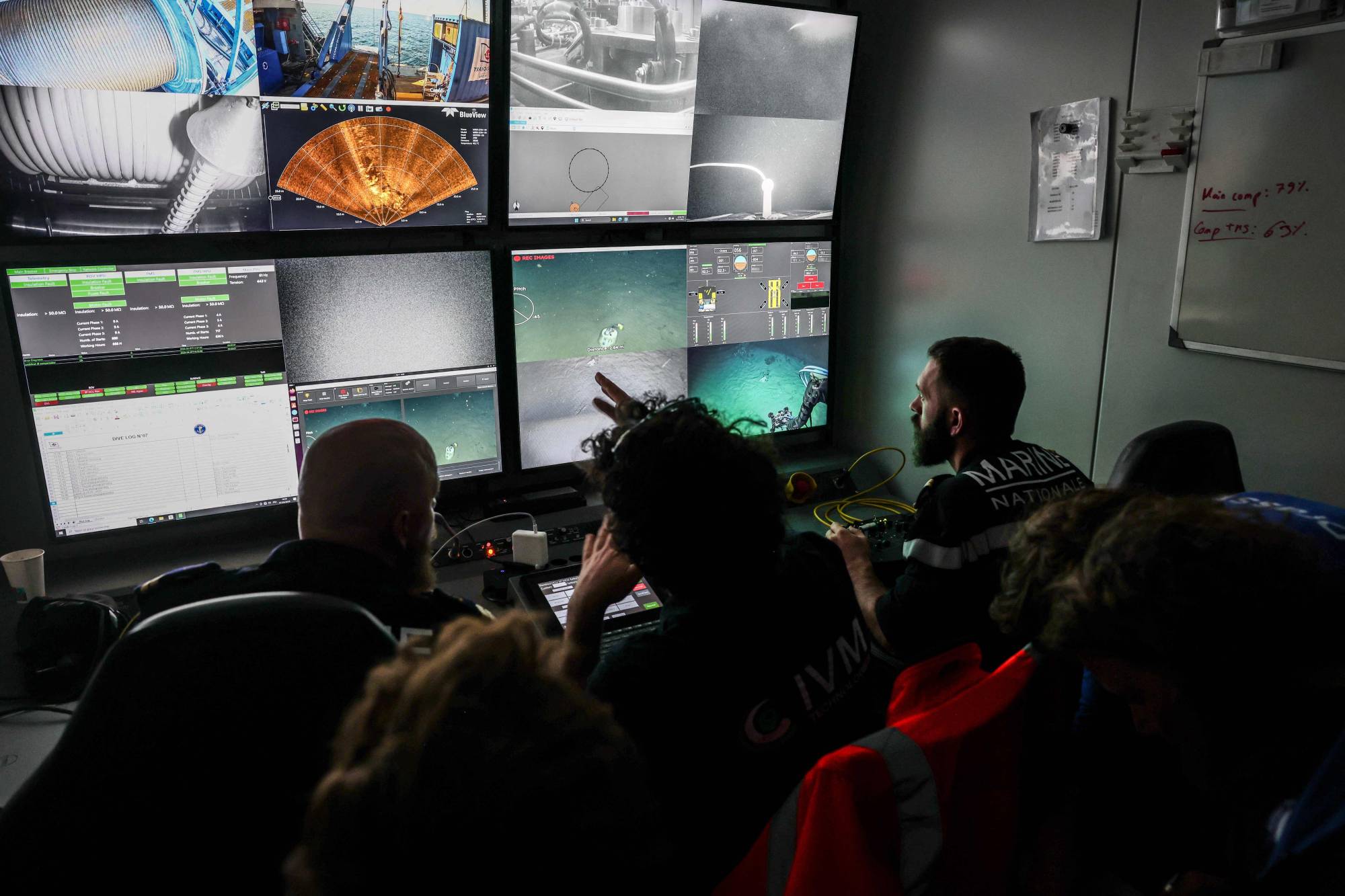
The robot, equipped with cameras and claw-like arms, was lowered into the depths via a long cable, while experts monitored its movements on screens.

After about an hour, it began gliding over piles of rounded ceramic jugs scattered across the seabed.

Images transmitted to the surface revealed details of the wreck, including cannons alongside hundreds of jugs and plates decorated with plant motifs, crosses and fish shapes.

The robot captured eight images per second over three hours, enabling the collection of more than 86,000 images, later used to produce a precise three-dimensional model of the site.

Archaeologist Franca Cibecchini said the clarity at that depth was striking: “It was excellent, something you wouldn’t imagine at this depth.” She added that the ship was likely a merchant vessel carrying glazed ceramics from Liguria in northwestern Italy, possibly loaded in the ports of Genoa or Savona.

Earlier surveys had identified two cauldrons, an anchor and six cannons at the site, along with modern debris such as a drinks can and an empty yogurt container visible near the anchor.

Pilots specializing in underwater robots from the French Navy, along with researchers, watch live feeds on screens showing the “ROV C 4000,” a remotely operated vehicle manufactured by the French company LD Travocean and designed for seabed exploration, during an archaeological mission on the wreck of the CAMARA 4 from the bridge of the (BSAA) Jason, off the coast of Ramatuel, in southeastern France, April 7, 2026. (Photo by Thibaud MORITZ / AFP)

Recovering One of the Deepest Finds

Marine Sadania, head of the excavation team, said the findings represent an important source for understanding 16th-century maritime trade, given the limited detailed historical records available.

During the recovery operation, the team carefully guided the robot as it lowered its arm to gently lift a crate, although one ceramic piece broke during the process.

Several jugs and plates were successfully retrieved and later examined in laboratories in Marseille, where initial analysis revealed dark blue lines and multicolored geometric patterns.

Sadania said these items are among the deepest artifacts ever recovered from a shipwreck in France.

The discovery follows the 2019 identification of the submarine La Minerve off Toulon at a depth of about 1.4 miles. The vessel sank in 1968 with 52 sailors aboard.

In a separate development, officials announced the discovery of another 16th-century shipwreck found during military exercises off Sweden’s coast.


US Company Aims to Resurrect Bluebuck Antelope that was Hunted to Extinction

An artist's rendering of the extinct African antelope species called the Bluebuck, released on April 30, 2026. Colossal Biosciences/Handout via REUTERS
TT

US Company Aims to Resurrect Bluebuck Antelope that was Hunted to Extinction

An artist's rendering of the extinct African antelope species called the Bluebuck, released on April 30, 2026. Colossal Biosciences/Handout via REUTERS

The bluebuck, an antelope with a silvery slate-blue coat and striking horns, inhabited the coastal grasslands of South Africa's southwestern Cape region until European settlers hunted it to extinction in around 1800. A US company now plans to resurrect the bluebuck as part of its de-extinction efforts.

Dallas-based Colossal Biosciences announced on Thursday that it has made the bluebuck the sixth species in its de-extinction portfolio based on genetic engineering, alongside three other mammals - the dire wolf, woolly mammoth and thylacine, also called the Tasmanian tiger - and two birds, the dodo and moa, Reuters reported.

"We're two years into the bluebuck project and have already completed several foundational steps," Colossal CEO and co-founder Ben Lamm told Reuters. "We are equally excited about how our technology can help living antelopes today. About a third of the world's roughly 90 antelope species are threatened or near-threatened."

Prized for the unique color of their hides, bluebuck were hunted to extinction just 34 years after the species was first documented scientifically. The animal stood about four feet (1.2 meters) tall at the shoulder, with backward-curving and ringed black horns reaching about 22 inches (56.5 cm) long, and was smaller than the closely related roan and sable antelopes.

"Humans did this. European settlers shot the bluebuck out of the Cape in under 34 years. There's no ambiguity about the cause and there's no ambiguity about the responsibility. If we have the capability to right that wrong, I think we have an obligation to," Lamm said.

The company in April 2025 announced the birth of three genetically engineered wolf pups created with the help of ancient DNA obtained from fossilized remains of dire wolves, an Ice Age predator that went extinct roughly 13,000 years ago. The process used to create them involved editing the genes of the gray wolf, the closest living relative of the extinct species, to add dire wolf traits, and creating an embryo.

In the case of the bluebuck, Colossal is editing the genes of an African antelope called the roan, its closest living relative.

"We are now in the genome-editing phase, where we introduce key bluebuck edits and genes into roan antelope cells," Lamm said, adding, "After finishing the various edits, the next step will be to use the edited cells to create an embryo and move toward implantation. From there, gestation would take about nine months."

The plan is for the embryo to be implanted into a surrogate roan mother. Through cloning, embryos were created from edited gray wolf cells in the dire wolf project, and these were implanted in surrogate domesticated dog mothers.

A MUSEUM SPECIMEN

Lamm said the company mainly used a mounted bluebuck skin from a young male specimen at the Swedish Museum of Natural History in Stockholm to obtain bluebuck DNA.

The team compared the bluebuck and roan genomes to understand what made the bluebuck unique, Lamm said, noting that the two species are more than 98% genomically similar. The team has created pluripotent stem cells in roan antelope - "essentially versatile 'starter cells' that can become many different cell types," Lamm said.

"We've also made breakthroughs in reproductive methods, including successfully collecting eggs from antelope species using advanced techniques," Lamm said.

Even as a growing number of species slip into oblivion due to human actions including hunting and habitat destruction, scientists have debated the ethics of attempting to resurrect extinct species.

"Honestly, I think the debate sometimes functions as a way to avoid a harder conversation, which is that conservation as currently practiced is not winning. We are losing species faster than our existing toolkit can address," Lamm said.

Colossal called the wolves it created dire wolves and referred to the species as the world's first successfully "de-extincted" animal. Some outside experts described them as genetically modified gray wolves.

"The dire wolves are doing great," Lamm said.

"The three dire wolves live on a 2,000-acre (810-hectare) secure, expansive ecological preserve that allows us to monitor and manage them while providing them a semi-wild habitat to thrive in. We hope to have more dire wolf pups by the end of the year. We will also have scientific progress announcements around the mammoth, dodo, thylacine and moa before the end of the year, but the projects are all running on track," Lamm said.