

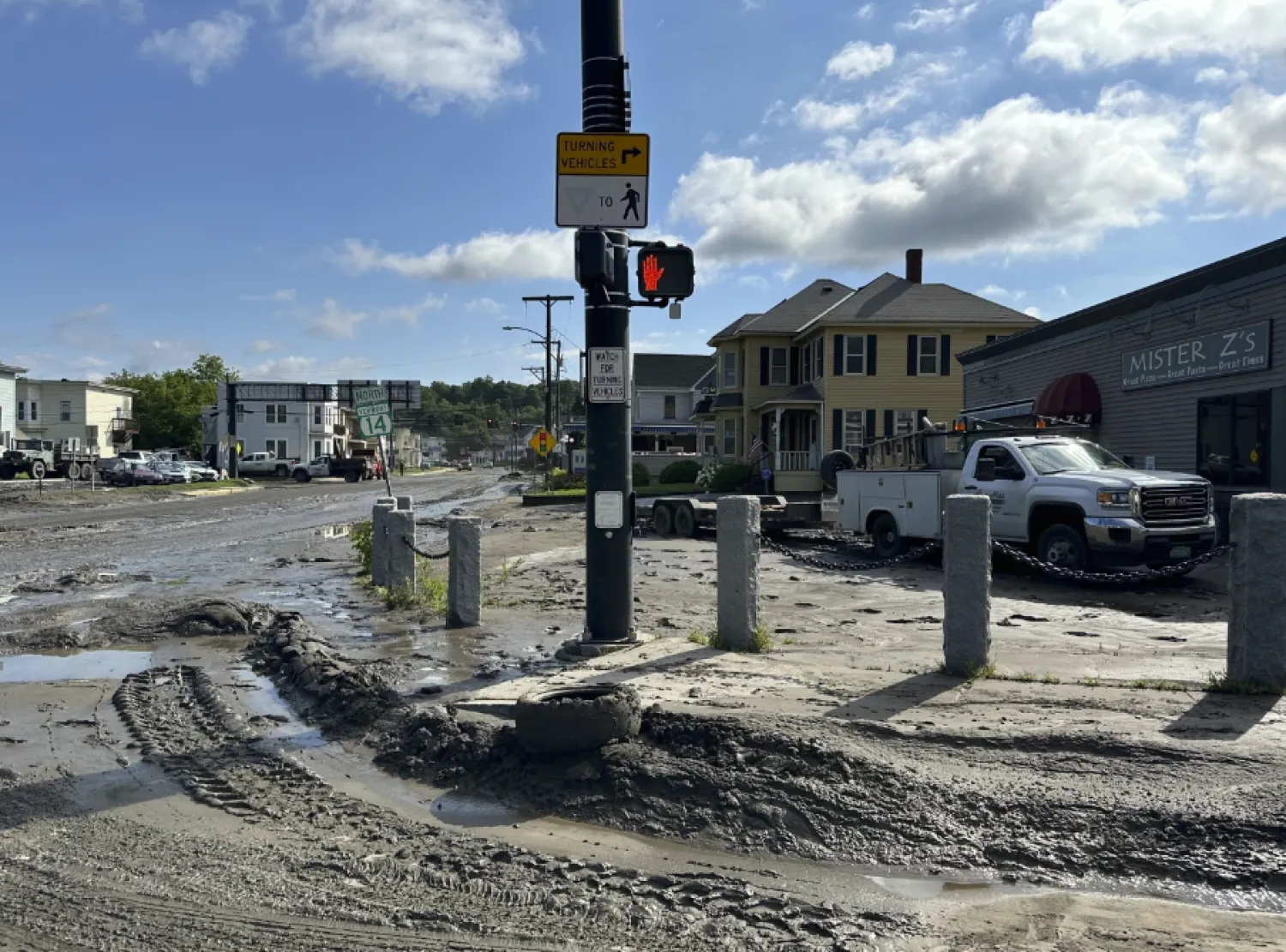

Disaster Revisits Vermont as Beryl’s Remnants Flood the State a Year after Catastrophic Rainfall

In Plainfield, residents of a six-unit apartment building had only 15 minutes to evacuate before the entire structure was swept away by floodwaters - The AP
TT

Disaster Revisits Vermont as Beryl’s Remnants Flood the State a Year after Catastrophic Rainfall

In Plainfield, residents of a six-unit apartment building had only 15 minutes to evacuate before the entire structure was swept away by floodwaters - The AP

The remnants of Hurricane Beryl dumped heavy rain on Vermont, causing flooding that washed away an apartment building, knocked out bridges and cut off towns, and retraumatized a state still recovering from catastrophic flooding that hit a year ago to the day. At least one person died.

Roads were flooded, washed out or covered with debris after heavy rain that started Wednesday and persisted into Thursday. Rescues continued late into the night, and some communities were under evacuation orders, The AP reported.

In Plainfield, residents of a six-unit apartment building had only 15 minutes to evacuate before the entire structure was swept away by floodwaters that also took out at least seven bridges and left many roads impassable and people stranded, said town Emergency Management Director Michael Billingsley. One car was swept away, but the occupant escaped, he said.

“It’s not lost on any of us the irony of the flood falling on the one-year anniversary to the day when many towns were hit last year. I know that only adds to the emotion many are feeling this morning," Gov. Phil Scott told reporters Thursday, adding that the state's “response and tools are only stronger” as a result of the tragedy a year ago.

The death came in the community of Peacham, officials said.

Public Safety Commissioner Jennifer Morrison urged people to continue to take precautions and stay out of the water, even as temperatures rise and make it temping to take a dip. “Regardless of river levels, our waterways are not safe right now. Currents are fast and there is a tremendous amount of flood debris in the water,” she said.

The deluge dropped more than 6 inches (15 centimeters) of rain on parts of Vermont, and the heaviest rainfall was in areas hit hard a year ago, said Marlon Verasamy, of the National Weather Service in Burlington. But the damage was not as widespread across the entire state as it was a year ago, he said.

Hilary Conant, who fled her second-floor Plainfield apartment, said she also had to flee rising waters a year ago.

“The water was coming up, so I knew it was time to leave with my dog. It’s very retraumatizing,” she said. A neighbor offered a camper to temporarily house her.

Art Edelstein assessed the destruction Thursday morning around a home he has owned for 50 years and now rents to tenants.

“I don’t even know how much water came from where because it’s just mud everywhere,” he said. "This is, in my impression, catastrophic. I’ve just never seen anything like this.”

In the small community of Moretown, the damage appeared worse than it was a year ago, and the school was among buildings once again damaged by floodwaters, said Tom Martin, chair of the town board. Workers hoped to install a temporary bridge Thursday on the main artery that provides access to the community, he said.

“They say we’re Vermont strong. We’ll get through it,” said Martin, his voice full of emotion.

Flash flooding also closed roads in several northern New Hampshire communities, including Monroe, Dalton, Lancaster and Littleton, where officials said 20 people were temporarily stranded at a Walmart store and crews made water rescues.

Two tornadoes were confirmed Wednesday in western New York. Some areas in the northern part of the state got 4 inches (10 centimeters) or more of rain, causing water to rush down streets in the village of Lowville.

Parts of northern New York and New England, including Vermont, remained under flood watches or warnings early Thursday. Thunderstorms associated with Beryl were forecast for much of the East Coast through Friday, the National Weather Service said.

Vermont emergency managers had urged residents Wednesday to seek higher ground if floodwaters approached and said rescue teams and the National Guard were at the ready.

Even though Vermont is not a coastal state, it nonetheless has experience with tropical weather. Tropical Storm Irene dumped 11 inches (28 centimeters) of rain on parts of Vermont in 24 hours in 2011. The storm killed six in the state, washed homes off their foundations, and damaged or destroyed more than 200 bridges and 500 miles of highway.

In May, Vermont became the first state to enact a law requiring fossil fuel companies to pay a share of the damage caused by extreme weather fueled by climate change.

Republican Gov. Phil Scott allowed the bill to become law without his signature, saying he was concerned about the costs of a grueling legal fight. But he acknowledged that he understands something has to be done to address the toll of climate change.

Beryl landed in Texas on Monday as a Category 1 hurricane and left millions in the Houston area without power. It then carved a path across the interior U.S. as a post-tropical cyclone that brought flooding and sometimes tornadoes from the Great Lakes to Canada and northern New England.

Beryl has been blamed for at least seven U.S. deaths — one in Louisiana and six in Texas — and at least 11 in the Caribbean. More than 1.3 million homes and businesses in Texas still lacked electricity early Thursday, down from a peak of over 2.7 million on Monday, according to PowerOutage.us.

The storm has caused at least $3.3 billion in damage in the United States, Mexico and the Caribbean, according to Karen Clark & Co., a Boston-based firm that works with insurance companies to estimate disaster costs.

It calculated a flash estimate Thursday of $2.7 billion in privately insured U.S. losses, along with $510 million in the Caribbean and $90 million in Mexico. The estimate is only for insured properties and does not include homes covered by the U.S. National Flood Insurance Program, so total losses will be higher.


Rocket Re-entry Pollution Measured in Atmosphere for 1st Time

A SpaceX Falcon 9 rocket with the company's Dragon spacecraft on top launches from Space Launch Complex 40 for the Crew-12 mission at Cape Canaveral Space Force Station in Florida on February 13, 2026. (Photo by Jim WATSON / AFP)
TT

Rocket Re-entry Pollution Measured in Atmosphere for 1st Time

A SpaceX Falcon 9 rocket with the company's Dragon spacecraft on top launches from Space Launch Complex 40 for the Crew-12 mission at Cape Canaveral Space Force Station in Florida on February 13, 2026. (Photo by Jim WATSON / AFP)

When part of a SpaceX rocket re-entered Earth's atmosphere exactly a year ago, it created a spectacular fireball that streaked across Europe's skies, delighting stargazers and sending a team of scientists rushing towards their instruments.

The German team managed to measure the pollution the rocket's upper stage emitted in our planet's difficult-to-study upper atmosphere -- the first time this has been achieved, according to a study published on Thursday.

It is vital to learn more about this little-understood form of pollution because of the huge number of satellites that are planned to be launched in the coming years, the scientists emphasized.

In the early hours of February 19, 2025, the upper stage of a Falcon 9 rocket was tumbling back to Earth when it exploded into a fireball that made headlines from the UK to Poland.

"We were excited to try and test our equipment and hopefully measure the debris trail," the team led by Robin Wing and Gerd Baumgarten of the Leibniz Institute of Atmospheric Physics in Germany told AFP via email.

In particular, the scientists wanted to measure how the rocket polluted what they call the "ignorosphere" -- because it is so difficult to study.

This region between 50 to 100 kilometers (31 to 62 miles) above Earth includes the mesosphere and part of the lower thermosphere.

- 'Harbinger' -

The team used technology called LIDAR, which measures pollution in the atmosphere by shooting out lots of laser pulses and seeing which bounce back off something.

They detected a sudden spike in the metal lithium in an area nearly 100 kilometers above Earth. This plume had 10 times more lithium than is normal in this part of the atmosphere.

The team then traced the plume back to where the rocket re-entered the atmosphere, west of Ireland.

For the first time, this proves it is possible to study pollution from re-entering rockets at such heights before it disperses, the scientists said.

But the impact from this rocket pollution remains unknown.

"What we do know is that one ton of emissions at 75 kilometers (altitude) is equivalent to 100,000 tons at the surface," they said.

The study warned the case was a "harbinger" of the pollution to come, given how many rockets will be needed to launch all the satellites that Earth is planning to blast into space.

Currently, there are around 14,000 active satellites orbiting our planet.
In the middle of last month, China applied for permission to launch around 200,000 satellites into orbit.

Then at the end of January, billionaire Elon Musk's SpaceX applied for permission to launch one million more.

Eloise Marais, a professor of atmospheric chemistry at University College London not involved in the new study, told AFP the research was "really important".

"There is currently no suitable regulation targeting pollution input into the upper layers of the atmosphere," she explained.

"Even though these portions of the atmosphere are far from us, they have potentially consequential impacts to life on Earth if the pollutants produced are able to affect Earth's climate and deplete ozone in the layer protecting us from harmful UV radiation."

The study was published in the journal Communications Earth & Environment.


Deep-sea Fish Break the Mold with Novel Visual System

A close-up showing the shiny silver-green photophores (light organs) on the lower head of the deep-sea fish Maurolicus muelleri from the Red Sea, seen in this photograph released on February 11, 2026. Dr. Wen-Sung Chung/Handout via REUTERS
TT

Deep-sea Fish Break the Mold with Novel Visual System

A close-up showing the shiny silver-green photophores (light organs) on the lower head of the deep-sea fish Maurolicus muelleri from the Red Sea, seen in this photograph released on February 11, 2026. Dr. Wen-Sung Chung/Handout via REUTERS

For more than a century, biology textbooks have stated that vision among vertebrates - people included - is built from two clearly defined cell types: rods for processing dim light and cones for bright light and color. New research involving deep-sea fish shows this tidy division is, in reality, not so tidy.

Scientists have identified a new type of visual cell in deep-sea fish that blends the shape and form of rods with the molecular machinery and genes of cones. This hybrid type of cell, adapted for sight in gloomy light conditions, was found in larvae of three deep-sea fish species in the Red Sea, Reuters reported.

The species studied were: a hatchetfish, with the scientific name Maurolicus mucronatus; a lightfish, named Vinciguerria mabahiss; and a lanternfish, named Benthosema pterotum. The hatchetfish retained the hybrid cells throughout its life. The other two shifted to the usual rod-cone dichotomy in adulthood.

All three are small, with adults measuring roughly 1-3 inches (3-7 cm) long and the larvae much littler. They inhabit a marine realm of twilight conditions, with sunlight struggling to penetrate into the watery depths.

The vertebrate retina, a sensory membrane at the back of the eye that detects light and converts it into signals to the brain, possesses two main types of light-sensitive visual cells, called photoreceptors. They are named for their shape: rods and cones.

"The rods and cones slowly change position inside the retina when moving between dim and bright conditions, which is why our eyes take time to adjust when we flick on the light switch on our way to the restroom at night," said Lily Fogg, a postdoctoral researcher in marine biology at the University of Helsinki in Finland and lead author of the research published in the journal Science Advances.

"We found that, as larvae, these deep-sea fish mostly use a mix-and-match type of hybrid photoreceptor. These cells look like rods - long, cylindrical and optimized to catch as many light particles - photons - as possible. But they use the molecular machinery of cones, switching on genes usually found only in cones," Fogg said.

The researchers examined the retinas of fish larvae caught at depths from 65 to 650 feet (20 to 200 meters). In the type of dim environment they inhabit, rod and cone cells both are usually engaged in the vertebrate retina, but neither works very well. These fish display an evolutionary remedy.

"Our results challenge the longstanding idea that rods and cones are two fixed, clearly separated cell types. Instead, we show that photoreceptors can blend structural and molecular features in unexpected ways. This suggests that vertebrate visual systems are more flexible and evolutionarily adaptable than previously thought," Fogg said.

"It is a very cool finding that shows that biology does not fit neatly into boxes," said study senior author Fabio Cortesi, a marine biologist and neuroscientist at the University of Queensland in Australia. "I wouldn't be surprised if we find these cells are much more common across all vertebrates, including terrestrial species."

All three species emit bioluminescence using small light-emitting organs on their bodies, mostly located on the belly. They produce blue-green light that blends with the faint background light from the sun above. This strategy, called counterillumination, is a common form of camouflage in the deep sea to avoid predators.

"Small fish like these fuel the open ocean. They are plentiful and serve as food for many larger predatory fishes, including tuna and marlin, marine mammals such as dolphins and whales, and marine birds," Cortesi said.

These kinds of fish also engage in one of the biggest daily migrations in the animal kingdom. They swim near the surface at night to feed in plankton-rich waters, then return to the depths - 650 to 3,280 feet (200 to 1,000 meters) - during daytime to avoid predation.

"The deep sea remains a frontier for human exploration, a mystery box with the potential for significant discoveries," Cortesi said. "We should look after this habitat with the utmost care to make sure future generations can continue to marvel at its wonders."


Japan City Gets $3.6 Mn Donation in Gold to Fix Water System

FILE PHOTO: Factories line the port of Osaka, western Japan October 23, 2017. REUTERS/Thomas White/File Photo
TT

Japan City Gets $3.6 Mn Donation in Gold to Fix Water System

FILE PHOTO: Factories line the port of Osaka, western Japan October 23, 2017. REUTERS/Thomas White/File Photo

Osaka has received an unusual donation -- 21 kilograms of gold -- to pay for the maintenance of its ageing water system, the Japanese commercial hub announced Thursday.

The donation worth $3.6 million was made in November by a person who a month earlier had already given $3,300 in cash for the municipal waterworks, Osaka Mayor Hideyuki Yokoyama told a press conference.

"It's an absolutely staggering amount," said Yokoyama, adding that he was lost for words to express his gratitude.

"I was shocked."

The donor wished to remain anonymous, AFP quoted the mayor as saying.

Work to replace water pipes in Osaka, a city of 2.8 million residents, has hit a snag as the actual cost exceeded the planned budget, according to local media.
