


Meet America’s Newest Giant Pandas, Yun Chuan and Xin Bao

 Xin Bao the female Panda sits in its enclosure at the San Diego Zoo prior to the opening of the new exhibit Panda Ridge Thursday, Aug. 8, 2024, in San Diego. (AP)
Xin Bao the female Panda sits in its enclosure at the San Diego Zoo prior to the opening of the new exhibit Panda Ridge Thursday, Aug. 8, 2024, in San Diego. (AP)
TT

Meet America’s Newest Giant Pandas, Yun Chuan and Xin Bao

 Xin Bao the female Panda sits in its enclosure at the San Diego Zoo prior to the opening of the new exhibit Panda Ridge Thursday, Aug. 8, 2024, in San Diego. (AP)
Xin Bao the female Panda sits in its enclosure at the San Diego Zoo prior to the opening of the new exhibit Panda Ridge Thursday, Aug. 8, 2024, in San Diego. (AP)

California’s governor flew in for the young bears’ debut. Throngs of media gathered inside the zoo, while the city of San Diego warned of traffic jams ahead of the much-anticipated event Thursday.

The San Diego Zoo rolled out the red carpet for the first public showing of its celebrity residents, who were already dressed in black-and-white attire. The two giant pandas, the first to enter the US in two decades, seemed unfazed by all the attention, sunbathing and chowing down on bamboo in their new home.

For years, the Chinese government has loaned pandas to zoos around the world in a practice called “panda diplomacy.” These fuzzy ambassadors have long been a symbol of the US-China friendship, ever since Beijing gifted a pair of pandas to the National Zoo in Washington, DC, in 1972.

But in recent years, China stopped renewing panda loans to zoos and calling back home the animals it had given to Western countries as relations soured. The San Diego Zoo’s previous pandas left in 2018 and 2019.

Then in February, the China Wildlife Conservation Association announced it was sending two more pandas to San Diego and also signing agreements with the zoo in the Spanish capital of Madrid, quelling fears that Beijing was ending its historic panda diplomacy. San Diego's pandas arrived in June and have been acclimating to their new home before being seen by the public.

“This is about something much deeper, much richer, than just the two beautiful pandas we celebrate,” Gov. Gavin Newsom said at the opening ceremony that included dancing, music, and remarks from Chinese ambassador Xie Feng, and other local officials. “It’s about celebrating our common humanity.”

For the occasion, Newsom proclaimed Aug. 8 as California Panda Day and recognized the San Diego Zoo as the first organization in the US to establish a cooperative panda conservation program with China.

Xie said he met someone on his flight who had traveled all the way from Washington, DC, to see the pandas.

“Two little panda fans from California wrote several letters to me proposing giving China grizzly bears to get pandas,” Xie said, eliciting laughs.

Only four other giant pandas currently reside in the United States, all at the zoo in Atlanta. However, the Smithsonian’s National Zoo will receive a new pair of pandas by the end of the year after its last bears returned to China last November. As part of the loan agreement, US zoos typically pay $1 million a year toward China’s wildfire conservation efforts, and all cubs born in the US must return to China by age 4.

Both pandas at the San Diego Zoo were born at the Wolong Shenshuping Panda Base in China’s Sichuan province.

Yun Chuan is a nearly five-year-old male panda described by the zoo as “mild-mannered, gentle and lovable.” He is the grandson of Bai Yun and Gao Gao, who both lived at the San Diego Zoo for more than a decade. His mother, Zhen Zhen, was the fourth cub born at the zoo.

Xin Bao is a nearly four-year-old female panda described by the zoo as a “gentle and witty introvert with a sweet round face and big ears.”

“Her name means a treasure of prosperity and abundance, and we hope she will bring you good luck,” Ambassador Xie said. He also spoke about China being California’s top trading partner as well as the large Chinese community in the state and the abundance of Chinese tourists.

Among the pandas' biggest fans are two kids who were proudly wearing “Panda Ridge” t-shirts and carrying plushies at the zoo Thursday morning.

“Pandas are their favorite animals, if you could only see what our house looks like in terms of stuffed animals,” their father James Metz said.

It was also his seven-year-old daughter's birthday, making it an extra special occasion. For weeks, the family has been eagerly watching live panda feeds from China in anticipation of the bears' arrival.

Yun Chuan and Xin Bao were hanging out and relaxing after eating, Metz said.

A portrait of one of the panda's grandmothers, who lived at the zoo for more than 20 years, was created by California-based artist Shepard Fairey, who is best known for designing the “Hope” imagery in former President Barack Obama’s 2008 campaign.



Jazan Marks Founding Day with 1,500 Banners and Regional Festivities

The region is set to host a diverse lineup of events, including national performances - SPA
TT

Jazan Marks Founding Day with 1,500 Banners and Regional Festivities

The region is set to host a diverse lineup of events, including national performances - SPA

The Jazan Municipality has finalized its preparations for Founding Day, decorating the region with over 1,500 banners and a comprehensive visual identity, SPA reported.

Streets, parks, and public squares across the city and its governorates have been transformed to reflect national pride and the joy of the local community.

In collaboration with various government departments, the region is set to host a diverse lineup of events, including national performances, folk arts, and heritage displays unique to Jazan.


Scottish Antiques Auction Selling Neck Shackles Accused of ‘Profiting from Slavery’

“I think it’s important not to upset and offend, but shock people into learning the whole truth,” the auctioneer, Marcus Salter, said. (Cheeky Auctions Tain)
TT

Scottish Antiques Auction Selling Neck Shackles Accused of ‘Profiting from Slavery’

“I think it’s important not to upset and offend, but shock people into learning the whole truth,” the auctioneer, Marcus Salter, said. (Cheeky Auctions Tain)

An antiques auction selling chains linked to the enslavement of African people in Zanzibar has been accused of “profiting from slavery,” according to The Guardian.

The shackles, dated to 1780 and valued at about £1,000, are among objects listed in the auction, called “Challenging History.”

The auctioneer Marcus Salter, of Cheeky Auctions in Tain, Ross, said he wanted to ensure history was confronted with the sale of the “sensitive artifact” and did not wish to offend.

“I think it’s important not to upset and offend, but shock people into learning the whole truth,” Salter said. “There are certain things we’re not allowed to sell at auction. We had to check with the platform we’re selling with that we could do this. They consider the slave chains to be a historical artefact, therefore we can.

But Labour MP Bell Ribeiro-Addy, who chairs the all-party parliamentary group for Afrikan reparations, said trading in such items meant people were “continuing to profit from the slave trade.”

She said, “If they were to be put in a museum I would understand, but buying and selling them like oddities is the same thing that people do when it comes to human remains– treating them as collector’s items, something to be fetishized rather than items that should be looked at in horror.”

Salter said he was selling the chains for a dealer whose father had owned them for 50 years, adding: “No matter what happens there’s going to be money made out of it from somewhere.”

He claimed if the item was donated to a museum, it could be “put into storage and never seen again”, and that slavery-linked mahogany was sold and used without controversy.

In 2024, the Antiques Roadshow expert Ronnie Archer-Morgan refused to value an ivory bangle linked to enslavement.

Caecilia Dance, an associate at London law firm Wedlake Bell, has advised on the restitution of Nazi-looted art. Dance said she could not comment on the auction, but that there was “no specific law against” trading objects linked to slavery.

She added that “public interest stewardship” – donation, sale, or long-term loan to a museum with relationships with affected communities – would be the “ideal management pathway” for an item linked to slavery.


Crews Recover Bodies of 9 Backcountry Skiers Days after California Avalanche

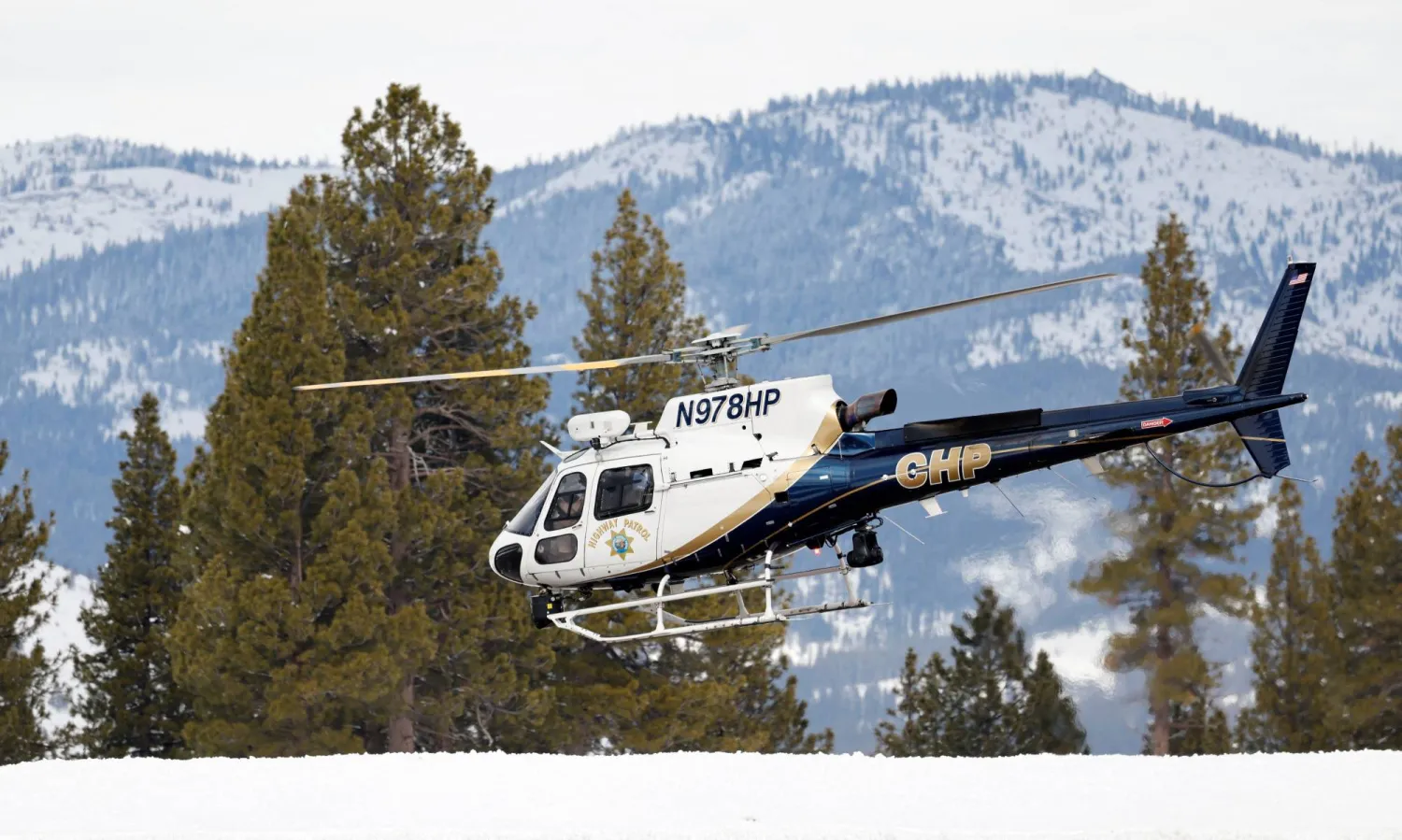
A California Highway Patrol helicopter lifts off from Truckee Tahoe Airport while taking part in recovery efforts for the skiers that died in an avalanche in the Sierra Nevada mountains, in Truckee, California, US February 21, 2026.  REUTERS/Fred Greaves
A California Highway Patrol helicopter lifts off from Truckee Tahoe Airport while taking part in recovery efforts for the skiers that died in an avalanche in the Sierra Nevada mountains, in Truckee, California, US February 21, 2026. REUTERS/Fred Greaves
TT

Crews Recover Bodies of 9 Backcountry Skiers Days after California Avalanche

A California Highway Patrol helicopter lifts off from Truckee Tahoe Airport while taking part in recovery efforts for the skiers that died in an avalanche in the Sierra Nevada mountains, in Truckee, California, US February 21, 2026.  REUTERS/Fred Greaves
A California Highway Patrol helicopter lifts off from Truckee Tahoe Airport while taking part in recovery efforts for the skiers that died in an avalanche in the Sierra Nevada mountains, in Truckee, California, US February 21, 2026. REUTERS/Fred Greaves

Crews recovered the bodies of nine backcountry skiers who were killed by an avalanche in California's Sierra Nevada, authorities said Saturday, concluding a harrowing operation that was hindered by intense snowfall.

A search team reached the bodies of eight victims and found one other who had been missing and presumed dead since Tuesday’s avalanche on Castle Peak near Lake Tahoe. The ninth person who was missing was found “relatively close” to the other victims, according to Nevada County Sheriff’s Lt. Dennis Hack, but was impossible to see due to whiteout conditions at that time.

At a news conference, Sheriff Shannon Moon praised the collective efforts of the numerous agencies that helped recover the bodies — from the California Highway Patrol to the National Guard to the Pacific Gas & Electric utility company — and 42 volunteers who helped on the last day of the operation.

“We are fortunate in this mountain community that we are very tight-knit, and our community shows up in times of tragedy,” The Associated Press quoted Moon as saying.

The sheriff named for the first time the three guides from Blackbird Mountain Company who died: Andrew Alissandratos, 34, Nicole Choo, 42, and Michael Henry, 30.

According to biographies on the company's website, Alissandratos was originally from Tampa, Florida, and moved to Tahoe roughly a decade ago. He enjoyed a wide array of adventure activities, from backcountry exploration to rock climbing.

Henry moved to Colorado in 2016 and then to Truckee three years later. He was described as “laid back” and devoted to sharing his knowledge and love of the mountains with others.

There was no bio for Choo on the website.

“This was an enormous tragedy, and the saddest event our team has ever experienced,” Blackbird Mountain founder Zeb Blais said Wednesday in a statement.

“We are doing what we can to support the families who lost so much,” he said, “and the members of our team who lost treasured friends and colleagues.”

The six other fatal victims were women who were part of a close-knit group of friends who were experienced backcountry skiers and knew how to navigate the Sierra Nevada wilderness, their families said this week.

They were identified as Carrie Atkin, Liz Clabaugh, Danielle Keatley, Kate Morse, Caroline Sekar and Kate Vitt, all in their 40s. They lived in the San Francisco Bay Area, Idaho and the Lake Tahoe area.

“We are devastated beyond words,” the families said in a statement. “Our focus right now is supporting our children through this incredible tragedy and honoring the lives of these extraordinary women. They were all mothers, wives and friends, all of whom connected through the love of the outdoors.”

The families asked for privacy while they grieve and added that they “have many unanswered questions.”

Two of the friends got out alive and were rescued along with four others, including one guide, after Tuesday’s avalanche. Their names have not been released.

The avalanche struck on the last day of the 15 skiers’ three-day tour, when the group decided to end the trip early to avoid the impending snowstorm.

Officials have said the path they took is a “normally traveled route” but declined to specify what that meant.

At around 11:30 a.m. Tuesday, the six survivors called for help, describing a sudden and terrifying slide that was approximately the length of a football field. In the aftermath they discovered the bodies of three fellow skiers, according to Hack.

Rescuers were not able to reach them until roughly six hours after the initial call for help, Hack said, and took two separate paths to arrive. They found five other bodies, leaving only one person unaccounted for.

But it was immediately clear to rescuers that it was too dangerous to extract the bodies at that time due to the heavy snowfall and threat of more avalanches.

Those conditions persisted on Wednesday and Thursday.

A breakthrough on Friday Authorities used two California Highway Patrol helicopters, with the help of Pacific Gas & Electric Company, to break up the snow and intentionally release unstable snowpack to reduce the avalanche risk.

Crews were then able to recover five victims that evening before it got too dark to access the last three.

Rescuers used helicopters and ropes to hoist the last four bodies from the mountain the following morning, fighting through severe winds that forced them to make multiple trips. The bodies were then taken to snowcats — trucks that are outfitted to drive on snow — for further transport.

“We cannot say enough how tremendously sorry we are for the families that have been affected by this avalanche,” Moon said.

Initial reports indicated that at least two of the surviving skiers were not swept away by the avalanche, Hack said. The others were standing separately and relatively close together and were hit.

Hack declined to offer information about what might have set off the avalanche.

Authorities close the area The terrain will be off-limits to visitors until mid-March, said Chris Feutrier, forest supervisor for the Tahoe National Forest. Officials intended to restore public access once the investigation is complete.

“This is the public’s land, and they love to recreate on it,” Feutrier said. “The Forest Service doesn’t close public land for every hazard or every obstacle. We trust the American people to use their best judgment when recreating.”