


Khamenei Urges Iran’s Judiciary to Tighten Control over Cyberspace

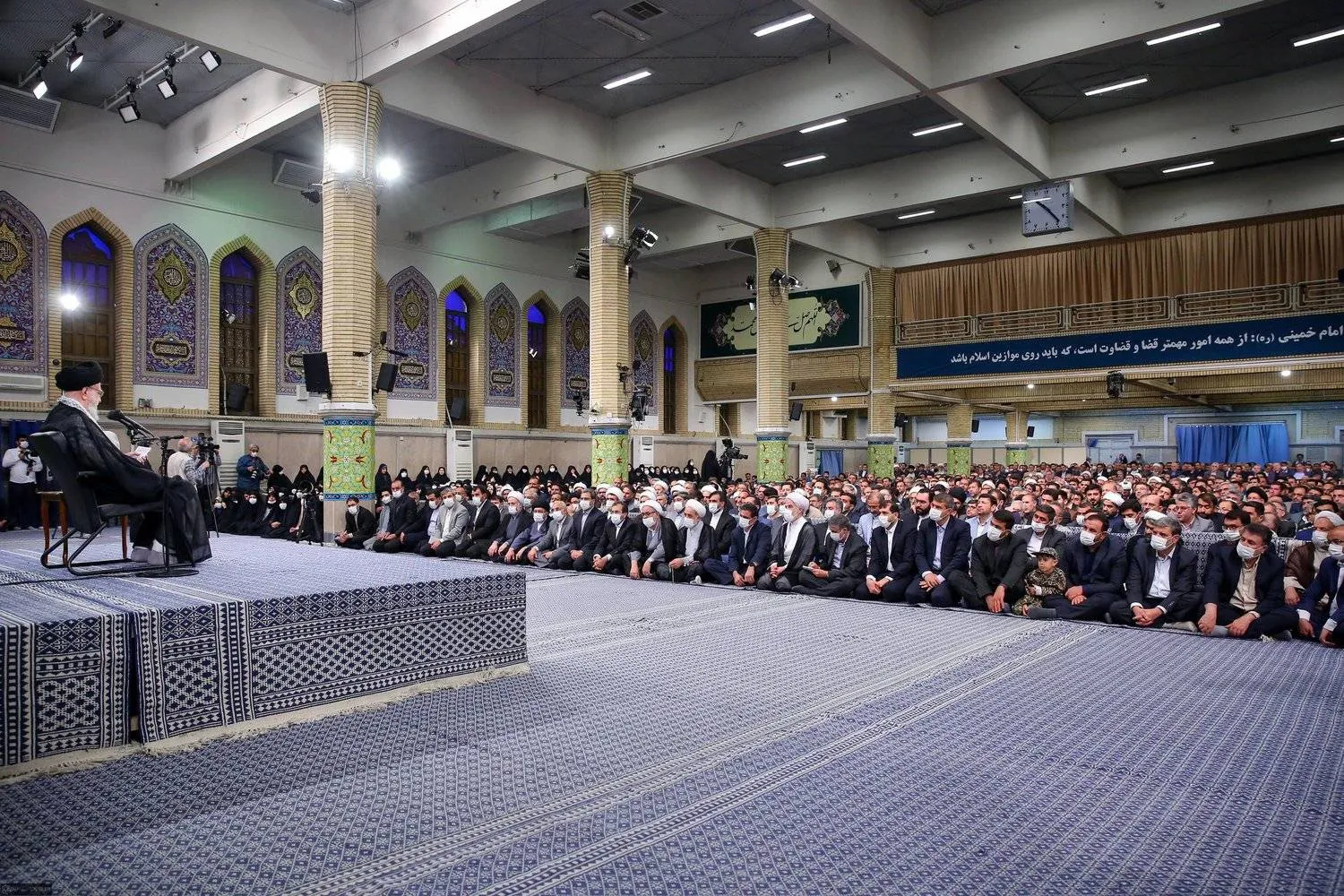
Iranian Supreme Leader Ali Khamenei in a meeting with the head and officials of Iran’s Judiciary Branch on Tuesday (Supreme Leader official website)
TT

Khamenei Urges Iran’s Judiciary to Tighten Control over Cyberspace

Iranian Supreme Leader Ali Khamenei in a meeting with the head and officials of Iran’s Judiciary Branch on Tuesday (Supreme Leader official website)

Iran's Supreme Leader Ali Khamenei has called on the judiciary to take serious steps to control social networks and tighten control over cyberspace.

"The prevention of startling and disrupting the mental security of people in the real world and the world of cyberspace is one of the manifestations of securing public rights. The judicial system must attend well to this difficult task with planning, discipline, and rules,” Khamenei told a group of officials and judiciary members.

Khamenei also considered it essential to ensure that people have lawful freedoms.

"According to the precise interpretation of the constitution, all the freedoms allowed by the Sharia law must be provided to the people. The institutions usually oppose these freedoms, and the judiciary must fulfill its duties."

Khamenei criticized the judiciary's image in the media and recommended taking measures to improve it.

He accused the media of tarnishing the judiciary's image, noting that media and advertisements were not effectively utilized to showcase and inform the public about its extensive work.

During the months that followed the "Woman, Life, Freedom" protests after the death of the young Kurdish woman, Mahsa Amini, last September, the Supreme Leader increased his criticism of the management of the Internet and social networks.

Earlier this month, Khamenei accused Western powers, led by the US, of "engineering" the riots.

He accused dissidents of organizing the riots, saying: "The comprehensive planning of these riots was carried out in the think tanks of Western countries."

Khamenei indicated its implementation was accompanied by extensive financial, arms, and media support of "Western security institutions, traitors and mercenaries who turned their backs on their country and agents of hostile policies against Iran."

The authorities eased some of their constraints on communications after the Internet was cut off on a large scale, starting last February, but they kept the basic restrictions, especially WhatsApp and Instagram.

Rights groups say more than 500 people have been killed during the authorities' violent crackdown to quell the protests. The violence also claimed the lives of about 70 members of the security services.

The number of detainees is estimated at 20,000, but the authorities did not provide official statistics on the number of the dead or arrested.

In the first official confirmation of the estimates of human rights organizations, the head of the judiciary, Gholam-Hossein Mohseni-Ejei, said during the annual conference of judicial officials that there are 20,000 judicial files in connection with the recent riots.

Last March, Mohseni-Ejei said that the authorities released 80,000 Iranian prisoners, including some of those arrested during the protests, following Khamenei's pardon.



2 Buildings Collapse in Central Istanbul after Gas Explosion

A man feeds seagulls on a rainy and windy day, in Istanbul, Türkiye, Friday, March 20, 2026. (AP Photo/Francisco Seco)
TT

2 Buildings Collapse in Central Istanbul after Gas Explosion

A man feeds seagulls on a rainy and windy day, in Istanbul, Türkiye, Friday, March 20, 2026. (AP Photo/Francisco Seco)

A natural gas explosion in Istanbul’s central Fatih district brought down two buildings on Sunday.

Search and rescue personnel were immediately dispatched to the site of the noon explosion, and determined nine people were caught under the rubble.

Istanbul Governor Davut Gul said they had recovered seven people, who are undergoing treatment in nearby hospitals. State-run news channel TRT reported an eighth has also been recovered and sent to hospital. Rescue operations are still working to find the last person.

TRT reports that none of the survivors is in critical condition.

One of the collapsed buildings was two stories, the other one.


Japan Could Consider Hormuz Minesweeping if Ceasefire Reached, Minister Says

Japanese Prime Minister Sanae Takaichi applauds US President Donald Trump during a dinner at the White House in Washington, D.C., US, March 19, 2026. REUTERS/Kevin Lamarque
TT

Japan Could Consider Hormuz Minesweeping if Ceasefire Reached, Minister Says

Japanese Prime Minister Sanae Takaichi applauds US President Donald Trump during a dinner at the White House in Washington, D.C., US, March 19, 2026. REUTERS/Kevin Lamarque

Japan could consider deploying its military for minesweeping in the Strait of Hormuz, a vital artery for global oil supplies, if a ceasefire is reached in the US-Israeli war on Iran, Foreign Minister Toshimitsu Motegi said on Sunday.

"If there were to be a complete ceasefire, hypothetically speaking, then things like minesweeping could come up," Motegi said during a Fuji TV program. "This is purely hypothetical, but if a ceasefire were established ‌and naval ‌mines were creating an obstacle, then I ‌think ⁠that would be ⁠something to consider."

Japan's military actions are limited under its postwar pacifist constitution, but 2015 security legislation allows Japan to use its Self-Defense Forces overseas if an attack, including on a close security partner, threatens Japan's survival and no other means are available to address it.

Tokyo has no ⁠immediate plans to seek arrangements to allow passage ‌through the Strait of ‌Hormuz for stranded Japanese vessels, Motegi said, adding it was "extremely ‌important" to create conditions that allow all ships to ‌navigate through the narrow waterway, the conduit for a fifth of the world's oil shipments.

Iranian Foreign Minister Abbas Araghchi told Japan's Kyodo news agency on Friday that he had spoken to ‌Motegi about potentially letting Japanese-related vessels pass through the strait.

Japan gets around 90% of its ⁠oil shipments ⁠via the strait, which Tehran has largely closed during the war, now in its fourth week. A spike in global oil prices has prompted Japan and other countries to release oil from their reserves.

US President Donald Trump met Japanese Prime Minister Sanae Takaichi on Thursday, urging her to "step up" as he presses allies - so far unsuccessfully - to send warships to help open the strait.

Takaichi told reporters after the Washington summit that she had briefed Trump on what support Japan could and could not provide in the strait under its laws.


UK Minister Says Trump Speaks for Himself on His Deadline for Iran

British Secretary of State for Housing, Communities and Local Government Steve Reed looks on, as he speaks to the press, on the first day of Britain's Labor Party's annual conference, in Liverpool, Britain, September 28, 2025. REUTERS/Phil Noble Purchase Licensing Rights
TT

UK Minister Says Trump Speaks for Himself on His Deadline for Iran

British Secretary of State for Housing, Communities and Local Government Steve Reed looks on, as he speaks to the press, on the first day of Britain's Labor Party's annual conference, in Liverpool, Britain, September 28, 2025. REUTERS/Phil Noble Purchase Licensing Rights

British cabinet minister Steve Reed said on Sunday that US President Trump spoke for himself when he threatened to "obliterate" Iran's power ‌plants if Tehran ‌did not ‌fully ⁠reopen the Strait ⁠of Hormuz within 48 hours.

Asked what Britain's position on Trump's deadline was, Housing Secretary ⁠Reed told ‌Sky ‌News: "The US president ‌is perfectly capable of ‌speaking for himself and defending what it is that he's ‌saying."

"We're not going to be dragged ⁠into ⁠the war, but we will protect our own interests in the region. We will work with our allies to de-escalate the situation."