


5 Prisoners Sought by US in Swap with Iran Are Freed, Arrive in Qatar

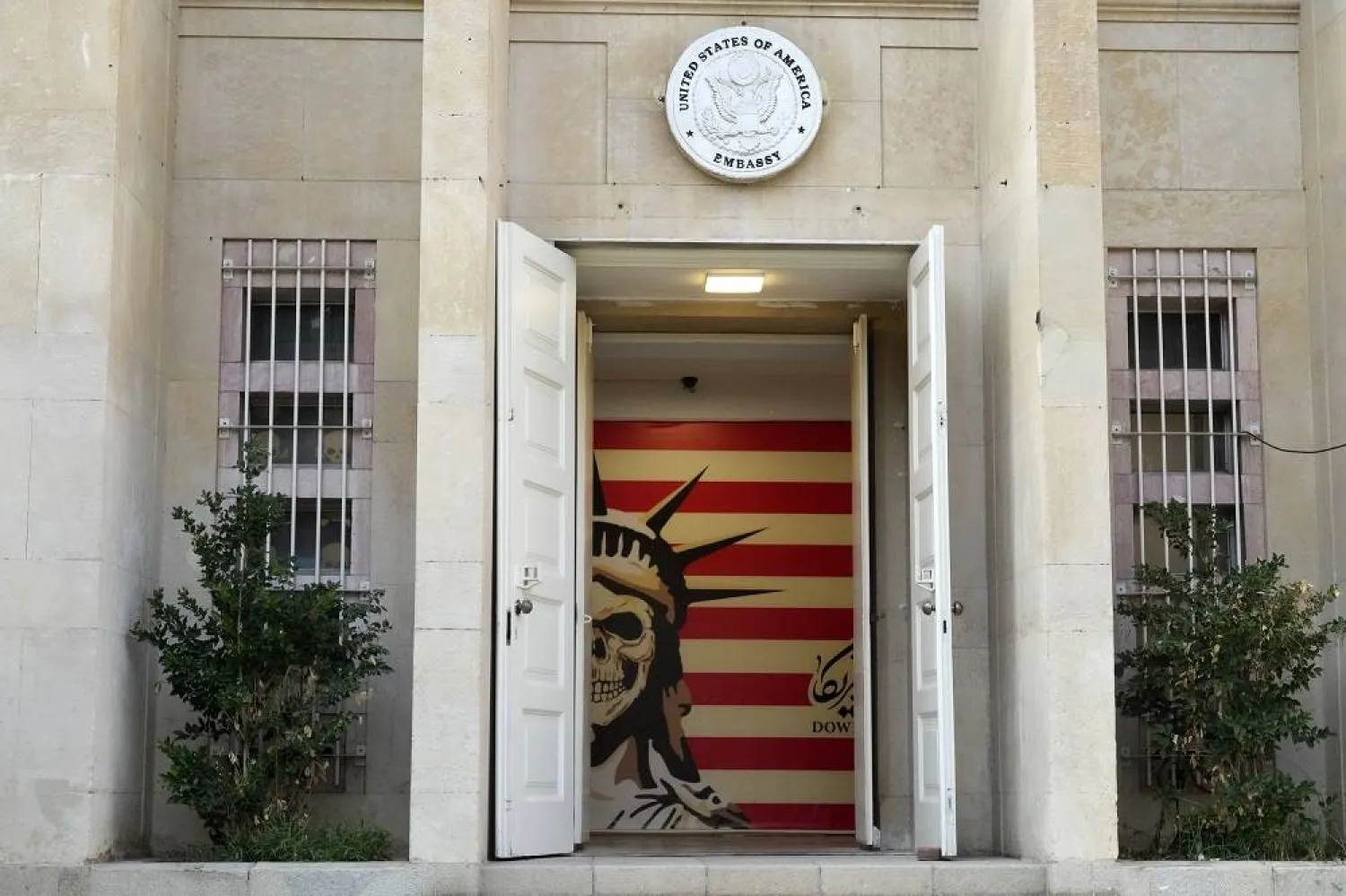
The entrance to the former US Embassy, which has been turned into an anti-American museum, is seen n Tehran, Iran, on Saturday, Aug. 19, 2023. (AP)
TT

5 Prisoners Sought by US in Swap with Iran Are Freed, Arrive in Qatar

The entrance to the former US Embassy, which has been turned into an anti-American museum, is seen n Tehran, Iran, on Saturday, Aug. 19, 2023. (AP)

Five prisoners sought by the US in a swap with Iran flew out of Tehran on Monday, officials said, part of a deal that saw nearly $6 billion in Iranian assets unfrozen.

Despite the deal, tensions are almost certain to remain high between the US and Iran, which are locked in various disputes, including over Tehran’s nuclear program. Iran says the program is peaceful, but it now enriches uranium closer than ever to weapons-grade levels.

The planned exchange has unfolded amid a major American military buildup in the Arabian Gulf, with the possibility of US troops boarding and guarding commercial ships in the Strait of Hormuz, through which 20% of all oil shipments pass.

President Joe Biden welcomed the news of the release in a statement, saying “five innocent Americans who were imprisoned in Iran are finally coming home.”

He urged Americans not to travel to Iran, and he demanded more information on what happened to Bob Levinson, an American who went missing years ago. Biden also announced sanctions on former Iranian President Mahmoud Ahmadinejad and the Iranian Ministry of Intelligence.

Two people, including a senior Biden administration official, said that the prisoners left Tehran on Monday. They spoke on condition of anonymity while the exchange was ongoing.

In addition to the five freed Americans, two US family members flew out, according to the Biden administration official.

Flight-tracking data showed a Qatar Airways flight take off from Tehran’s Mehrabad International Airport, which has been used for exchanges in the past. Several of the former prisoners could be seen climbing the stairs to the flight in video released by Iranian media. The plane later landed in Doha, Qatar.

Meanwhile, Nour News, a website believed to be close to Iran’s security apparatus, said two of the Iranian prisoners had arrived in Doha for the swap.

Earlier, Iranian Foreign Ministry spokesman Nasser Kanaani said that the exchange would take place Monday after nearly $6 billion in once-frozen Iranian assets reached Qatar.

“Fortunately Iran’s frozen assets in South Korea were released and God willing today the assets will start to be fully controlled by the government and the nation,” Kanaani said.

“On the subject of the prisoner swap, it will happen today and five prisoners, citizens of the Islamic Republic, will be released from the prisons in the US,” he added. “Five imprisoned citizens who were in Iran will be given to the US side.”

He said two of the Iranian prisoners will stay in the US.

Mohammad Reza Farzin, Iran’s Central Bank chief, later came on state television to acknowledge the receipt of over 5.5 billion euros — $5.9 billion — in accounts in Qatar. Months ago, Iran had anticipated getting as much as $7 billion.

The planned exchange comes ahead of the convening of world leaders at the UN General Assembly this week in New York, where Iran’s hard-line President Ebrahim Raisi will speak.

The deal has already opened US President Joe Biden to fresh criticism from Republicans and others who say that the administration is helping boost the Iranian economy at a time when Iran poses a growing threat to American troops and Mideast allies. That could have implications in his reelection campaign as well.

On the US side, Washington has said the planned swap includes Siamak Namazi, who was detained in 2015 and was later sentenced to 10 years in prison on spying charges; Emad Sharghi, a venture capitalist sentenced to 10 years; and Morad Tahbaz, a British-American conservationist of Iranian descent who was arrested in 2018 and also received a 10-year sentence. All of their charges have been widely criticized by their families, activists and the US government.

US officials have so far declined to identify the fourth and fifth prisoner.

The five prisoners Iran has said it seeks are mostly held over allegedly trying to export banned material to Iran, such as dual use electronics that can be used by a military.

The two that Nour News said were in Doha were: Mehrdad Ansari, an Iranian sentenced to 63 months in prison in 2021 for obtaining equipment that could be used in missiles, electronic warfare, nuclear weapons and other military gear, and Reza Sarhangpour Kafrani, an Iranian charged in 2021 over allegedly unlawfully exporting laboratory equipment to Iran.

The cash represents money South Korea owed Iran — but had not yet paid — for oil purchased before the US imposed sanctions on such transactions in 2019.

The US maintains that, once in Qatar, the money will be held in restricted accounts and will only be able to be used for humanitarian goods, such as medicine and food. Those transactions are currently allowed under American sanctions targeting Tehran over its advancing nuclear program.

Iranian government officials have largely concurred with that explanation, though some hard-liners have insisted, without providing evidence, that there would be no restrictions on how Tehran spends the money.

Iran and the US have a history of prisoner swaps dating back to the 1979 US Embassy takeover and hostage crisis following the revolution. Their most recent major exchange happened in 2016, when Iran came to a deal with world powers to restrict its nuclear program in return for an easing of sanctions.

The West accuses Iran of using foreign prisoners — including those with dual nationality — as bargaining chips, an allegation Tehran rejects.

Negotiations over a major prisoner swap faltered after then-President Donald Trump unilaterally withdrew America from the nuclear deal in 2018. From the following year on, a series of attacks and ship seizures attributed to Iran have raised tensions.

Meanwhile, Iran’s nuclear program now enriches closer than ever to weapons-grade levels. While the head of the United Nations’ nuclear watchdog has warned that Iran now has enough enriched uranium to produce “several” bombs, months more would likely be needed to build a weapon and potentially miniaturize it to put it on a missile — if Iran decided to pursue one.

Iran maintains its nuclear program is peaceful, and the US intelligence community has kept its assessment that Iran is not pursuing an atomic bomb.

Iran has taken steps in recent months to settle some issues with the International Atomic Energy Agency. But the advances in its program have led to fears of a wider regional conflagration as Israel, itself a nuclear power, has said it would not allow Tehran to develop the bomb. Israel bombed both Iraq and Syria to stop their nuclear programs, giving the threat more weight. It also is suspected in carrying out a series of killings targeting Iran’s nuclear scientists.

Iran also supplies Russia with the bomb-carrying drones Moscow uses to target sites in Ukraine in its war on Kyiv, which remains another major dispute between Tehran and Washington.



US Judge Blocks Deportation of Columbia University Palestinian Activist

Mohsen Mahdawi at a press conference in Vermont last year - Photo by Alex Driehaus/AP
TT

US Judge Blocks Deportation of Columbia University Palestinian Activist

Mohsen Mahdawi at a press conference in Vermont last year - Photo by Alex Driehaus/AP

A US immigration judge has blocked the deportation of a Palestinian graduate student who helped organize protests at Columbia University against Israel's war in Gaza, according to US media reports.

Mohsen Mahdawi was arrested by immigration agents last year as he was attending an interview to become a US citizen.

Mahdawi had been involved in a wave of demonstrations that gripped several major US university campuses since Israel began a massive military campaign in the Gaza Strip.

A Palestinian born in the occupied West Bank, Mahdawi has been a legal US permanent resident since 2015 and graduated from the prestigious New York university in May. He has been free from federal custody since April.

In an order made public on Tuesday, Judge Nina Froes said that President Donald Trump's administration did not provide sufficient evidence that Mahdawi could be legally removed from the United States, multiple media outlets reported.

Froes reportedly questioned the authenticity of a copy of a document purportedly signed by Secretary of State Marco Rubio that said Mahdawi's activism "could undermine the Middle East peace process by reinforcing antisemitic sentiment," according to the New York Times.

Rubio has argued that federal law grants him the authority to summarily revoke visas and deport migrants who pose threats to US foreign policy.

The Trump administration can still appeal the decision, which marked a setback in the Republican president's efforts to crack down on pro-Palestinian campus activists.

The administration has also attempted to deport Mahmoud Khalil, another student activist who co-founded a Palestinian student group at Columbia, alongside Mahdawi.

"I am grateful to the court for honoring the rule of law and holding the line against the government's attempts to trample on due process," Mahdawi said in a statement released by his attorneys and published Tuesday by several media outlets.

"This decision is an important step towards upholding what fear tried to destroy: the right to speak for peace and justice."


Fire Breaks out Near Iran's Capital Tehran, State Media Says

Smoke rises from a fire caused by an explosion in Tehran (File photo - Reuters)
TT

Fire Breaks out Near Iran's Capital Tehran, State Media Says

Smoke rises from a fire caused by an explosion in Tehran (File photo - Reuters)

A fire broke out in Iran's Parand near the capital city Tehran, state media reported on Wednesday, publishing videos of smoke rising over the area which is close to several military and strategic sites in the country's Tehran province, Reuters reported.

"The black smoke seen near the city of Parand is the result of a fire in the reeds around the Parand river bank... fire fighters are on site and the fire extinguishing operation is underway", state media cited the Parand fire department as saying.


Pakistan PM Sharif to Seek Clarity on Troops for Gaza in US Visit

US President Donald Trump looks at Pakistan's Prime Minister Shehbaz Sharif speaking following the official signing of the first phase of the Gaza ceasefire agreement between Israel and Hamas, during a world leaders' summit on ending the Gaza war, in Sharm El-Sheikh, Egypt, October 13, 2025. REUTERS/Evelyn Hockstein/File Photo
TT

Pakistan PM Sharif to Seek Clarity on Troops for Gaza in US Visit

US President Donald Trump looks at Pakistan's Prime Minister Shehbaz Sharif speaking following the official signing of the first phase of the Gaza ceasefire agreement between Israel and Hamas, during a world leaders' summit on ending the Gaza war, in Sharm El-Sheikh, Egypt, October 13, 2025. REUTERS/Evelyn Hockstein/File Photo

Before Pakistan commits to sending troops to Gaza as part of the International Stabilization Force it wants assurances from the United States that it will be a peacekeeping mission rather than tasked with disarming Hamas, three sources told Reuters.

Pakistan's Prime Minister Shehbaz Sharif is set to attend the first formal meeting of President Donald Trump's Board of Peace in Washington on Thursday, alongside delegations from at least 20 countries.

Trump, who will chair the meeting, is expected to announce a multi-billion dollar reconstruction plan for Gaza and detail plans for a UN-authorized stabilization force for the Palestinian enclave.

Three government sources said during the Washington visit Sharif wanted to better understand the goal of the ISF, what authority they were operating under and what the chain of command was before making a decision on deploying troops.

"We are ready to send troops. Let me make it clear that our troops could only be part of a peace mission in Gaza," said one of the sources, a close aide of Sharif.

"We will not be part of any other role, such as disarming Hamas. It is out of the question," he said.

Analysts say Pakistan would be an asset to the multinational force, with its experienced military that has gone to war with arch-rival India and tackled insurgencies.

"We can send initially a couple of thousand troops anytime, but we need to know what role they are going to play," the source added.

Two of the sources said it was likely Sharif, who has met Trump earlier this year in Davos and late last year at the White House, would either have an audience with him on the sidelines of the meeting or the following day at the White House.

Initially designed to cement Gaza's ceasefire, Trump sees the Board of Peace, launched in late January, taking a wider role in resolving global conflicts. Some countries have reacted cautiously, fearing it could become a rival to the United Nations.

While Pakistan has supported the establishment of the board, it has voiced concerns against the mission to demilitarize Gaza's militant group Hamas.