

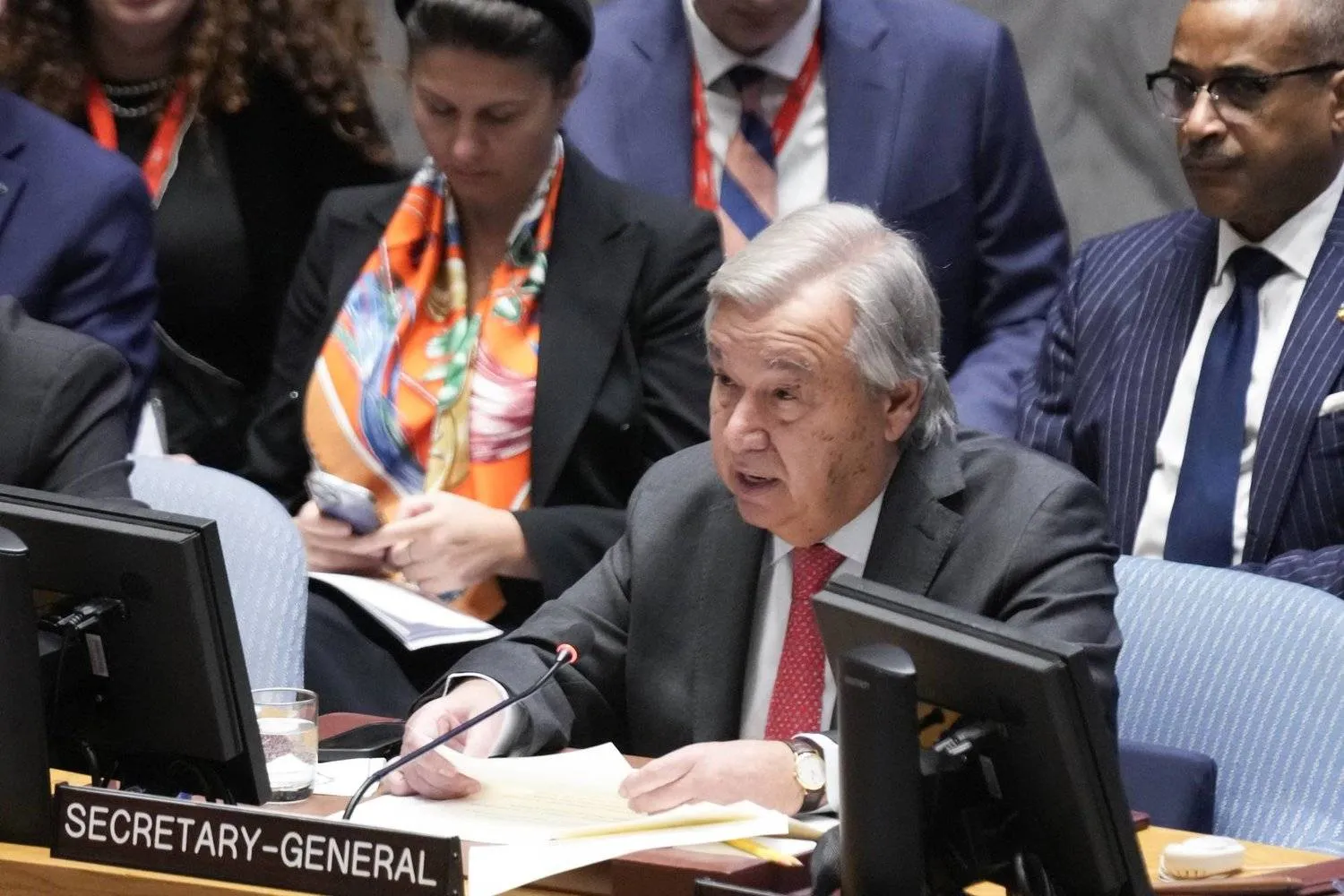

UN Sec-Gen Shocked Over Misrepresentation of Statement, Israel Cancels His Visit

The UN Sec-Gen Antonio Guterres during the Security Council meeting (AP)
TT

UN Sec-Gen Shocked Over Misrepresentation of Statement, Israel Cancels His Visit

The UN Sec-Gen Antonio Guterres during the Security Council meeting (AP)

The UN Sec-Gen Antonio Guterres rejected accusations by Israel that in his statement to the Security Council he had justified attacks by Hamas on Israel.

"I am shocked by the misrepresentations by some of my statements... as if I was justifying acts of terror by Hamas. This is false. It was the opposite," he told reporters.

Following his statement, Israel canceled Guterres' visit and began other punitive measures against the United Nations.

The United Nations News account on the X platform said that misinterpreting Guterres' speech made it appear that he was justifying acts of terrorism committed by Hamas.

The Sec-Gen said during a session of the UN Security Council on Tuesday that it was important to recognize that the attacks by "Hamas did not happen in a vacuum."

In his speech, Guterres noted that the "Palestinian people have been subjected to 56 years of suffocating occupation."

"All hostages must be treated humanely and released immediately and without conditions," he said, adding that he was deeply concerned about the "clear violations of international humanitarian law that we are witnessing in Gaza."

He asserted that the aid must be delivered without restrictions, noting that: "to ease epic suffering, make the delivery of aid easier and safer, and facilitate the release of hostages, I reiterate my appeal for an immediate humanitarian ceasefire."

"Some humanitarian relief is finally getting into Gaza," said the Sec-Gen, describing it as "a drop of aid in an ocean of need."

UN fuel supplies in Gaza will run out in a matter of days, which would be another disaster.

Guterres expressed deep concerns about the clear violations of international humanitarian law in Gaza.

"Let me be clear: No party to an armed conflict is above international humanitarian law.|

However, the statement angered the Israelis, so the government canceled his planned visit to Tel Aviv and began other punitive measures against the UN.

Political sources in Tel Aviv reported that the withdrawal of travel visas for UN officials was among the sanctions.

Israel's UN Ambassador Gilad Erdan described Guterres' speech as "shocking" and called on Guterres to resign immediately, while Israel's visiting Foreign Minister Eli Cohen said he would not meet with Guterres on Tuesday as planned.

However, Israel did not find a single country that supported its stance.

Meanwhile, Germany expressed its support for Guterres on Wednesday, rejecting calls for his resignation.

The Israeli government is annoyed with the UN's activity in the field, especially since they monitor operations on both sides. During wars, they publish a daily report on the situation.

In its daily report on Wednesday, the UN Relief and Works Agency (UNRWA), the UN agency for Palestinian refugees, warned that it would be forced to stop all its operations in Gaza by Wednesday night unless fuel was delivered.

The report noted that since October 11, the Gaza Strip has witnessed a complete power outage, forcing hospitals and water facilities to rely on backup generators.

It warned that "only one-third of UNRWA clinics in the South and Middle Areas are operational," and fuel stocks in the functional UNRWA primary healthcare centers are about to run out.

The UN also expressed concern about the estimated 1.4 million displaced persons in Gaza, with nearly 600,000 internally displaced people sheltering in 150 UNRWA facilities.

Overcrowding is a source of increasing concern, given that the average number of displaced people in each shelter center is 2.6 times more than its capacity, and the most overcrowded centers are 11 times more than their intended capacity.

Notably, Israeli governments used to disdain the UN and established bad relations with it, which caused severe crises between the two parties.

However, the Israelis reported an improvement in the UN's dealings with Israel, and diplomats have been elected to senior positions there.

They viewed Guterres as a moderate person but turned against him because of his recent statement, in which he tried to draw attention to the fact that the ongoing conflict is the cause of all the calamity the region is witnessing.



Iran Says Received US Response to Its Proposal to End War

Vessels in the Strait of Hormuz near the beach of Bandar Abbas, Iran, September 28, 2026. Amirhosein Khorgooi/ISNA/via WANA (West Asia News Agency) via REUTERS
TT

Iran Says Received US Response to Its Proposal to End War

Vessels in the Strait of Hormuz near the beach of Bandar Abbas, Iran, September 28, 2026. Amirhosein Khorgooi/ISNA/via WANA (West Asia News Agency) via REUTERS

Iranian authorities said on Wednesday they received the official US response to their proposal to end the Middle East war, state media reported, days after US President Donald Trump rejected the plan. 

"At today's cabinet meeting, the American side's proposal was presented to President Masoud Pezeshkian by Foreign Minister Abbas Araghchi," government spokeswoman Fatemeh Mohajerani told the official IRNA news agency, without specifying the content of the reply. 

After seven months of conflict, indirect talks between the United States and Iran resumed last week on the sidelines of the UN General Assembly, said AFP. 

Iran said it has put forward seven conditions for ending hostilities and reopening the strategic Strait of Hormuz, a vital route for oil and gas exports. 

The strait lies at the heart of the conflict between the United States and Iran, which began with US-Israeli strikes on Iran in late February. 

Tehran imposed a blockade on Hormuz after the war started, prompting Washington to respond with its own blockade on Iranian ports. 

While not all conditions have been made public, Iran is notably demanding a ceasefire across the Middle East, including in Lebanon, where its ally Hezbollah has been battling Israeli forces. 

It is also demanding the unfreezing of Iranian assets abroad, the lifting of sanctions on its oil sector and an end to the US naval blockade. 

Trump rejected the proposal when speaking to the press on Saturday, but Tehran had been awaiting an official response via Qatari mediators. 

Fighting has subsided in recent weeks, though Tehran has continued to target ships in the strait. 

Iran's Revolutionary Guards, the ideological arm of the country's military, said on Wednesday that they have been striking small vessels that try to pass through the strait. 

"We have been striking ships for quite some time now -- specifically the small vessels I mentioned that attempt to pass. We block their passage, yet the US has not retaliated for a while," Guards spokesperson Hossein Mohebi told state TV. 

The US, meanwhile, has stepped up its economic warfare against Iran, imposing sanctions on Iranian airlines and vowing to take a hard stance against foreign companies that provide them with assistance. 


US Supreme Court Lifts Limits on Third-country Deportations

The United States has deported thousands of migrants to so-called third-countries, including Liberia, as part of US President Donald Trump's immigration crackdown. Matthew Jacobs / AFP
TT

US Supreme Court Lifts Limits on Third-country Deportations

The United States has deported thousands of migrants to so-called third-countries, including Liberia, as part of US President Donald Trump's immigration crackdown. Matthew Jacobs / AFP

The US Supreme Court on Tuesday lifted restrictions on the deportations of immigrants to countries that are not their own, while agreeing to hear the issue on its merits in December.

The conservative-dominated high court granted an emergency request by the Trump administration to suspend a lower court ruling that restricted, but did not outright ban, so-called "third-country removals."

The lower court had said people targeted with deportation must be given effective notice ahead of time about where they are being sent to allow them to raise concerns about potential persecution, said AFP.

The three liberal justices on the nine-member bench said they would not have granted the administration's request.

President Donald Trump campaigned on promises to expel millions of undocumented migrants from the United States and has taken several actions aimed at speeding up deportations since returning to the White House in 2025.

The Trump administration has defended third-country deportations as necessary since the home nations of some of those who are targeted for removal sometimes refuse to accept them.

In a brief to the Supreme Court, opponents of lifting the restrictions argued that the lower court ruling did not fully block all third-country deportations, "it simply requires them to do so lawfully."

Trump's solicitor general, John Sauer, meanwhile told the court that the rapid deportation to third countries was "an essential tool to remove certain aliens, including some of the worst criminal aliens."

The lower court ruling "created substantial logistical problems" with removals, he said.

- 'Indefensible' -

An AFP investigation found that the US has offered multimillion-dollar deals and threatened visa restrictions in a bid to get "third countries," especially in Africa, to take such deportees.

Once in these countries -- and outside US jurisdiction -- deportees have been subject to abuse by local guards, indefinite detention, or quickly re-deported to their home countries.

According to an investigation published last week, the United States has deported more than 25,000 people under secretive agreements with 35 countries to take migrants with no ties to those nations.

The investigation by Forbidden Stories found the administration has earmarked $410 million to be paid directly to the receiving countries, or to United Nations agencies to facilitate the returns.

The vast majority of the deportees -- around 20,000 -- were sent to Mexico, but the rest were dispersed to 27 other countries across Latin America, Africa, and the Pacific, and agreements have been finalized with seven more.

Congress has made it US policy not to deport people to countries where their lives would be in danger or they could be subject to torture.

After the high court's ruling, some Democratic lawmakers were calling for more formalized steps to prevent such deportations and uphold due process.

"Congress must step in. No one should be shipped off to a country that is not their own without basic due process and a meaningful opportunity to raise legitimate fears for their safety," House Democrat Lois Frankel said on X.

Rob Menendez, another congressional Democrat, called the Supreme Court's decision "indefensible."

"Taxpayers shouldn't fund tearing people from the only home they've ever known, nor should our legal system fast-track these unilateral deportations."


US Withdraws from European Anti-Corruption Panel

FILE PHOTO: A general view of a US State Department sign outside the US State Department building in Washington, DC, US, July 11, 2025. REUTERS/Annabelle Gordon/File Photo
TT

US Withdraws from European Anti-Corruption Panel

FILE PHOTO: A general view of a US State Department sign outside the US State Department building in Washington, DC, US, July 11, 2025. REUTERS/Annabelle Gordon/File Photo

The Trump administration has withdrawn the United States from a top European anti-corruption watchdog as it forges ahead with plans to disengage from international and multilateral organizations that it accuses of exceeding their mandates, being inefficient or not adapting to US policies.

The Council of Europe said Tuesday that the US formally notified it a day earlier that it would leave the Group of States against Corruption, or GRECO. Only two other countries have left GRECO before — Russia and Belarus.

The State Department confirmed the move, saying that US participation, which requires an annual monetary contribution, “does not provide tangible benefits to US national security.”

“The era of writing blank checks to international bureaucracies is over,” it said. “The department is instead prioritizing higher-impact tools to combat corruption, such as visa restrictions, sanctions, and targeted foreign assistance to strengthen foreign criminal investigations into corruption directly threatening US security and prosperity.”

The Strasbourg-based Council of Europe said the US had been “a valuable contributor” to GRECO "and to the exchange of experience and good practice in preventing and combating corruption.”

“GRECO remains open to resuming cooperation with the United States in the future in support of shared efforts to prevent corruption, strengthen integrity and uphold the rule of law,” it said in a statement.

The decision was announced a week after the Organization for Security and Cooperation in Europe said the US had declined to invite its members to observe November’s congressional midterm elections, a sharp break from past practice.

The US has already withdrawn from a number of European-based UN and multilateral agencies, including the World Health Organization and the UN Human Rights Council, and is weighing further such steps.

The US withdrew in January from another Council of Europe panel — the Venice Commission, which is an advisory body on constitutional law.

GRECO was created in 1999 by the Council of Europe to monitor compliance with the organization’s anti-corruption standards. Membership is not limited to European Union members, and the United States joined a year after its founding.