

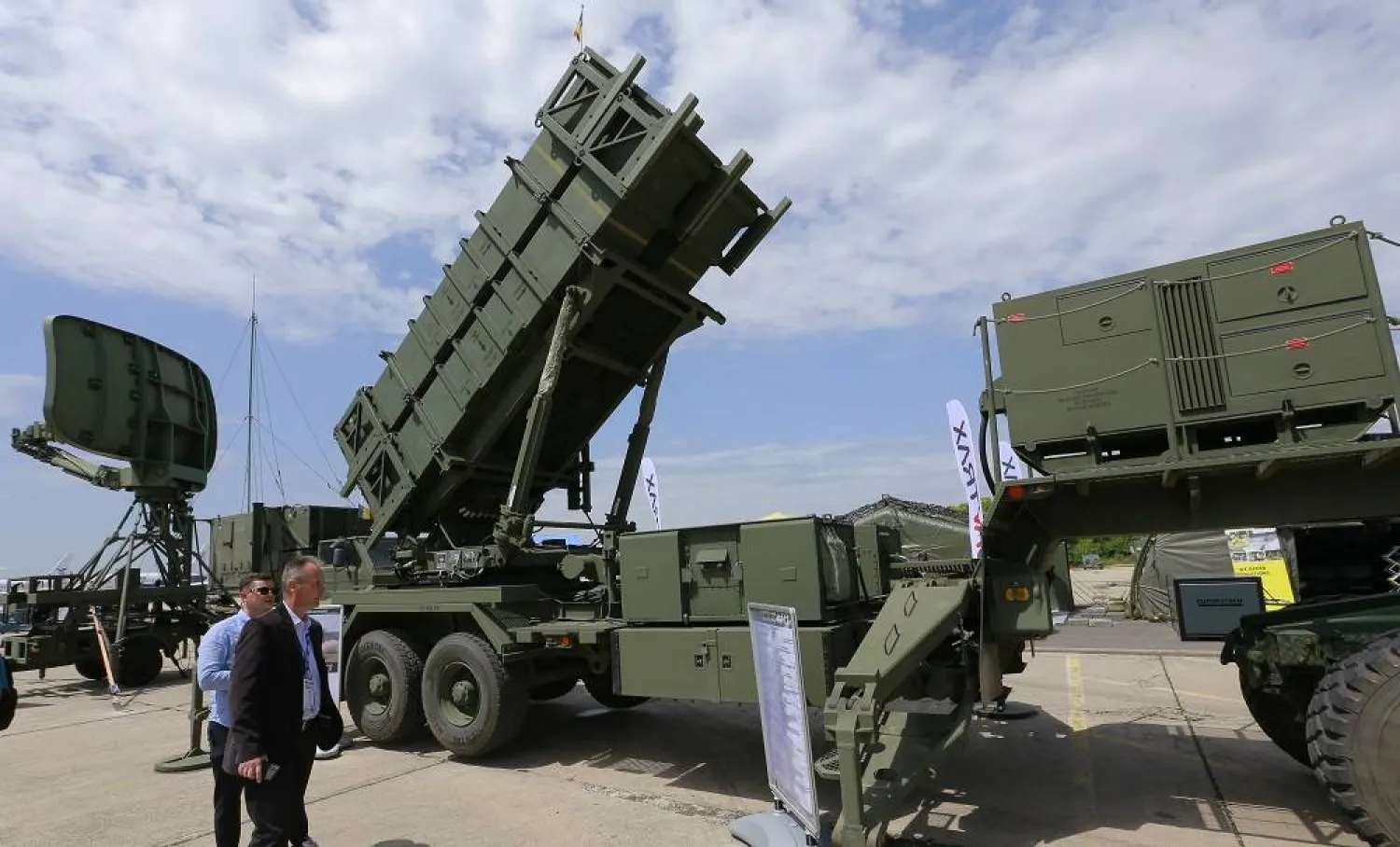

Ukraine’s Zelenskyy Gets More Air Defense Missiles from Spain to Fight Deadly Russian Glide Bombs

Visitors check US-made Patriot surface-to-air missile system during the first day of the Black Sea Defense & Aerospace Exhibition 2024 (BSDA'24) in Bucharest, Romania, 22 May 2024. (EPA)
TT

Ukraine’s Zelenskyy Gets More Air Defense Missiles from Spain to Fight Deadly Russian Glide Bombs

Visitors check US-made Patriot surface-to-air missile system during the first day of the Black Sea Defense & Aerospace Exhibition 2024 (BSDA'24) in Bucharest, Romania, 22 May 2024. (EPA)

Ukrainian President Volodymyr Zelenskyy on Monday secured from Spain a pledge of additional air defense missiles to help fight the about 3,000 bombs that he says Russia launches every month at Ukraine in the third year of the war.

However, Ukraine still urgently needs another seven US-made Patriot air defense systems to stop Russia hitting the power grid and civilian areas, as well as military targets, with devastating glide bombs that wreak wide destruction, Zelenskyy said.

“If we had these modern Patriot systems, (Russian) airplanes wouldn’t be able to fly close enough to drop the (glide) bombs on the civilian population and the military,” Zelenskyy told a news conference in the Spanish capital.

Glide bombs are heavy Soviet-era bombs fitted with precision guidance systems and launched from aircraft flying out of range of air defenses. The bombs weigh more than a ton and blast targets to smithereens, leaving a huge crater.

Two Patriot systems are needed to protect the northeastern Kharkiv region, where the Kremlin’s forces launched a cross-border offensive on May 10 that left Ukrainian troops reeling, Zelenskyy said. The death toll from a glide bomb attack on a Kharkiv shopping mall Saturday rose to 18, regional Gov Oleh Syniehubov said Monday, with five people still missing.

The Kharkiv push has further strained Ukraine’s already depleted army, which in recent months has been fighting Russia’s intense drive deeper into the partially occupied eastern Donetsk region. Zelenskyy said on Sunday that the Kremlin’s army is mustering at another point in Russia, farther north but close to the approximately 1,000-kilometer (600-mile) front line, aiming to stretch Ukraine's depleted army thinner and crack its resistance in the area.

Zelenskyy and Spanish Prime Minister Pedro Sánchez signed a bilateral security agreement that allocates 1 billion euros ($1.1 billion) of military aid to Ukraine in 2024, and 5 billion euros ($5.4 billion) by 2027. More Leopard tanks and artillery ammunition also feature in the package.

“After more than two years (of war), Russia’s aggression continues, and that’s why it is more necessary than ever to redouble our support,” Sánchez told the joint news conference.

The Patriot is a surface-to-air guided missile system that was first deployed in the 1980s and can target aircraft, cruise missiles and shorter-range ballistic missiles. It is expensive but is effective and sought after by armies around the world.

European countries have hesitated to send Patriot systems to Ukraine, fearing they may need them.

Spain’s King Felipe VI earlier welcomed Zelenskyy at the capital’s Barajas airport. Zelenskyy was due in neighboring Portugal on Tuesday.

He had been due to visit Spain earlier this month but postponed all his foreign trips after Russia launched its offensive in the Kharkiv region.

Ukraine has repeatedly tried to strike behind Russian lines, often with drones, though Russia’s response to the new technology used in unmanned vehicles has improved in recent months.

A Ukrainian long-range drone set a new distance record by attacking overnight an early-warning radar in the Russian city of Orsk, some 1,800 kilometers (1,120 miles) from the Ukrainian border, Ukrainian officials claimed.

The operation was conducted by Ukraine’s military intelligence, GUR, an intelligence official told The Associated Press on condition of anonymity because the person was not authorized to comment publicly. Ukraine’s previous long-range attack record was at 1,500 kilometers (930 miles) when a drone struck an oil refinery in Russia’s Bashkortostan on May 9.

It was not immediately possible to verify either claim.

Meanwhile, a Western intelligence assessment suggested that Russia’s Kharkiv offensive has subsided.

“The northern Kharkiv front has likely stabilized with Russian territorial control fragmented and not joined up,” the UK Defense Ministry said Sunday. “Russia’s gains in this axis will be limited in the coming week, as Russia’s initial momentum has been contained by Ukrainian resistance.”

That is in line with Zelenskyy’s claim last Friday that Ukrainian forces have secured “combat control” of areas where Russian troops entered the Kharkiv region.

The onslaught unfolding as the weather improves has brought Ukraine’s biggest military test since Russia’s full-scale invasion in February 2022. Slow deliveries of support by its Western partners, especially a lengthy delay in US military aid, have left Ukraine at the mercy of Russia’s bigger army and air force.



US Judge Blocks Deportation of Columbia University Palestinian Activist

Mohsen Mahdawi at a press conference in Vermont last year - Photo by Alex Driehaus/AP
TT

US Judge Blocks Deportation of Columbia University Palestinian Activist

Mohsen Mahdawi at a press conference in Vermont last year - Photo by Alex Driehaus/AP

A US immigration judge has blocked the deportation of a Palestinian graduate student who helped organize protests at Columbia University against Israel's war in Gaza, according to US media reports.

Mohsen Mahdawi was arrested by immigration agents last year as he was attending an interview to become a US citizen.

Mahdawi had been involved in a wave of demonstrations that gripped several major US university campuses since Israel began a massive military campaign in the Gaza Strip.

A Palestinian born in the occupied West Bank, Mahdawi has been a legal US permanent resident since 2015 and graduated from the prestigious New York university in May. He has been free from federal custody since April.

In an order made public on Tuesday, Judge Nina Froes said that President Donald Trump's administration did not provide sufficient evidence that Mahdawi could be legally removed from the United States, multiple media outlets reported.

Froes reportedly questioned the authenticity of a copy of a document purportedly signed by Secretary of State Marco Rubio that said Mahdawi's activism "could undermine the Middle East peace process by reinforcing antisemitic sentiment," according to the New York Times.

Rubio has argued that federal law grants him the authority to summarily revoke visas and deport migrants who pose threats to US foreign policy.

The Trump administration can still appeal the decision, which marked a setback in the Republican president's efforts to crack down on pro-Palestinian campus activists.

The administration has also attempted to deport Mahmoud Khalil, another student activist who co-founded a Palestinian student group at Columbia, alongside Mahdawi.

"I am grateful to the court for honoring the rule of law and holding the line against the government's attempts to trample on due process," Mahdawi said in a statement released by his attorneys and published Tuesday by several media outlets.

"This decision is an important step towards upholding what fear tried to destroy: the right to speak for peace and justice."


Fire Breaks out Near Iran's Capital Tehran, State Media Says

Smoke rises from a fire caused by an explosion in Tehran (File photo - Reuters)
TT

Fire Breaks out Near Iran's Capital Tehran, State Media Says

Smoke rises from a fire caused by an explosion in Tehran (File photo - Reuters)

A fire broke out in Iran's Parand near the capital city Tehran, state media reported on Wednesday, publishing videos of smoke rising over the area which is close to several military and strategic sites in the country's Tehran province, Reuters reported.

"The black smoke seen near the city of Parand is the result of a fire in the reeds around the Parand river bank... fire fighters are on site and the fire extinguishing operation is underway", state media cited the Parand fire department as saying.


Pakistan PM Sharif to Seek Clarity on Troops for Gaza in US Visit

US President Donald Trump looks at Pakistan's Prime Minister Shehbaz Sharif speaking following the official signing of the first phase of the Gaza ceasefire agreement between Israel and Hamas, during a world leaders' summit on ending the Gaza war, in Sharm El-Sheikh, Egypt, October 13, 2025. REUTERS/Evelyn Hockstein/File Photo
TT

Pakistan PM Sharif to Seek Clarity on Troops for Gaza in US Visit

US President Donald Trump looks at Pakistan's Prime Minister Shehbaz Sharif speaking following the official signing of the first phase of the Gaza ceasefire agreement between Israel and Hamas, during a world leaders' summit on ending the Gaza war, in Sharm El-Sheikh, Egypt, October 13, 2025. REUTERS/Evelyn Hockstein/File Photo

Before Pakistan commits to sending troops to Gaza as part of the International Stabilization Force it wants assurances from the United States that it will be a peacekeeping mission rather than tasked with disarming Hamas, three sources told Reuters.

Pakistan's Prime Minister Shehbaz Sharif is set to attend the first formal meeting of President Donald Trump's Board of Peace in Washington on Thursday, alongside delegations from at least 20 countries.

Trump, who will chair the meeting, is expected to announce a multi-billion dollar reconstruction plan for Gaza and detail plans for a UN-authorized stabilization force for the Palestinian enclave.

Three government sources said during the Washington visit Sharif wanted to better understand the goal of the ISF, what authority they were operating under and what the chain of command was before making a decision on deploying troops.

"We are ready to send troops. Let me make it clear that our troops could only be part of a peace mission in Gaza," said one of the sources, a close aide of Sharif.

"We will not be part of any other role, such as disarming Hamas. It is out of the question," he said.

Analysts say Pakistan would be an asset to the multinational force, with its experienced military that has gone to war with arch-rival India and tackled insurgencies.

"We can send initially a couple of thousand troops anytime, but we need to know what role they are going to play," the source added.

Two of the sources said it was likely Sharif, who has met Trump earlier this year in Davos and late last year at the White House, would either have an audience with him on the sidelines of the meeting or the following day at the White House.

Initially designed to cement Gaza's ceasefire, Trump sees the Board of Peace, launched in late January, taking a wider role in resolving global conflicts. Some countries have reacted cautiously, fearing it could become a rival to the United Nations.

While Pakistan has supported the establishment of the board, it has voiced concerns against the mission to demilitarize Gaza's militant group Hamas.