


IAEA Chief Sees Willingness from Iran to Re-Engage on Nuclear File

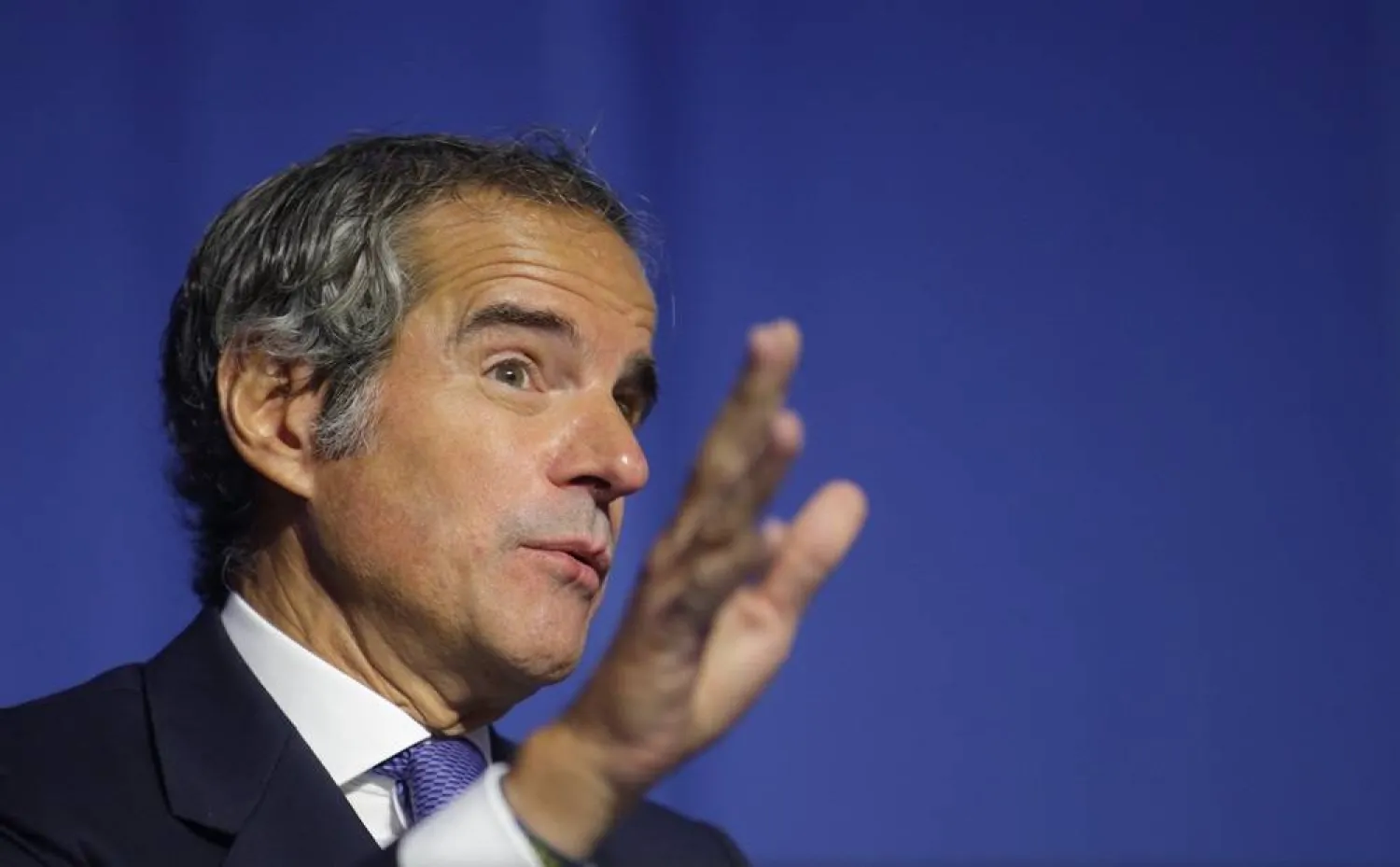
International Atomic Energy Agency (IAEA) Director General Rafael Grossi attends the 68th IAEA General Conference in Vienna, Austria, 16 September 2024. (EPA)
TT

IAEA Chief Sees Willingness from Iran to Re-Engage on Nuclear File

International Atomic Energy Agency (IAEA) Director General Rafael Grossi attends the 68th IAEA General Conference in Vienna, Austria, 16 September 2024. (EPA)

UN nuclear watchdog chief Rafael Grossi said on Tuesday he had sensed a greater willingness by Iranian officials to engage with the agency in a more meaningful way after talks in New York, and that he hoped to travel to Tehran in October.

Several long-standing issues have dogged relations between Iran and the International Atomic Energy Agency, including Tehran's barring of uranium-enrichment experts on the inspection team and its failure for years to explain uranium traces found at undeclared sites.

Grossi held talks with Iranian Foreign Minister Abbas Araqchi, one of the key architects to the 2015 accord that limited Iran's ability to enrich uranium in return for a lifting of Western sanctions, on the sidelines of the UN General Assembly.

"What I see is an expressed willingness to re-engage with us in a more meaningful fashion," Grossi told Reuters in an interview.

With nuclear diplomacy largely stalled between the Iranian presidential election and the US one on Nov. 5, Iranian and European officials have met in New York to test their mutual willingness to reduce tensions amid Tehran's disputed nuclear program, its role in Ukraine and mounting regional tensions.

Grossi said he wanted to make real progress in restoring proper technical discussions with Iran quickly and was aiming to travel to Tehran in October to meet with Iranian President Masoud Pezeshkian.

"Of course, now we have to give content and substance to this because we are not starting from zero. We have had relatively protracted process without replies to some of the questions we have," he said.

"We also need to calibrate together with them how we go through this period where they are waiting to see what is going to happen with their other partners, starting with the United States."

IAEA board resolutions ordering Iran to cooperate urgently with the investigation into the uranium traces and calling on it to reverse its barring of inspectors have brought little change, and quarterly IAEA reports seen by Reuters on Aug. 29 showed no progress.

Development of Iran's nuclear program has also advanced. By the end of the quarter, the latest IAEA reports showed Iran had completed installation of eight new cascades at Fordow but still not brought them online.

At its larger underground site at Natanz, which is enriching to up to 5% purity, it had brought 15 new cascades of other advanced models online.

"Iran has kept a regular pace without accelerating too much, but it continues," Grossi said, adding that the Fordow cascades remained offline.

Iran has stepped up nuclear work since 2019, after then-US President Donald Trump abandoned an agreement reached under his predecessor Barack Obama.

When asked about the prospects of a revival of nuclear talks, Grossi said the preparatory work needed to start now, notably for the IAEA to get the necessary clarity on Iran's activities since it reduced cooperation with the agency.

"I think we need to, or the ambition should be to get results in a different way, because the old way is simply not going to be possible anymore," he said, adding that he foresaw a more active role for the agency.



Iranian Mourning Ceremonies Prompt New Crackdowns in Echo of 1979 Revolution

Iranians walk on a street in Tehran, Iran, 16 February 2026. (EPA)
TT

Iranian Mourning Ceremonies Prompt New Crackdowns in Echo of 1979 Revolution

Iranians walk on a street in Tehran, Iran, 16 February 2026. (EPA)

Iranians have returned to the streets this week to mourn those killed by security forces during last month's anti-government demonstrations, sparking some new crackdowns in an echo of the 1979 revolution that brought down the US-backed Shah.

The anti-Shah revolutionaries turned Shiite Muslim memorial processions 40 days after each death into new protests, which prompted renewed violence from the authorities and fresh "martyrs" for the cause.

The clerical establishment's opponents, deploying the same tactics after five decades, have yet to match the momentum of those times, but Iran's clerical rulers, threatened with military attack by US President Donald Trump over their nuclear and security policies, have demonstrated their concern.

They deployed security forces to some cemeteries and invited citizens to attend state-organized 40-day "Chehelom" ceremonies on Tuesday after apologizing to "all those affected" by violence they blamed on people described as "terrorists".

"They tried to prevent history repeating itself by holding these ceremonies in mosques across ‌the country. To ‌prevent any gatherings of angry families in cemeteries, but they failed," said one rights activist ‌in ⁠Iran who declined ⁠to be named for fear of retribution.

SECURITY FORCES CLASH WITH MOURNERS

Videos circulating on social media showed families holding their own memorials across Iran on Tuesday, 40 days after security forces began two days of widespread shooting that human rights groups say killed thousands of protesters.

Some of Tuesday's memorials turned into wider anti-government protests and some were met with deadly force.

In the Kurdish town of Abdanan in Ilam province, witnesses and activists said security forces opened fire on hundreds of mourners gathered at a cemetery.

Videos showed people scattering as gunfire rang out amid chants of "Death to the dictator", a reference to Iran's Supreme Leader Ali Khamenei.

Reuters journalists verified that ⁠the videos were filmed at the cemetery. They were unable to verify the date but ‌found no versions posted before Tuesday: eyewitnesses and activists said that was when ‌people gathered at the cemetery were fired upon.

Hengaw, a Kurdish Iranian rights group, said at least three people were injured and nine ‌arrested in Abdanan. Similar clashes were reported in Mashhad and Hamedan. Sources in Iran said internet access was heavily restricted ‌in those cities.

WEDNESDAY IS 40 DAYS SINCE HEIGHT OF JANUARY PROTESTS

More mourning ceremonies were expected to be taking place on Wednesday, 40 days since the deadliest two days of the January unrest, although communications restrictions meant that it was not immediately possible to tell how many or their outcome.

January's unrest grew from modest economic protests in December among traders in Tehran's Grand Bazaar into the gravest threat to ‌Iran's theocracy in nearly five decades, with protesters calling for ruling clerics to step down.

Authorities cut internet access, blaming "armed terrorists" linked to Israel and the United States ⁠for the violence, and have arrested ⁠journalists, lawyers, activists, human rights advocates and students, rights groups say.

Iranian officials have told Reuters the leadership is worried a US strike could erode its grip on power by fueling more protests. Repression, inequality, corruption and the sponsorship of proxies abroad are the main grievances.

"How long can they kill people to stay in power? People are angry, people are frustrated," said government employee Sara, 28, from the central city of Isfahan.

"The Islamic Republic has brought nothing but war, economic misery and death to my country".

Trump has deployed aircraft carriers, fighter jets, guided-missile destroyers and other capabilities to the Middle East for a possible attack if talks to limit Iran's nuclear program and weaken its foreign proxies do not yield results.

Even without a US attack, continued isolation from Western sanctions would likely fuel further public anger.

In 1979, the anti-Shah revolt in provincial towns and villages was amplified by oil workers whose strikes cut most of Iran's revenue, and bazaar merchants who funded the rebel clerics.

This time there have been no reports of either, but people have adopted some of the small-scale tactics, chanting “Allah is great” and “Death to the dictator”, often from rooftops, during nightly demonstrations, according to witnesses and social media posts.


Iran ‘Drafting Framework to Advance’ Future US Talks, Says FM

Iranian Foreign Minister Abbas Araghchi speaks during the Conference on Disarmament at the European headquarters of the United Nations in Geneva, Switzerland, 17 February 2026. (EPA)
TT

Iran ‘Drafting Framework to Advance’ Future US Talks, Says FM

Iranian Foreign Minister Abbas Araghchi speaks during the Conference on Disarmament at the European headquarters of the United Nations in Geneva, Switzerland, 17 February 2026. (EPA)

Iran's top diplomat Abbas Araghchi said on Wednesday that Tehran was "drafting" a framework for future talks with the United States, as the US energy secretary said Washington would stop Iran's nuclear ambitions "one way or another".

Diplomatic efforts are underway to avert the possibility of US military intervention in Iran, with Washington conducting a military build-up in the region.

Iran and the US held a second round of Oman-mediated negotiations on Tuesday in Geneva, after talks last year collapsed following Israel's attack on Iran in June, which started a 12-day war.

Araghchi said on Tuesday that Tehran had agreed with Washington on "guiding principles", but US Vice President JD Vance said Tehran had not yet acknowledged all of Washington's "red lines".

On Wednesday, Araghchi held a phone call with Rafael Grossi, the head of the UN nuclear watchdog, the International Atomic Energy Agency.

In the call, Araghchi "stressed Iran's focus on drafting an initial and coherent framework to advance future talks", according to a statement from the Iranian foreign ministry.

Also on Wednesday, US Energy Secretary Chris Wright warned that Washington would deter Tehran from acquiring nuclear weapons "one way or the other".

"They've been very clear about what they would do with nuclear weapons. It's entirely unacceptable," Wright told reporters in Paris on the sidelines of meetings of the International Energy Agency.

Earlier on Wednesday, Reza Najafi, Iran's permanent representative to the IAEA in Vienna, held a joint meeting with Grossi and the ambassadors of China and Russia "to exchange views" on the upcoming session of the agency's board of governors meetings and "developments related to Iran's nuclear program", Iran's mission in Vienna said on X.

Tehran has suspended some cooperation with the IAEA and restricted the watchdog's inspectors from accessing sites bombed by Israel and the United States, accusing the UN body of bias and of failing to condemn the strikes.

- Displays of military might -

The Omani-mediated talks were aimed at averting the possibility of US military action, while Tehran is demanding the lifting of US sanctions that are crippling its economy.

Iran has insisted that the discussions be limited to the nuclear issue, though Washington has previously pushed for Tehran's ballistic missiles program and support for armed groups in the region to be on the table.

US President Donald Trump has repeatedly threatened to intervene militarily against Iran, first over a deadly crackdown on protesters last month and then more recently over its nuclear program.

On Wednesday, Israeli President Isaac Herzog sent a message to Iranians, saying "I want to send the people of Iran best wishes for the month of Ramadan, and I truly hope and pray that this reign of terror will end and that we will see a different era in the Middle East," according to a statement from his office.

Washington has ordered two aircraft carriers to the region, with the first, the USS Abraham Lincoln with nearly 80 aircraft, positioned about 700 kilometers (435 miles) from the Iranian coast as of Sunday, satellite images showed.

Iran has also sought to display its own military might, with its Islamic Revolutionary Guard Corps beginning a series of war games on Monday in the Strait of Hormuz.

Iranian politicians have repeatedly threatened to block the strait, a major global conduit for oil and gas.

On Tuesday, state TV reported that Tehran would close parts of the waterway for safety measures during the drills.

Iran's supreme leader warned on Tuesday that the country had the ability to sink a US warship deployed to the region.


US Judge Blocks Deportation of Columbia University Palestinian Activist

Mohsen Mahdawi at a press conference in Vermont last year - Photo by Alex Driehaus/AP
TT

US Judge Blocks Deportation of Columbia University Palestinian Activist

Mohsen Mahdawi at a press conference in Vermont last year - Photo by Alex Driehaus/AP

A US immigration judge has blocked the deportation of a Palestinian graduate student who helped organize protests at Columbia University against Israel's war in Gaza, according to US media reports.

Mohsen Mahdawi was arrested by immigration agents last year as he was attending an interview to become a US citizen.

Mahdawi had been involved in a wave of demonstrations that gripped several major US university campuses since Israel began a massive military campaign in the Gaza Strip.

A Palestinian born in the occupied West Bank, Mahdawi has been a legal US permanent resident since 2015 and graduated from the prestigious New York university in May. He has been free from federal custody since April.

In an order made public on Tuesday, Judge Nina Froes said that President Donald Trump's administration did not provide sufficient evidence that Mahdawi could be legally removed from the United States, multiple media outlets reported.

Froes reportedly questioned the authenticity of a copy of a document purportedly signed by Secretary of State Marco Rubio that said Mahdawi's activism "could undermine the Middle East peace process by reinforcing antisemitic sentiment," according to the New York Times.

Rubio has argued that federal law grants him the authority to summarily revoke visas and deport migrants who pose threats to US foreign policy.

The Trump administration can still appeal the decision, which marked a setback in the Republican president's efforts to crack down on pro-Palestinian campus activists.

The administration has also attempted to deport Mahmoud Khalil, another student activist who co-founded a Palestinian student group at Columbia, alongside Mahdawi.

"I am grateful to the court for honoring the rule of law and holding the line against the government's attempts to trample on due process," Mahdawi said in a statement released by his attorneys and published Tuesday by several media outlets.

"This decision is an important step towards upholding what fear tried to destroy: the right to speak for peace and justice."