Ahmed Ali Saleh Launches First Public Attack on Yemen's Houthis

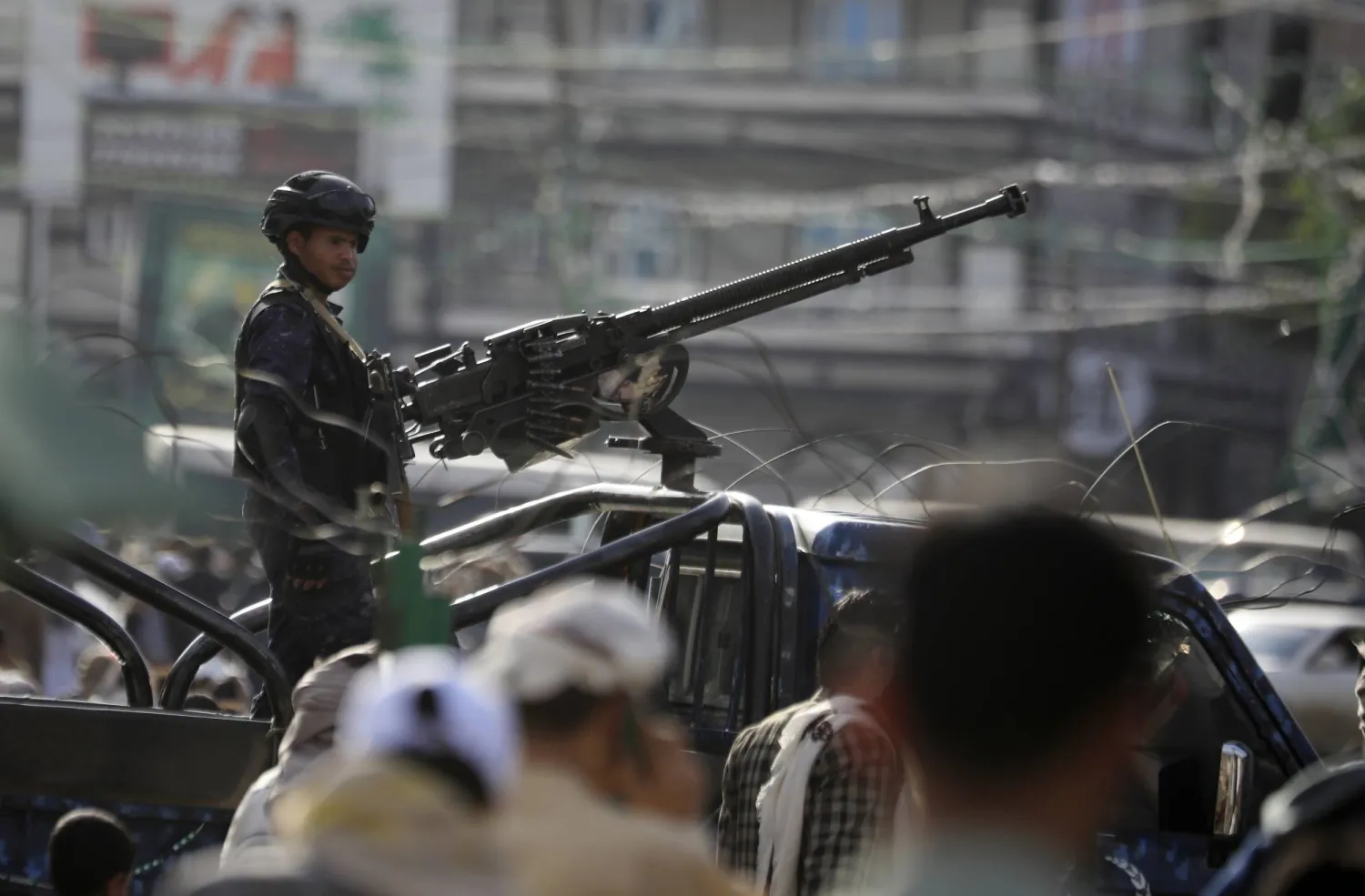
A Houthi militiaman mans a machine gun on a pick-up truck while on patrol in Sanaa, Yemen, 26 September 2025. EPA/YAHYA ARHAB
TT

Ahmed Ali Saleh Launches First Public Attack on Yemen's Houthis

A Houthi militiaman mans a machine gun on a pick-up truck while on patrol in Sanaa, Yemen, 26 September 2025. EPA/YAHYA ARHAB

Ahmed Ali Abdullah Saleh, the son of Yemen’s late president, launched his first public diatribe against the Houthi militias on Friday, ending years of silence since his father was killed in 2017.

Speaking on the 63rd anniversary of Yemen’s Sept. 26 revolution, which toppled the imamate in the north in 1962, Saleh branded the Houthis as heirs of the “backward clerical rule” and vowed their defeat, saying Yemenis who overthrew the imamate could do so again to “regain freedom and dignity.”

His fiery remarks, broadcast by his Yemen Today TV channel, came weeks after a Houthi court sentenced him to death, confiscated his assets and forced the group’s loyalists inside the General People’s Congress party (GPC) in Sanaa to strip him of his post as deputy party leader.

Analysts said the moves underscored the Houthis’ unease over his symbolic weight inside the party his father founded, and may have prompted his public challenge.

In his speech, Saleh evoked both the Sept. 26 revolution and the December 2017 uprising led by his father against the Houthis, portraying them as one continuous struggle. He called for a “national rescue project” to unite anti-Houthi forces, transcending political divisions that he said had allowed the group to consolidate power.

The address also carried regional messages. Saleh thanked Saudi Arabia, the United Arab Emirates, Egypt and Oman for supporting Yemen in its “darkest times,” stressing that the country could not rise in isolation from its Arab neighbors and allies.

Since the Houthis killed former president Ali Abdullah Saleh in December 2017, the group has kept GPC under the nominal leadership of Sadeq Abu Rass, whom party members and critics say lacks real authority and has been sidelined, even as Houthis accuse him and others of plotting against them.


Israel Sends Message to Lebanon and Hezbollah through Strikes

A man watches as heavy machinery, first aid responders and residents search the site of an Israeli airstrike that targeted a neighborhood in the southern Lebanese village of Deir al-Zahrani on August 15, 2026. (Photo by Abbas FAKIH / AFP)
TT

Israel Sends Message to Lebanon and Hezbollah through Strikes

A man watches as heavy machinery, first aid responders and residents search the site of an Israeli airstrike that targeted a neighborhood in the southern Lebanese village of Deir al-Zahrani on August 15, 2026. (Photo by Abbas FAKIH / AFP)

Israel sent political and security messages on Saturday to the Lebanese state and Hezbollah through a sudden escalation of strikes in southern Lebanon.

Israeli airstrikes on two towns killed 11 people, including an entire family, in what the Israeli military said was a response to a military operation carried out by Hezbollah against its forces operating in southern Lebanon. The military said it had targeted a Hezbollah command center, killing a senior commander in the group’s Radwan Force.

The escalation comes on the eve of the Monday expiration of the 60-day deadline stipulated in the memorandum of understanding between the United States and Iran. It also coincides with US mediation efforts between Lebanon and Israel to consolidate the ceasefire and expand the designated pilot areas in southern Lebanon.

In a statement, President Joseph Aoun said the escalation is a “message to the negotiation path and the US efforts aiming to consolidate the Framework Agreement”.

Prime Minister Nawaf Salam also said the escalation was “extremely dangerous and undermines efforts to consolidate stability in the south”, stressing that “dealing with any military infrastructure, if present on Lebanese territory, is the exclusive responsibility of the state, and its presence does not give Israel the right to violate Lebanese territory or put civilians at risk.”

While Hezbollah has not claimed responsibility for any military operation, Tel Aviv is seeking to establish new rules of engagement linked to Israeli preparations to seize control of the Ali al-Taher Heights.

According to sources who spoke on condition of anonymity, Israel is trying to send Hezbollah a message that “any attempt to halt the advance toward Ali al-Taher heights will be met with an expansion of the bombing deeper into Lebanese territory.”


Gaza Health Sector Faces Mounting Crises, Risk of Total Collapse

A Palestinian carries a child wounded in an Israeli strike that killed the child’s parents at Al-Aqsa Martyrs Hospital in Deir al-Balah, central Gaza Strip, July 15, 2026 (Reuters) 
TT

Gaza Health Sector Faces Mounting Crises, Risk of Total Collapse

A Palestinian carries a child wounded in an Israeli strike that killed the child’s parents at Al-Aqsa Martyrs Hospital in Deir al-Balah, central Gaza Strip, July 15, 2026 (Reuters) 

Gaza’s health sector is facing a deepening series of crises amid the devastation caused by the Israeli war that followed Hamas’ Oct. 7, 2023 attack.

Israel has not only damaged hospitals through raids and strikes but continues to control the entry of medicines and medical supplies, as well as the departure of patients seeking treatment abroad, further complicating an already dire health situation.

Gaza’s Health Ministry warned Saturday that the operating capacity of the remaining oxygen stations had been fully exhausted and that they were working beyond their limits amid repeated breakdowns.

Only 12 of 34 oxygen stations remain operational, under highly difficult technical and mechanical conditions that make it increasingly hard to meet the needs of health facilities and other service providers. The ministry said just four of 30 oxygen-cylinder filling units remain functional and could stop at any moment because engineering teams lack the means to carry out emergency maintenance.

It warned that the remaining stations risk complete shutdown, threatening oxygen supplies to hospitals and patients receiving care at home. The ministry called for the immediate entry of spare parts and technical equipment, as well as the urgent supply of new oxygen stations.

The crisis is also placing severe pressure on kidney patients. The Hind al-Daghma Dialysis Center at Nasser Medical Complex is treating more than 200 patients from across Gaza amid acute shortages of medical supplies, medicines and equipment.

Riyad Barbakh, head of the dialysis department, said demand was rising as equipment and treatment supplies dwindled, creating harsh conditions that had contributed to patient deaths.

Dialysis sessions are the only barrier between life and death for these patients, Barbakh said, warning that any disruption to supplies or equipment could pose an immediate threat to hundreds of lives.

Cancer patients face similarly grave conditions

Mohammed Abu Nada, medical director of the Gaza Cancer Center, warned of an unprecedented deterioration in the condition of cancer patients, saying severe shortages of essential treatments and restrictions on travel threaten about 11,000 people.

Abu Nada said three cancer patients were dying each day from complications, while about 4,000 patients holding official medical referrals for treatment or diagnosis abroad remained unable to leave because of tight restrictions and continued crossing closures.

He pointed that Gaza lacks radiotherapy entirely and faces severe shortages of chemotherapy, with cancer drugs accounting for 61% of medicines in short supply. The destruction of specialized treatment centers has forced medical teams to make difficult clinical decisions, including performing full mastectomies in some early-stage breast cancer cases because radiotherapy is unavailable and travel abroad remains difficult.

Abu Nada called on international health organizations to urgently provide sufficient and sustainable supplies of chemotherapy and specialized medicines and facilitate the evacuation of patients requiring treatment abroad.

The crisis comes as Israel has failed to implement humanitarian provisions of a recent agreement reached in Cairo, including commitments to repair hospitals and allow medicines and medical equipment into Gaza.

Field tensions have also continued despite a partial reduction in Israeli strikes deep inside the enclave.

Three Palestinians were wounded shortly before noon Saturday, one seriously, in an Israeli drone strike targeting a motorcycle in Deir al-Balah in central Gaza. They were taken to Al-Aqsa Martyrs Hospital.

Israeli artillery also shelled several areas, particularly near the Yellow Line, while major demolitions were reported east of Khan Younis. Israeli vehicles and drones opened fire in several locations, while naval vessels targeted fishing boats operating within one nautical mile of the coast off Gaza City, central Gaza and Khan Younis.


Iraq: Security Reshuffle Reaches Green Zone Command

A view of Baghdad’s fortified Green Zone (Reuters) 
TT

Iraq: Security Reshuffle Reaches Green Zone Command

A view of Baghdad’s fortified Green Zone (Reuters) 

Iraqi Prime Minister Ali al-Zaidi has extended a series of changes to senior security and military posts, most recently appointing a new commander for the force responsible for protecting Baghdad’s heavily fortified Green Zone.

The reshuffle comes as security and political preparations accelerate ahead of the scheduled end of the international coalition’s mission in Iraq in late September, amid mounting tensions over the weapons held by armed factions.

Iraqi security sources said Zaidi appointed Special Forces Maj. Gen. Osama Abd Tarish commander of the Special Division responsible for protecting the Green Zone. It houses key state institutions, including Baghdad Palace, the president’s official residence; the Government Palace, the prime minister’s headquarters; parliament; and the headquarters of the National Intelligence Service and National Security Service.

The district also houses offices affiliated with the Popular Mobilization Forces, as well as the US, British and Saudi embassies and the UN mission.

Informed sources described the move as completing what amounts to a “military cordon” around vital sites in Baghdad amid concerns that tensions could escalate with armed factions refusing to disarm after the expiration of a government deadline.

Political disagreements have meanwhile prevented the appointment of permanent defense and interior ministers. Zaidi has placed both ministries under his direct authority through the Office of the Commander-in-Chief of the Armed Forces, headed by Interior Minister Gen. Abdul Amir al-Shammari.

Zaidi has made several other senior security changes in recent months, replacing Counter Terrorism Service chief Gen. Karim al-Tamimi with Lt. Gen. Zaid Houshi and Federal Police commander Maj. Gen. Saad al-Halfi with Lt. Gen. Mohammed Qasim al-Fahd.

Zaidi also referred Lieutenant General Maher Najm, the Interior Ministry’s Intelligence Affairs Undersecretary, to retirement and appointed Lieutenant General Falah Shaghati to the post. Earlier changes included the appointment of Qasim al-Aboudi as National Security Adviser, replacing Qasim al-Araji.

Alongside the security reshuffle, Zaidi has asked parliament’s Security and Defense Committee to draft legislation restricting weapons to state forces.

Informed sources said the move reflects an effort to address the armed factions through legislation as well as security measures, while groups including Kataib Hezbollah and Harakat al-Nujaba continue to reject disarmament.

The factions are seeking support from political forces, particularly Shiite groups close to Iran, led by the Badr Organization, the sources said. Their efforts include highlighting Türkiye’s military presence in northern Iraq, which they describe as an “occupation” comparable to the US presence, and opposing Iraq’s growing engagement with Arab states.

The government regards bringing weapons under state control as part of strengthening official institutions, while factions opposed to disarmament argue that their security and ideological roles justify retaining their arms.

The dispute poses a key test for Zaidi’s government as Iraq prepares for a new security phase with the international coalition’s mission scheduled to end in late September.