


Arabs Demand Halt of Iran's Regional Interventions

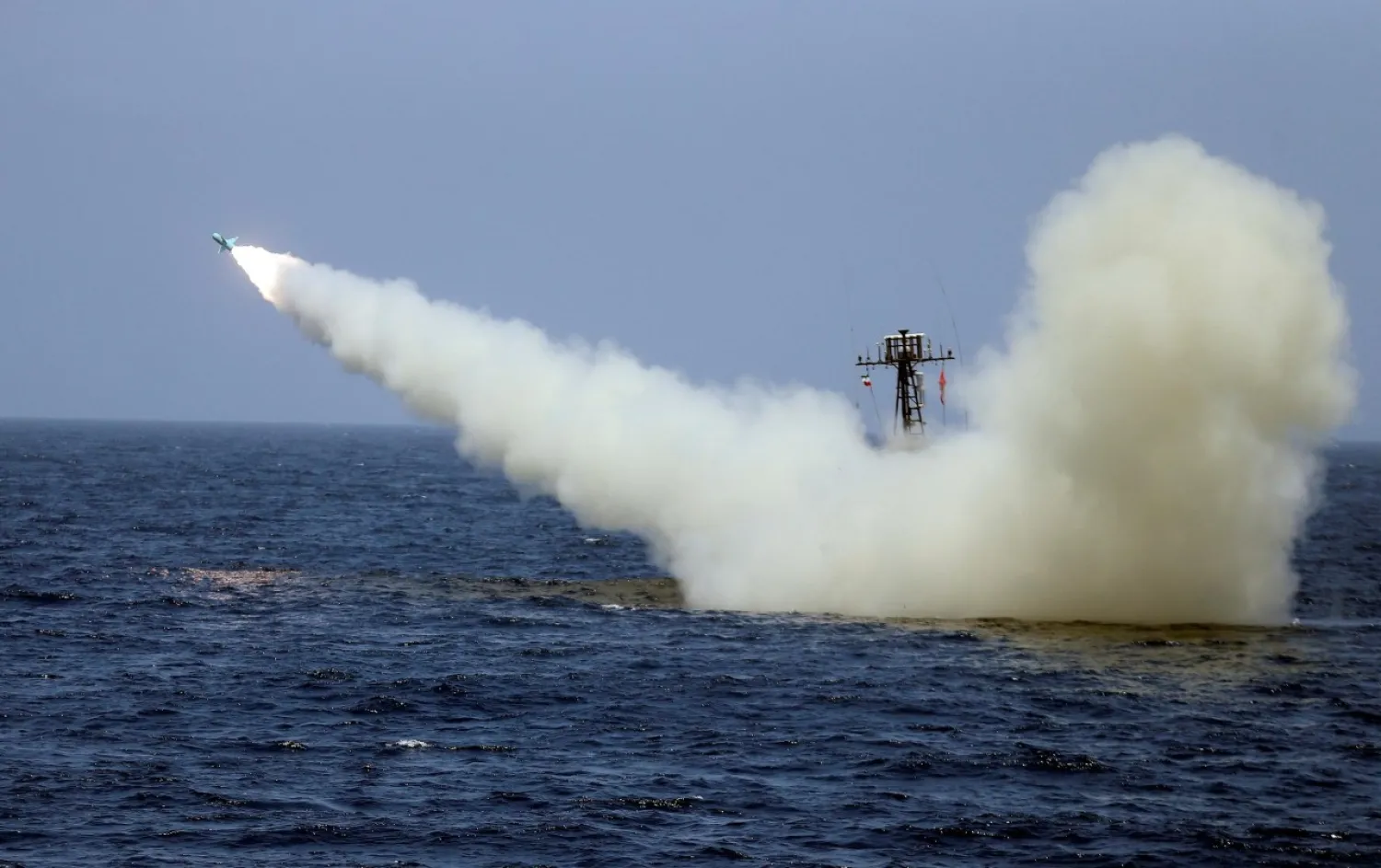
An Iranian locally made cruise missile is fired during war games in the northern Indian Ocean and near the entrance to the Gulf, Iran June 17, 2020. Picture taken June 17, 2020. WANA (West Asia News Agency) via REUTERS
TT

Arabs Demand Halt of Iran's Regional Interventions

An Iranian locally made cruise missile is fired during war games in the northern Indian Ocean and near the entrance to the Gulf, Iran June 17, 2020. Picture taken June 17, 2020. WANA (West Asia News Agency) via REUTERS

The Arab League Secretary-General, Ahmed Aboul Gheit, has denounced Iran’s military, political, and religious meddling in the Gulf and several Arab states, in his recent remarks at a virtual meeting of the United Nations Security Council on Tuesday.

Nevertheless, Aboul Gheit expressed the Arab countries' hope to build constructive and healthy ties with the neighboring countries.

The Gulf’s security could be in its idle state when the concept of good neighborhood dominates and the option of the use of power is ruled out, he noted. Only then, it is possible to establish a collective security system that guarantees all parties' interests and ensures the freedom of navigation.

The secretary-general flagged up the fact that the Gulf remains the most jeopardized by armed conflicts. He listed as an example, last year's sabotage military activities to which the UN held one party accountable. Iran was the party pointed at, Aboul Gheit added, not only for standing behind the sabotage activities but also for threatening international navigation and recruiting militias in countries.

He stated that sovereignty is a cornerstone for regional security, and any endeavors towards building confidence between the opposing sides of the Gulf should launch from holding talks on sovereignty. As he emphasized that collective security guarantees all parties’ interests, he regretted that, however, it remained out of reach.

For his part, Secretary-General of the Gulf Cooperation Council Nayef Falah Al-Hajraf said the Gulf region is essential to international peace and stability but is experiencing turmoil due to Iran’s approach of violence and destabilization, including the use of drones and missiles.

He further accused Iran of inciting violence and instability in some countries in the region, such as Iraq, Syria, Lebanon, and Yemen. "It is unfortunate that Iran, especially since 2011, has used the methods of hostility, violence, and destabilization in the region to achieve its political goals," Hajraf added.

Some GCC member states have been repeatedly attacked by Iran and its representatives in the region, such as ballistic missile and drone strikes in Saudi Arabia targeting civilian areas. For that, Hajraf underscored the importance of having a comprehensive international agreement to ensure that Iran does not acquire any nuclear weapons.



Vatican Says It Will Not Participate in Trump’s ‘Board of Peace’ 

Pope Leo XIV speaks after leading a Mass during a visit to the parish of Santa Maria Regina Pacis in Ostia Lido, Rome, Italy, February 15, 2026. (Reuters)
TT

Vatican Says It Will Not Participate in Trump’s ‘Board of Peace’ 

Pope Leo XIV speaks after leading a Mass during a visit to the parish of Santa Maria Regina Pacis in Ostia Lido, Rome, Italy, February 15, 2026. (Reuters)

The Vatican ‌will not participate in US President Donald Trump's so-called "Board of Peace" initiative, Cardinal Pietro Parolin, the Vatican's top diplomatic official, said on Tuesday while adding that efforts to handle crisis situations should be managed by the United Nations.

Pope Leo, the first US pope and a critic of some of Trump's policies, was invited to join the board in January.

Under Trump's Gaza plan that led to a fragile ceasefire in October, the board was meant to supervise Gaza's temporary governance. Trump thereafter said the board, with him as chair, would ‌be expanded to ‌tackle global conflicts.

The board will hold its ‌first ⁠meeting in Washington ⁠on Thursday to discuss Gaza's reconstruction.

Italy and the European Union have said their representatives plan to attend as observers as they have not joined the board.

The Holy See "will not participate in the Board of Peace because of its particular nature, which is evidently not that of other States," Parolin said.

"One concern," he said, "is that ⁠at the international level it should above all ‌be the UN that manages ‌these crisis situations. This is one of the points on which we have insisted."

The ⁠Gaza truce has been repeatedly violated with hundreds of Palestinians and four Israeli soldiers reported killed since it began in October.

Israel's assault on Gaza has killed over 72,000, caused a hunger crisis and internally displaced Gaza's entire population.

Multiple rights experts, scholars and a UN inquiry say it amounts to genocide. Israel calls its actions self-defense after Hamas-led fighters killed 1,200 people and took over 250 hostages in a late 2023 attack.

Leo has repeatedly decried conditions in Gaza. The pope, leader of the world's 1.4 billion Catholics, rarely joins international boards. The Vatican has an extensive diplomatic service and is a permanent observer at the United Nations.


Poland Bars Chinese-Made Cars from Military Sites Over Data Security Fears 

A soldier from the 18th Mechanized Division stands guard on a Light Strike Vehicle "Zmija" during a media tour organized by the country's military to demonstrate the security measures on the Polish Belarusian border, near Bialowieza, Poland, January 10, 2025. (Reuters)
TT

Poland Bars Chinese-Made Cars from Military Sites Over Data Security Fears 

A soldier from the 18th Mechanized Division stands guard on a Light Strike Vehicle "Zmija" during a media tour organized by the country's military to demonstrate the security measures on the Polish Belarusian border, near Bialowieza, Poland, January 10, 2025. (Reuters)

Poland has barred Chinese-made vehicles from entering military facilities due to concerns their onboard sensors could be used to collect sensitive data, the Polish Army said on Tuesday evening.

The army said in ‌a statement ‌that such vehicles ‌may ⁠still be allowed onto ⁠secured sites if specified functions are disabled and other safeguards required under each facility's security rules are in place.

To ⁠limit the risk ‌of ‌exposing confidential information, the military has ‌also banned connecting company ‌phones to infotainment systems in vehicles manufactured in China.

The restrictions do not apply ‌to publicly accessible military locations such as hospitals, ⁠clinics, ⁠libraries, prosecutors' offices or garrison clubs, the army said.

It added that the measures are precautionary and align with practices used by NATO members and other allies to ensure high standards of protection for defense infrastructure.


Starmer, Trump discussed Russia-Ukraine, Iran after Geneva Talks, Downing Street Says 

US President Donald Trump and British Prime Minister Keir Starmer announce an agreement between the two countries as they hold a press conference at Chequers at the conclusion of a state visit on September 18, 2025 in Aylesbury, Britain. (Reuters)
TT

Starmer, Trump discussed Russia-Ukraine, Iran after Geneva Talks, Downing Street Says 

US President Donald Trump and British Prime Minister Keir Starmer announce an agreement between the two countries as they hold a press conference at Chequers at the conclusion of a state visit on September 18, 2025 in Aylesbury, Britain. (Reuters)

British ‌Prime Minister Keir Starmer spoke to US President Donald Trump on Tuesday night about US-mediated Russia-Ukraine peace talks in Geneva, as well as talks between the US and Iran on ‌their nuclear ‌dispute, a Downing Street ‌spokesperson ⁠said.

Starmer also discussed ⁠Gaza with Trump and stressed on the importance of securing further access for humanitarian aid, the spokesperson said.

Negotiators ⁠from Ukraine and ‌Russia ‌concluded the first of two days ‌of the US-mediated ‌peace talks in Geneva on Tuesday, with Trump pressing Kyiv to act fast ‌to reach a deal.

Separately, Iranian Foreign Minister ⁠Abbas ⁠Araqchi said Tehran and Washington reached an understanding on Tuesday on "guiding principles" aimed at resolving their longstanding nuclear dispute, but that did not mean a deal is imminent.