


US Wants to Keep Iran out of Southern Syrian

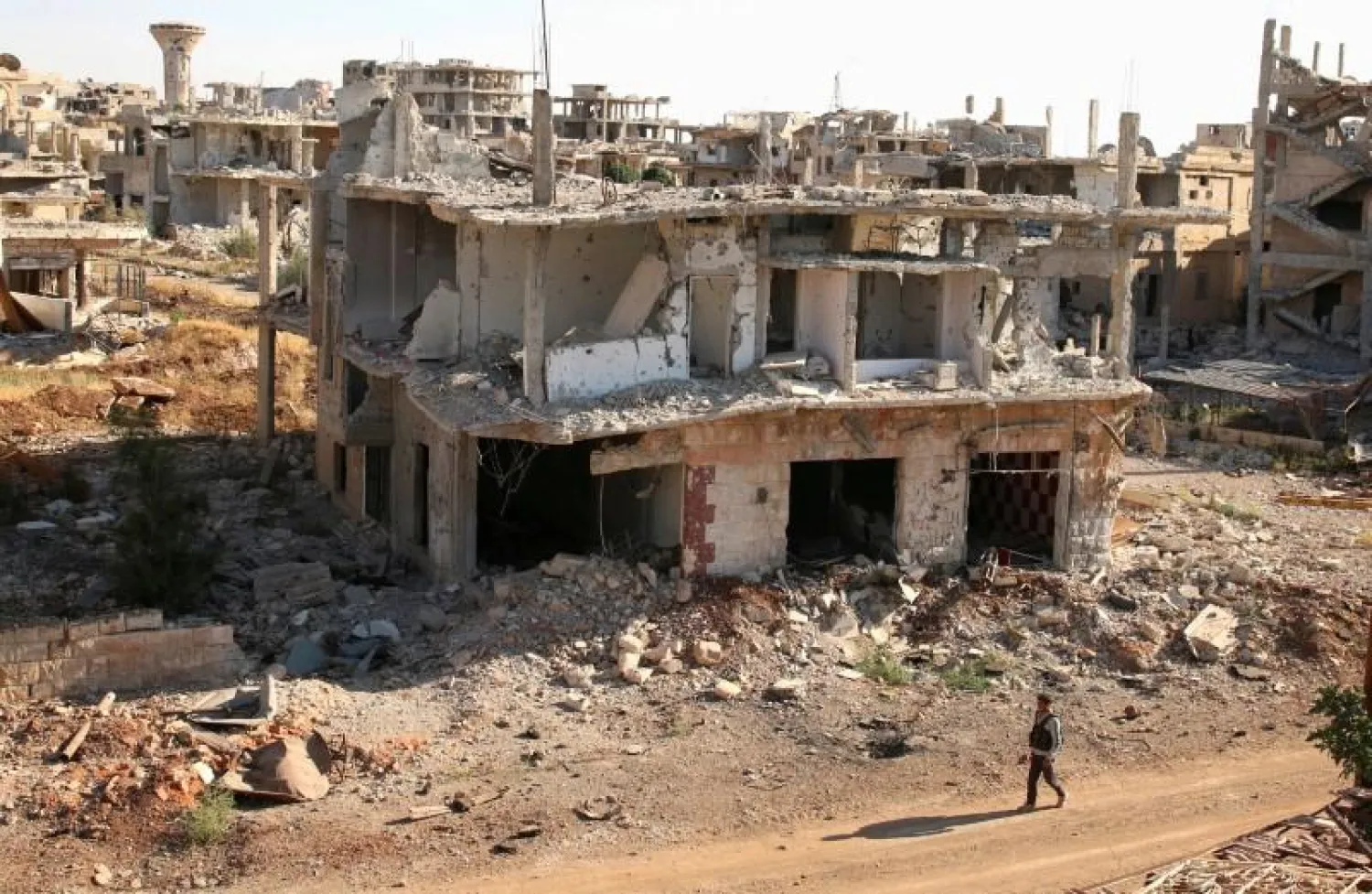
A rebel fighter walks past damaged buildings in a rebel-held part of the southern city of Deraa, Syria June 22, 2017. (File Photo: Reuters /Alaa Al-Faqir)
TT

US Wants to Keep Iran out of Southern Syrian

A rebel fighter walks past damaged buildings in a rebel-held part of the southern city of Deraa, Syria June 22, 2017. (File Photo: Reuters /Alaa Al-Faqir)

The United states is trying to push Russia to comply with the "de-escalation" agreement in southern Syria and prevent regime forces and Iran-backed organizations from advancing to it, as well as to implement the terms of the agreement, which state that Hezbollah and other Tehran-affiliated Syrian and foreign groups must be about 25 kilometers from the Jordanian border.

Parts of the provinces of Daraa, Quneitra and Suwayda south of Syria are one of the areas to reduce the escalation according to US-Russian-Jordanian agreement in July. After Ghouta and Homs, it is clear that Damascus has settled its choice to push its forces and organizations backed by Iran to the south.

On Saturday, Washington asked Moscow to honor its obligations under Presidents Donald Trump and Russia President Vladimir Putin's statement last year.

After Ghouta and Homs, it is clear that Damascus has decided to push its forces and organizations supported by Iran to the south, including the forces of Brig. Suhail al-Hassan, known as the "tiger" and the fourth division, "al-Quds Brigade" of the Popular Front-General Command led by Ahmed Jibril.

On Friday, Syrian aircraft dropped leaflets on Daraa, urging fighters to lay down their weapons or face an offensive. One of the leaflets included a picture showing lined up bodies of anti-regime fighters, with the caption warning that this is the “inevitable fate of anyone who insists on carrying arms.” Another leaflet announced the arrival of the Syrian Arab army’s soldiers.

Opposition factions control 70 percent of Daraa and parts of the district center, while regime forces retain control over the majority of the north.

In May 2017, negotiations were launched between Washington, Moscow and Amman to establish a de-escalation zone in the south, which led to the agreement between Trump and Putin on the sidelines of Hamburg summit. It was later re-established at the Asia-Pacific Economic Cooperation (APEC) summit in Vietnam, in November.

At the time, then US Secretary of State Rex Tillerson and Russian Sergei Lavrov reached an agreement that included de-escalation in the south as a "temporary step" to maintain a ceasefire and ultimate elimination of presence of foreign forces and fighters from the region to ensure a more sustainable peace.

For Moscow, the plan, which guaranteed Russian-US cooperation, meant the total elimination of the al-Nusra Front and ISIS-affiliate Khalid Army. At that time, the Trump administration made a concession that it had frozen the secret program to support opposition factions. At the end of last year, military and financial support for 35,000 opposition fighters on the southern front was effectively halted.

During the battles of Ghouta, opponents tried to mobilize for "Najda al-Ghouta", however, the US Embassy in Amman sent a letter to the leaders of the southern front factions of Free Syrian Army, saying that Russian or Syrian air strikes do not mean in any way the termination of the de-escalation agreement between the United States, Russia and Jordan.

As reinforcements approached Daraa and Iranian militias were re-deployed, opposition allies began to consider their options.

Sources told Asharq Al-Awsat that over the past week, Deputy Assistant Secretary of State David Satterfield was working on formulating a proposal which included the withdrawal of all Syrian and non-Syrian militias to 20-25 kilometers from the Jordanian border, the transfer of opposition fighters and their families to Idlib in northern Syria, the reopening of the crossing point between Syria and Jordan, in addition to the formation of a US-Russian mechanism to control the implementation of the agreement.

Satterfield also wants to discuss the possibility of dismantling US Tanf camp at the Syrian-Jordanian-Iraqi border, which has been publicly criticized by Moscow.

Jordanian officials also tried to get in touch with the Russians to obtain "guarantees" to secure the borders and not to bring new refugees to Jordan. They also want to open the way for the return of Syrian refugees to their country.

Satterfield is likely to leave office and possibly become an ambassador to Ankara.

The State Department announced on Saturday that it would take “firm and appropriate measures in response to Assad regime violations”, saying it was concerned by reports of an impending Assad regime operation in southwest Syria within the boundaries of the de-escalation zone negotiated between the United States, Jordan, and Russia.

“As a guarantor of this de-escalation area with Russia and Jordan, the United States will take firm and appropriate measures in response to Assad regime violations,” State Department spokeswoman Heather Nauert said in a statement late on Friday.

“It is time for Russia to acknowledge its role in the shooting down of MH17 and to cease its callous disinformation campaign,” added the spokeswoman.

The resumption of talk about the withdrawal of Iranian-backed militias from southern Syria and the pressure to abide by the "southern truce" coincided with two elements: first, the ongoing Israeli raids on Iranian and Hezbollah sites in Syria, and Putin’s statement after meeting with Assad.

A Western official noted that the Israeli raids on Iranian sites in Syria coincided with the visit of Israeli Prime Minister Benjamin Netanyahu to Moscow, "which means a Russian political and field approval because the Russian army did not operate the defense system of S-400 missiles located in western Syria."

The official explained that it was remarkable that after the raid, Russia did not take any diplomatic measure nor did it criticize them, like it did after the US-British-French tripartite raids on regime sites in April in response to a chemical attack on Douma.

Putin said after meeting with Assad that foreign armed forces will be withdrawn from the territory of the Syrian Arab Republic.

A day later, Putin’s envoy for Syria, Alexander Lavrentiev clarified that Putin’s comment was aimed at the US and Turkey along with Iran and Hezbollah.

“This statement involves all foreign troops in Syria including the Turkish, American, Iranian and Hezbollah,” he said, but added that Putin’s comments should be viewed as a “political statement” rather than as the beginning of a withdrawal process.

Later, Iran’s Foreign Ministry spokesperson Bahram Qasemi responded by saying that as long as terrorism exists and the Syrian government wants, Iran will be present in Syria.

“Those who have entered Syria without the consent of the Syrian government should leave,” indicated Qasemi.

Syria’s Deputy Foreign Minister Faisal Mekdad responded by hailing Iran’s assistance to his country, stressing that the pullout of the Iranian military advisers from the Arab country was not up for discussion.

Diplomats considered it a sign of additional disagreement between Russia and Iran. They believe Damascus is trying to balance between the two allies. However, it is becoming increasingly difficult as the battles approach areas where Moscow has come to terms with foreign countries.

“Damascus seems to be closer to the Iranian option in terms of the southern battle,” they indicated.

One diplomat indicated that the past few days had witnessed a "re-deployment" of Iranian forces, which are now, according to him, few kilometers away from the Jordanian border, but stayed closer to Golan Heights.

Syria sent a proposal through mediators to regional states that included: the withdrawal of Hezbollah and Iranian militias 25 kilometers away from the disengagement area from the occupied Golan Heights, in accordance with arrangements allowing the presence of local councils in Beit Jann and villages in the liberated Golan Heights as well as considering the possibility of reviving the agreement on disengagement between Syria and Israel of 1974.

At the same time, backed by Iran, Damascus continues to reinforce its troops and vehicles to the south. Scenarios similar to Ghouta are proposed for the Damascus region, and before that east of Aleppo, where the forces advance from Daraa to the Naseeb crossing with Jordan. East of de-escalation area will be separated from the west and several strategic hills will become under control. At the same time, troops will increase the raids taking control of areas one after the other.

In practice, this means pushing the opposition to choose between three options: the "Douma model", “Hammouriya model" in Ghouta, which came under the "scorched earth" approach, and the "Sakba model" which is between the first two approaches.

Damascus is trying to put it under the pretense of fighting "al-Nusra Front" or "Khalid army" of ISIS, although the tripartite agreement to reduce the escalation stipulated that it is the responsibility of the guarantors of the agreement, namely US and Russia, which was confirmed by Washington in its Department of State statement.



Hundreds in Somalia’s Capital Protest Israel’s Recognition of Breakaway Territory of Somaliland

People protest against Israel’s recognition of the self-declared Republic of Somaliland in Mogadishu, Somalia, Thursday, Jan. 8, 2026. (AP)
TT

Hundreds in Somalia’s Capital Protest Israel’s Recognition of Breakaway Territory of Somaliland

People protest against Israel’s recognition of the self-declared Republic of Somaliland in Mogadishu, Somalia, Thursday, Jan. 8, 2026. (AP)

Hundreds of demonstrators gathered in Somalia’s capital to protest Israel’s recognition of the self-declared Republic of Somaliland, waving Somali flags and chanting patriotic songs in a show of national unity.

The protest on Thursday night took place at Taleh Square in downtown Mogadishu, where the crowds condemned Israel’s move as a violation of sovereignty and territorial integrity in the east African country. Demonstrators carried placards rejecting what they described as foreign interference in Somalia’s internal affairs.

The rally came two weeks after Israel announced that it recognized Somaliland as an independent and sovereign nation — and two days after Israel’s foreign minister visited Hargeisa, the Somaliland capital. On his visit, Foreign Minister Gideon Saar said that Israel would soon open an embassy and appoint an ambassador.

Thursday night's demonstration was the third such event since Israel recognized Somaliland on Dec. 26.

“We are protesting against the division of our country,” demonstrator Said Gedi said. “This is against the sovereignty, independence and territorial integrity of Somalia, and we hope Somalia will stand united.”

Another protester, Abdirahman Abdulkadir, said that the demonstration was meant to send a message of unity.

“Somalia cannot be divided,” he said. “We are united by one religion, one culture and the same heritage.”

The demonstration coincided with a televised address by President Hassan Sheikh Mohamud, who strongly rejected Israel’s decision and urged dialogue between Somaliland’s leaders and the federal government in Mogadishu.

“I want to make it clear once again that the Republic of Somalia is a sovereign and united country,” Mohamud said. “Its territory cannot be divided or ceded by any letter written by Israel or signed by (Israeli Prime Minister Benjamin) Netanyahu.”

Mohamud warned that the dispute could undermine Somalia’s political stability, economic recovery and development if not handled carefully. He urged Somaliland’s leadership to aim for talks, saying successful secessions elsewhere usually happened through political agreements. He cited examples including South Sudan, which became independent of Sudan in 2011.

Israel has no historical, cultural or economic ties with Somalia, he said.

Somaliland, a former British protectorate, declared independence from Somalia in 1991 following the collapse of the central government. Despite maintaining its own institutions and relative stability, it had never been recognized by a UN member state.

More than 20 mostly Middle Eastern or African countries and the Organization of Islamic Cooperation rejected Israel’s move.

Egyptian Foreign Minister Badr Abdelatty said Tuesday that Israeli recognition of Somaliland was a “dangerous precedent that threatens regional and international peace and security.”

US and Israeli officials told The Associated Press last year that Israel had approached Somaliland about taking in Palestinians from Gaza as part of US President Donald Trump’s plan at the time to resettle the territory’s population. Somalia's foreign ministry says such a proposal has neither been discussed nor considered.

Washington has since abandoned that plan, and the US State Department says it continues to recognize the territorial integrity of Somalia, “which includes the territory of Somaliland.”


Israel Casts Doubt on Hezbollah Disarmament South of the Litani

A French peacekeeper of the United Nations Interim Force in Lebanon (UNIFIL) stands by munitions formerly used by Iran-backed Hezbollah at a position that was held by the group in the Khraibeh Valley in el-Meri in south Lebanon on August 27, 2025. (AFP)
TT

Israel Casts Doubt on Hezbollah Disarmament South of the Litani

A French peacekeeper of the United Nations Interim Force in Lebanon (UNIFIL) stands by munitions formerly used by Iran-backed Hezbollah at a position that was held by the group in the Khraibeh Valley in el-Meri in south Lebanon on August 27, 2025. (AFP)

Israel on Thursday voiced skepticism over the Lebanese Army’s announcement that its plan to seize weapons from southern Lebanon has reached an advanced stage, calling the effort insufficient.

The reaction came even as Israeli Prime Minister Benjamin Netanyahu described the move as an “encouraging beginning,” while reiterating accusations that Hezbollah is rearming with Iranian support.

In a statement, Netanyahu’s office said the efforts by the Lebanese government and army to disarm Hezbollah amount to “a promising start, but absolutely not enough.”

It accused the group of attempting to rebuild its military infrastructure with backing from Iran, stressing that the US-brokered ceasefire agreement clearly calls for Hezbollah’s complete disarmament.

Israel’s Foreign Ministry echoed this skepticism, saying Hezbollah’s military infrastructure south of the Litani River remains intact and that the goal of disarming the group in southern Lebanon “is still far from being achieved.”

The ministry described the Lebanese Army’s efforts as limited, repeating claims that Hezbollah continues to rearm with Iranian assistance.

The Israeli security establishment adopted a sharper tone. Army Radio quoted military sources as saying statements by the Lebanese Army about disarmament in the south “do not reflect reality on the ground,” asserting that Hezbollah fighters and infrastructure are still present south of the Litani.

A military source told Haaretz that Israel’s assessment of the disarmament process “is not based on declarations, but on data and operational results,” adding that as long as Hezbollah’s military structures remain in place, there can be no talk of genuine disarmament.

Yedioth Ahronoth, citing military sources, reported that the Lebanese announcement had been expected and that Israel is inclined to reject claims that the area south of the Litani has been effectively disarmed.

According to the paper, the Israeli army believes Hezbollah still maintains combat capabilities there, describing the Lebanese Army’s performance as slow and partial, despite reaching sites where it was tasked with collecting Hezbollah weapons.

Lebanese parliamentary sources said Israel’s skeptical stance comes as no surprise. MP Mohammed Khawaja, of the Development and Liberation bloc, warned that Israeli threats against Lebanon “have not stopped and continue through its media,” stressing that the danger is aimed at all Lebanese, not a specific group or faction.

Speaking to Asharq Al-Awsat, Khawaja said Israel is openly threatening the region and that Lebanon has long been part of its ambitions.

MP Waddah Al-Sadek said Netanyahu’s recent remarks suggest that, from Israel’s perspective, the continuation of the ceasefire is now conditional on Hezbollah’s full disarmament.

He argued that Israel’s description of Lebanese efforts as encouraging but inadequate may be a sign that an escalation could happen in the future despite assurances from Lebanon’s leaders and army command of their commitment to the ceasefire.

In Israel’s view, he said, such commitments are meaningless without concrete measures and a clear timetable for disarmament, conditions that risk providing Israel with justification for further escalation.


Chinese Envoy Visited Israel and Ramallah This Week, Ministry Says

Israeli Foreign Minister Gideon Saar speaks during a meeting with Hungary's Foreign Minister Peter Szijjarto (not pictured), in Budapest, Hungary, October 27, 2025. (Reuters)
TT

Chinese Envoy Visited Israel and Ramallah This Week, Ministry Says

Israeli Foreign Minister Gideon Saar speaks during a meeting with Hungary's Foreign Minister Peter Szijjarto (not pictured), in Budapest, Hungary, October 27, 2025. (Reuters)

A Chinese envoy visited Israel and Ramallah ​this week and met senior officials from both sides, China's foreign ministry said in statements on ‌Friday.

Zhai Jun, ‌special ‌envoy ⁠of ​the ‌Chinese government on the Middle East issue, was in Israel from Tuesday to Thursday and held talks ⁠with Israeli officials ‌including Foreign Minister Gideon ‍Saar ‍and "exchanged views on ‍regional hot issues".

In a separate statement, the ministry said Zhai ​also visited Ramallah in the West Bank ⁠on Wednesday and held a meeting with Palestinian President Mahmoud Abbas in which they discussed China-Palestinian relations and the Palestinian issue.