
Hariri Calls On Italy to Increase Investment in Lebanon
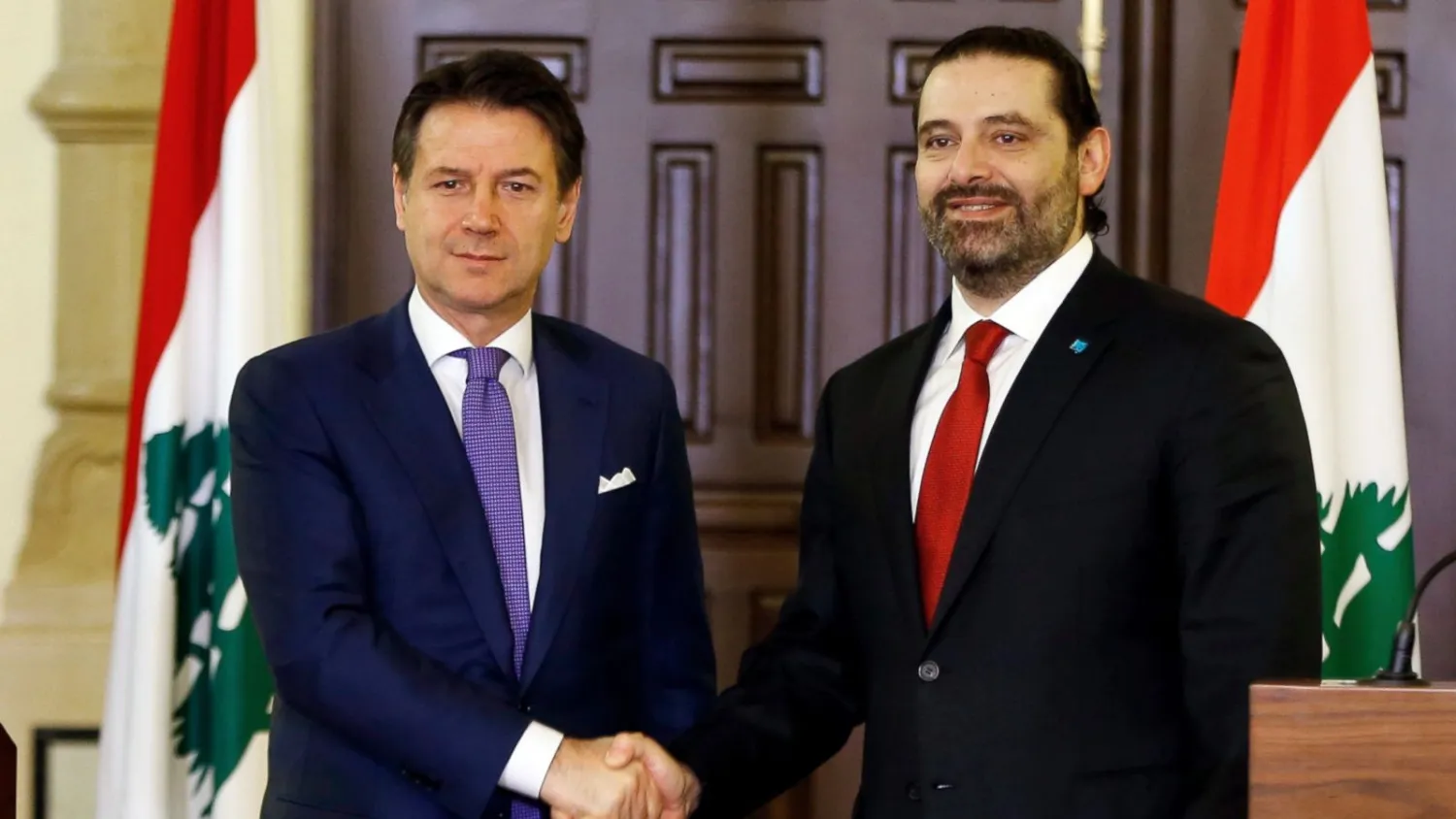
Italian Prime Minister Giuseppe Conte, left, shakes hands with his Lebanese counterpart Saad Hariri after a joint press conference, at the Government House in Beirut, Lebanon, Thursday, Feb. 7, 2019. (AP Photo/Bilal Hussein)
Hariri Calls On Italy to Increase Investment in Lebanon
Italian Prime Minister Giuseppe Conte, left, shakes hands with his Lebanese counterpart Saad Hariri after a joint press conference, at the Government House in Beirut, Lebanon, Thursday, Feb. 7, 2019. (AP Photo/Bilal Hussein)
Lebanon's Prime Minister has called on Italian companies to invest in his country as it seeks to address deepening economic challenges.
Saad Hariri met with his Italian counterpart, Giuseppe Conte, at the Grand Serail in Beirut on Thursday.
The two Prime Ministers then held a meeting attended by Minister Jamal Jarrah, former minister Ghattas Khoury, the Italian Ambassador to Lebanon Massimo Marotti and the Secretary General of the Council of Ministers Fouad Fleifel.
After Hariri and Conte held a closed meeting, they toured parts of the Serail and held a joint press conference.
Hariri lauded the relations between Lebanon and Italy and said that "the coming period in Lebanon is a period of work ... with many investment opportunities."
"The relations between Lebanon and Italy are historic and deeply rooted, and we will work together in the next phase to develop and activate them on all levels, especially at the economic, trade and investment levels," Hariri said.
"Italy has always been at the forefront of Lebanon's commercial partners in terms of our imports, which we hope will apply to Lebanese exports to Italy in the near future."
Italy is a traditional trading partner of Lebanon, has invested in its gas and oil sector and also supports Lebanese military and security forces. Rome has over 1,000 peacekeepers in the UN force monitoring the ceasefire with Israel.
Hariri said he's "convinced that Lebanon can be a regional center for the Italian private sector."
For his part, Conte said that Italy is ready to invest in Lebanon and Italian companies are willing to offer their expertise to their Lebanese counterparts.
"We agreed to organize a visit for Lebanese Prime Minister Saad Hariri to Italy to encourage Italian companies to invest in development projects in Lebanon," Conte said.
He said that Italy will continue to support Lebanon on all levels, stressing the strong friendship between the two countries "based on mutual respect and a common Mediterranean identity."
"Italy has long stood by the Lebanese institutions and the Lebanese people and will continue to contribute to the peace process, to dialogue and to social cohesion."
Furthermore, Hariri thanked Italian companies that are active in fields such as oil and gas and electricity.
"We want to encourage these companies to come and explore investment opportunities in Lebanon," he said.
Hariri added that Lebanon is about to implement numerous infrastructure projects under the framework of CEDRE in which Italian companies can have a stake.
The CEDRE is an international conference in support of Lebanon's development and reforms. Hariri's government hopes to unlock around $11 billion in soft loans and grants pledged by international donors in Paris last year.
Hariri also expressed his gratitude for Italy for always standing beside Lebanon while providing humanitarian and military assistance.
Later in the day, the Italian prime minister will meet with Lebanese President Michel Aoun and Parliament Speaker Nabih Berri and visit Italy's UNIFIL (the UN Interim Forces in Lebanon) contingent.
Palestinians walk amid war-damaged buildings in Gaza City, Wednesday, Sept. 23, 2026. (AP Photo/Jehad Alshrafi)
Israel's army said Friday that two reserve soldiers were killed in Gaza, with a military source telling AFP they died in an explosion of an Israeli army drone.
"The IDF drone crashed at a military post in the Gaza Strip but did not explode. The soldiers approached the drone, which exploded moments later," the official said.
The army identified the soldiers as Nadav Kali, aged 24, and Ofek Moalem, 23, from its 7007th Battalion, 16th Brigade.
‘Tripoli Cell’ Sparks Accusations Among Libya’s Rival Factionshttps://english.aawsat.com/arab-world/5322381-%E2%80%98tripoli-cell%E2%80%99-sparks-accusations-among-libya%E2%80%99s-rival-factions
Firefighters fought to contain a blaze burning at an oil facility in Libya’s key western oil town of Zawiya, on Aug. 12, 2006, a day after a drone strike ignited a gasoline-storage tank. AP
‘Tripoli Cell’ Sparks Accusations Among Libya’s Rival Factions
Firefighters fought to contain a blaze burning at an oil facility in Libya’s key western oil town of Zawiya, on Aug. 12, 2006, a day after a drone strike ignited a gasoline-storage tank. AP
The dismantling of the alleged “sabotage cell” in the Libyan capital, Tripoli, has sparked accusations between the parties to Libya’s conflict, with each side pointing fingers over who is supporting the group.
On September 6, the Government of National Unity (GNU) announced the arrest of a cell accused of carrying out drone attacks on oil storage facilities and a power station in Tripoli and Zawiya. Since then, however, no further details have been released regarding the results of the investigation with five Libyans and several foreigners.
Some allege that Saddam Haftar, deputy commander-in-chief of the Libyan National Army (LNA), was behind the cell, claims that political analyst Omar Bousaada dismissed as “absurd accusations that no longer deceive anyone.”
The GNU’s Ministry of Defense had stated that it had also thwarted additional plots, including plans to target the South Tripoli power station as well as vital infrastructure and political, security, and military figures.
With the Public Prosecutor’s Office maintaining secrecy over the investigation into the detained cell members, some public figures have adopted narratives circulated by foreign media outlets, leading to intense political exchanges.
Libyan activist Ahmed Al-Zarrouq claimed that the Tariq Ben Zeyad Brigade, affiliated with the LNA, was responsible for the “sabotage cell” that targeted key facilities in Tripoli with the aim of creating crises in the capital.
Al-Zarrouq, a cousin of Saif al-Islam Gaddafi, asserted that Saddam Haftar was behind the cell, which allegedly consisted of one Spaniard and four Libyans. He published their names and the roles they were assigned.
The Allibiya TV Channel, owned by the Al Ghad Media Group and considered close to Saif al-Islam Gaddafi, echoed Al-Zarrouq’s narrative. The channel also cited unnamed sources claiming that Tripoli authorities had released the Spanish suspect accused of involvement in the cell under pressure from Saddam Haftar.
A security source close to the LNA denied the allegations, telling Asharq Al-Awsat that Libya’s political, military, and security climate is moving toward greater stability and that ending the country’s division through elections is within reach.
The source, who requested anonymity because he is not authorized to speak to the media, argued that some factions in Libya benefit from division and fragmentation rather than stability. He questioned how such allegations could emerge at a time when military and security leaders in both Benghazi and Tripoli are publicly emphasizing the need to end the country’s split.
On September 19, Presidential Council Chairman Mohamed Al-Menfi revealed that Libya had formally approached the International Criminal Court (ICC) for technical, technological, and legal support to strengthen investigations into the cell.
Bousaada told Asharq Al-Awsat that “fabricated statements and frivolous accusations have become a trademark of failure” propagated by what he described as “factories of illusion,” which, he said, resort to manipulating narratives and manufacturing scenarios whenever they feel politically marginalized or operationally weakened.
He argued that linking Saddam Haftar to the cell “is not merely false, but a desperate attempt to obscure the reality that his camp is currently operating from a position of strength and possesses genuine negotiating leverage that has secured its presence in major regional and international decision-making capitals.”
In his statement, Al-Menfi said Libya had submitted its request to the ICC Prosecutor’s Office through official diplomatic channels, via the Ministry of Foreign Affairs and in coordination with the Ministry of Defense, to enhance cooperation in the ongoing investigation.
Meanwhile, the GNU Ministry of Defense insisted that the case remains under the jurisdiction of the Public Prosecutor’s Office and denied any attempt to negotiate with any party regarding the matter. The ministry reaffirmed that investigations are continuing to identify all individuals involved in the sabotage cell and any entities connected to it.
Prefabricated Homes Arrive in Destroyed South Lebanon Townhttps://english.aawsat.com/arab-world/5322378-prefabricated-homes-arrive-destroyed-south-lebanon-town
Workers set up a prefabricated house to provide housing for families whose homes have been destroyed in the fighting between Hezbollah and Israel, in the village of Zawtar al-Gharbiyeh (Western Zawtar) in southern Lebanon, on September 21, 2026. (Photo by Ammar Ammar / AFP)
Prefabricated Homes Arrive in Destroyed South Lebanon Town
Workers set up a prefabricated house to provide housing for families whose homes have been destroyed in the fighting between Hezbollah and Israel, in the village of Zawtar al-Gharbiyeh (Western Zawtar) in southern Lebanon, on September 21, 2026. (Photo by Ammar Ammar / AFP)
Nearly two months after the Lebanese army entered the town of Zawtar al-Gharbiyeh in southern Lebanon, temporary housing units have started reaching families unable to live in their homes.
The army began deploying in Zawtar al-Gharbiyeh end of July after Israeli forces withdrew from the area, marking the first test of a US-brokered plan agreed by Lebanon and Israel in direct talks.
The plan foresees the Lebanese army confiscating weapons from Hezbollah in designated areas and Israeli troops withdrawing in phases so that Lebanese troops can deploy. Zawtar al-Gharbiyeh is one of several towns or villages covered by the initial pilot program.
On Tuesday, the Council for the South began handing over the first batch of prefabricated homes to property owners whose plots had been cleared of rubble and prepared to receive the units.
This comes in coordination with the Military Coordination Group for Lebanon.
Workers set up a prefabricated house to provide housing for families whose homes have been destroyed in the fighting between Hezbollah and Israel, in the village of Zawtar al-Gharbiyeh (Western Zawtar) in southern Lebanon, on September 21, 2026. (Photo by Ammar Ammar / AFP)
On September 9, authorities announced that around 70 percent of the town’s residents had been able to return to inspect their properties, while only 16 percent, estimated at about 60 families out of 450, had been able to resettle. Officials estimated that 85 percent of homes had been completely destroyed and 15 percent partially damaged.
A source at the Higher Relief Commission told Asharq Al-Awsat that the prefabricated homes in Zawtar are part of a broader effort to support residents’ return and that solutions will vary according to the extent of destruction and local needs.
“We are now in the first phase, and while solutions in the villages covered by this stage may be similar or serve as models, they will not be identical because the scale of destruction differs from one area to another. The farther south we go, the more widespread the devastation becomes, making it impossible to apply a single solution to every town.”
The source explained that the response would rely on “a combination of solutions,” with prefabricated homes being one of them, adding that efforts are underway to secure available units locally as well as additional supplies from donors or foreign sources.
“We had the option of obtaining as many prefabricated homes as the local market could provide, while arranging for additional quantities from donor countries and external sources, allowing us to prepare for the first phase. In later stages, the need will certainly be greater.”
The source noted that Lebanese officials had explored opportunities for aid and grants during overseas visits, including to Türkiye, saying: “The cost of a prefabricated home in the local market is not cheap. We know this type of housing is only part of the solution, so we must secure it either through available resources or through grants and assistance.”
He added that while prefabricated homes may currently be a key solution in Zawtar, demand for them could be even greater in other areas during later phases.
“Unfortunately, our capabilities do not allow us to provide enough prefabricated homes for everyone in need. We are talking about roughly 300,000 housing units that are either completely destroyed or damaged to a degree that makes them uninhabitable. This is an enormous number. Therefore, prefabricated housing is one solution, not the only one.”
He stressed that the initiative marks the beginning of a broader process aimed at enabling residents to return and reasserting the presence of the state in the south, followed by restoring government agencies and institutions.
“It is not enough to ask people to return simply because homes are livable or because we have provided prefabricated housing if public institutions remain absent. If there is no municipal office, civil defense center, police station, or clinic, how can a normal return take place? The return of residents must go hand in hand with the return of state institutions, with prefabricated housing serving as one of the tools that help make this possible.”
Zawtar al-Gharbiyeh Mayor Abed Ezzeddine told Asharq Al-Awsat that introducing prefabricated homes addresses the “exceptional situation” of families who remain displaced. He explained that the municipality had requested 15 units.
“We have a number of families that are still displaced, some of whom can no longer afford rent. Other families are staying in buildings that must be vacated as schools reopen. We therefore needed to provide temporary shelter until their circumstances improve, especially with winter approaching.”
“There are also other families demanding to return to the town, which means we will likely need more than 15 homes,” he added.
“People want to return to Zawtar, but they need somewhere to stay while they work to rebuild their lives.”
“Many people come every day, sit in the town squares or on the ruins of their homes, and then return in the evening to the places where they are currently displaced. We therefore need to find a solution to this problem.”
He noted that displaced residents are spread across villages around Sidon, Iqlim al-Kharroub, and the Zahrani coast, where transportation costs and everyday living expenses add to their burdens amid limited employment opportunities and rising fuel costs. He confirmed that coordination is taking place directly with the Council for the South.
Workers set up a prefabricated house to provide housing for families whose homes have been destroyed in the fighting between Hezbollah and Israel, in the village of Zawtar al-Gharbiyeh (Western Zawtar) in southern Lebanon, on September 21, 2026. (Photo by Ammar Ammar / AFP)
Ezzeddine pointed out that “we in Zawtar al-Gharbiyeh live in a state of anxiety. The security situation remains unstable, especially because Zawtar al-Sharqiyeh is very close to us, and the near-daily explosions frighten people ... Every so often we hear another explosion, and homes are destroyed.”
“There are children, women, and elderly people in the town, so it is impossible to say that conditions are stable. People want to return, settle down, and find peace, but the security situation remains difficult.”
He hoped there would be stability in the south “because people are exhausted and simply want to live in peace.”
لم تشترك بعد
انشئ حساباً خاصاً بك لتحصل على أخبار مخصصة لك ولتتمتع بخاصية حفظ المقالات وتتلقى نشراتنا البريدية المتنوعة