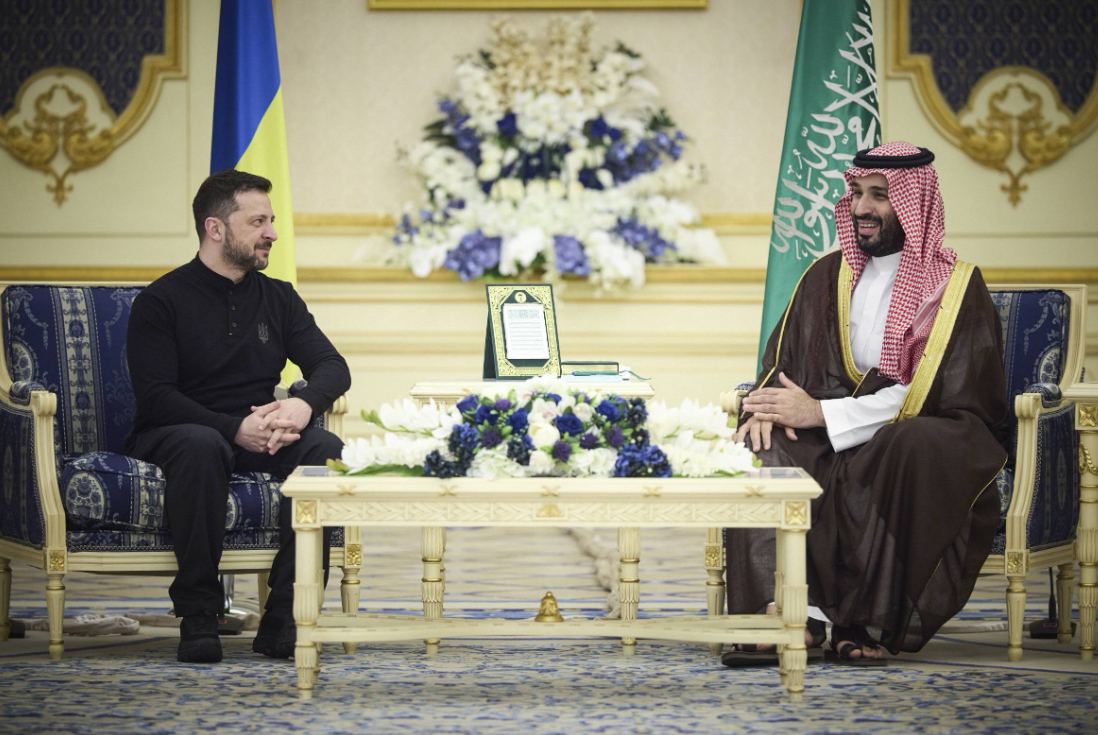
Crown Prince Mohammed bin Salman, Deputy Prime Minister and Minister of Defense, said that Saudi Arabia does not want a war in the region, but stressed that it “will not hesitate in dealing with any threat against our people, sovereignty and vital interests.”
In an interview with Asharq Al-Awsat, the Crown Prince said that the Kingdom “supported the re-imposition of US sanctions on Iran out of our belief that the international community needed to take a decisive stance against Iran.”
He hoped that the Iranian regime “would opt to become a normal state and cease its malign behavior.”
The Crown Prince told Asharq Al-Awsat that the attacks on oil tankers in the Gulf, oil facilities in the Kingdom and Abha airport “underscore the importance of our demands for the international community to take a decisive stance against an expansionist regime that has supported terrorism and spread death and destruction over the past decades not only in the region, but the whole world.”
He criticized Iran for using the nuclear deal’s economic benefits “to support its hostile activities in the region through its tools of chaos and destruction.”
While stressing that the Kingdom’s hand is always extended for peace, he said that “the Iranian regime did not respect the (Japanese) prime minister as a guest (in Iran) during his visit and in effect responded to his efforts by attacking the two oil tankers in the Gulf, one of which was apparently Japanese.”
“It also employed its militias to carry out a heinous attack against Abha Airport. This is clear evidence of the Iranian regime’s policy and intentions to target the security and stability of the region.”
The Crown Prince said that Saudi Arabia “places great importance on the strategic ties with the US,” considering it a “main factor in achieving regional security and stability.”
He also expressed confidence that “our strategic relations with the US will not be affected by media campaigns or arbitrary stances.”
The Kingdom constantly seeks to “clarify facts and misconceptions by some parties in the US and other countries. We listen to various views and we welcome constructive and rational advise, but ultimately our priority is our national interest.”
He said Saudi Arabia backed all efforts to reach a political solution to the Yemeni crisis but “the Houthi militias prioritize Iran’s agenda over the interests of Yemen and its people.”
“The Kingdom cannot accept the presence of militias operating outside the apparatus of states on our borders,” he said, adding “we not only seek to liberate Yemen from the Iranian militias, but achieve prosperity and stability for all of the people of Yemen.”
The Crown Prince said in the interview that his country is greatly concerned with the security and stability of Sudan, “not only due to the strategic importance of its location and danger of the collapse of its state institutions, but also the strong brotherly ties that bind us.”
He pledged to “continue to support our brothers in all fields until Sudan achieves what it deserves in prosperity and progress.”
On the Syrian crisis, he said Riyadh is working with its allies to achieve its objectives, including “defeating ISIS, preventing the re-emergence of terrorist organizations, dealing with the destabilizing Iranian influence in Syria and using all possible means to achieve political transition in line with Resolution 2254, in a manner that preserves Syria’s unity.”
The Crown Prince described the murder of Saudi citizen Jamal Khashoggi as a “very painful crime.”
The Kingdom is seeking to “achieve full justice and accountability, without getting distracted by positions taken by some for their own domestic considerations that are known to everyone,” he said. “Any party seeking to politically exploit the case must cease doing so and present whatever evidence it has to the courts in the Kingdom to help achieve justice.”
He also pledged to “continue to forge forward in our unwavering approach in confronting all forms of extremism and sectarianism, and the policies that support them.”
“We will not waste our time in offering partial solutions to extremism as history has proven the futility of such efforts,” said the Crown Prince.
On the economy, he expressed commitment to “the initial public offering of Saudi Aramco given it is under the appropriate circumstances, and in a timely manner.” But said “setting the location of the IPO now is premature.” And he noted the completion of several preliminary measures in preparation for the offering.
He said that Saudi Vision 2030 has “moved from planning and design to implementation on all levels, and started finding results.”
“What is happening in the Kingdom is not simply a set of financial and economic reforms aiming to realize specific figures,” but a comprehensive restructuring of the Kingdom's economy aimed at transforming economic and development performance in the medium and long terms.
“We are now shifting from a rentier economy to one that is characterized by productivity and global competitiveness,” he said.
He expressed that “Vision 2030 and its programs, like all strategic plans has to be reviewed and updated according to circumstances that may arise during implementation, without compromising its foundation or objectives.”
“I am proud that Saudi citizens are driving change at a time many feared the vision will face resistance due to the size of the change it entails,” he added.
Here is the full text of the interview:
*The region has recently witnessed dangerous developments that threaten the security and stability of the region and world. What is Saudi Arabia’s stance towards these developments and how does the Kingdom deal with this escalation?
-Saudi Arabia’s stance is clear as stipulated in its official statements. It does not want a war in the region, but we will not hesitate in dealing with any threat against our people, sovereignty and vital interests. Our priority is our national interest and achieving the aspirations of our people through the economic and social goals of the Kingdom’s vision 2030 and through development, and economic and social reform. This demands a stable and enabling environment within the Kingdom and region. This is why you will find that the role of the Kingdom, whether in the Arabian Gulf, North Africa, Horn of Africa or other regions, is supporting stability and peace. This is a policy that the Kingdom has adopted since its establishment whereby it has always sought to shun division, sectarianism and extremism and instead preserve unity and stability in the region and international peace.
The Kingdom also plays an important role in the international community through its efforts to ensure that oil supplies pass through vital routes that surround it with the aim of protecting the stability of the global economy. The world witnessed how we dealt with the Iranian tanker in the Red Sea. It was handled based on what our morals and principles and what international treaties and norms demand. In return, we see how the Iranian regime and its proxies have carried out sabotage operations against four oil tankers near Fujairah port. Two of the tankers were Saudi. This confirms the approach followed by this regime in the region and entire world. Plenty of evidence supports this and which has accumulated over many years.
We must not forget that this regime had openly declared since 1979 that its priority and main goal is to export the revolution. It seeks to achieve this at the expense of the aspirations of its people and the peoples of the region. This explains the behavior of the Iranian regime. The export of the revolution and Wilayat al-Faqih principle demand the destabilization of countries and the region, stoking sectarianism, spreading extremism and dedicating the resources of the Iranian people towards financing and arming terrorist militias.
Despite this, the Kingdom has constantly extended its hand for peace with Iran to avoid the horrors of wars and destruction on the region and its people. Saudi Arabia even supported the nuclear deal with Iran because the Kingdom has throughout history never spared an effort to resolve any crisis through diplomatic and peaceful means. We had hoped that the Iranian regime would have taken advantage of this initiative to change its behavior towards the countries in the region and see it as a first step towards Iran’s return to the international community as a normal state. Unfortunately, Iran misused the economic benefits of this deal to support its hostile acts in the region. It continued to violate international resolutions. It was better off dedicating the economic benefits in improving the lives of the Iranian people, developing infrastructure and achieving economic development instead of continuing its destructive behavior in the region.
Iran’s recklessness has reached unprecedented levels. After the nuclear pact, the Iranian Revolutionary Guards Corps’ budget increased and it intensified its support for sectarian militias in the region and even the whole world. We have all seen how terrorist and hostile Iranian operations were recently thwarted in Europe. This is why the Kingdom supported the re-imposition of US sanctions on Iran. It did so out of our belief that the international community needed to take a decisive stance against Iran. It must also take the necessary measures to limit the regime’s ability to spread chaos and destruction in the whole world.
Recent developments in the region, including the targeting of Aramco oil pumping stations by the Iran-backed Houthi militias, underscores the importance of our demand for the international community to take a decisive stance against an expansionist regime that has supported terrorism and spread death and destruction over the past decades not only in the region, but the whole world.
The choice is clear before Iran. Does it want to be a normal country that plays a constructive role in the international community or does it want to be a rogue state? We hope that the Iranian regime would opt to become a normal country and cease its malign behavior.
*You have pointed to the American stance on Iran, which coincides with the Saudi stance, as is the case with the majority of strategic issues. Recent months have, however, seen criticism directed at the Kingdom from within the United States over a number of issues, especially the Jamal Khashoggi case. Has this criticism affected the strategic cooperation between the two countries?
- The Kingdom places great importance on the strategic ties with the US. They are relations that extend to more than 70 years during which this strategic partnership has defeated several challenges that have targeted the security, stability and sovereignty of our countries. Our ties with the US are important and pivotal, not only for achieving joint interests, whether economic, on the security level or others, but they are a main factor in achieving regional security and stability. Together with the US, and in cooperation with several countries in the region and world, we seek to achieve sustainable stability in the region that would establish the necessary environment to meet the aspirations of its people to live in dignity and real development. We do so by confronting the forces of chaos, destruction and instability embodied in terrorist organizations and their state-sponsors, starting with the Iranian regime, and confronting all forms of extremism.
As for media campaigns or some stances in the US, they certainly do not serve the joint interests of our countries. Throughout the Kingdom’s history, however, we have previously faced such campaigns that are often biased and not based on accurate information. We constantly seek to clarify facts and misconceptions by some parties in the US and other countries. We listen to various views and we welcome constructive and rational advise, but ultimately our priority is our national interest. Our priority is the citizen in Riyadh, Jeddah, Jazan, Tabuk, Dammam and other regions in the Kingdom, not the beliefs or views of others about the Kingdom. Throughout the Kingdom’s history, we have managed to work with our main allies, despite natural differences that exist between all countries, by respecting the sovereignty of nations and avoiding meddling in their internal affairs. We expect nothing less than reciprocal treatment when it comes to our sovereignty and internal affairs. I am confident that our strategic relations with the US will not be affected by media campaigns or arbitrary stances.
As for the murder of citizen Jamal Khashoggi, as I have previously said, this is a very painful crime that is unprecedented in the history of the Kingdom. Such acts are alien to our culture and contradict our principles and values. The Kingdom has taken the necessary measures, whether through the judiciary to hold the perpetrators to account or through taking procedural measures to prevent such unfortunate crimes from taking place again in the future. These measures stem first and foremost from the importance we place, in the Kingdom, on the lives of every Saudi citizen, irrespective of their views. These measures have not and will not be affected by any other factors. We are a state governed by the rule of law and it is unacceptable for the life of a citizen to be violated in such a painful way under any circumstance. Unfortunately, the suspects are government employees and we seek to achieve full justice. Any party seeking to politically exploit the case must cease doing so and present whatever evidence it has to the courts in the Kingdom to help achieve justice.
*Does the agreement with the US on Iran apply to the situation in Syria, especially in wake of the American decision to withdraw from the country?
- We are in agreement on the objectives in Syria, which are the defeat of the ISIS, preventing the re-emergence of terrorist organizations, dealing with the destabilizing Iranian influence in Syria and using all possible means to achieve political transition according to Resolution 2254, in a manner that preserves Syria’s unity. We are working with friendly countries to achieve these goals.
*How do you interpret the Japanese Prime Minister’s recent visit to Iran and his meeting with the supreme leader?
- We thank the (Japanese) prime minister for his good intentions and the Kingdom’s hand is always extended for peace to achieve security and stability of the region.
The Iranian regime, however, did not respect the (Japanese) prime minister as a guest (in Iran) during his visit and in effect responded to his efforts by attacking the two oil tankers in the Gulf, one of which was apparently Japanese. It also employed its militias to carry out a heinous attack against Abha Airport. This is clear evidence of the Iranian regime’s policy and intentions to target the security and stability of the region. Iran is the party that is constantly escalating tensions in the region. It carries out terrorist attacks and immoral acts of aggression directly or through its militias. The problem lies in Tehran, not anywhere else. As I have previously stated, Iran must choose between becoming a normal country that plays a constructive role in the international community or remain a rogue state and assume the international consequences of its choice.
*The Turkish president and other Turkish officials have recently escalated their rhetoric in questioning the credibility of the Kingdom’s judiciary and held the Kingdom and its leadership responsible in Khashoggi’s case. How do you respond to such accusations?
- Jamal Khashoggi is a Saudi citizen and there is no doubt that what happened to him was painful and unfortunate. The Kingdom has taken all measures to hold the perpetrators accountable and the accused have been referred to the judiciary. The judiciary in the Kingdom is an independent authority and no one can meddle in its affairs. We confront any development firmly and without hesitation, by taking the steps that are necessary to achieve justice, rectify any flaw and prevent mistakes from taking place again, while disregarding any claims and accusations.
As for the statements by some Turkish officials towards the Kingdom, the Kingdom, as the home of the two holy mosques, seeks strong ties with all Islamic countries, including Turkey. This is important for the interest of the region and joint Islamic work in particular. In the Kingdom, we work in service of the holy mosques and their visitors. We work on achieving the security and stability of our nation, not becoming embroiled in disputes that harm the interests of our nation and Islamic world. We will forge forward in achieving these goals, without getting distracted by positions taken by some for their own domestic considerations that are known to everyone
*Four years have passed since the Arab coalition kicked off its operations in Yemen. How do you assess the political and military progress that has been achieved and what are the prospects for resolving the crisis in Yemen, especially in wake of the Stockholm deal and terrorist Houthi attacks on Saudi oil pumping stations and its Najran and Abha airports?
- Many parties forget or claim to forget how the crisis in Yemen first broke out. The coalition operations began after the international community had exhausted all political solutions between Yemeni parties and the Houthi militias. One must be reminded that the Kingdom is the pioneer of the political solution. It presented the GCC initiative and worked on achieving peaceful political transition in Yemen in 2011. It supported the national dialogue and presented over 7 billion dollars in economic support for Yemen between 2012 and 2014. Since 2011, the Kingdom’s efforts have sought to achieve smooth political transition in a manner that preserves the country’s independence and sovereignty and unity of its political and security institutions to prevent it from slipping into chaos.
Indeed, the Yemeni parties met in Riyadh and signed the GCC initiative and its implementation mechanism. All Yemeni parties, including the Houthis, were present at the comprehensive national dialogue.
Unfortunately, Iran obstructed the political process in Yemen through its proxy houthi militias, which started to occupy Yemeni cities and seize the state’s various resources and capabilities. The Kingdom offered all possible opportunities to resolve the situation through peaceful means, but Iran was following a policy of imposing a new reality in Arab countries by force of arms. Unfortunately, the international community at the time did not confront Iran’s expansionist and sectarian agenda. Iran therefore, continued to try, through its militias, to impose its control in Yemen. The Yemeni people and leadership, however, made a historic stand against this Iranian interference. Along with our brothers in the coalition, we responded immediately to the appeal of the legitimate government to protect Yemen and its people and our national security. The Kingdom cannot accept the presence of militias operating outside the apparatus of states on our borders.
Most Yemeni territories have been liberated and we have supported all efforts to reach a political solution to the crisis. Unfortunately, the Houthi militias prioritize Iran’s agenda over the interests of Yemen and its people. We have recently witnessed the terrorist attack on oil facilities and Najran airport, which the Houthis boasted of claiming. This once again demonstrates that these militias do not care for the interests of the Yemeni people or any political process to resolve the crisis. Their actions reflect the priorities of Tehran, not Sanaa.
The Arab coalition’s stance is very clear about resolving the crisis. We support efforts to reach a political solution based on UN Security Council resolution 2216, the GCC initiative and its implementation mechanism, and national dialogue outcomes. We accept the participation of all Yemeni parties in the political process, but according to the three references. The Kingdom will not accept the militias to remain outside state control. We will pursue this ultimate goal and maintain our operations and continue on offering support to the Yemeni people in their effort to protect their independence and sovereignty despite our sacrifice. The Kingdom will also maintain its humanitarian and economic relief in Yemen. We not only seek to liberate Yemen from the Iranian militias, but achieve prosperity and stability for all of the people of Yemen.
*You have spoken of a dream to transform the Middle East into the new Europe. How do you confront obstacles in reaching this dream given the major regional political upheaval and economic and development challenges?
- We must not become hostages of temporary conditions that prevent us from fulfilling our primary duty, as leaders in the region, of reviving our states. Today’s challenges must also not prevent us from working promptly to achieve a better future for the coming generations.
You mentioned political upheaval. This is undoubtedly taking place in the region. At the same time, however, we must look at the overall Arab region and realize that the majority of the countries are unanimous in prioritizing a dignified life for the people and achieving security and stability. The people do not want to be hostages to ideological conflicts that waste their potential. We are before a precedent in that everyone shares one goal. Competition between the majority of our countries focuses on reaching the best standard of living for the people, attracting investment and achieving development in all fields.
The source of political upheaval is well known. They are terrorist groups, such as ISIS, al-Qaeda, the Muslim Brotherhood and policies of the Iranian regime, the top sponsor of terrorism and extremism. We will not waste our time in offering partial solutions to extremism as history has proven the futility of such efforts. God willing, we will continue to forge forward in our unwavering approach in confronting all forms of extremism and sectarianism, and the policies that support them.
The Kingdom is the home of the Two Holy Mosques. It has been blessed with natural resources, a strategic location, and wise leadership since the days of its founder and until the present reign of the Custodian of the Two Holy Mosques. It is also blessed with its great and innovative people. Today, it is living in security, stability and prosperity. It is unbecoming for this great nation not to occupy leading positions in all fields regardless of the conditions and challenges. We will not rest until we first achieve this goal for our nation and then our brothers in the region.
*How do you assess the upheaval in Sudan and the political changes?
- We are greatly concerned with the security and stability of Sudan, not only due to the strategic importance of its location and danger of the collapse of its state institutions, but also the strong brotherly ties that bind us. Our brothers and sisters in Sudan have been and continue to be a part of our social fabric, they have contributed greatly to our progress in all fields. We will not spare any effort to achieve the security and stability for Sudan and its people. The Kingdom has taken measures to support the brotherly people of Sudan, including an economic aid package and depositing 250 million Dollars in its Central Bank. We will continue to support our brothers in all fields until Sudan achieves the prosperity and progress it deserves.
*Three years after launching Saudi Vision 2030, where are we at?
- We moved from the planning and design phase to implementation on all levels, and started seeing results on the ground. On developing the financial sector, for example, we have seen noteworthy progress after the launching of the Vision as the Saudi market joined three global indices, the FTSE, the Morgan Stanley (MSCI) Emerging Markets Index, and S&P Dow Jones Indices. This will pump capital worth billions into the market. The Kingdom has seen a 40 % increase in investors in investment funds, a first since 2006. The Kingdom has recently achieved the greatest leap among some of the world’s most competitive countries in the IMD World Competitiveness Rankings 2019, ranking 26th, moving up 13 ranks compared to last year, and ranking 7th among G20 member states.
In the telecommunications and information sector, we witnessed remarkable development. The contribution of the digital economy to the GDP increased both directly and indirectly, with the Kingdom becoming one of the top 10 fastest e-commerce growing countries worldwide with a rate of 32%. Simultaneously, Internet speeds have improved fourfold to accelerate digital transformation. The Kingdom was also the first country in the Middle East and North Africa region to roll out 5G network services back in 2018 in the Eastern Province for trial. Today, we have 1,000 communication towers in the Kingdom that are offering this new service and expanding.
In the field of energy and industry, non-oil exports increased by 22% in 2018 compared to 2017, and we launched many industrial cities in different regions across the Kingdom. This confirms the keenness of the government of the Custodian of the Two Holy Mosques to achieve balanced and comprehensive development in various cities and regions, including the King Salman Energy Park (Spark), Jizan, and Waad Al Shamal where the first phase of the production of phosphates and phosphate fertilizers has been achieved, laying down the foundation for the second phase, which will make the Kingdom, God willing, the second largest producer of phosphate fertilizers globally.
I would like to note that what is happening in the Kingdom is not simply a set of financial and economic reforms aiming to realize specific figures, but a comprehensive restructuring of the Kingdom's macro-economy aimed at improving economic and development performance in the medium and long terms. We have undertaken major economic and structural reforms that contribute to fiscal balance and financial control and the diversification of income sources, while maintaining a continuing macroeconomic growth, sustaining public finances, supporting social expenditures, raising government spending efficiency and stimulating the private sector, which is considered a key partner in growth and development, and achieving the Vision’s objectives.
*But there are claims about setbacks in some of Vision 2030’s initiatives?
- What is happening in the Kingdom is a comprehensive structural change in the economy aimed at creating a shift in medium- and long-term economic performance. The Vision 2030 and its programs, like all strategic plans has to be reviewed and updated according to circumstances that may arise during implementation, without compromising its foundation or objectives and with the aim of achieving top results, especially at a time we have gained a higher quality of decision-making based on studies, analyses, figures, facts and data.
Responding to your question about some Vision-related initiatives that might be in decline: We do not expect this. The Vision’s programs are effectively contributing to the economic transformation process and we are now shifting from a rentier economy to one that is characterized by productivity and global competitiveness.
*Some may argue that the Public Investment Fund (PIF) is giving the private sector a run for its money with its direct investments and mega projects. What role does it play in achieving the Vision and how can negative effects be avoided?
- In line with Vision 2030 and in order to achieve its objectives, it was important to review the role of the PIF and transform it into a state sovereign fund. In 2015 we re-launched PIF with a new vision and mission aimed at developing new sectors in Saudi Arabia, investing in leading international partnerships and the formation of a new board of directors under my leadership. Between 2016 and 2018, the number of staffers increased from 40 to nearly 500 employees. Meanwhile, PIF assets have increased from SR500 billion to SR 1 trillion, nearly doubling within two years.
The PIF is now a vital state instrument for economic diversification, and targets both domestic and international investments. Domestically, it targets major project investments that the private sector alone cannot finance, such as NEOM, the Red Sea project and Qiddiya, that will offer dozens, if not hundreds, of good investment opportunities for the private sector.
For PIF and the government, it is of utmost importance to involve the private sector. We have earmarked 13 programs for privatization, giving the private sector a greater opportunity to participate in investment, achieve profitable returns and improve spending efficiency and services.
In terms of foreign investments, apart from achieving attractive returns on its assets, PIF will play an important role in establishing economic partnerships that will help boost knowledge exchange, stimulate high-efficiency investments and enhance local content, generating long-term returns for future generations. The PIF also targets new strategic sectors such as tourism and entertainment. These sectors have an important dimension in stimulating foreign investment, regional development, creating a large number of jobs and improving overall quality of life.
The PIF operates under an outstanding level of corporate governance and transparent investment strategy, which were approved after completing its reform and governance process in 2015. It operates within a system that includes a board, executive committee and investment committee that play clear roles in guaranteeing distinguished levels of professionalism in performance. The PIF also has investment portfolios distributed according to development priorities, such as in Saudi companies, promising sectors and major projects.
*What are the latest developments in the privatization program?
- We now have an exceptional and global center specialized in privatization that is built on the best practices drawn from experiences of more than 20 countries that have undertaken privatization in the past. When establishing the center, it was taken into account that it contains a legal structure ensuring the rights of both the state and investors. We have identified promising opportunities for privatization in 12 sectors. Our goal from the privatization program is for it to strengthen the effectiveness of the role of government and to maximize the contribution of the private sector to GDP.
In 2019, the National Center for Privatization (NCP) supported the signing of five agreements with a total value exceeding SR 12.5 billion, inked by local and international companies in various fields and with 70% foreign financing from six countries. These agreements include projects that focus on sewage treatment, desalination plants and health services, through dialysis centers.
The NCP is currently working on finalizing agreements totaling over SR2 billion and that cover flour mills and medical and shipping services. These agreements are expected to be completed by the end of 2019. Work is also underway for privatizing education sector projects, expected in 2020 with investments adding up to about SR1 billion.
In the future, the private sector will also have the largest investment share in electricity sector projects, especially power generation plans and including major renewable energy projects previously announced.
*Amidst such economic transformation, what is your Highness's message to citizens?
- I am proud that Saudi citizens are driving change at a time many feared the Vision will face resistance due to the size of the change it entails. Many have told me that the most difficult part I will face in realizing this strategic transformation is resistance. But I saw this as a very small factor when looking at Saudi youth that is now leading change.
I would like to pay tribute to the role of young people in the transformation currently taking place in the Kingdom. It is a young Vision with a young spirit.
Discussions have shifted from a change desired from the state to the change we all make together.
*When following news about the anticipated Saudi Aramco’s IPO in global markets, we find there is a lack of information about the issue and the timeline. Where are matters now? And what actions have been taken in this regard?
- We are committed to the initial public offering of Saudi Aramco, but under the appropriate circumstances and in a timely manner. As I mentioned previously, I expect that it will happen between 2020 and the beginning of 2021, and setting the location of the IPO now is premature. Much of the work has been successfully completed, and the timeframe for the offering will depend on several factors including: market conditions for the IPO, given its size, and Aramco's acquisition of a majority stake in SABIC from PIF.
The latter is a deal which would create a stellar transformation through establishing a fully integrated national energy and petrochemical company that will lead the global energy sector and further enhance Saudi Aramco's growth potential and profitability in volatile oil markets.
As for preparations for Aramco’s IPO, several important actions have been taken, including the issuance of the hydrocarbon tax system, the re-issuance of an exclusive franchise agreement, the appointment of a new board of directors and the first-ever releasing of Aramco’s annual financial report and audit of its oil reserves. All these measures reinforce transparency, which is a core principle of Saudi Vision 2030, which is committed to protecting the Kingdom’s interests and those of potential investors.
Saudi Aramco, for its part, has also logged several achievements within its internal program in preparation for the IPO. One of the most important features of the program was amending internal rules and regulations, the transformation into a joint stock company and releasing its financial report, meeting requirements of potential financial markets for the IPO.
This has left investors satisfied worldwide, as we have seen through the recent bond offering.