


Diplomatic Crisis Arises between Sudan, UN over Envoy

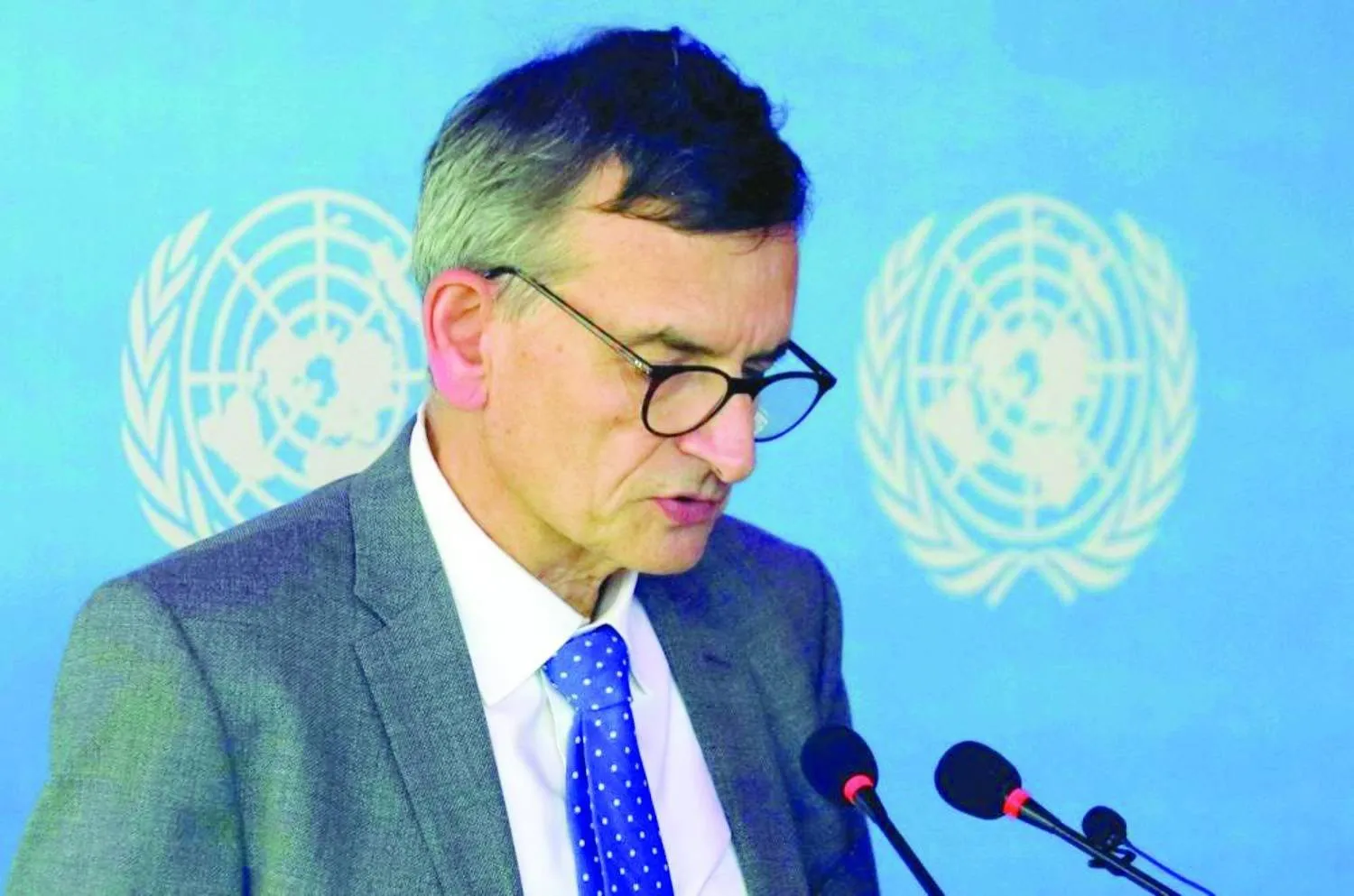
Sec-Gen Special Representative for Sudan and Head of UNITAMS Volker Perthes (Reuters)
TT

Diplomatic Crisis Arises between Sudan, UN over Envoy

Sec-Gen Special Representative for Sudan and Head of UNITAMS Volker Perthes (Reuters)

A new diplomatic crisis erupted between Sudan and the UN after the Sudanese delegation to the Security Council meeting on the situation in the country stipulated on Wednesday the exclusion of the UN envoy to Sudan, Volker Perthes.

Sudan accused the Special Representative of the Sec-Gen (SRSG) and head of the UN Integrated Transition Assistance Mission in Sudan (UNITAMS) of lacking neutrality and interfering in the country's internal affairs after Perthes submitted a report about the atrocities in the war raging since mid-April.

During the Security Council meeting, US Ambassador Linda Thomas-Greenfield denounced Perthes' absence: "We now know that the Sudanese government threatened to end the UN Mission in Sudan if the SRSG participated in this briefing."

She directed her speech to the Sudanese ambassador al-Harith al-Idriss saying it "was really outrageous, and I did make that point in the Council. No country should be able to bully a briefer into silence, let alone the United Nations."

Sudan denies

The Sudanese delegate denied the accusation, saying the Sudanese mission to the UN did not send a message threatening to boycott the Security Council session.

But Thomas-Greenfeld later repeated her accusation in front of reporters at the UN headquarters.

"We were told that Volker would be briefing the Council. And this morning, his name was pulled. And we understand that that happened because the Sudanese government threatened to pull UNITAMS out of Sudan if he briefed the Council," she said, describing the behavior as "outrageous" and "unacceptable."

Sudanese Foreign Minister Ali Al-Sadiq said that Perthes no longer represents the UN in Sudan, calling on the Secretary-General, Antonio Guterres, to speed up the appointment of a substitute.

Al-Sadiq explained that Perthes did not attend the session because Sudan objected to his participation, emphasizing that the step was not a blackmail or threat to any party.

He said the objection was merely a legal right of the country.

Weapons shipment

The Sudanese army seized on Thursday a shipment of weapons en route to the Rapid Support Forces (RSF) on the border of the Butana region with the east of the country.

In a press circular on the official Facebook page, the army stated that the intelligence of the 11th Infantry Division in the Khashm al-Qurba area seized three cars loaded with weapons.

The army is tightening control over the ports and land routes between the eastern region along the Butana Plain to Khartoum, where battles occur between the two parties.

Clashes continue

Meanwhile, clashes continued between the Sudanese Army and the Rapid Support Forces in Khartoum.

Eyewitnesses told Asharq Al-Awsat that heavy artillery could be heard in the city, near the army's point in Bahri.

The Rapid Support Forces announced the defection of a new group of officers and soldiers of the Army's Sixth Division in el-Fashir, the capital of North Darfur state.

The RSF said in a statement that thousands of forces joined their ranks, and they will form the nucleus of the professional national army that includes all Sudanese.

They renewed their call to the members of the Sudanese Armed Forces to align themselves with the people's will to eliminate the remnants of the ousted regime and rebuild the state.

Troika countries

The Troika: Norway, the UK, and the US condemned in the strongest terms the ongoing violence in Darfur, especially reports of killings based on ethnicity and widespread sexual violence by the RSF and allied militias.

"We call on all parties to immediately cease attacks and prevent the further spread of fighting. Those responsible must be held to account. Full access to conflict-affected areas must be granted so that abuses can be properly investigated and life-saving humanitarian aid can reach survivors who urgently need it."

The statement asserted the Troika's concern about reports of a military build-up near El Fasher, North Darfur, and Nyala, South Darfur, where further violence will put more civilians at risk.

The statement warned that expanding the needless and ruinous conflict between RSF and the Sudanese Armed Forces SAF to Darfur had caused incalculable human suffering.

"We remind the parties of the conflict of their obligations under international humanitarian law related to protecting civilians. We call on all parties to the conflict to enable humanitarian access in Darfur and throughout the country”, added the statement.



Gold Drops Below Key $4,000 Level as Dollar Firms, Rate Hike Bets Rise

FILED - 16 March 2023, Bavaria, Munich: FILE PHOTO - Gold bars and coins lie on the table at the Precious metal dealership Pro Aurum. Photo: Sven Hoppe/dpa
TT

Gold Drops Below Key $4,000 Level as Dollar Firms, Rate Hike Bets Rise

FILED - 16 March 2023, Bavaria, Munich: FILE PHOTO - Gold bars and coins lie on the table at the Precious metal dealership Pro Aurum. Photo: Sven Hoppe/dpa

Gold prices fell more than 3% and traded below a key psychological level of $4,000 per ounce, under pressure from a firmer US dollar and growing expectations of interest rate hikes.

Spot gold fell 3.4% to $3,968.41 an ounce as of 1312 GMT, after hitting its lowest level since November 2025.

US gold futures declined nearly 4% to $3,984.40.

The US dollar firmed, making dollar-priced bullion more expensive for holders of other currencies.

Traders have ramped up bets on US interest rate hikes this year after the US central bank struck a hawkish tone at its latest policy meeting and as fears of inflationary pressures stemming from the Iran war persist.

"The market pricing a rate hike as soon as September due to a hawkish Fed, a surging dollar at 13-month highs combined with lower inflation expectations are putting heavy pressure on precious metals," Tai Wong, an independent metals trader, said.

"For gold, there is support just under $3,900 and central bank purchases continue, so a collapse is unlikely, but expect a potentially long period of consolidation as the gold trade is now out of favor," he added.

Gold becomes less attractive to investors when interest rates rise because it offers no yield.

Spot gold, which scaled a record peak of $5,594.82 in late January, has since shed over $1,600 an ounce.

ING analysts cut their gold forecasts, now expecting prices to average $4,300 an ounce in the third quarter of 2026 and $4,600 in the fourth, compared with their previous projections of $4,850 and $5,000, respectively, according to Reuters.

Investors are also awaiting US Personal Consumption Expenditures data, the Fed's preferred inflation measure, due on Thursday for further signals on the monetary policy outlook.

More hawkish signals from Fed officials or economic data that supports the argument for higher rates may translate to further downside risk for gold, said Lukman Otunuga, senior research analyst at FXTM.

Among other metals, spot silver fell 6% to $58.28 per ounce after hitting its lowest level since December 2025.

Platinum lost 4.3% to $1,580.76, and palladium dropped 4.9% to $1,177.50.


US Forces Killed ISIS Leader in Syria Airstrike, Central Command Says

A still from a video released by US Central Command on Friday showing US Air Force F-16 fighter jets refueling mid-air during a patrol mission over the Middle East (CENTCOM)
TT

US Forces Killed ISIS Leader in Syria Airstrike, Central Command Says

A still from a video released by US Central Command on Friday showing US Air Force F-16 fighter jets refueling mid-air during a patrol mission over the Middle East (CENTCOM)

The US military conducted an airstrike in northwestern Syria last week that killed a senior ISIS leader, US Central Command said on Wednesday.

The strike, carried out on Friday, was part "of ongoing US efforts to disrupt and eliminate terrorists seeking to attack Americans abroad or the US homeland" and killed Ali Husayn al-Ulaywi, it said in a statement on X.

ISIS has declared a new phase of operations in Syria against the government of President Ahmed al-Sharaa, carrying out a spate of attacks since February. Last year, Sharaa's government joined the US-led coalition fighting ISIS.

On Saturday, the militant group claimed responsibility for an attack near the city of Manbij in Syria's northeastern Aleppo province.

ISIS controlled around a quarter or more of Syria at the peak of its power during the Syrian civil war a decade ago, before being driven out of the territory by a US-led coalition and other foes.


Oil Extends Slide to More than 1% on Expectations of Smoother Crude Flows via Hormuz

Storage tanks for crude oil, gasoline, diesel, and other refined petroleum products in Carson, California (Reuters)
TT

Oil Extends Slide to More than 1% on Expectations of Smoother Crude Flows via Hormuz

Storage tanks for crude oil, gasoline, diesel, and other refined petroleum products in Carson, California (Reuters)

Oil prices fell more than 1% on Wednesday, extending this week's losses to hit fresh four-month lows on signs that more oil tankers are set to move out of the Strait of Hormuz.

Brent crude futures were down $1.37, or 1.8%, at $75.71 a barrel by 0805 GMT. US West Texas Intermediate slipped by $1.08, or 1.5%, to $72.13.

Brent touched a low of $75.60, its weakest level since February 27, the day before the initial US-Israeli strikes on Iran. WTI fell as low as $72.03, the weakest since March 3.

"While there are early encouraging signs of increased tanker activity, the market is pricing in the broader scenario of Iranian oil re-entering the global market and the Strait of Hormuz normalising," said Tim Waterer, chief market analyst at KCM Trade.

"If sanctions are eased, Iranian production and exports could ramp up relatively quickly given the substantial amount stored on tankers — we are likely talking weeks rather than months," Waterer added, Reuters reported.

Prices have also come under pressure this week from the 60-day sanctions waiver Washington granted Tehran after initial peace talks, allowing Iran to sell oil, and from an easing of hostilities in Lebanon, with prices approaching pre-war levels.

Ship-tracking data showed that three stranded supertankers passed through the strait on Tuesday. The UN shipping agency said an evacuation plan is under way to enable hundreds of stranded ships to sail through the strait after the US-Iran ceasefire deal.

On Tuesday, Oman and Iran agreed to press on with discussions about managing navigation in the strait. US Secretary of State Marco Rubio said that any attempt by Iran to levy transit fees would violate international law.

Uncertainty remains over the durability of the accord, however. US President Donald Trump said on Tuesday that Iran had agreed to nuclear inspections into "infinity", though Tehran said it had made no such concession.

"Markets are currently assigning too much confidence to a favorable outcome without fully discounting the risks associated with unresolved nuclear issues and inspection disputes," said Mark Malek, CIO at Siebert Financial.

Investors are also watching how quickly Middle Eastern producers can restore exports and whether more ships will enter the region.

Meanwhile, US crude stocks fell by 765,000 barrels in the week to June 19, market sources said, citing data from the American Petroleum Institute.

Nine analysts polled by Reuters estimated, on average, that crude inventories fell by about 4.5 million barrels in the past week.