Hochstein: US Wants to Avoid 'Greater War' along Tense Lebanon-Israel Borderhttps://english.aawsat.com/5031935-hochstein-us-wants-avoid-greater-war-along-tense-lebanon-israel-border
Hochstein: US Wants to Avoid 'Greater War' along Tense Lebanon-Israel Border
Israeli firefighters work following rocket attacks from Lebanon, amid ongoing cross-border hostilities between Hezbollah and Israeli forces, near the border on its Israeli side, June 13, 2024. REUTERS/Avi Ohayon
Hochstein: US Wants to Avoid 'Greater War' along Tense Lebanon-Israel Border
Israeli firefighters work following rocket attacks from Lebanon, amid ongoing cross-border hostilities between Hezbollah and Israeli forces, near the border on its Israeli side, June 13, 2024. REUTERS/Avi Ohayon
The United States is trying to avert a greater war between Israel and Lebanon's Hezbollah movement, US envoy Amos Hochstein said on Tuesday, following an escalation in cross-border fire between the foes along Lebanon's southern frontier.
Iran-backed Hezbollah has been trading fire with Israel for the last eight months in parallel with the Gaza war. Last week, the group fired the largest volleys of rockets and drones of the hostilities so far at Israeli military sites, after an Israeli strike killed the most senior commander yet.
Hochstein, special envoy to US President Joe Biden, said he had been dispatched to Lebanon immediately following a brief trip to Israel because the situation was "serious".
"We have seen an escalation over the last few weeks. And what President Biden wants to do is avoid a further escalation to a greater war," Hochstein said on Tuesday.
He had met the head of Lebanon's army earlier on Tuesday and spoke to reporters following a meeting with parliament speaker Nabih Berri, who heads the armed Amal movement, which is allied to Hezbollah and has also fired rockets on Israel.
The US and France are engaged in diplomatic efforts to secure a negotiated end to the hostilities along Lebanon's border. Hezbollah says it will not halt its attacks unless there is a ceasefire in the Gaza Strip.
"Whether diplomatically or militarily one way or another, we will ensure the safe and secure return of Israelis to their homes in northern Israel. That is not up for negotiation. Oct. 7 cannot happen again anywhere in Israel or on any of Israel's borders," Israeli government spokesman David Mencer said.
He added that Israel was "impeding Hezbollah's military buildup and their stockpiling of weapons for terror against Israelis".
Hezbollah began trading fire with Israel on Oct. 8, a day after its Palestinian ally Hamas attacked southern Israel, sparking the Gaza war. Tens of thousands of people have fled both sides of the border.
DRONE ATTACK
Hochstein urged Hamas to accept a US-backed proposal for a ceasefire in Gaza, which he said "also provides an opportunity to end the conflict across the Blue Line", a reference to a demarcation line between Lebanon and Israel where parts of the international border are disputed.
Hochstein met caretaker Lebanese Prime Minister Najib Mikati, who told him that "Lebanon does not seek escalation", according to comments issued by Mikati's office.
The increase in attacks last week was followed by a brief respite during the Eid al-Adha Muslim holiday, which concludes on Tuesday. Hezbollah announced a drone attack against an Israeli tank on Tuesday afternoon - its first announced attack since Saturday.
The group used more of its extensive arsenal against Israel last week, prompting United Nations officials in Lebanon to warn over the weekend that the "danger of miscalculation leading to a sudden and wider conflict is very real".
UN human rights chief Volker Turk said on Tuesday that he too was worried about the escalation, and called "for a cessation of hostilities and for actors with influence to take all possible measures to avert a full-scale war".
Obeidat to Asharq Al-Awsat: Gaddafi Tried to Assassinate King Hussein with Missile Given to Wadie Haddadhttps://english.aawsat.com/interviews/5242281-obeidat-asharq-al-awsat-gaddafi-tried-assassinate-king-hussein-missile-given
Obeidat to Asharq Al-Awsat: Gaddafi Tried to Assassinate King Hussein with Missile Given to Wadie Haddad
King Hussein and Moammar Gaddafi holding talks on the sidelines of an Arab summit in Cairo in 1970 (AFP).
In the second installment of his interview with Asharq Al-Awsat, former Jordanian prime minister and intelligence chief Ahmad Obeidat recounts details of a missile plot to assassinate King Hussein, which he says was backed by Muammar Gaddafi and carried out through operatives linked to Wadie Haddad, head of the external operations arm of the Popular Front for the Liberation of Palestine.
Obeidat, who also served as head of intelligence and as minister of interior and defense, revisits the confrontation between Israeli forces, the Jordanian army, and Palestinian guerrillas (fedayeen) in the border town of Karameh in March 1968, asserting that the Jordanian army “decided the battle,” but suffered a “moral defeat amid the fedayeen’s claims of victory.”
Obeidat died earlier this month. The interview was recorded before the “Al-Aqsa Flood,” whose aftermath delayed its publication. Below is the text of the second installment.
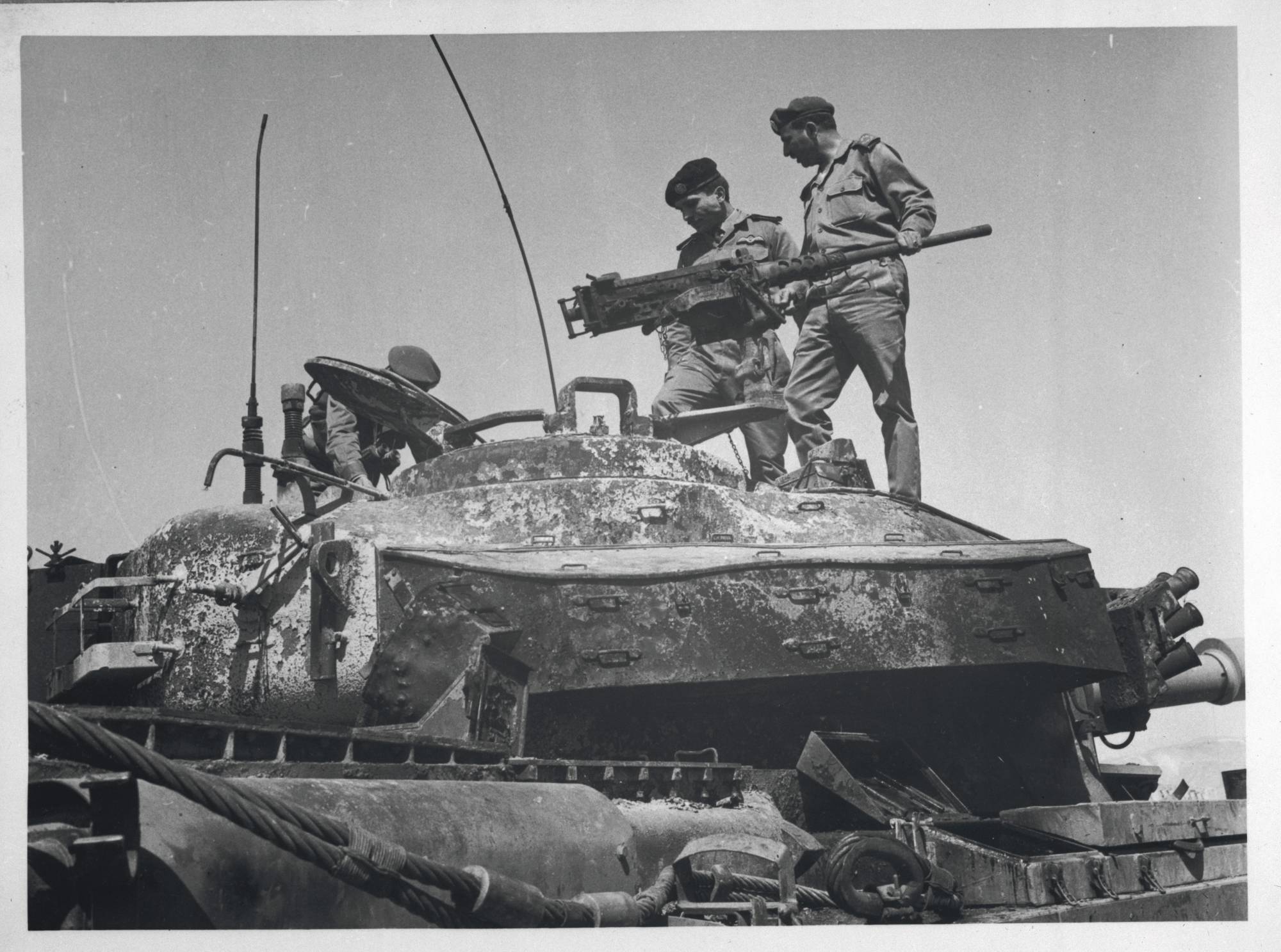
King Hussein inspects an Israeli tank left behind by occupying forces during the Battle of Karameh (Getty)
“Battle of Karameh”
Obeidat calls Karameh “a pivotal point of utmost importance,” especially for an army still reeling from the 1967 defeat and its withdrawal from the West Bank.
“The army lived the bitterness of that defeat,” he says. “It felt a moral, national, and pan-Arab responsibility.”
Karameh, he argues, offered a chance to restore the army’s fighting morale and reclaim some of its lost dignity.
“It was the army that settled the battle,” Obeidat says.
He credits Jordanian forces with thwarting Israeli attempts to build crossing bridges, destroying their vehicles on Jordanian soil and forcing, for the first time in Israel’s history, a request for a ceasefire. “The late King Hussein refused,” he adds.
Israel, he says, did not acknowledge a fifth of its casualties. Helicopters were evacuating the wounded who were “dripping with blood.”
He singles out artillery observation officers who advanced to the closest possible positions, relaying precise coordinates even as they effectively marked their own locations for shelling.
“The Jordanian soldier would identify his position near the Israeli army to be shelled,” he says, describing a willingness to die in order to restore dignity after the 1967 setback.
He says the declaration of “armed struggle” effectively erased the army’s role, presenting Palestinian fedayeen as the victors over Israel. “They monopolized the victory and ignored the army’s role entirely,” Obeidat says. “We emerged with a moral defeat in the face of their claims.”
He alleges that hundreds of millions of dollars in donations collected afterward, much of it going to Fatah, did not reach the Palestinian people but went to organizations and their leaders.
When the army entered Amman in September 1970, Obeidat says, it aimed to end what he describes as chaos: armed displays, roadblocks, arrests of soldiers on leave and interference in courts.
“The army swept areas without distinguishing between Jordanian and Palestinian,” he says. “It wanted to restore control over security, nothing more.”
He later describes what he calls a “state within a state,” extending from the Jordan Valley to Amman, after armed groups asserted authority over courts, roads, and civilian life.
On Syria’s intervention, Obeidat says Syrian forces entered northern Jordan flying Palestine Liberation Organization flags.
He later learned the decision was political, taken by the Baath Party, and that then-Defense Minister Hafez al-Assad complied reluctantly before Syrian tanks withdrew.
Iraq, he says, did not intervene. Obeidat affirms that he was told by Iraqi officials that neither the Iraqi state nor its forces intended to participate in any operation aimed at ending the Hashemite monarchy in Jordan.
According to one account, Iraqi leaders did not want to shoulder the political and diplomatic burden of the Palestinian issue or risk an uncalculated adventure.
He recounts another account, which he says he cannot adopt, according to which the operations command in the army was handled by a Pakistani figure. Under this account, Zia ul-Haq was receiving operational communications and sending messages that caused confusion among Iraqi and other forces, leading them to believe they would confront powerful strike units, prompting them to remain in a state of alert rather than engage.
He also recalls a meeting in which Palestinian figures, including Abu Iyad, reproached Iraqi President Ahmed Hassan al-Bakr. Al-Bakr replied: “We are a state with one life. If we make a fundamental mistake, we end. You are like cats with seven lives.”
As director of intelligence, Obeidat says he dealt directly with operations attributed to Haddad.
Between 1975 and 1977, he says, a missile was sent to Jordan with a group led by a Jordanian, Brik al-Hadid, affiliated with the PFLP. The target was King Hussein’s aircraft.
“The intention was to strike the plane, with Gaddafi’s knowledge and approval,” Obeidat says.
Jordanian intelligence monitored the group from the outset and later arrested its members. The king’s aircraft departed Marka military airport as scheduled but flew in the opposite direction to its planned route as a precaution, using jamming devices against any incoming missiles.
When confronted by Mudar Badran, then head of the Royal Court, Gaddafi denied knowledge. “I have no information,” Obeidat quotes him as saying.
Obeidat describes the aircraft hijackings orchestrated by Haddad as “the straw that broke the camel’s back,” contributing to the army’s intervention.
He says Jordanian intelligence had infiltrated Fatah and monitored its leaders, including Abu Iyad and Abu Yusuf al-Najjar.
In mid-1972, intelligence learned that Abu Dawood and a group were planning to enter Jordan from Baghdad to seize the Jordanian cabinet during a session and hold ministers hostage in exchange for the release of detained Fatah members.
The group crossed in three Mercedes cars, dressed in traditional Arab attire, with weapons concealed inside the seats and forged passports in hand. They were arrested at the border after a thorough search.
Obeidat rejects claims by Abu Iyad that Abu Dawood was tortured, insisting that “not a single hair on his head was touched,” and says Abu Dawood confessed only after realizing the operation had been fully uncovered.
Later, King Hussein met Abu Dawood’s parents, who pleaded for clemency. The king read the full confession and then met Abu Dawood himself. He ultimately ordered his release, honoring a promise he had made to Abu Dawood’s parents.
In Obeidat’s view, Abu Dawood was affected by the king’s treatment of his parents and “did not pose any future threat to Jordan.”
Obeidat describes a direct relationship between King Hussein and the General Intelligence Department.
The king met with officers regularly, not only to hear briefings but also to hear their personal views. Security presentations would include Crown Prince Hassan, senior advisers, army commanders, the public security chief, the Royal Court chief, and the prime minister.
“Sometimes,” Obeidat says, “it was necessary to elaborate orally before the king on certain matters so they would not circulate more widely.”
Obeidat says the late King Hussein maintained a direct relationship with the General Intelligence Department, meeting regularly with senior officers and listening not only to intelligence briefings but also to their personal assessments.
When security briefings were presented before the king, Crown Prince Hassan would attend, along with royal advisers, senior army commanders, the public security chief, the head of the Royal Court, and the prime minister.
Obeidat says he would submit reports to the prime minister and also meet with the king. When addressing the king, however, it was sometimes necessary to elaborate verbally on certain issues so that such information would not circulate among staff. He met with the king regularly.
When he was asked to present a security briefing before the king, the late King Hussein would summon Crown Prince Hassan. The king’s advisers would also attend, along with senior army commanders, the public security leadership, the head of the Royal Court, and the prime minister. The briefing of the security report would include an explanation of the security situation and any external or internal challenges.
US Judge Blocks Deportation of Columbia University Palestinian Activisthttps://english.aawsat.com/world/5242263-us-judge-blocks-deportation-columbia-university-palestinian-activist
US Judge Blocks Deportation of Columbia University Palestinian Activist
Mohsen Mahdawi at a press conference in Vermont last year - Photo by Alex Driehaus/AP
A US immigration judge has blocked the deportation of a Palestinian graduate student who helped organize protests at Columbia University against Israel's war in Gaza, according to US media reports.
Mohsen Mahdawi was arrested by immigration agents last year as he was attending an interview to become a US citizen.
Mahdawi had been involved in a wave of demonstrations that gripped several major US university campuses since Israel began a massive military campaign in the Gaza Strip.
A Palestinian born in the occupied West Bank, Mahdawi has been a legal US permanent resident since 2015 and graduated from the prestigious New York university in May. He has been free from federal custody since April.
In an order made public on Tuesday, Judge Nina Froes said that President Donald Trump's administration did not provide sufficient evidence that Mahdawi could be legally removed from the United States, multiple media outlets reported.
Froes reportedly questioned the authenticity of a copy of a document purportedly signed by Secretary of State Marco Rubio that said Mahdawi's activism "could undermine the Middle East peace process by reinforcing antisemitic sentiment," according to the New York Times.
Rubio has argued that federal law grants him the authority to summarily revoke visas and deport migrants who pose threats to US foreign policy.
The Trump administration can still appeal the decision, which marked a setback in the Republican president's efforts to crack down on pro-Palestinian campus activists.
The administration has also attempted to deport Mahmoud Khalil, another student activist who co-founded a Palestinian student group at Columbia, alongside Mahdawi.
"I am grateful to the court for honoring the rule of law and holding the line against the government's attempts to trample on due process," Mahdawi said in a statement released by his attorneys and published Tuesday by several media outlets.
"This decision is an important step towards upholding what fear tried to destroy: the right to speak for peace and justice."
Fire Breaks out Near Iran's Capital Tehran, State Media Sayshttps://english.aawsat.com/world/5242260-fire-breaks-out-near-irans-capital-tehran-state-media-says
Fire Breaks out Near Iran's Capital Tehran, State Media Says
Smoke rises from a fire caused by an explosion in Tehran (File photo - Reuters)
A fire broke out in Iran's Parand near the capital city Tehran, state media reported on Wednesday, publishing videos of smoke rising over the area which is close to several military and strategic sites in the country's Tehran province, Reuters reported.
"The black smoke seen near the city of Parand is the result of a fire in the reeds around the Parand river bank... fire fighters are on site and the fire extinguishing operation is underway", state media cited the Parand fire department as saying.
لم تشترك بعد
انشئ حساباً خاصاً بك لتحصل على أخبار مخصصة لك ولتتمتع بخاصية حفظ المقالات وتتلقى نشراتنا البريدية المتنوعة