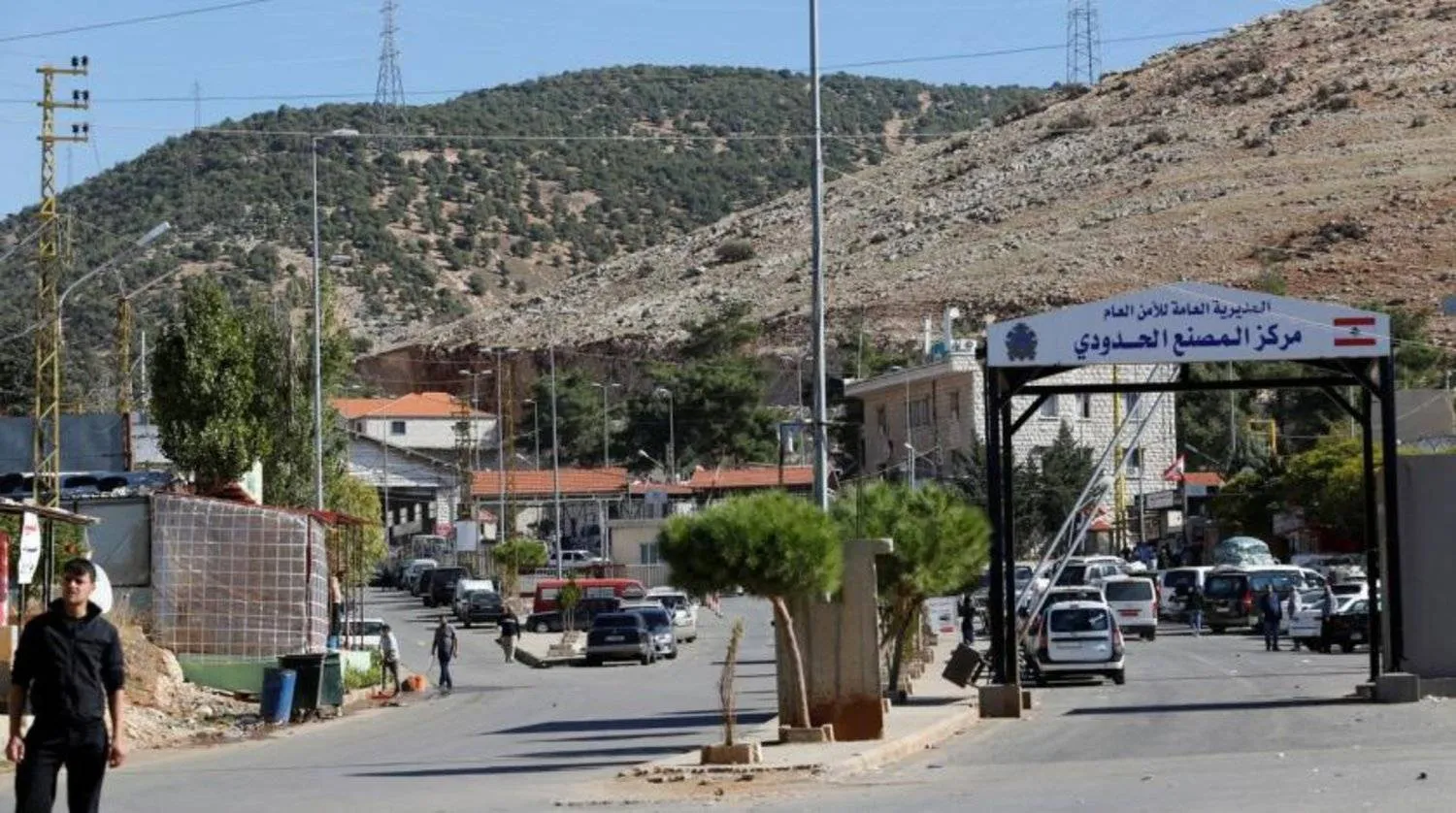
Lebanese Minister: Israeli Strike Closes Off Road Used to Flee Lebanon to Syria

Masnaa border crossing between Lebanon and Syria, Lebanon November 1, 2018. Picture taken November 1, 2018. REUTERS/Jamal Saidi
TT

Lebanese Minister: Israeli Strike Closes Off Road Used to Flee Lebanon to Syria

Masnaa border crossing between Lebanon and Syria, Lebanon November 1, 2018. Picture taken November 1, 2018. REUTERS/Jamal Saidi

An Israeli strike on Friday morning near Lebanon's Masnaa border crossing with Syria cut off a road used by hundreds of thousands of people to flee Israeli bombardments in recent days, Lebanon Transport Minister Ali Hamieh told Reuters.
Hamieh said the strike hit inside Lebanese territory near the border crossing, creating a four-meter (12 feet) wide crater.
An Israeli military spokesman had accused Lebanese armed group Hezbollah on Thursday of using the crossing to transport military equipment into Lebanon.
Israel “will not allow the smuggling of these weapons and will not hesitate to act if forced to do so, as it has done throughout this war," Israeli army spokesman Avichay Adraee said on X.
Hamieh had said at a press conference on Thursday that the crossing was subject to the authority of the Lebanese state.
According to Lebanese government statistics, more than 300,000 people - a vast majority of them Syrian - had crossed from Lebanon into Syria over the last 10 days to escape escalating Israeli bombardment.



Analysts Say Iran is Drowning in its Own Oil

FILE PHOTO: Iranian flag overlayed with a rising stock graph and 3D printed gas pump miniature are seen in this illustration taken June 23, 2025. REUTERS/Dado Ruvic/Illustration/File Photo
TT

Analysts Say Iran is Drowning in its Own Oil

FILE PHOTO: Iranian flag overlayed with a rising stock graph and 3D printed gas pump miniature are seen in this illustration taken June 23, 2025. REUTERS/Dado Ruvic/Illustration/File Photo

The US naval blockade is having significant impact on oil flows in Iran, which is running out of places to store its own crude and only about 22 days of capacity left to avoid a crippling production shutdown.

With shipments falling sharply and fuel reservoirs nearly filled, Iran’s storage capacity crisis poses a prominent threat to the country's infrastructure.

Analysts say the country could soon run out of space to store oil — forcing deeper production cuts and potentially triggering long-term damage to its energy system.

According to data firm Kpler, The Wall Street Journal and Bloomberg, the blockade has cut exports by roughly 70%, forcing Iran to revive derelict sites known as “junk storage,” using improvised containers and trying to ship crude by rail to China.

The unusual steps are aimed at delaying an infrastructure crisis and blunting Washington’s leverage in the standoff over the Strait of Hormuz, according to The Wall Street Journal.

Since early April, with the imposition of the naval blockade on Iranian ports, the volume of oil loading onto tankers has dropped from 1.85 million barrels per day in March to only 567 thousand, according to a Bloomberg report.

And despite reports saying some tankers have evaded the blockade, data from Kpler and The Wall Street Journal said no ships have successfully escaped the US blockade of Iranian ports, with officials stating that vessels had been turned back or complied with redirection orders.

Chabahar Port, located east of the Strait of Hormuz and outside the Arabian Gulf, is a critical backup gateway for Iran to circumvent strait-related risks. However, satellite imagery confirms that around six to eight Very Large Crude Carriers (VLCCs) are anchored off the coast of Chabahar in the Gulf of Oman, where the tankers serve as “floating oil storage” unable to break the US blockade.

To manage the crisis, Iran is using new ways to store excess oil that it cannot sell due to the blockade. Tehran has activated the 30-year-old supertanker Nasha for emergency oil storage near Kharg Island.

According to Kpler, the accumulation of oil at sea is substantial. Iran currently holds around 184 million barrels of crude in floating storage, with 60 million barrels trapped within the blockade zone and the remainder located near major Asian trading hubs.

Last week, the US Navy said it forcefully intercepted and turned away two VLCCs.

Iran's onshore crude inventories have risen by about 4.6 million barrels since the blockade to nearly 49 million barrels, according to Bloomberg.

While total storage capacity is estimated at around 95 million barrels if additional northern refinery tanks are included, Kpler said operational constraints, safety limits, and geographic factors mean a significant portion of this capacity may not be practically usable.

This means that Iran has just 12 days of onshore capacity storage left, rising to about 22 days including floating storage, before it is forced to cut production of up to 1.5 million barrels a day as soon as mid-May.


Saudi Envoy Says Adherence to Taif Accord is Key to Any Settlement in Lebanon

Saudi Ambassador to Lebanon Walid Bukhari meets Grand Mufti Sheikh Abdul Latif Derian (X)
TT

Saudi Envoy Says Adherence to Taif Accord is Key to Any Settlement in Lebanon

Saudi Ambassador to Lebanon Walid Bukhari meets Grand Mufti Sheikh Abdul Latif Derian (X)

Saudi Ambassador to Lebanon Walid Bukhari said adherence to the 1989 Taif Agreement is the backbone to any settlement in Lebanon, alongside the need to reinforce civil peace and prioritize wisdom and reason.

Bukhari made the remarks during visits to Grand Mufti Sheikh Abdul Latif Derian, Deputy Head of the Higher Islamic Shiite Council Sheikh Ali al-Khatib and Druze spiritual leader Sheikh Sami Abi al-Muna.

During his meeting with Derian, Bukhari stressed Saudi Arabia’s commitment to Lebanon’s unity in facing current challenges, saying the Kingdom was pursuing diplomatic efforts to help Lebanon through its crisis and stood by the Lebanese state and its institutions in support of solutions that promote security, stability and prosperity.

Derian, for his part, praised Saudi Arabia’s role in the region, particularly in supporting Lebanon’s stability, security and unity under exceptional circumstances.

He said rebuilding the state was the only path to saving Lebanon by restoring its authority across all its territory, confining weapons to the Lebanese army and adhering to the Taif accord while strengthening national unity.

Derian also welcomed diplomatic efforts by President Joseph Aoun and Prime Minister Nawaf Salam, with the support of Arab and international partners, to halt the war in Lebanon and reach a settlement that ensures stability.

In a second stop, Bukhari met Ali al-Khatib at the Higher Islamic Shiite Council, where they reviewed developments in Lebanon and the region and prospects for the coming phase.

Bukhari voiced optimism about the future and stressed the need to strengthen civil peace in Lebanon, saying this had been a focus of recent Saudi efforts and expressing confidence in “people of wisdom and reason.”

He stressed that what is needed today is a path agreed by Lebanon’s three top leaders to safeguard civil peace, while praising the wisdom and experience of Parliament Speaker Nabih Berri at every critical juncture.

Bukhari said a return to the Taif accord was the main gateway to agreement on broad principles that protect every Lebanese component and avoid excluding any party, recalling late parliament speaker Hussein Husseini’s saying that “the alternative to Taif is implementing Taif.”

Khatib, for his part, praised Saudi Arabia’s role in strengthening civil peace in Lebanon and repeated that “we have no separate political project of our own.”

He said hopes rested on Saudi Arabia’s role in curbing Israeli and Western overreach, calling for cooperation among major Arab and Islamic states to forge a project capable of confronting the Zionist plan.

He added that the Arab and Islamic worlds needed a front to protect them and that Saudi Arabia was central to that effort, expressing hope such cooperation would lead to greater integration while preserving each state’s particularities.

Bukhari also met Abi al-Muna to discuss broader developments in light of continued military operations, efforts to stop the war, Saudi Arabia’s role in helping Lebanon overcome its difficult circumstances, the importance of preserving civil peace and national unity, and the outcome of the recent visit to Lebanon by Saudi Foreign Ministry adviser Yazid bin Farhan.


Officials Exert Efforts to Unify Lebanon’s Stance on Negotiations with Israel

Lebanese President Joseph Aoun receives MP Melhem Riachi (Lebanese Presidency)
TT

Officials Exert Efforts to Unify Lebanon’s Stance on Negotiations with Israel

Lebanese President Joseph Aoun receives MP Melhem Riachi (Lebanese Presidency)

Efforts are underway to unify Lebanon’s position on negotiations with Israel amid disagreements on how to approach the issue, particularly as Hezbollah objects to the process and wages what critics describe as a systematic campaign against President Joseph Aoun and Prime Minister Nawaf Salam, even as both enjoy broad support among most political factions.

A meeting between Aoun, Parliament Speaker Nabih Berri and Salam is expected to be held this week in an effort to consolidate Lebanon’s position.

Meanwhile, Israeli Foreign Minister Gideon Saar said his country had no intention of seizing Lebanese territory.

Speaking at a joint news conference with Serbian Foreign Minister Marko Djuric, Saar said: “Israel has no territorial ambitions in Lebanon. Our presence in areas along our northern border serves one purpose only: protecting our citizens,” referring to the deployment of Israeli forces in parts of southern Lebanon.

His remarks came as the Israeli military continues air and ground operations against Hezbollah despite the ceasefire.

Aoun has drawn broad domestic backing since a first-of-its-kind statement Monday in which he accused Hezbollah of betrayal, saying: “The traitor is the one who dragged his country into war in pursuit of foreign interests.”

In a sign of support, MP Melhem Riachi visited him as an envoy of Lebanese Forces leader Samir Geagea.

After the meeting, Riachi said: “We held wide-ranging talks on current developments, particularly negotiations between Lebanon and Israel aimed at securing a ceasefire and containing the situation in the south.”

“I expressed full support for the president’s efforts,” he added.

Referring to reports about a possible meeting involving Aoun and Israeli Prime Minister Benjamin Netanyahu in Washington, Riachi said: “We encourage him to meet (US) President Donald Trump, and if other meetings are to take place, they should come at the appropriate time .... We have no objection to any step that spares Lebanon and its people, especially our people in the south.”

Echoing his remarks, the political bureau of the Kataeb Party, meeting under the chairmanship of MP Sami Gemayel, said Aoun’s position “expressed the will of the Lebanese, who reject a militia - Hezbollah - unilaterally imposing its will on the Lebanese in service of the interests of the Islamic Republic of Iran.”

It added that the roadmap laid out by Lebanon to reach peace is being translated in practice through the negotiating track launched under Arab and international sponsorship.

The political bureau called for creating the conditions necessary for the Israeli withdrawal, the end to attacks, the return of detainees, the end to war, the deployment of the Lebanese army and the launch of reconstruction.