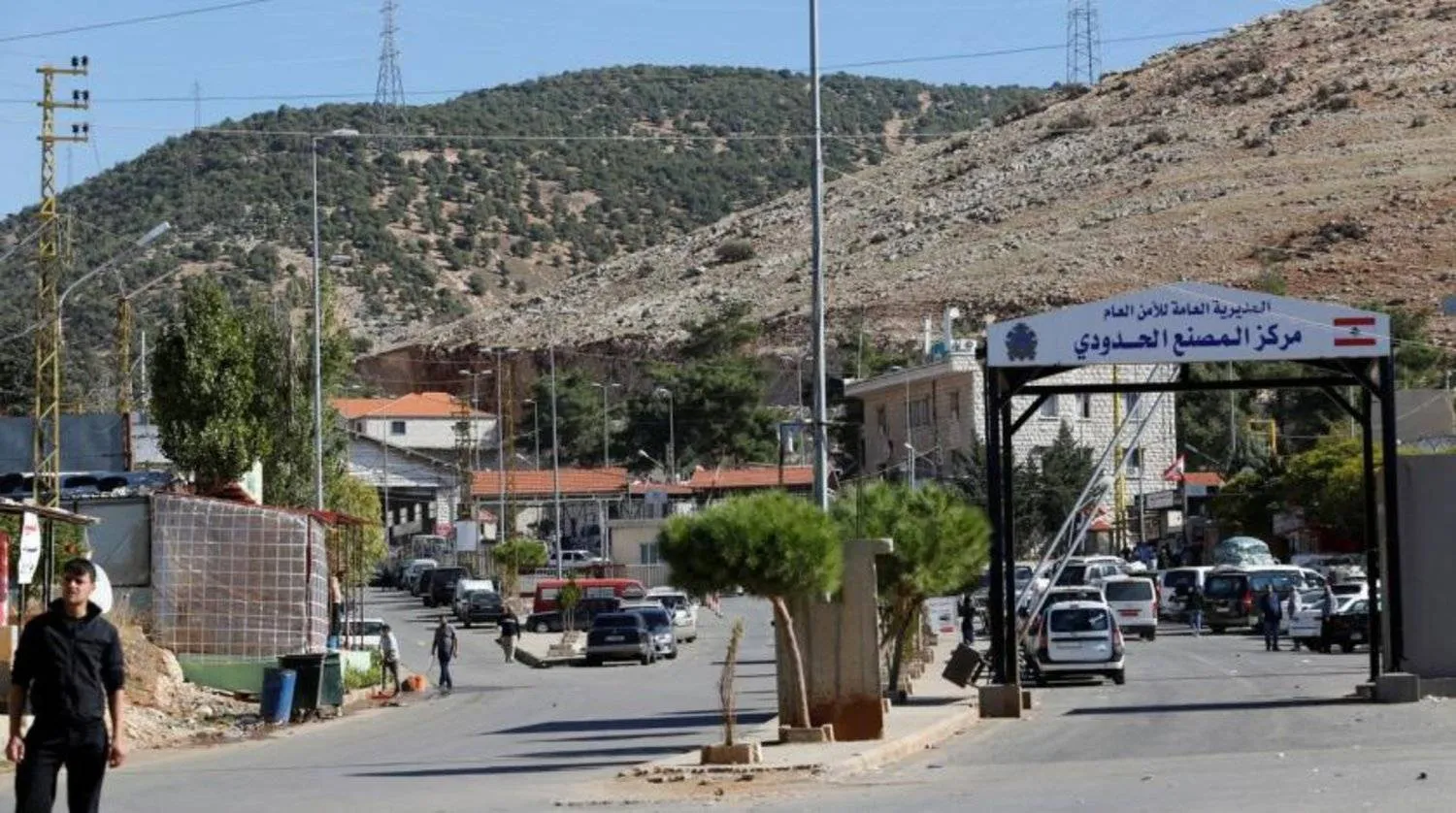
Lebanese Minister: Israeli Strike Closes Off Road Used to Flee Lebanon to Syria

Masnaa border crossing between Lebanon and Syria, Lebanon November 1, 2018. Picture taken November 1, 2018. REUTERS/Jamal Saidi
TT

Lebanese Minister: Israeli Strike Closes Off Road Used to Flee Lebanon to Syria

Masnaa border crossing between Lebanon and Syria, Lebanon November 1, 2018. Picture taken November 1, 2018. REUTERS/Jamal Saidi

An Israeli strike on Friday morning near Lebanon's Masnaa border crossing with Syria cut off a road used by hundreds of thousands of people to flee Israeli bombardments in recent days, Lebanon Transport Minister Ali Hamieh told Reuters.
Hamieh said the strike hit inside Lebanese territory near the border crossing, creating a four-meter (12 feet) wide crater.
An Israeli military spokesman had accused Lebanese armed group Hezbollah on Thursday of using the crossing to transport military equipment into Lebanon.
Israel “will not allow the smuggling of these weapons and will not hesitate to act if forced to do so, as it has done throughout this war," Israeli army spokesman Avichay Adraee said on X.
Hamieh had said at a press conference on Thursday that the crossing was subject to the authority of the Lebanese state.
According to Lebanese government statistics, more than 300,000 people - a vast majority of them Syrian - had crossed from Lebanon into Syria over the last 10 days to escape escalating Israeli bombardment.


Why Israel Fears Military Rapprochement Between Egypt and Türkiye

Egyptian Abdel Fattah al-Sisi meets Turkish Recep Tayyip Erdogan on the sidelines of the D-8 Organization for Economic Cooperation summit in Egypt’s New Administrative Capital in December 2024. (Egyptian Presidency)
TT

Why Israel Fears Military Rapprochement Between Egypt and Türkiye

Egyptian Abdel Fattah al-Sisi meets Turkish Recep Tayyip Erdogan on the sidelines of the D-8 Organization for Economic Cooperation summit in Egypt’s New Administrative Capital in December 2024. (Egyptian Presidency)

The growing rapprochement between Egypt and Türkiye is raising concern in Israel, particularly as military cooperation expands through joint training and exercises between two of the region’s largest and most strategically significant armed forces.

Those concerns resurfaced after international military drills involving Egyptian and Turkish forces concluded in the Libyan city of Sirte.

Experts who spoke to Asharq Al-Awsat said the unease stems from several factors, including the two countries’ military weight and their growing alignment on regional issues and defense manufacturing.

They expect the rapprochement could evolve into a regional alliance with expanding influence, while ruling out any imminent military confrontation.

Israeli concerns

The Israeli newspaper Maariv published an article by retired general Yitzhak Brik warning that Tel Aviv could face a “difficult war” against a potential Egyptian-Turkish alliance as both countries strengthen their military capabilities.

Brik warned that strategic cooperation between Cairo and Ankara could extend to joint military production and defense integration.

Any military rapprochement between Egypt and Türkiye, he said, could reshape deterrence dynamics in the region and pose new security challenges for Israel, requiring a comprehensive reassessment of its military doctrine and defense strategies.

Israeli channel i24NEWS reported on April 18 that talks between Egypt and Türkiye were accelerating, noting that in-depth discussions had been referred to Turkish parliamentary committees on security, defense, and intelligence.

Turkish President Recep Tayyip Erdogan visited Cairo in February, where several agreements were signed, including in the defense sector. During a joint press conference, Egyptian President Abdel Fattah al-Sisi said the two countries share converging views on regional and international issues, particularly Gaza, Sudan, Libya and the Horn of Africa.

Israel has also expressed reservations about the possibility of Ankara participating in international stabilization forces in Gaza, after Türkiye became involved in mediation and guarantees for implementing a ceasefire agreement in October. Media reports have also pointed to the possibility of a future military confrontation between Israel and Türkiye following tensions linked to Iran.

‘Cold peace’

Egyptian military and strategic expert Samir Ragheb said Türkiye’s direct presence in the region, combined with its rapprochement with Egypt, reinforces what he described as a “cold peace” with Israel.

He told Asharq Al-Awsat that Cairo and Ankara command the region’s two largest armies and maintain strong ties with key regional powers, something Israel views with concern.

One of the most sensitive issues for Israel, he said, is cooperation in drone manufacturing.

Both Egypt and Türkiye have significant capabilities in this field, and joint production could meet their domestic needs while positioning them as strong competitors to Israeli drones in regional markets, particularly as negative perceptions of Israeli products grow due to ongoing conflicts, making Egyptian-Turkish alternatives more appealing.

Coordination between Egypt and Türkiye spans a broad geographic arc from Somalia to Syria, including Libya. This, Ragheb said, adds to Israeli concerns, particularly as Türkiye seeks to expand its footprint in Africa through Egypt, the continent’s main gateway.

Turkish affairs researcher Taha Ouda Oglu told Asharq Al-Awsat that cooperation between Egypt and Türkiye on Gaza, Libya and Africa is further raising Israeli concerns.

Rising military cooperation

Military cooperation between Egypt and Türkiye has accelerated in recent months. In late 2025, for the first time in 13 years, Egyptian forces took part in joint naval exercises on Turkish soil, involving Turkish frigates, attack boats, a submarine and F-16 fighter jets, alongside Egyptian naval units.

Türkiye’s Defense Ministry said on Thursday that the “Flintlock 2026” exercises, which were in Sirte from April 13 to 30, had concluded. The drills, which included Egyptian forces, aimed to enhance military cooperation and combat readiness through integrated land, air and naval scenarios.

In September, Turkish Foreign Minister Hakan Fidan said in a televised interview that Ankara is seeking to strengthen cooperation with Egypt in defense industries and joint security, noting that regional threats are driving deeper discussions on security as ties develop.

Egypt and Türkiye also signed an agreement in late August to locally produce the “Turkha” drone in Egypt, a step aimed at localizing drone technology and boosting domestic defense industries. The aircraft features advanced surveillance and reconnaissance systems and vertical takeoff and landing capabilities.

Ragheb ruled out the possibility of Israel waging a military confrontation against either Egypt or Türkiye, saying Israeli military doctrine does not allow for fighting on multiple fronts simultaneously against major powers.

He added that the United States would be unlikely to support Israel in a war against countries the size of Egypt or Türkiye, noting both nations rely on deterrence through strength rather than rhetoric.

He said the rapprochement, while not directed against Israel, could evolve into a broader regional alliance that may include major countries, such as Pakistan.

Oglu said military cooperation between Egypt and Türkiye is likely to deepen further and expand across multiple arenas, increasing their influence in the region, without leading to a direct confrontation with Israel.


Aoun Insists on Ceasefire Before Lebanon-Israel Talks

A billboard depicting Lebanese President Joseph Aoun and sentence reading in Arabic "The decision is up to Lebanon" is seen in the predominantly Christian Ashrafieh neighborhood in Beirut, Lebanon, 01 May 2026. (EPA)
TT

Aoun Insists on Ceasefire Before Lebanon-Israel Talks

A billboard depicting Lebanese President Joseph Aoun and sentence reading in Arabic "The decision is up to Lebanon" is seen in the predominantly Christian Ashrafieh neighborhood in Beirut, Lebanon, 01 May 2026. (EPA)

Lebanese President Joseph Aoun is pushing to lock in a ceasefire and halt Israeli strikes on civilians before Lebanese and Israeli representatives resume bilateral talks in Washington, as Hezbollah continues to vehemently reject the negotiations.

Aoun is under pressure from both sides. The United States is urging direct engagement between Lebanon and Israel, including a meeting between Aoun and Israeli Prime Minister Benjamin Netanyahu. Hezbollah, meanwhile, rejects direct talks outright.

Aoun says diplomacy is the only option to secure a ceasefire, ensure an Israeli withdrawal, and extend state control across all Lebanese territory. But he refuses any meeting with Netanyahu, after rejecting even a phone call with him as part of a US-mediated three-way contact.

Consolidating the ceasefire

Aoun’s push to cement the ceasefire was discussed with US Ambassador to Beirut Michel Issa, hours after the US Embassy said a direct meeting between Aoun and Netanyahu, "facilitated by President Trump, would give Lebanon the chance to secure concrete guarantees on full sovereignty, territorial integrity, secure borders, humanitarian and reconstruction support, and the complete restoration of Lebanese state authority over every inch of its territory -- guaranteed by the United States."

The Lebanese presidency said Aoun met Issa after returning from Washington and reviewed developments, focusing on consolidating the ceasefire and stopping attacks on civilians and civilian facilities, ahead of further Washington talks aimed at securing peace and stability along the border.

Issa reaffirmed the US’s continued support for Lebanon and its institutions. Aoun thanked Washington for its backing.

Prime Minister Nawaf Salam also met Issa to discuss consolidating the ceasefire and negotiations with Israel, the prime minister’s office said.

Sources close to the presidency told Asharq Al-Awsat that a ceasefire and a halt to attacks on civilians and civilian facilities are “the basis for completing negotiations.”

Aoun’s position on a direct meeting “is known and declared,” the sources said. “Anyone who rejected a phone call with Netanyahu will certainly reject meeting him.”

Hezbollah pressure

Alongside US pressure, Aoun faces pressure from Hezbollah, which has vowed to keep fighting Israel in the south, and is holding the state responsible for the path it is taking.

Hezbollah’s Loyalty to the Resistance parliamentary bloc said the authorities’ move toward direct negotiations is “rejected and condemned,” calling it a deviation from national principles, a violation of sovereignty, and a contradiction of the Taif Accord and national consensus.

It said it is “not concerned at all” with their outcomes.

The bloc accused Israel of daily killings of civilians and systematic destruction of border villages, calling them war crimes that will not deter people from defending the country, but instead reinforce support for the resistance- Hezbollah.

It added that such actions should push the authorities to “stop their series of free concessions.”

Geagea

The move toward direct talks with Israel has drawn support from some political forces, led by the Lebanese Forces.

MP Sethrida Geagea said Lebanon’s current phase “cannot tolerate more one-upmanship or populist rhetoric,” which she said has only led to further collapse.

She voiced full support for Aoun’s efforts to end the war through a “clear and explicit negotiating path” aimed at protecting Lebanon and re-establishing the state as the sole authority.


In South Syria, Families Fear for Relatives Seized by Israel

Fifty-three-year-old Syrian Aicha al-Safadi, holds the a picture of her son Hassane Mohammed al-Safadi, with details of when he was detained by Israel as she sits in her house in the southern Syrian village of Beit Jinn, near the Israeli-annexed Syrian Golan Heights and at the foot Mount Hermon, known in Arabic as Jabal al-Sheikh on April 29, 2026. (AFP)
TT

In South Syria, Families Fear for Relatives Seized by Israel

Fifty-three-year-old Syrian Aicha al-Safadi, holds the a picture of her son Hassane Mohammed al-Safadi, with details of when he was detained by Israel as she sits in her house in the southern Syrian village of Beit Jinn, near the Israeli-annexed Syrian Golan Heights and at the foot Mount Hermon, known in Arabic as Jabal al-Sheikh on April 29, 2026. (AFP)

Whenever Fatima al-Safadi hears a knock at the door, she imagines it might be her sons -- among dozens of people Israel has seized from southern Syria and whose fate remains unknown months later.

Mohammed, 40, and Ahmed, 36, were among seven people seized in a nighttime Israeli army incursion into the village of Beit Jinn, southwest of Damascus, in June last year.

Israel's army said it apprehended several alleged members of Palestinian group Hamas accused of planning attacks on Israeli civilians and troops, and transferred them to Israeli territory "for further interrogation".

Syria said a civilian was killed in the incident.

Safadi, 57, has not seen her two sons since.

"Sometimes I hear a knock at the door and I rush to open it, but there is nobody there," she said, holding a picture of her sons close.

"I'm afraid about what has happened... and that they won't be released," she told AFP.

Beit Jinn is located near the Israeli-annexed Syrian Golan Heights and at the foot of Mount Hermon, known in Arabic as Jabal al-Sheikh.

Israel moved its forces into a UN-patrolled demilitarized zone on the Golan after the December 2024 ousting of longtime Syrian ruler Bashar al-Assad and now controls a permanent position at the summit of Mount Hermon.

It has also launched hundreds of strikes on Syria and carries out regular incursions into the country's south, where it demands a demilitarized zone.

Safadi said her joy at Assad's overthrow was overtaken by suffering after her sons were taken.

- 'Incommunicado' -

Along the road leading from Damascus to Beit Jinn, Syrian soldiers with light weapons man checkpoints, while heavy army vehicles previously stationed near Jabal al-Sheikh are gone.

Another resident, Aisha al-Safadi, 53, fought back tears as she spoke of her son Hassane who was among those seized in Beit Jinn last June.

"It's hard because we don't know what's happened to him," she said, kissing one of his photographs.

"I've been counting the days and nights" since he was taken, she said, his three children gathered around her.

"Every day, I say to myself, he'll be released."

She pleaded for the Syrian government to "help in every way possible to get our people released from Israel".

In a report this week, Human Rights Watch said that since Assad's fall, Israeli forces have "carried out frequent ground raids, airstrikes, and other operations in Quneitra, Daraa, and Sweida" provinces in the country's south.

"Israeli forces have also arbitrarily detained Syrian civilians and transferred them into Israel, where they are held without charge and incommunicado," it added.

Last November, the Israeli army said it carried out an operation in Beit Jinn to apprehend suspects from Lebanese group Jamaa Islamiya, a Hamas ally which denied having any activity outside Lebanon.

The operation left 13 Syrians dead and six Israeli soldiers wounded.

- 'Torment' -

In a government building close to a new Israeli military base, Quneitra province official Mohammed al-Saeed said that "the Israeli army has kidnapped more than 50 people" from the region.

Israel "has occupied new lands at a depth between 500 meters (1,640 feet) and one kilometer, over an area of around 240 square kilometers" where its forces have set up temporary checkpoints and stormed homes, he added.

Israel's army told AFP's Jerusalem bureau that in Syria its forces "have apprehended individuals where there was reasonable suspicion of their involvement in terrorist activity against the State of Israel".

"In appropriate cases, continued detention is carried out for preventive security purposes, in accordance with Israeli law and the applicable rules of international law," it said in a statement.

"Detention orders and their duration are subject to judicial review as required by law," it added.

Since ousting Assad, Syria's new authorities have held a series of talks with Israeli officials.

This year, under US pressure, Israel and Syria agreed to establish an intelligence-sharing mechanism as the two countries edge towards a security agreement after decades of hostilities.

In the Quneitra province town of Khan Arnabah, real estate agent Mohammed al-Sayed, 45, recounted with anguish his detention by Israeli forces last year.

"During my 65 days in prison, every moment far from our families, our children, our relatives, was like being besieged," he said.

"Every moment that passed was a torment," he said.

"What about those who have been there for more than a year without any news of their families, and without their families knowing what has happened to them?"