


Syrian Presidency: SDF Call for Federalism Threatens the Country’s Unity, Safety 

Syria’s interim President Ahmed al-Sharaa attends an interview with Reuters at the presidential palace, in Damascus, Syria March 10, 2025. (Reuters)
TT

Syrian Presidency: SDF Call for Federalism Threatens the Country’s Unity, Safety 

Syria’s interim President Ahmed al-Sharaa attends an interview with Reuters at the presidential palace, in Damascus, Syria March 10, 2025. (Reuters)

Syria's leaders said on Sunday that Kurdish demands for the country to adopt a decentralized system of government in a post-Assad political order posed a threat to national unity.

"We clearly reject any attempt to impose a partition or create separatist cantons under the terms of federalism or self-autonomy without a national consensus," Syrian President Ahmed al-Sharaa's office said in a statement.

"The unity of Syrian territory and its people is a red line," the statement said.

Rival Syrian Kurdish parties, including the dominant faction in the Kurdish-run northeast, agreed at a meeting in Syria's Kurdish-controlled city of Qamishli on Saturday on a common political vision for Syria's Kurdish minority.

A communique at the end of the conference, which was attended by US officials, demanded that a future Syrian constitution should enshrine respect for Kurdish national rights in Syria after the ouster of Bashar al-Assad.

"A joint Kurdish political vision has been formulated that expresses a collective will and its project for a just solution to the Kurdish issue in Syria as a decentralized democratic state," the pan-Kurdish statement said.

The Kurdish-led Syrian Democratic Forces (SDF), backed by the US, last month signed a deal with Damascus on merging Kurdish-led governing bodies and security forces with the central government.

The Syrian presidency's statement also said recent statements by SDF leaders advocating a federal solution went clearly against that deal.

The agreement with the SDF could be a "constructive step forward if it was implemented with national spirit, away from narrow agendas," it continued.

It warned against obstructing state institutions in regions held by the SDF and against imposing a monopoly on resources. "The SDF leadership cannot take unilateral decisions in northeastern Syria. There can be no stability and no future without real partnership," it declared.

During the 14-year civil war, Kurdish-led groups took control of roughly a quarter of Syrian territory, where most of the country's oil wealth is found along with fertile arable land that produces a major proportion of the country's wheat.

Kurdish officials have objected to the way Syria's new rulers are shaping the transition from Assad's rule, saying they are failing to respect Syria's diversity despite promises of inclusivity.

The presidency statement stressed that "Kurdish rights are being protected under the one state, without the need for foreign intervention or hegemony." It called on the SDF to commit to the agreement reached in March and to prioritize national interests.


Turkish Police Detain Deutsche Welle Journalist over Social Media Posts

19 February 2026, Canada: Deutsche Welle (DW) logo is seen displayed on a smartphone screen. Photo: Thomas Fuller/SOPA Images via ZUMA Press Wire/dpa
TT

Turkish Police Detain Deutsche Welle Journalist over Social Media Posts

19 February 2026, Canada: Deutsche Welle (DW) logo is seen displayed on a smartphone screen. Photo: Thomas Fuller/SOPA Images via ZUMA Press Wire/dpa

Turkish police have detained investigative journalist Alican Uludag on suspicion of insulting President Recep Tayyip Erdogan and spreading misinformation, sparking outrage among journalism groups.
Uludag, who works for German broadcaster Deutsche Welle’s Turkish service, was taken from his home in Ankara late Thursday as part of an investigation into social media posts. The Istanbul Chief Prosecutor’s Office said he is suspected of “insulting the president” and “disseminating misleading information.”
The journalist, whose reporting focuses mainly on the judiciary and on corruption cases, was later transferred to Istanbul for questioning.
His detention drew sharp condemnation from press freedom advocates, who described it as an attack on media independence and democratic norms, The Associated Press said.
Deutsche Welle’s director‑general, Barbara Massing, demanded his release, calling the arrest “a deliberate act of intimidation.”
On Friday, journalists gathered outside Istanbul’s Çaglayan Courthouse to protest Uludag’s detention and to call for his immediate release.
The advocacy group, Reporters Without Borders considers Türkiye to be one of the most repressive countries for journalists, nothing that most media organizations are under government control and journalists face frequent legal pressure or intimidation.
At least 14 journalists or media sector workers are currently in prison, according to the Turkish Journalists Syndicate.


Indian PM, President of Saudi Arabia’s SDAIA Discuss AI Cooperation 

Indian Prime Minister Narendra Modi and President of the Saudi Data and Artificial Intelligence Authority (SDAIA) President Dr. Abdullah Al-Ghamdi meet on the sidelines of the India AI Impact Summit 2026. (SPA)
TT

Indian PM, President of Saudi Arabia’s SDAIA Discuss AI Cooperation 

Indian Prime Minister Narendra Modi and President of the Saudi Data and Artificial Intelligence Authority (SDAIA) President Dr. Abdullah Al-Ghamdi meet on the sidelines of the India AI Impact Summit 2026. (SPA)

Indian Prime Minister Narendra Modi held talks with President of the Saudi Data and Artificial Intelligence Authority (SDAIA) President Dr. Abdullah Al-Ghamdi on the sidelines of the India AI Impact Summit 2026, reported the Saudi Press Agency on Friday.

Discussions focused on knowledge transfer and the exchange of expertise to accelerate digital development in both nations. They also tackled expanding bilateral cooperation in data and AI.

Al-Ghamdi commended India’s leadership in hosting the summit, noting that such international partnerships are essential for harnessing advanced technology to benefit humanity and achieve shared strategic goals.


India Chases 'DeepSeek Moment' with Homegrown AI

A handout photo made available by the Press Information Bureau (PIB) of Indian Prime Minister Narendra Modi speaking with global leaders at the AI Impact Summit 2026 at Bharat Mandapam in New Delhi, India, 19 February 2026.EPA/PRESS INFORMATION BUREAU HANDOUT HANDOUT
TT

India Chases 'DeepSeek Moment' with Homegrown AI

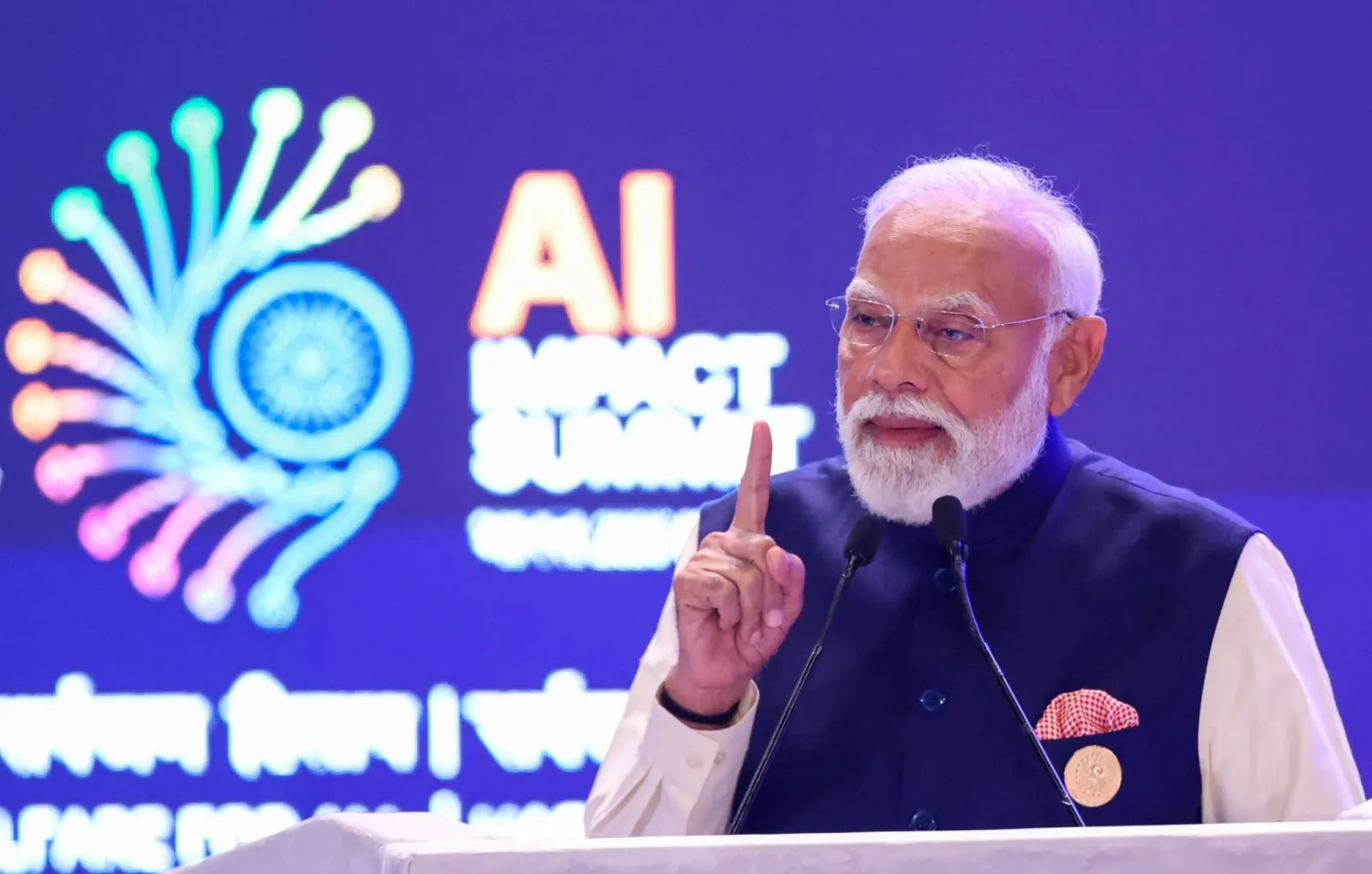
A handout photo made available by the Press Information Bureau (PIB) of Indian Prime Minister Narendra Modi speaking with global leaders at the AI Impact Summit 2026 at Bharat Mandapam in New Delhi, India, 19 February 2026.EPA/PRESS INFORMATION BUREAU HANDOUT HANDOUT

Fledgling Indian artificial intelligence companies showcased homegrown technologies this week at a major summit in New Delhi, underpinning big dreams of becoming a global AI power.

But analysts said the country was unlikely to have a "DeepSeek moment" -- the sort of boom China had last year with a high-performance, low-cost chatbot -- any time soon, AFP reported.

Still, building custom AI tools could bring benefits to the world's most populous nation.
At the AI Impact Summit, Prime Minister Narendra Modi lauded new Indian AI models, along with other examples of the country's rising profile in the field.

"All the solutions that have been presented here demonstrate the power of 'Made in India' and India's innovative qualities," Modi said Thursday.

One of the startups making a buzz at the five-day summit was Sarvam AI, which this week released two large language models it says were trained from scratch in India.

Its models are optimized to work across 22 Indian languages, says the company, which received government-subsidized access to advanced computer processors.

The five-day summit, which wraps up Friday, is the fourth annual international meeting to discuss the risks and rewards of the fast-growing AI sector.

It is the largest yet and the first in a developing country, with Indian businesses striking deals with US tech giants to build large-scale data center infrastructure to help train and run AI systems.

On Friday, Abu Dhabi-based tech group G42 said the United Arab Emirates would deploy an AI supercomputer system in India, in a project "designed to lower barriers to AI innovation".

So-called sovereign AI has become a priority for many countries hoping to reduce dependence on US and Chinese platforms while ensuring that systems respect local regulations, including on data privacy.

AI models that succeed in India "can be deployed all over the world", Modi said on Thursday.

But experts said the sheer computational might of the United States would be hard to match.

"Despite the headline pledges, we don't expect India to emerge as a frontier AI innovation hub in the near term," said Reema Bhattacharya, head of Asia research at risk intelligence company Verisk Maplecroft.

"Its more realistic trajectory is to become the world's largest AI adoption market, embedding AI at scale through digital public infrastructure and cost-efficient applications," she said.

Another Indian company that drew attention with product debuts this week was the Bengaluru-based Gnani.ai, which introduced its Vachana speech models at the summit.

Trained on more than a million hours of audio, Vachana models generate natural-sounding voices in Indian languages that can process customer interactions and allow people to interact with digital services out loud.

Job disruption and redundancies, including in India's huge call center industry, have been one key focus of discussions at the Delhi summit.

Prihesh Ratnayake, head of AI initiatives at think-tank Factum, told AFP that the new Indian AI models were "not really meant to be global".

"They're India-specific models, and hopefully we'll see their impact over the coming year," he said.

"Why does India need to build for the global scale? India itself is the biggest market."
And Nanubala Gnana Sai at the Cambridge AI Safety Hub said that homegrown models could bring other benefits.

Existing models, even those developed in China, "have intrinsic bias towards Western values, culture and ethos -- as a product of being trained heavily on that consensus", Sai told AFP.

India already has some major strengths, including "technology diffusion, eager talent pool and cheap labor", and dedicated efforts can help startups pivot to artificial intelligence, he said.

"The end-product may not 'rival' ChatGPT or DeepSeek on benchmarks, but will provide leverage for the Global South to have its own stand in an increasingly polarized world."