


US Military Transfers 150 ISIS Group Detainees from Syria to Iraq

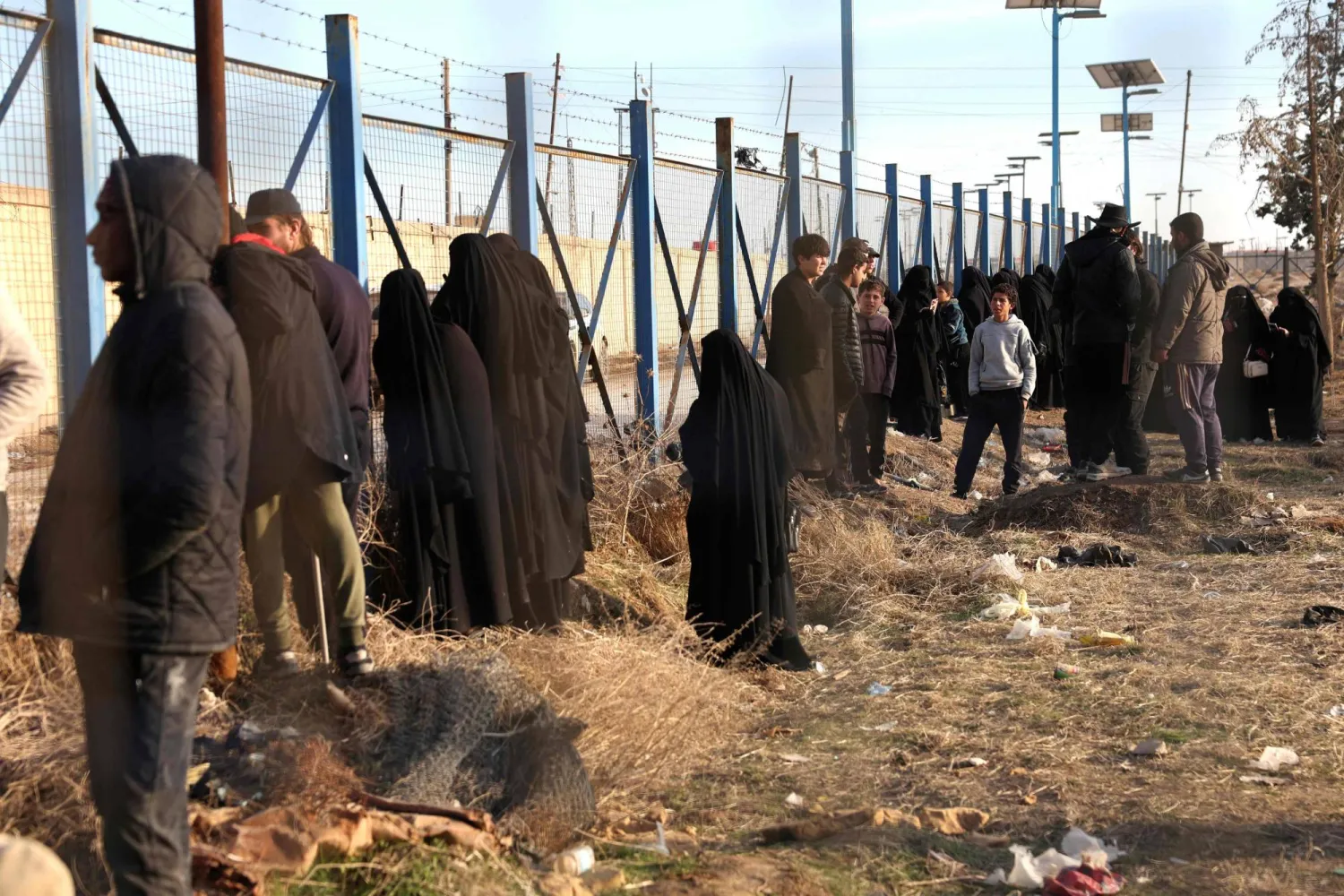
Relatives of suspected ISIS detainees, stand behind a fence in al-Hol camp in the desert region of Syria's Hasakeh province on January 21, 2026. (AFP)
TT

US Military Transfers 150 ISIS Group Detainees from Syria to Iraq

Relatives of suspected ISIS detainees, stand behind a fence in al-Hol camp in the desert region of Syria's Hasakeh province on January 21, 2026. (AFP)

The US military said on Wednesday that its forces have transferred 150 ISIS detainees from Syria to Iraq. The move comes after the rapid collapse of the Kurdish-led Syrian Democratic Forces in northeast Syria triggered uncertainty over the security of around a dozen prisons and detention camps they had been guarding. 

In a statement, the ‌US military said ‌the United States ‌was able ⁠to transport ‌150 ISIS fighters held at a detention facility in Hasakeh, Syria, to a secure location in Iraq. 

Ultimately, up to 7,000 ISIS detainees could be transferred from Syria to Iraqi-controlled facilities, the statement added. 

"We ⁠are closely coordinating with regional partners, including the Iraqi ‌government, and we sincerely appreciate their ‍role in ensuring ‍the enduring defeat of ISIS," said ‍US Admiral Brad Cooper, the head of US forces in the Middle East. 

Syria on Tuesday announced a ceasefire with Kurdish forces from which it has seized swathes of territory in the northeast and gave them ⁠four days to agree on integrating into the central state, which their main ally, the United States, urged them to accept. 

The lightning government advances in recent days and the apparent withdrawal of US support for SDF's continued holding of territory represent the biggest change of control in the country since opposition factions ousted Bashar al-Assad 13 ‌months ago. 


Al-Wali to Asharq Al-Awsat: Riyadh Talks a Pivotal Moment for Yemen’s Southern Cause

Former Yemeni minister and veteran southern politician Abdel Nasser Al-Wali speaks to Asharq Al-Awsat.
TT

Al-Wali to Asharq Al-Awsat: Riyadh Talks a Pivotal Moment for Yemen’s Southern Cause

Former Yemeni minister and veteran southern politician Abdel Nasser Al-Wali speaks to Asharq Al-Awsat.

Former Yemeni minister and veteran southern politician Abdel Nasser Al-Wali described the meeting of Yemen’s southern leaders in Riyadh for consultations and dialogue on their cause on Sunday as a pivotal moment in its history, calling for the opening created by Saudi Arabia to be channeled into a political process that delivers lasting peace.

Speaking on the Asharq Al-Awsat podcast with Gulf affairs editor Badr Al-Qahtani, Al-Wali said Riyadh was not merely a diplomatic stop, but a place close to the heart of the Arab and Islamic worlds, offering a chance to correct past shortcomings in conveying the southern voice.

The veteran Yemeni politician said southerners now faced a “huge opportunity” under Saudi sponsorship, noting that Riyadh had taken the initiative to invite discussions on the issue and “left the matter in our hands.”

He pointed to Saudi Arabia’s role in bringing the parties together without imposing guardianship and in supporting whatever they agree upon without interference.

He said Saudi assurances had been explicit: “The opinion is yours, the decision is yours. We are sponsors and will not impose anything on you. Raise your ceiling to the sky.”

Al-Wali said a message from Saudi Defense Minister Prince Khalid bin Salman was clear and direct.

“The southern cause is just, with historical and social dimensions, and the Kingdom will not abandon the people of the south and will stand with their will,” he remarked.

“It is enough for the southern voice to reach Saudi Arabia, and for it to understand the justice of the pain that has accumulated since unification,” he stressed.

On preparations for the Riyadh Conference for Yemeni southern dialogue, Al-Wali said discussions would address the shape of the state and its system “with an open ceiling,” to be decided by consensus without exclusion.

The focus was on restoring the state as a path toward dignity, security, stability, development, and prosperity for people, he went on to say.

“The South has room for everyone. There are no intentions of marginalization or exclusion. Any other projects are not sidelined, but discussed,” he assured.

Al-Wali addressed a message to the southern people, saying: “Trust us. We represent in Riyadh those who authorized us,” in a reference to not compromising the cause or taking decisions that contradict popular will.

In another message, he said: “The Saudis will find from the southerners only what pleases God and pleases them, while preserving the bonds of neighborhood, blood, kinship, and shared interests.”

Turning to the roots of the issue, Al-Wali said Yemeni unity had not been an “invasion” or imposed by force, but a voluntary move toward Sanaa “with open hearts,” in the hope of a larger state, a broader economy, and deeper development.

He said that if the price of stability, calm, and development were Yemen’s return to two states, then it would be better, in his view, to have two neighboring states bound by affection, with flexible and smooth economic and social relations and strong fraternal ties, rather than antagonism that “paralyzed both peoples.”

Outlining his vision for a future state, Al-Wali presented the contours of a “federal southern state” that would grant governorates room to contribute to development, investment, and wealth, with equality in rights and duties and fairness in the distribution of resources so that they reach all who deserve them.

He reiterated the centrality of Saudi Arabia’s role, saying the Kingdom’s weight was “very balanced” regionally and globally, and that its engagement represented a historic opportunity to achieve peace “without it being followed by war.”

Asked how he found Riyadh, Al-Wali replied: “As I have always known it. A country of security and stability. Calm and serenity. Love and peace. You come to it, your soul settles, and you feel reassured.”

“Their promises are sincere and are not broken,” he stressed.


Israel Launches Wave of Fresh Strikes on Lebanon

Smoke and sparks ascend from the site of an Israeli airstrike that targeted a building in the southern Lebanese village of Kfour on January 21, 2026. (AFP)
TT

Israel Launches Wave of Fresh Strikes on Lebanon

Smoke and sparks ascend from the site of an Israeli airstrike that targeted a building in the southern Lebanese village of Kfour on January 21, 2026. (AFP)

Israel launched fresh strikes on what it said were Hezbollah targets in south Lebanon after raids earlier Wednesday killed two people, the latest violence despite a year-old ceasefire with the group.

The state-run National News Agency said Israeli warplanes launched raids on buildings in several south Lebanon towns including Qanarit and Kfour, after the Israeli army issued evacuation warnings to residents identifying sites it intended to strike there.

An AFP photographer was slightly wounded along with two other journalists who were working near the site of a heavy strike in Qanarit.

The Israeli army said it was striking Hezbollah targets in response to the group's "repeated violations of the ceasefire understandings".

Under heavy US pressure and fears of expanded Israeli strikes, Lebanon has committed to disarming Hezbollah.

But Israel has criticized the Lebanese army's progress as insufficient and has kept up regular strikes, usually saying it is targeting members of the Iran-backed group or its infrastructure.

Earlier Wednesday, the health ministry said an Israeli strike on a vehicle in the town of Zahrani, in the Sidon district, killed one person.

An AFP correspondent saw a charred car on a main road with debris strewn across the area and emergency workers in attendance.

Later, the ministry said another strike targeting a vehicle in the town of Bazuriyeh in the Tyre district killed one person.

Israel said it struck Hezbollah operatives in both areas.

A Lebanese army statement decried the Israeli targeting of "civilian buildings and homes" in a "blatant violation of Lebanon's sovereignty" and the ceasefire deal.

It also said such attacks "hinder the army's efforts" to complete the disarmament plan.

This month, the army said it had completed the first phase of its plan to disarm Hezbollah, covering the area south of the Litani river, around 30 kilometers (20 miles) from the Israeli border.

Most of Wednesday's strikes were north of the river.

More than 350 people have been killed by Israeli fire in Lebanon since the ceasefire, according to an AFP tally of health ministry reports.

The November 2024 truce sought to end more than a year of hostilities, but Israel accuses Hezbollah of rearming, while the group has rejected calls to surrender its weapons.


Saudi Arabia and Ecuador Sign General Cooperation Agreement

Saudi Minister of Foreign Affairs Prince Faisal bin Farhan bin Abdullah and his Ecuadorian counterpart Gabriela Sommerfeld meet in Davos on Wednesday. (SPA)
TT

Saudi Arabia and Ecuador Sign General Cooperation Agreement

Saudi Minister of Foreign Affairs Prince Faisal bin Farhan bin Abdullah and his Ecuadorian counterpart Gabriela Sommerfeld meet in Davos on Wednesday. (SPA)

Saudi Minister of Foreign Affairs Prince Faisal bin Farhan bin Abdullah held talks on Wednesday with his Ecuadorian counterpart Gabriela Sommerfeld on the sidelines of the World Economic Forum (WEF) in Davos.

They reviewed relations between their countries and ways to boost them in various fields. They also exchanged views on a number of topics of mutual interest.

Following the meeting, the ministers signed a general cooperation agreement between their respective governments aimed at strengthening relations between their countries and advancing them toward broader horizons.
