
Tunisia Investigates Guardsman's Motive for Killing 5 Outside Historic Synagogue

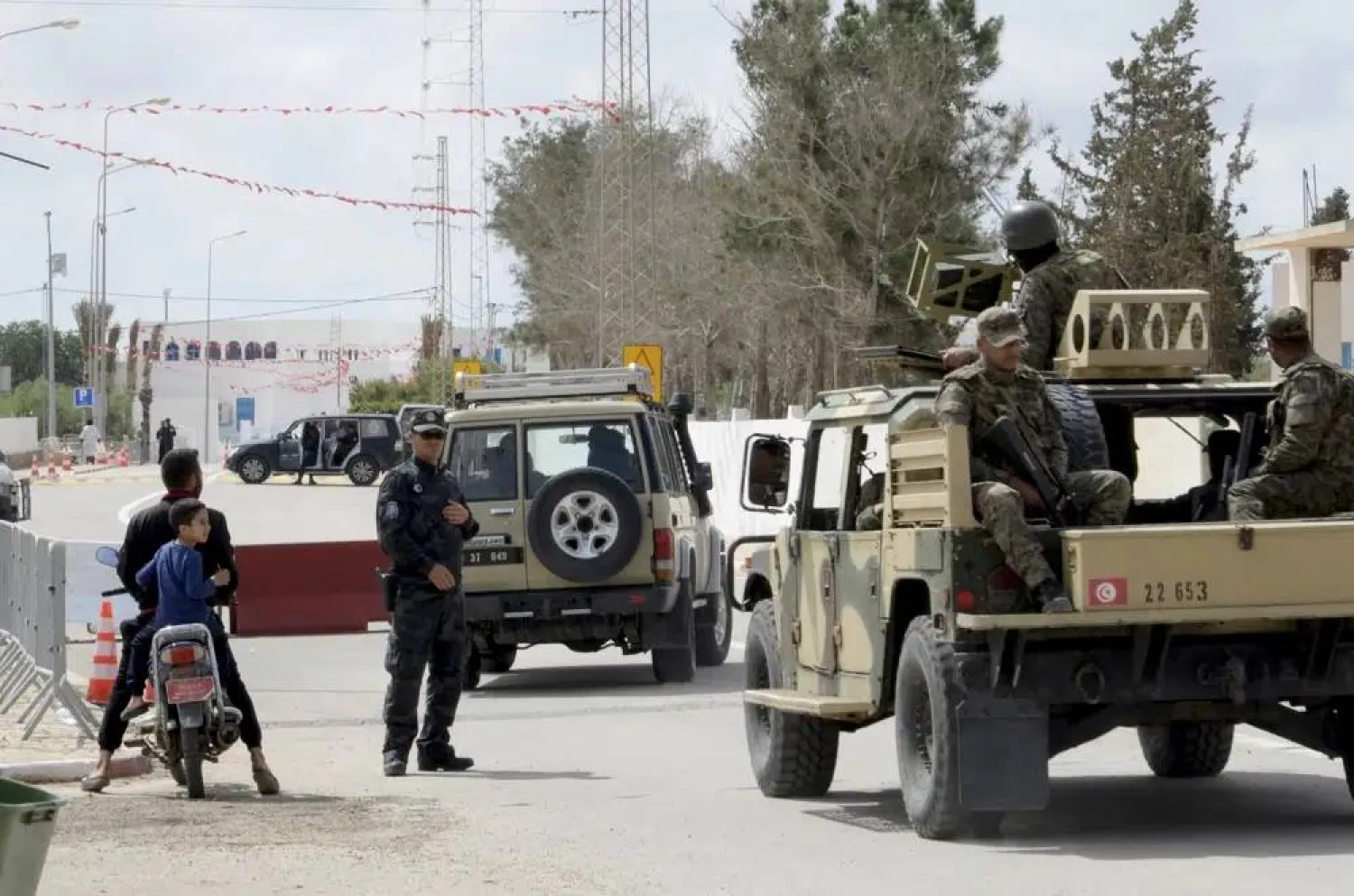
Police officers and soldiers stand near Ghriba synagogue in Djerba, Tunisia, Wednesday May 10, 2023. (AP Photo/Moncef Abidi)
TT

Tunisia Investigates Guardsman's Motive for Killing 5 Outside Historic Synagogue

Police officers and soldiers stand near Ghriba synagogue in Djerba, Tunisia, Wednesday May 10, 2023. (AP Photo/Moncef Abidi)

Tunisian authorities opened an investigation Wednesday into a shooting attack at a synagogue that killed two Jewish pilgrims and three members of the country's security forces. The motive of the gunman, whom guards killed before he could enter the building on the island of Djerba, remained unclear.

The island's historic Ghriba synagogue, thought to be one of the world’s oldest Jewish temples, is a popular pilgrimage destination, but it was unknown if the assailant, a member of the Tunisian National Guard, specifically targeted Jews in Tuesday's attack, The Associated Press said.

The death toll from the attack rose to five Wednesday when a police guard who was hospitalized in the immediate aftermath died of his wounds, according to a medical official cited by Tunisia's TAP news agency. Four other members of Tunisia's security forces remain hospitalized in Djerba, including one in critical condition.

The chair of the synagogue's committee, Perez Trabelsi, was in the house of worship during the attack and told The Associated Press of his terror “when the sound of the cartridges broke out.”

“I was scared, as were most of the people gathered in the ‘oukala,’ a large space adjacent to the synagogue. Everyone was panicking. Many took refuge in the rooms for fear of being hit by the shots that came from outside,” he said.

The synagogue attracted more pilgrims this year — around 6,000 people from the United States, Canada, Australia, Europe and beyond — than it had for some time, Trabelsi said. He said he was saddened that the pilgrimage to the site that is revered in Judaism “was spoiled by those who wish Tunisia harm.”

Israeli and Tunisian authorities and family members identified the civilian victims as cousins: Aviel Haddad, 30, who held dual Tunisian and Israeli citizenship, and Benjamin Haddad, 42, who was French. Four civilians were also wounded, the Tunisian Interior Ministry said.

Israeli Prime Minister Benjamin Netanyahu said he was sorry to hear that two “members of our people” were killed in Djerba. “On behalf of myself and the government of Israel, I send condolences from the bottom of my heart to the families of the murdered,” he said in a statement.

The assailant, a guardsman affiliated with the naval center in the island's port town of Aghir, first killed a colleague with his service weapon before seizing ammunition and heading toward the Ghriba synagogue, the Tunisian Interior ministry said.

When he reached the site, he opened fire on security units stationed at the temple. The guards fired back, killing him before he reached the entrance, the ministry said.

Jews have lived on Djerba, a picturesque island off the southern coast of Tunisia, since 500 B.C. The first Jewish arrivals were said to have brought a stone from the ancient temple of Jerusalem that was destroyed by the Babylonians.

The stone is kept in a grotto at the synagogue. Women and children descend into the grotto to place eggs scrawled with wishful messages on them.

Djerba’s Jewish population is one of North Africa’s biggest, although in recent years it declined to 1,500, down from 100,000 in the 1960s.

Djerba, a dusty island of palm trees and olive groves, lures hundreds of thousands of tourists every year — mainly Germans and French — for its sandy beaches and rich history. The Ghriba synagogue itself, said to date to 586 B.C., once drew up to 2,000 visitors per day, Jewish leaders have said.

The French Foreign Ministry expressed its “deep sadness” at the attack. In a statement, the ministry paid tribute to the “rapid intervention of the Tunisian security forces and stands by Tunisia to continue the fight against antisemitism and all forms of fanaticism.”

Israeli Diaspora Affairs Minister Amichai Chikli noted that “unfortunately, the incident was preceded by a tense period of shouts and harassment of the Jewish community at the site,” according to his office.

Israeli Foreign Minister Eli Cohen spoke with Tunis Chief Rabbi Haim Bitan, and “told him that Israel stands alongside the community in this difficult hour.” He said he instructed ministry officials to provide all needed aid. Israel and Tunisia don’t have formal diplomatic relations.

The European Jewish Congress expressed its “shock and outrage”.

In 2002, a truck bombing killed about 20 people at the entrance to the same temple during the annual Jewish pilgrimage. Al-Qaida claimed the attack, whose victims included German and French tourists as well as Tunisians.

In 2015, an attack in Tunisia at the Mediterranean resort of Sousse killed 38 people, mostly British tourists. The ISIS group claimed the attack, along with attacks that year on the famed Bardo Museum in the capital Tunis and on a bus carrying presidential guards.


Iraq Closes Three Iran Crossings, Pursues Those Behind Attacks on Saudi Arabia

Travelers at the Shalamsheh border crossing between Iraq and Iran after Iraqi authorities ordered its closure as a precautionary measure following the latest drone attacks on Saudi Arabia on September 12, 2026 (Reuters)
TT

Iraq Closes Three Iran Crossings, Pursues Those Behind Attacks on Saudi Arabia

Travelers at the Shalamsheh border crossing between Iraq and Iran after Iraqi authorities ordered its closure as a precautionary measure following the latest drone attacks on Saudi Arabia on September 12, 2026 (Reuters)

Iraq closed three border crossings with Iran on Saturday, officials told AFP, after a drone attack on a Saudi Arabian pipeline that both Riyadh and Baghdad said was launched from Iraq.

An Iraqi security source and a government official told AFP that authorities ordered the closing of three border crossings with Iran.

The security source said the decision was "part of an intelligence effort to track down the perpetrators and prevent their escape... and to hinder the smuggling of drones through these crossings".

Both sources, who spoke on condition of anonymity because they were not allowed to speak to the media, could not specify when the crossings would reopen.

The closed crossings are Shalamsheh in Basra province, al-Shib in Missan and al-Mandali in the central province of Diyala.

Other border crossings with Iran are still open.

A security official said that "security forces found drone launchers near the Iraq-Iran border in the al-Tib" region, a remote part of Missan, close to the al-Shib crossing. A second security source gave the same account.

Military spokesperson Sabah al-Numan said the prime minister had approved "Iran's request to conduct a joint investigation into finding drone launch platforms near the Iraq-Iran border".

The government's security media cell said earlier that authorities "have started administrative and security reorganization operations at several border crossings".

It added that they had stepped up "intelligence activities" to determine "the breaches and violations that took place at these crossings".

It later announced that passengers stranded for hours at two crossings were permitted to pass.


Al-Halbousi Condemns Attacks on Saudi Arabia

Iraqi Speaker of parliament Mohammed al-Halbousi speaks with the news media as he departs the Department of State after meeting with Secretary of State Mike Pompeo, in Washington, on March 28, 2019. (AP)
TT

Al-Halbousi Condemns Attacks on Saudi Arabia

Iraqi Speaker of parliament Mohammed al-Halbousi speaks with the news media as he departs the Department of State after meeting with Secretary of State Mike Pompeo, in Washington, on March 28, 2019. (AP)

Speaker of the Iraqi Council of Representatives Haibat Al-Halbousi strongly condemned the attacks targeting the Kingdom of Saudi Arabia that originated from within Iraqi territory.

In a statement issued on Saturday, Al-Halbousi rejected the use of Iraq's territory or airspace to threaten Saudi Arabia's security or that of any neighboring state, describing such actions as unacceptable violations that contradict Iraq's national interests, stated foreign policy, and regional relations.

Al-Halbousi emphasized the critical need to restrict weapons exclusively to the state and its constitutional institutions under the authority of the commander-in-chief of the Armed Forces.

He stressed that enforcing state control over arms is vital to reinforcing national sovereignty, preserving domestic stability, and preventing Iraq from being drawn into wider regional conflicts.


Lebanese Army Detains Bashar Assad’s Relative on Weapons and Drugs Charges

Ousted Syrian President Bashar Assad - File Photo
TT

Lebanese Army Detains Bashar Assad’s Relative on Weapons and Drugs Charges

Ousted Syrian President Bashar Assad - File Photo

Lebanese authorities have detained a relative of ousted Syrian President Bashar Assad along with the son of a notorious drug dealer in northeast Lebanon on charges of carrying weapons and drugs, officials and the Lebanese army said Saturday.

Suleiman Assad and Ali Zeiter, son of Noah Zeiter, the suspected drug trafficker arrested last year, were detained Friday near the northeastern city of Baalbek, said the two judicial officials, who spoke on condition of anonymity because they were not authorized to speak to the media. Suleiman Assad is the son of Hilal Assad, a cousin of the ousted president, The AP news reported.

A number of Syrian officials and relatives of Assad have fled from Syria to other countries including Lebanon, after the five-decade Assad family rule came to an end in December 2024, when the opposition seized power. Bashar Assad and his younger brother, Maher, have been living in Russia.

The Lebanese army said in a statement that it detained three people, including a Syrian citizen who did not have documents proving that he is staying legally in Lebanon.

The army said they had weapons with them along with hashish, a drug that is processed from cannabis that are widely planted in northeast Lebanon. The army did not release the names but the initials of their first and family names matched those of Assad and Zeiter. The army said they were questioned under the supervision of judicial officials.

The arrest of Suleiman Assad comes weeks after Lebanon handed over to Syrian authorities a retired major general who commanded a division in Bashar Assad’s army.