



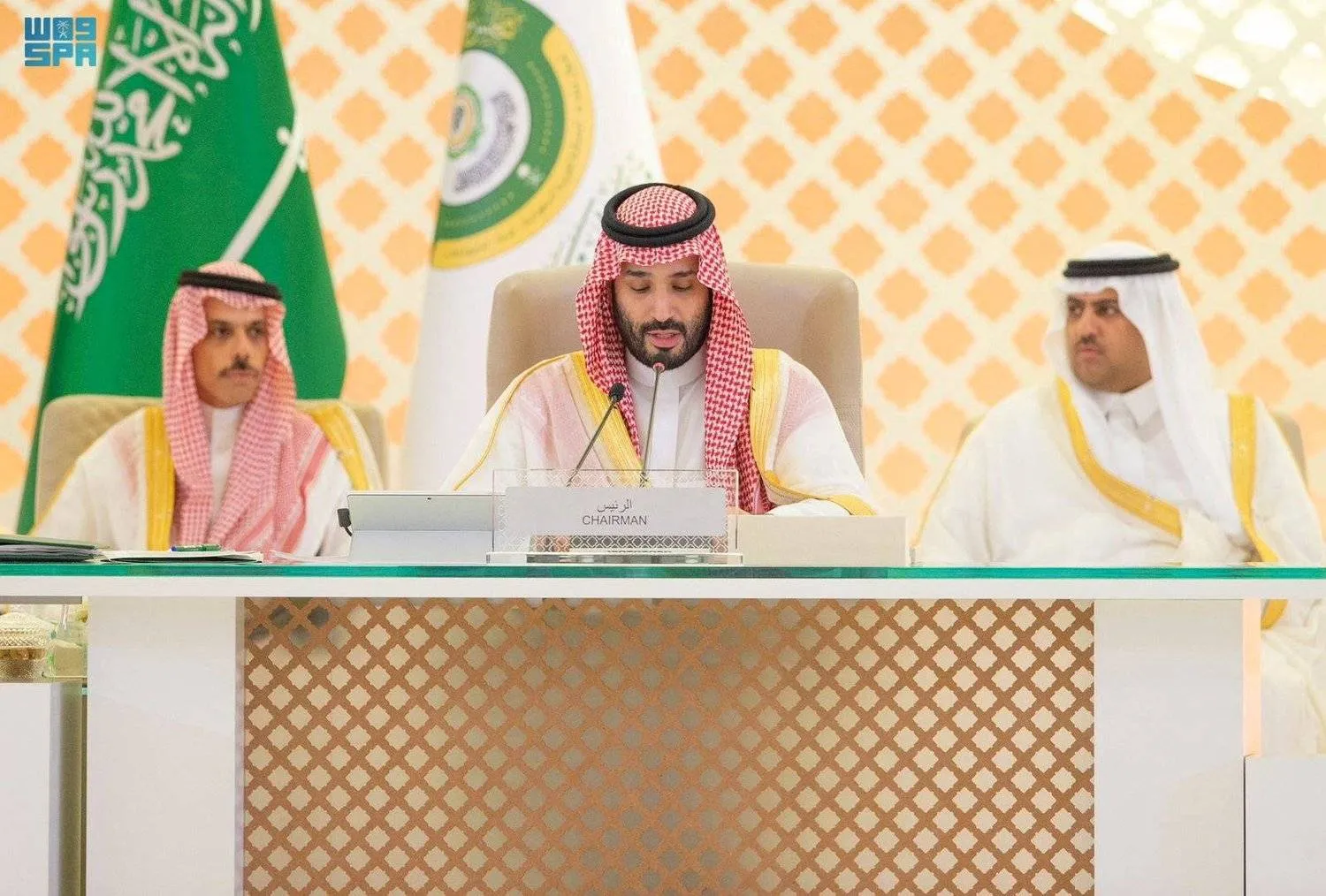

The leaders of the Arab countries stressed on Friday the importance of protecting the sovereignty of their nations, and on strengthening joint Arab action based on common foundations, values, interests, and one destiny.
This came in the "Jeddah Declaration" at the conclusion of 32nd Regular Session of the Arab League Council at the Summit Level today (Jeddah Summit). The following is its text:
"Jeddah Declaration, Jeddah - the Kingdom of Saudi Arabia
Friday, Shawwal 29, 1444 AH, corresponding to May 19, 2023
At the generous invitation of the Custodian of the Two Holy Mosques, King Salman bin Abdulaziz Al Saud, the Arab leaders held the 32nd regular session of the Council of the League of Arab States at summit level (Jeddah Summit) on May 19, 2023, under the chairmanship of His Royal Highness Prince Mohammed bin Salman bin Abdulaziz Al Saud, Crown Prince and Prime Minister of the Kingdom of Saudi Arabia.
Emphasizing the importance of strengthening joint Arab action based on common foundations, values, interests and one destiny, and the necessity of unifying ranks, solidarity and cooperation in maintaining security and stability, protecting the sovereignty of our countries and the cohesion of their institutions, preserving their achievements, striving for further progress concerning Arab action, and taking advantage of the human and natural assets that our region enjoys addressing the challenges of the new era in a way that serves the goals and aspirations of a promising future for our peoples and future generations.
Emanating from our keenness to secure conditions, utilize opportunities, strengthen and dedicate partnerships and consolidate understandings among our countries based on common interests, and increase cooperation to achieve sustainable development goals and implement the ambitious development visions of our countries through a comprehensive renaissance in all fields to keep pace with global developments and create a future that meets the hopes and aspirations of our peoples and achieves the common interest and benefit of our countries, inspired by the past experiences of our countries and aware of the amount of challenges surrounding Arab security and the events that some of our countries went through, as well as the importance of preserving our culture and values, and our firm determination that the citizens of our countries be the target of development and a solid pillar of stability and progress, and security the key to stability, we:
1- We reaffirm the centrality of the Palestinian issue to our countries as one of the key factors of stability in the region. We condemn in the strongest terms the practices and violations targeting Palestinians in their lives, property and existence. We stress the importance of intensifying efforts to achieve a comprehensive and just settlement to the Palestinian issue and find real grounds for achieving peace based on the two-state solution in accordance with international references, mainly the Arab Peace Initiative, relevant international resolutions and the principles of international law, to ensure the establishment of an independent and sovereign Palestinian state on Palestinian territory on the 1967 borders with East Jerusalem as its capital. We also call upon the international community to fulfill its responsibilities to end the occupation and stop repeated attacks and violations that impede political solutions and undermine international peace efforts, reiterating the need to continue efforts to protect the occupied city of Jerusalem and its holy sites in the face of the occupation's condemned endeavors to change its demography, identity and historical and legal status quo. We support the historical Hashemite custodianship to protect Islamic and Christian holy sites and the Jordan-run Jerusalem and Aqsa Mosque Affairs Department affiliated with the Jordanian Ministry of Awqaf, which is the sole body authorized to administer the affairs of Al Haram Al Sharif, as well as supporting the role of Al-Quds Committee and Bayt Mal Al-Quds Agency in defending the holy city and the resilience of its people.
2- We are following up with interest on the developments and events taking place in our brotherly Republic of Sudan, expressing our deep concern at the ramifications of the crisis for the security, safety and stability of our countries and peoples. We reaffirm the need to ensure de-escalation, resort to dialogue and unity, alleviate the suffering of the Sudanese people, preserve national state institutions, prevent their deterioration and avoid any external interference in Sudan's affairs that would fuel conflict and threaten regional peace and security. The meetings of Jeddah, which commenced on May 6, 2023, among Sudanese groups, is an important step that can be built upon to end this crisis and restore security and stability in Sudan and protect the capabilities of its people.
3- We welcome the decision made by the Arab League council at the ministerial level to resume the participation of delegations of the Syrian government in the meetings of the Arab League and its affiliated bodies, expressing hope for this decision to support the stability of Syria, preserve its territorial unity, and resume its role within the Arab world. We stress the importance of continuing to intensify pan-Arab efforts aimed at helping Syria overcome its crisis in line with the joint Arab efforts and brotherly relations that connect all Arab peoples.
4- We support all efforts that could guarantee security and stability in the Republic of Yemen and fulfill the aspirations of the brotherly Yemeni people. We also advocate for the UN and regional efforts seeking to come up with a comprehensive political solution to the Yemeni crisis based on the three terms of reference: the GCC initiative and its implementation mechanism, the Yemeni National Dialogue outcomes, and the UN Security Council Resolution 2216. We reiterate support for the efforts of the Presidential Leadership Council in Yemen to achieve security, stability and peace in the country in a way that ensures an end to the Yemeni crisis.
5- We express our solidarity with Lebanon and urge all Lebanese parties to dialogue in order to elect a President of the Republic who fulfills the aspirations of the Lebanese people, the regular work of the constitutional institutions, and the adoption of the required reforms to get Lebanon out of its crisis.
6- We call for stopping foreign interference in the domestic affairs of Arab countries and categorically reject all support for the formation of armed groups and militias outside the scope of state institutions. We stress that internal armed conflicts will not result in the victory of any one party, but will rather exacerbate the suffering of the peoples, destroy their achievements and impede their progress.
7- We stress that sustainable development, security, stability and peace are inherent rights for all Arab citizens. These will only be achieved through concerted efforts and through firmly fighting crime and corruption at all levels. We also stress the need to mobilize potentials and capabilities in order to create a future that is based on creativity and innovation and that keeps abreast of various developments in a way that serves and enhances security, stability and the well-being of our people.
8- We believe that visions and plans based on investing in resources and opportunities and addressing challenges can localize development and activate available capabilities. Such visions and plans should utilize technology in order to achieve a comprehensive Arab industrial and agricultural renaissance to which our countries should contribute through integrated potentials. We should boost our solidarity and enhance our interdependence and unity in order to achieve the ambitions and aspirations of our Arab peoples.
9- We express our commitment to and pride in our values and culture based on dialogue, tolerance, openness and non-interference in other countries' affairs under any pretext. Meanwhile, we emphasize our respect for the values and cultures of others and the sovereignty, independence and territorial integrity of states. At the same time, we believe that cultural diversity contributes to better understanding and coexistence. We categorically reject using the dominance of some cultures as a pretext for interfering in the domestic affairs of our countries.
10- We seek to exert more efforts to preserve our culture and inherent Arab identity among our sons and daughters and to strengthen their pride in our well-established values, customs and traditions. We pledge to make every effort to highlight our cultural and intellectual heritage and spread our well-established culture to make it a bridge for communication with other cultures.
11- We appreciate the Kingdom of Saudi Arabia's keenness, during the year it held the presidency of the 32nd Arab League summit, on a number of initiatives that are bound to contribute to advancing the joint Arab work in the cultural, economic, social and environmental fields, including:
- The initiative of teaching the Arabic language to non-native speakers, which targets the children of the second and third generations of Arab immigrants, in a way that contributes to enhancing civilizational communication between Arab countries and the world, and highlights and preserves the well-established Arab civilisation and culture.
- The Culture and Green Future Initiative aims to raise the level of commitment of the cultural sector in the Arab countries towards the goals of sustainable development and to develop cultural policies related to sustainability, in addition to contributing to supporting environmentally friendly cultural practices and supporting the creative economy in the Arab countries.
- The initiative of sustaining the supply chains of essential food commodities for the Arab countries relies mainly on a set of activities and the provision of investment opportunities with economic and financial feasibility that contribute to meeting the needs of Arab countries for food commodities.
- The initiative of research and excellence in the water desalination industry and its solutions stimulates scientific and applied research and innovation in the desalinated water production industry and water solutions for interested and needy countries. It focuses on spreading and sharing knowledge and experiences, contributing to improving the economics of this industry in order to reduce costs, raise the efficiency of operations and improve its environmental sustainability, in addition to the issuance of specifications, standardizations and institutional restructuring for the water sectors to make them a strategic industry for the Arab countries.
- The initiative to establish a think tank for research and studies in sustainability and economic development would embrace new directions and ideas and highlight the importance of sustainable development initiatives in the Arab region to enhance joint and multilateral interest in research cooperation and the conclusion of strategic partnerships."


