


Syria: AANES Issues Warning Regarding Outcomes of ‘Astana Meetings’

A funeral procession held for female Kurdish leaders who were killed in a strike launched by a Turkish drone on Wednesday (Asharq Al-Awsat)
TT

Syria: AANES Issues Warning Regarding Outcomes of ‘Astana Meetings’

A funeral procession held for female Kurdish leaders who were killed in a strike launched by a Turkish drone on Wednesday (Asharq Al-Awsat)

A high-ranking official within the Autonomous Administration of North and East Syria (AANES) has issued a cautionary statement regarding the implications arising from the recent Astana meetings.

These meetings focused on deliberating a roadmap aimed at establishing normalized relations between Türkiye and the Syrian government.

According to the official, these outcomes carry substantial risks for the de-escalation zones in Syria, as they encompass the activation of military, security, and intelligence components between Ankara and Damascus.

This comes at a time the “Syrian Democratic Council,” the political body of the Syrian Democratic Forces (SDF), stressed the importance of active involvement by Arab countries in finding a comprehensive political solution in Syria, in line with international resolutions.

The Council emphasized the necessity for Arab openness towards the Damascus government to align with “the aspirations of the Syrian people to achieve their demands for change and democratic transition.”

The co-chair of the Department of External Relations in the AANES, Bedran Ciya Kurd, affirmed that the outcomes of the recent Astana meeting have outlined a roadmap for cooperation and coordination between Damascus and Ankara on various levels.

Ciya Kurd further noted that the outcomes “guarantee the interests of all parties involved in the process, sharing influence among them, and embarking on actions against national interests.”

“This track has entered a new and dangerous phase aimed at repairing bilateral relations between Türkiye and the Syrian regime, at the expense of the Syrian people's interests,” he told Asharq Al-Awsat.

“It involves conducting mutual deals and working on security and intelligence issues to undermine stability in the established de-escalation zones,” explained Ciya Kurd.

Ciya Kurd’s remarks reflect the concerns of Syrian Kurds that the normalization between Ankara and Damascus may come at their expense.

The Syrian government, led by President Bashar al-Assad, accuses the Kurds of having separatist tendencies, while Türkiye accuses them of being affiliated with the Kurdistan Workers' Party (PKK), which is listed as a terrorist organization.



US Slaps Sanctions on Sudan’s RSF Commanders over El-Fasher Killings

FILE - A Sudanese child, who fled el-Fasher city with family after Sudan's RSF attacked the western Darfur region, receives treatment at a camp in Tawila, Sudan, Nov. 2, 2025. (AP Photo/Mohammed Abaker, File)
TT

US Slaps Sanctions on Sudan’s RSF Commanders over El-Fasher Killings

FILE - A Sudanese child, who fled el-Fasher city with family after Sudan's RSF attacked the western Darfur region, receives treatment at a camp in Tawila, Sudan, Nov. 2, 2025. (AP Photo/Mohammed Abaker, File)

The United States announced sanctions on Thursday on three Sudanese Rapid Support Forces (RSF) commanders over their roles in the "horrific campaign" of the siege and capture of El-Fasher.

The US Treasury said the RSF carried out "ethnic killings, torture, starvation, and sexual violence" in the operation.

Earlier Thursday, the UN's independent fact-finding mission on Sudan said the siege and seizure of the city in Darfur bore "the hallmarks of genocide."

Its investigation concluded that the seizure last October had inflicted "three days of absolute horror," and called for those responsible to be brought to justice.

"The United States calls on the Rapid Support Forces to commit to a humanitarian ceasefire immediately," US Treasury Secretary Scott Bessent said in a statement.

"We will not tolerate this ongoing campaign of terror and senseless killing in Sudan."

The Treasury noted that the three sanctioned individuals were part of the RSF's 18-month siege of and eventual capture of El-Fasher.

They are RSF Brigadier General Elfateh Abdullah Idris Adam, Major General Gedo Hamdan Ahmed Mohamed and field commander Tijani Ibrahim Moussa Mohamed.

Bessent warned that Sudan's civil war risks further destabilizing the region, "creating conditions for terrorist groups to grow and threaten the safety and interests of the United States."

The UN probe into the takeover of El-Fasher -- after the 18-month siege -- concluded that thousands of people, particularly from the Zaghawa ethnic group, "were killed, raped or disappeared."


Israel's Netanyahu Says No Reconstruction of Gaza before Demilitarization

Israel’s Prime Minister Benjamin Netanyahu - File Photo/AFP
TT

Israel's Netanyahu Says No Reconstruction of Gaza before Demilitarization

Israel’s Prime Minister Benjamin Netanyahu - File Photo/AFP

Israeli Prime Minister Benjamin Netanyahu said on Thursday there would be no reconstruction of war-shattered Gaza before the disarmament of Hamas, as the "Board of Peace" convened for its inaugural meeting in Washington.

Around two dozen world leaders and senior officials met for the first meeting of the board, which was set up after the United States, Qatar and Egypt negotiated a ceasefire in October to halt two years of war in the Gaza Strip.

"We agreed with our ally the US there will be no reconstruction of Gaza before the demilitarization of Gaza," Netanyahu said during a televised speech at a military ceremony on Thursday, AFP reported.

The meeting in Washington will also look at how to launch the International Stabilization Force (ISF) that will ensure security in Gaza.

One of the most sensitive issues before the board is the future of the Islamist movement Hamas, which fought the war with Israel and still exerts influence in the territory.

Disarmament of the group is a central Israeli demand and a key point in negotiations over the ceasefire's next stage.

US officials including Steve Witkoff, Trump's friend and roving negotiator, have insisted that solid progress is being made and that Hamas is feeling pressure to give up weapons.

Israel has suggested sweeping restrictions including seizing small personal rifles from Hamas.

It remains unclear whether, or how, the Palestinian technocratic committee formed to handle day-to-day governance of Gaza will address the issue of demilitarization.

The 15-member National Committee for the Administration of Gaza (NCAG) will operate under the supervision of the "Board of Peace", and its head, Ali Shaath, is attending the meeting in Washington on Thursday.


Trump Tells First Meeting of Board of Peace that $7 billion Raised for Gaza

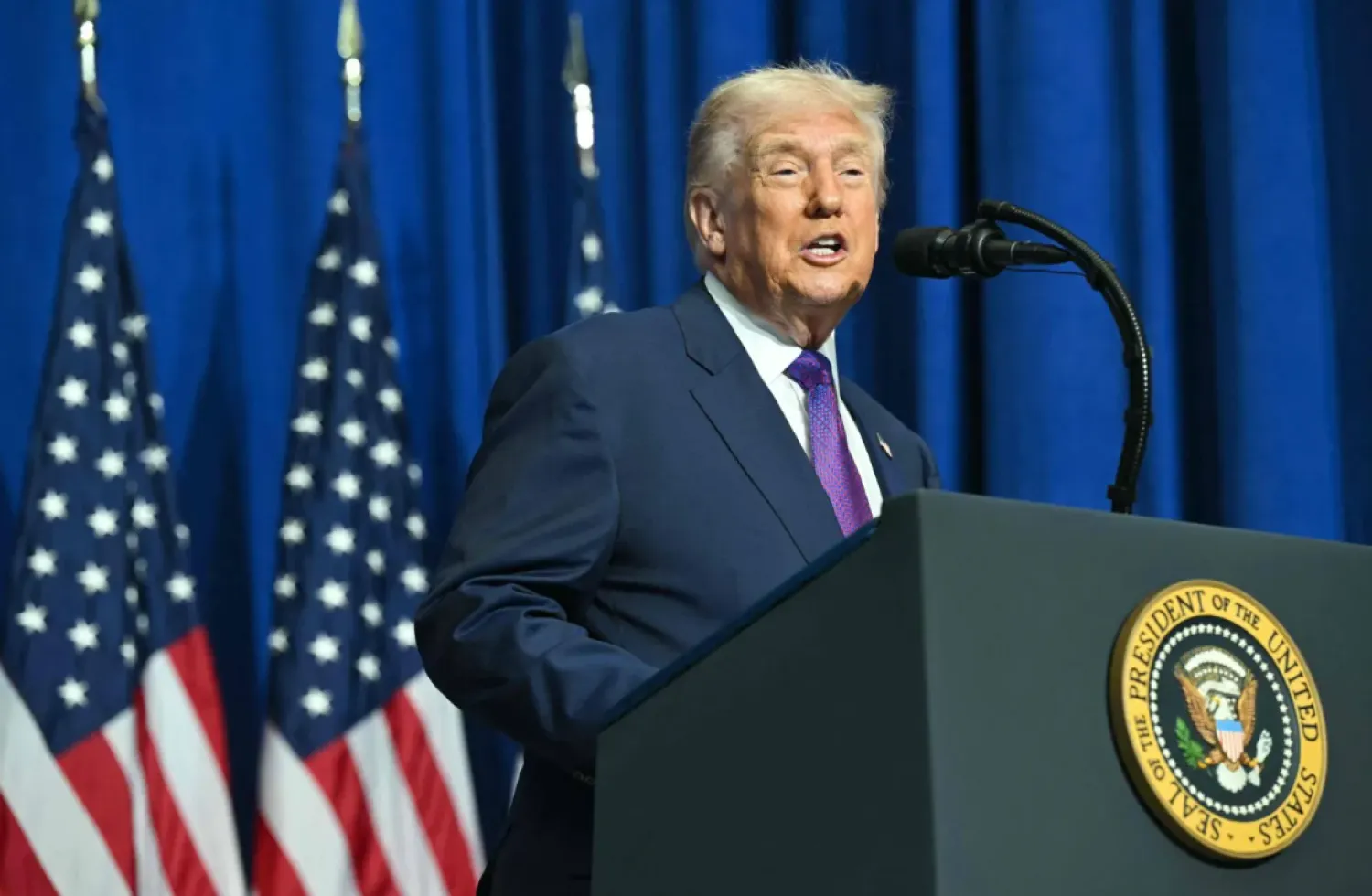
US President Donald Trump speaking in Washington - AFP
TT

Trump Tells First Meeting of Board of Peace that $7 billion Raised for Gaza

US President Donald Trump speaking in Washington - AFP

US President Donald Trump told the first meeting of his Board of Peace on Thursday that $7 billion has been contributed to a Gaza reconstruction fund that aims to rebuild the enclave once Hamas disarms, an objective that is far from becoming a reality.

The disarmament of Hamas militants and accompanying withdrawal of Israeli troops, the size of the reconstruction fund and the flow of humanitarian aid to the war-battered populace of Gaza are among the major questions likely to test the effectiveness of the board in the weeks and months ahead.

In a flurry of announcements at the end of a long, winding speech, Trump said the United States will make a contribution of $10 billion to the Board of Peace. He said contributing nations had raised $7 billion as an initial down payment for Gaza reconstruction.

Trump first proposed the board last September when he announced his plan to end Israel's war in Gaza. He later made clear the board's remit would be expanded beyond Gaza to tackle other conflicts worldwide.

Trump also said FIFA will raise $75 million for soccer-related projects in Gaza and that the United Nations will chip in $2 billion for humanitarian assistance.

TRUMP SAYS ANY IRAN DEAL MUST BE MEANINGFUL, PROSPECTS SHOULD BE CLEAR IN 10 DAYS

The Board of Peace includes Israel but not Palestinian representatives and Trump's suggestion that the Board could eventually address challenges beyond Gaza has stirred anxiety that it could undermine the UN's role as the main platform for global diplomacy and conflict resolution.

"We're going to strengthen the United Nations," Trump said, trying to assuage his critics. "It's really very important."

The meeting came as Trump threatens war against Iran and has embarked on a massive military buildup in the region in case Tehran refuses to give up its nuclear program.

Trump said he should know in 10 days whether a deal is possible. "We have to have a meaningful deal," he said.

The event had the feel of a Trump campaign rally, with music blaring from his eclectic playlist from Elvis Presley to the Beach Boys. Red Trump hats were given to participants.

Senior US officials said Trump will also announce that several nations are planning to send thousands of troops to participate in an International Stabilization Force that will help keep the peace in Gaza when it eventually deploys.

Hamas, fearful of Israeli reprisals, has been reluctant to hand over weaponry as part of Trump's 20-point Gaza plan that brought about a fragile ceasefire last October in the two-year Gaza war.

Trump said he hoped use of force to disarm Hamas would not be necessary. He said Hamas had promised to disarm and it "looks like they're going to be doing that, but we'll have to find out."