


Israeli Troops and Drones Hit Jenin in Major West Bank Operation

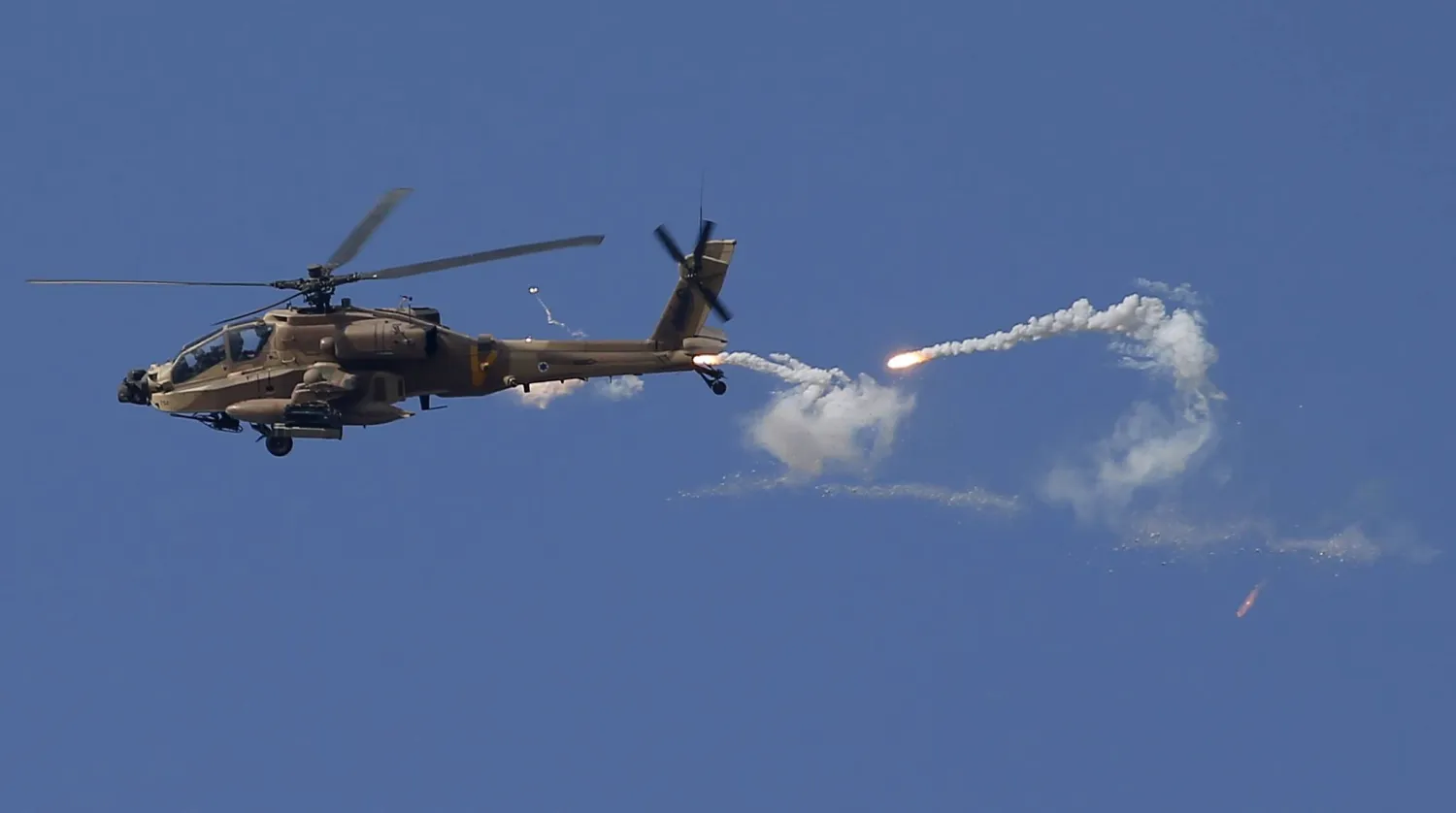
An Apache attack helicopter from Israel's military fires during an Israeli army raid in the West Bank city of Jenin, 19 June 2023. EPA/ALAA BADARNEH
TT

Israeli Troops and Drones Hit Jenin in Major West Bank Operation

An Apache attack helicopter from Israel's military fires during an Israeli army raid in the West Bank city of Jenin, 19 June 2023. EPA/ALAA BADARNEH

Israeli forces hit the city of Jenin with drone strikes on Monday as part of one of the biggest West Bank operations in 20 years, killing at least eight people and involving hundreds of troops in gun battles that continued into the afternoon.

Gunfire and explosions were heard throughout the day as fighting continued between Israeli troops and fighters from the Jenin Brigades, a unit made up of armed groups based in the city's crowded refugee camp.

"What is going on in the refugee camp is real war," said Palestinian ambulance driver Khaled Alahmad. "There were strikes from the sky targeting the camp, every time we drive in, around five to seven ambulances and we come back full of injured."

At times during the morning, at least six drones could be seen circling over the city and the adjoining camp, a densely packed area housing around 14,000 refugees in less than half a square kilometer.

The camp has been at the heart of an escalation of violence across the West Bank that has triggered mounting alarm from Washington to the Arab world, without so far opening the way to a resumption of political negotiations that have been stalled for almost a decade.

For more than a year, army raids in cities such as Jenin have become routine, while there have been a series of deadly attacks by Palestinians against Israelis and rampages by Jewish settler mobs against Palestinian villages.

The Palestinian health ministry confirmed at least eight people had been killed and more than 50 wounded in Jenin, while another man was killed in Ramallah overnight, shot in the head at a checkpoint.

The Israeli military said its forces struck a building that served as a command center for fighters from the Jenin Brigades in what it described as an extensive counterterrorism effort aimed at destroying infrastructure and disrupting fighters from using the refugee camp as a base.

As the operation proceeded, Israeli armored bulldozers ploughed up roads in the camp, cutting city water supplies, the Jenin municipality said as residents described soldiers breaking through the walls to pass from house to house.

"Nothing is safe in the camp. They dug up the roads with bulldozers. Why? What did the camp do?" said Hussein Zeidan, 67, as he recovered from his wounds in hospital.

An Israeli military spokesman said the operation would last as long as needed and suggested forces could remain for an extended period. "It could take hours, but it could also take days. We are focused on our goals," he said.

Until June 21, when it carried out a strike near Jenin, the Israeli military had not used drone strikes in the West Bank since 2006. But the growing scale of the violence and the pressure on ground forces meant such tactics may continue, a military spokesman said.

"We're really stretched," the spokesman told journalists. "It's because of the scale. And again, from our perception, this will minimize friction," he said, adding that the strikes were based on "precise intelligence".

'Hornets' nest'

Monday's operation, involving a force described as "brigade-size" - suggesting around 1,000-2,000 troops - was intended to help "break the safe haven mindset of the camp, which has become a hornets’ nest," the spokesman said.

A spokesman for Palestinian President Mahmoud Abbas called the operation "a new war crime against our defenseless people," while UN Middle East envoy Tor Wennesland said he was talking with all parties to de-escalate and ensure humanitarian access.

Hundreds of fighters from armed groups including Hamas, Islamic Jihad and Fatah are based in the camp, which was set up 70 years ago to house refugees in the aftermath of the 1948 Palestine war. The fighters have an array of weapons and a growing arsenal of explosive devices.

The Israeli military, which regularly accuses militant groups of basing fighters in civilian areas, said troops seized an improvised rocket launcher and hit a weapons production and explosives storage facility with hundreds of devices ready to be used as well as radios and other equipment.

It was unclear whether the incursion would trigger a wider response from Palestinian factions, drawing in militant groups in the Gaza Strip, the coastal enclave controlled by Hamas.

Saleh Al-Arouri, accused by Israel of leading the Hamas military wing in the West Bank, told Aqsa TV that fighters in Jenin should try to capture Israeli soldiers.

"Our fighters will rise from everywhere, and you will never know where the new fighter will come from," he said.

Israeli Defense Minister Yoav Gallant said his forces were "closely monitoring the conduct of our enemies," with the defense establishment "ready for all scenarios."

Following the last major raid in Jenin in June, Palestinian gunmen killed four Israelis near a Jewish settlement in the West Bank. That led to a rampage by mobs of settlers in Palestinian villages and towns.

Israel captured the West Bank, which the Palestinians see as the core of a future independent state, in the 1967 Middle East war. Following decades of conflict, peace talks that had been brokered by the United States have been frozen since 2014.



Brother Details to Asharq Al-Awsat Luring, Disappearance of Lebanese Retired Officer

Abdul Salam Shukr speaks to Asharq Al-Awsat from Nabi Sheet. (Asharq Al-Awsat)
TT

Brother Details to Asharq Al-Awsat Luring, Disappearance of Lebanese Retired Officer

Abdul Salam Shukr speaks to Asharq Al-Awsat from Nabi Sheet. (Asharq Al-Awsat)

Shock still grips the family of retired Lebanese General Security captain Ahmed Shukr, who was abducted days ago, as Lebanese security and judicial assessments increasingly point to Israeli intelligence as being behind his disappearance, over suspected links to the 1986 vanishing of Israeli airman Ron Arad in southern Lebanon.

His brother, Abdul Salam Shukr, told Asharq Al-Awsat the story began when a Lebanese expatriate living in Kinshasa, identified as A.M., contacted Ahmed and asked to rent his apartment in the Choueifat area, south of Beirut.

The two agreed months ago, and the man paid $500 in rent.

The expatriate made repeated visits to Lebanon and met Shukr at his home during one of them. He later contacted the retired officer to say that a wealthy African investor named Salim Kassab, later found to be a fake name, was interested in purchasing a plot of land in the eastern city of Zahle and needed his assistance.

Abdul Salam said the expatriate inspected the land, then called two weeks after leaving Lebanon to say the investor had agreed to buy it and would visit the country. He asked Ahmed to meet him at the site at 4:30 p.m. on the day of the abduction.

He said the expatriate insisted on the timing because it suited the buyer, despite Ahmed’s objections that darkness would have fallen by then, and the land’s features would not be visible. The expatriate later apologized for not attending, claiming he had broken his foot, and said the investor would visit the site alone with Ahmed.

At the time of the meeting, Ahmed disappeared.

“We know nothing about him except what we have heard through security and judicial leaks,” Abdul Salam said. He added that the abductors had rented a house in Zahle and erased all traces from it after kidnapping Ahmed.

Surveillance cameras tracked the vehicle as it headed toward the town of Souireh in the western Bekaa, where the trail then vanished. Souireh was previously used as a smuggling route from southwestern Damascus into Lebanon.

Loyalty to the state

“My brother served 40 years in the military establishment. His loyalty was only to the state and its institutions. He never belonged to any party,” Abdul Salam said. “We are a family that does not engage in politics.”

Ahmed was lured last week in a carefully planned operation that began in his hometown of Nabi Sheet in the northern Bekaa, before he went missing at a point very close to the city of Zahle.

Family members and residents have been gathering at the home of Nabi Sheet’s mukhtar, Abbas Shukr, to voice their protest and condemnation of the abduction.

The family said Ahmed Shukr retired nine years ago after serving for four decades in the General Security, during which he held several posts, including the Masnaa border crossing with Syria and the Qaa crossing in northeastern Lebanon.

“My brother joined the military in 1979, which means he was an ‘officer of the state’ when Arad disappeared in 1986,” Abdul Salam told Asharq Awsat. “An officer of the state does not belong to parties.”

He rejected attempts to link the family by kinship to Fuad Shukr, a Hezbollah leader killed by Israel in July 2024 in Beirut’s southern suburbs, saying no one in the town even knew him.

“He left the town in the early 1980s and never returned. He was distant even from his relatives,” he said, adding that since retiring, his brother “never left the Bekaa. He stayed at home and played cards with friends at night.”

The family home remains in a state of disbelief, a scene that has persisted since his disappearance last week. The case only began to move officially after Vice President of the Supreme Islamic Shiite Council Sheikh Ali al Khatib contacted Lebanese President Joseph Aoun and Interior Minister Ahmed al-Hajjar, according to Abdul Salam.

He said Aoun pledged to instruct security and judicial authorities to expand the investigation and uncover the circumstances surrounding the incident. Officials from the Amal Movement were also in constant contact with Parliament Speaker Nabih Berri, who is head of the movement, to follow up on the case.

Mystery remains

“We demand that the judiciary and security agencies confirm or deny the leak about an alleged link to Ron Arad’s disappearance,” Abdul Salam said.

“That leak does not concern us. What matters is what the security agencies say, including General Security, where Ahmed served, and the Information Branch of the Internal Security Forces, which is leading the investigation.”

He said the key to the mystery lies with A.M., a native of the southern town of Qana who lives in Kinshasa and has been evading the family’s calls.

“The Lebanese state must ask Interpol to arrest him and bring him to Lebanon for questioning,” he urged, adding that the man no longer answers his phone and that all available information about him, including video clips, is now in the hands of security agencies.

Abdul Salam said the family believes the expatriate coordinated the plot with Israel’s Mossad, guiding them to this point and enabling an operation carried out with precision and professionalism.

He said Lebanese security agencies told the family the abductors left no fingerprints, neither at the Zahle property nor at the Choueifat apartment, and that no evidence has been found. The kidnappers’ vehicle also remains unidentified.


UK, Canada, Germany and Others Condemn Israel’s West Bank Settlement Plan

A Palestinian woman walks past the Israeli settlement of Har Homa, southeast of Jerusalem, on November 21, 2025. (AFP)
TT

UK, Canada, Germany and Others Condemn Israel’s West Bank Settlement Plan

A Palestinian woman walks past the Israeli settlement of Har Homa, southeast of Jerusalem, on November 21, 2025. (AFP)

Countries including Britain, Canada and Germany and others on Wednesday condemned the Israeli security cabinet's approval of 19 new settlements in the occupied West ‌Bank, saying ‌they violated ‌international ⁠law and risked ‌fueling instability.

"We call on Israel to reverse this decision, as well as the expansion of ⁠settlements," said a joint ‌statement released ‍by Britain, ‍which also included ‍Belgium, Denmark, France, Italy, Iceland, Ireland, Japan, Malta, the Netherlands, Norway and Spain.

"We recall that such unilateral actions, as ⁠part of a wider intensification of the settlement policies in the West Bank, not only violate international law but also risk fueling instability," the statement ‌added.


Syria State Media Says 3 Dead in Clashes in Latakia Province

A large Syrian flag flutters above Tishreen Park in Damascus, June 4, 2025. (AFP)
TT

Syria State Media Says 3 Dead in Clashes in Latakia Province

A large Syrian flag flutters above Tishreen Park in Damascus, June 4, 2025. (AFP)

Syrian state media said three people were killed Wednesday in clashes with security forces in coastal Latakia province, the heartland of the country's Alawite minority community.

"Three members of remnants of the former regime were killed after clashes with internal security forces" outside the city of Jableh, state television said.

State news agency SANA had earlier reported "clashes with a group of wanted outlaws" in the area, and said an unspecified number of security personnel were wounded.

Since last December's ousting of longtime ruler Bashar al-Assad, himself an Alawite, Syria's new authorities have frequently reported security operations against remnants of his government.

Syria's coastal areas saw the killing of Alawite civilians in March, with authorities accusing armed Assad supporters of sparking the violence by attacking security forces.

A national commission of inquiry said at least 1,426 members of the minority community were killed at the time.

Last month, thousands of people demonstrated on the Alawite coast in protest of fresh attacks targeting their community.