Syrian Regime Prepares for Military Operation in Western Countryside of Daraahttps://english.aawsat.com/arab-world/4414801-syrian-regime-prepares-military-operation-western-countryside-daraa
Syrian Regime Prepares for Military Operation in Western Countryside of Daraa
Syrian regime forces in Tafas, summer of 2022. (Horan Free League)
TT
TT
Syrian Regime Prepares for Military Operation in Western Countryside of Daraa
Syrian regime forces in Tafas, summer of 2022. (Horan Free League)
Military reinforcements arrived in Syria's western countryside of Daraa Governorate on Monday morning, signaling the Syrian government's preparation for new military operations in the outskirts of Tafas, Dael, Yadouda, and Al-Mazareeb.
This information was reported by local military sources in the western countryside of Daraa.
According to sources, Syrian regime forces successfully reached the Tafas-Al-Mazareeb road on Monday morning.
They deployed at various points in the area and conducted extensive combing operations. Moreover, they raided several abandoned buildings in the southern part of Tafas, west of Daraa, including the “Planter” factory and the Abu Na'im Press.
The local news network Daraa 24 reported that the military campaign in the western countryside of the governorate is targeting farms and expansive plains between the city of Tafas and the towns of Al-Mazareeb and Yadouda, along with the surrounding areas.
This region has witnessed recurring incidents of theft, road blockades, and assassinations.
Additionally, it has become a haven for cells affiliated with ISIS following the recent military campaign against the organization in Daraa city. Moreover, a drug trafficking gang is active in the area.
A leader in one of the local factions in Tafas explained to Asharq Al-Awsat that the targeted groups by Syrian regime forces in the recent military movements in western Daraa, including drug traffickers and cells affiliated with ISIS, have been working to swiftly evacuate and relocate their positions as soon as they learn of potential military operations targeting them.
Speaking to Asharq Al-Awsat, the local leader, who requested anonymity, pointed out that the regime forces conducted military operations in this area around the same time last year.
They imposed financial levies on farmers, who ended up incurring significant losses, estimated at over one billion Syrian pounds, because of the military operations coincided with the harvest season.
Netanyahu Says Spoke with Syria’s Sharaa on Sweida Unresthttps://english.aawsat.com/arab-world/5330151-netanyahu-says-spoke-syria%E2%80%99s-sharaa-sweida-unrest
People walk under a giant election billboard bearing a portrait of Israeli Prime Minister Benjamin Netanyahu's Likud party in Ramat Gan, on October 15, 2026. (AFP)
TT
TT
Netanyahu Says Spoke with Syria’s Sharaa on Sweida Unrest
People walk under a giant election billboard bearing a portrait of Israeli Prime Minister Benjamin Netanyahu's Likud party in Ramat Gan, on October 15, 2026. (AFP)
Israeli Prime Minister Benjamin Netanyahu said on Thursday that he had previously spoken with Syrian President Ahmed al-Sharaa about violence towards the Druze community, in his first acknowledgement of direct contact.
Netanyahu did not say when exactly the call took place, but implied it had been during bloody clashes in southern Syria in July of 2025 involving Druze factions, Bedouin fighters and government security forces.
"I called al-Sharaa. It was a very short, very sharp conversation, and the slaughter stopped," Netanyahu said at an election rally with Israel's Druze community, according to footage aired by Israel's public broadcaster KAN.
The 2025 clashes erupted in Syria's Sweida province between armed Druze factions and Bedouin fighters, with government security forces and some tribal groups then intervening.
A committee set up by the Syrian government said it had documented 1,760 deaths.
Israel, which also has a Druze population, intervened militarily during the clashes, with strikes in Sweida and against government targets in Damascus, saying it was defending the minority community.
Government-aligned forces later withdrew from Sweida city, leaving a fragile ceasefire in place, and in July of this year Damascus said it had begun trying suspects over the violence.
A Syrian government source told the country's state news agency SANA on Thursday that Damascus "categorically rejects any attempt to politicize (Syria's Druze minority) or to involve it in Israeli propaganda and elections," without confirming nor denying whether the call between Netanyahu and Sharaa had taken place.
Since the December 2024 ousting of longtime Syrian ruler Bashar al-Assad, Israel has carried out hundreds of strikes in Syria and sent troops into a UN-patrolled buffer zone that had separated Israeli and Syrian forces in the Golan since 1974.
It has also carried out repeated incursions deeper into Syrian territory and has vowed to keep troops in a so-called "security zone" in southern Syria, where it seeks a broader demilitarized area.
Syria's new leaders have condemned Israeli military action in the country's south but have refrained from responding with force.
Despite the tensions, Syria and Israel have held several rounds of direct talks as they edge towards a security agreement.
Iraq Parliament Fills Cabinet Posts, Naming a US-Sanctioned Deputy Prime Ministerhttps://english.aawsat.com/arab-world/5330127-iraq-parliament-fills-cabinet-posts-naming-us-sanctioned-deputy-prime-minister
Iraqi Prime Minister Ali al-Zaidi attends a parliamentary session to approve the remaining members of his cabinet, in Baghdad, Iraq, October 15, 2026. (Iraqi Prime Minister's Media Office/Handout via Reuters)
TT
TT
Iraq Parliament Fills Cabinet Posts, Naming a US-Sanctioned Deputy Prime Minister
Iraqi Prime Minister Ali al-Zaidi attends a parliamentary session to approve the remaining members of his cabinet, in Baghdad, Iraq, October 15, 2026. (Iraqi Prime Minister's Media Office/Handout via Reuters)
Iraq's parliament voted Thursday to appoint ministers to previously vacant Cabinet posts and complete the country's government, including a deputy prime minister who is under US sanctions.
Laith al-Khazali, appointed to that post, is the brother of Qais al-Khazali, leader of the Iran-backed Asaib Ahl al-Haq armed faction. Laith al-Khazali was arrested by US forces in 2007 over allegations related to an attack targeting American forces in Karbala in January of that year, which resulted in the deaths of five US soldiers.
He was released from US custody in June 2009. In 2019, the US Treasury Department imposed sanctions on him, citing his leadership role in Asaib Ahl al-Haq and allegations involving human rights abuses as well as the 2007 attack.
His appointment to a senior government position raises questions about its potential implications for relations between Baghdad and Washington. Iraqi Prime Minister Ali al-Zaidi was backed by US President Donald Trump when he took the post and has strong relations with Washington, but he has also sought to maintain relations with Iran.
Past Iraqi governments have also sought to balance relations with Washington and Tehran, but the balancing act has become more difficult since the US and Iran went to war on Feb. 28.
There was no immediate official statement from the US on the appointment.
Republican US Rep. Joe Wilson wrote on X that al Khazali “is a designated terrorist and Iranian puppet whose militia AAH killed Americans and Iraqis.”
“He is no better than ISIS, maybe even worse,” Wilson said. "It is outrageous but sadly not shocking that he has been appointed deputy PM of Iraq.”
The parliament also appointed two other deputy prime ministers, as well as a new interior minister, defense minister, planning minister, minister of higher education and scientific research, and culture minister.
The other Cabinet posts had been appointed five months earlier.
Al-Zaidi said in a statement that with the vacant posts filled, “we are embarking on a phase of accelerated, diligent work” and pledged to "move forward in implementing our government’s priorities and program, and in fulfilling the aspirations of all Iraqis.”
He said the government had worked over the past several months amid complicated domestic and international circumstances, noting that the war in the region had imposed exceptional economic challenges on Iraq, in addition to security challenges.
Al-Zaidi has vowed to fight corruption and strengthen Iraq's sovereignty, both by completing the withdrawal of US forces from the country and by disarming non-state armed groups.
Some of the most powerful factions have said they have no intention of giving up their weapons, although Asaib Ahl al-Haq is one of a handful that have agreed to hand over their arms.
Houthis Launch Attack on Presidential Palace in Yemen’s Adenhttps://english.aawsat.com/arab-world/5330124-houthis-launch-attack-presidential-palace-yemen%E2%80%99s-aden
Houthis Launch Attack on Presidential Palace in Yemen’s Aden
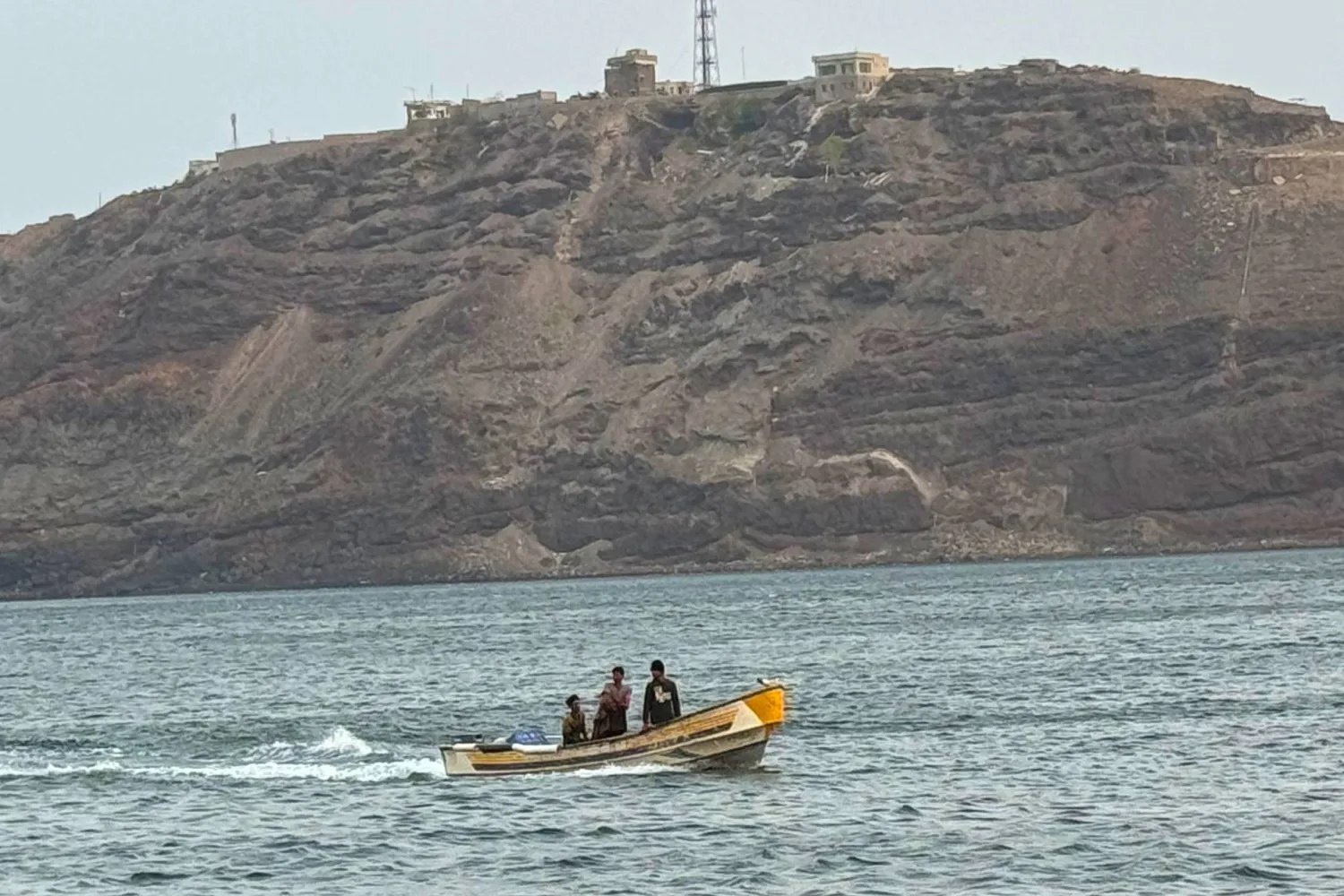
A boat motors under Al-Maashiq Presidential Palace, at top, in Aden, Yemen, Aug. 20, 2024. (AP)
At least six explosions struck Thursday near the palace used by Yemen's legitimate government in the port city of Aden, witnesses said. An official said at least two people were killed, and Iran-backed Houthi militants based in northern Yemen quickly claimed responsibility.
It was a rare attack on the palace area, as fighting has escalated between the militia and a Saudi-led coalition in the latest front in the Iran war. The explosions caused panic among residents, who fled the area.
Yemen's Ministry of Information confirmed the safety of Prime Minister Shaya Al-Zindani and ministers, saying they no longer hold permanent meetings inside the palace in anticipation of such attacks.
At least two people were killed and six wounded, said the official, who spoke on condition of anonymity because he was not authorized to speak to the press. The government said the Houthis attacked with missiles and drones, the Aden-based SABA news agency reported.
A security official said at least two explosions were on top of the hill near the Al-Maashiq Presidential Palace, and two others were near the security gate.
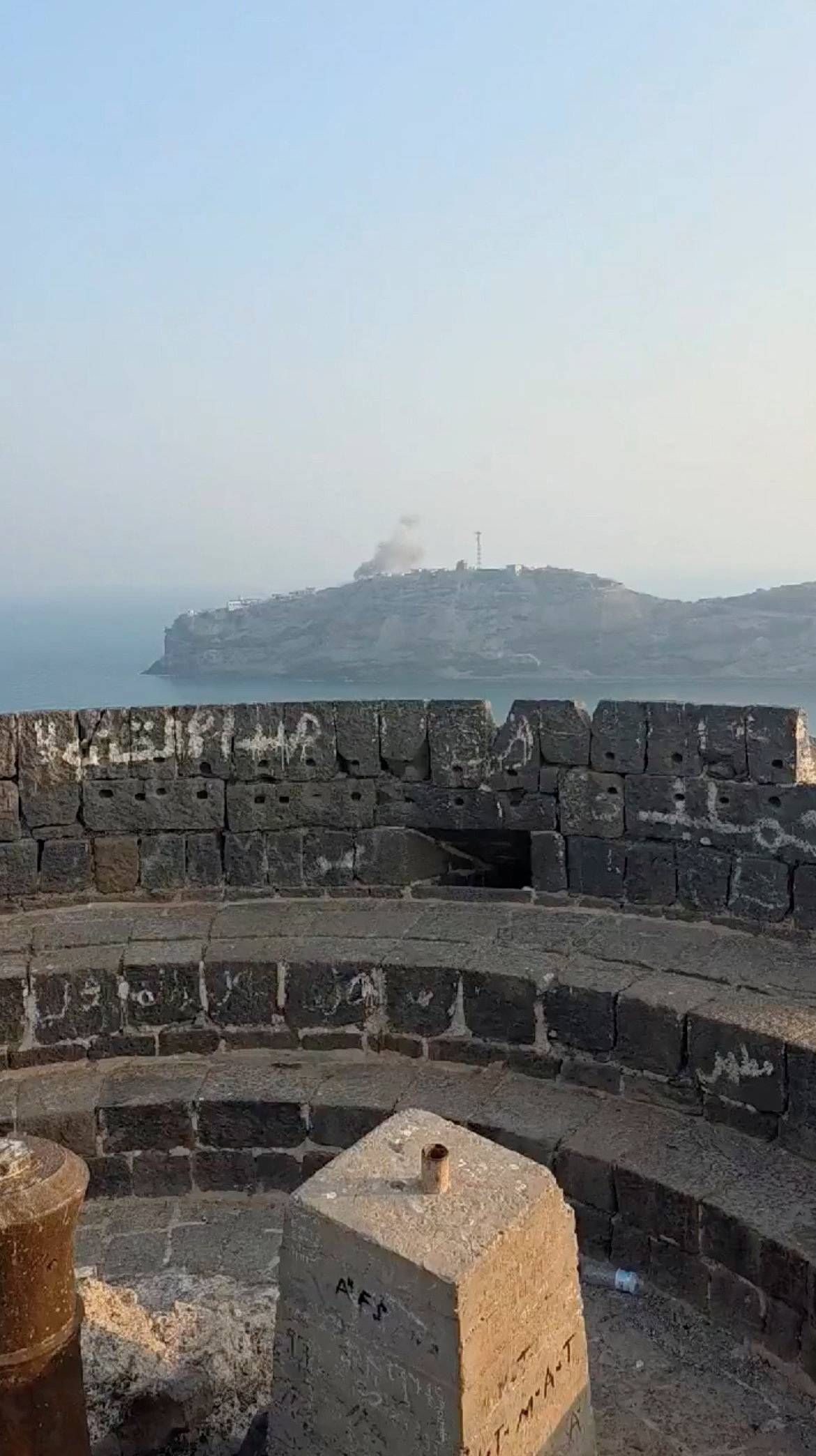
Many of Yemen's government leaders are living in exile, and those in Aden were safe, a government official said. Both officials spoke on condition of anonymity because they were not authorized to speak to the media. A video circulating on social media and analyzed by The Associated Press shows smoke rising from the area where the palace is located.
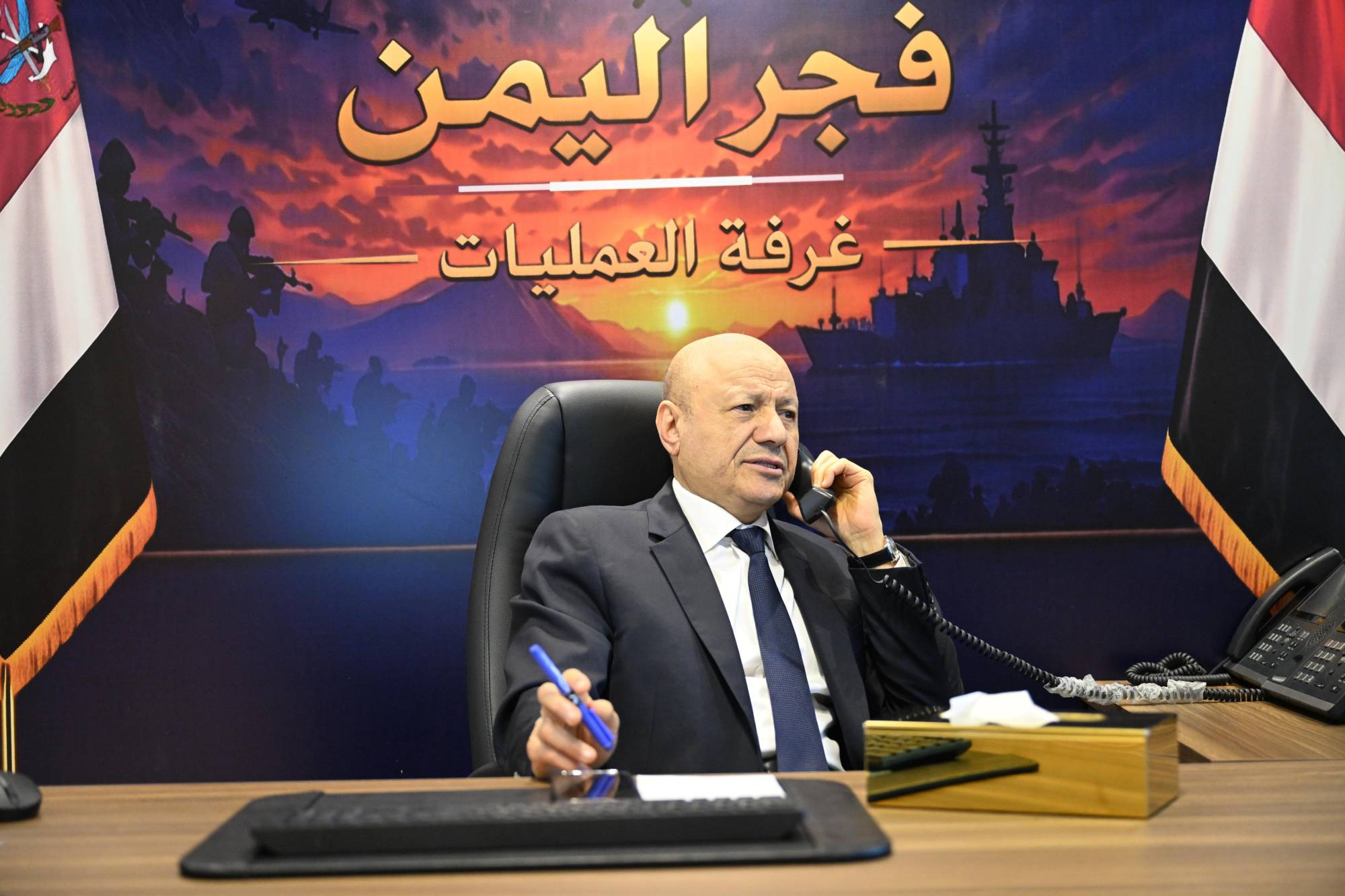
Chairman of the Presidential Leadership Council Dr. Rashad al-Alimi contacted ministers in wake of the attack.
Chairman of the Presidential Leadership Council Dr. Rashad al-Alimi contacted ministers in wake of the attack. (SABA)
He asserted that the Houthi attack on the palace is an extension of the militias' approach of targeting airports, oil facilities, and civilian objects in Yemen and Saudi Arabia, threatening regional security and waterways.
He stressed that the state will continue to carry out its constitutional responsibilities with utmost firmness, and that protecting its sovereign facilities and citizens is a non-negotiable responsibility.
He ordered the relevant military and security authorities to take the necessary measures to protect state institutions, counter terrorist threats, and respond appropriately to sources of threat in a manner that ensures the protection of civilians and civilian objects.
In turn, the cabinet affirmed that the attack on the Al-Maashiq Palace reveals the terrorist approach of the Houthis and their persistence in targeting civilians.
It stressed that it will not deter the government from performing its responsibilities and duties toward citizens, and continuing the battle to restore the state and its institutions and end the coup being pursued by the Dawn of Yemen Operation.
The attack on the palace is part of an escalating pattern of Houthi terrorism that has not been limited to targeting state institutions, but has extended to attacks on civilian objects and vital facilities in Saudi Arabia, and the shelling of residential neighborhoods in the governorates of Taiz and Lahj.
"The future of Yemen will not be held hostage by a militia that bears arms against its people, targets the security of its neighbors, and relies on violence to compensate for the Yemeni rejection of its coup project,” it added.
The cabinet called on the international community and the United Nations to take a clear and firm stance regarding these attacks, to stop treating them as isolated incidents separate from their context, to exert the necessary pressure to halt the targeting of civilians and civilian facilities, and to hold those responsible for the violations accountable.
Smoke billows from the presidential palace complex following an attack by Yemen's Houthis, according to government officials, in Aden, Yemen, October 15, 2026, in this screen grab obtained from a social media video. (Social media/via Reuters)
Elsewhere in Yemen, the fighting has revived a devastating civil war after four years of relative calm. One focus of alarm is the Houthi-besieged city of Taiz.
Residents of Yemen’s third-largest city are running short of basic necessities. Where goods can be found, prices have soared. Gas stations sit empty or out of service. The World Food Program said it can no longer reach more than 600,000 people in Taiz who depend on aid.
At a news conference late Thursday in Taiz, the Health Ministry said 120 people were killed and 307 wounded in the fighting through Oct. 5, with most of the deaths reported in Taiz, Saada and Jawf areas.
Fathiyya Mohamed al-Mugahed said she had gone looking for flour, cooking gas and fuel but found none.
“The Houthis have surrounded us from all sides,” she said. “Projectiles are all we have received from them.”
The International Committee of the Red Cross said Taiz has seen some of the “highest casualty burdens” in the country.
لم تشترك بعد
انشئ حساباً خاصاً بك لتحصل على أخبار مخصصة لك ولتتمتع بخاصية حفظ المقالات وتتلقى نشراتنا البريدية المتنوعة