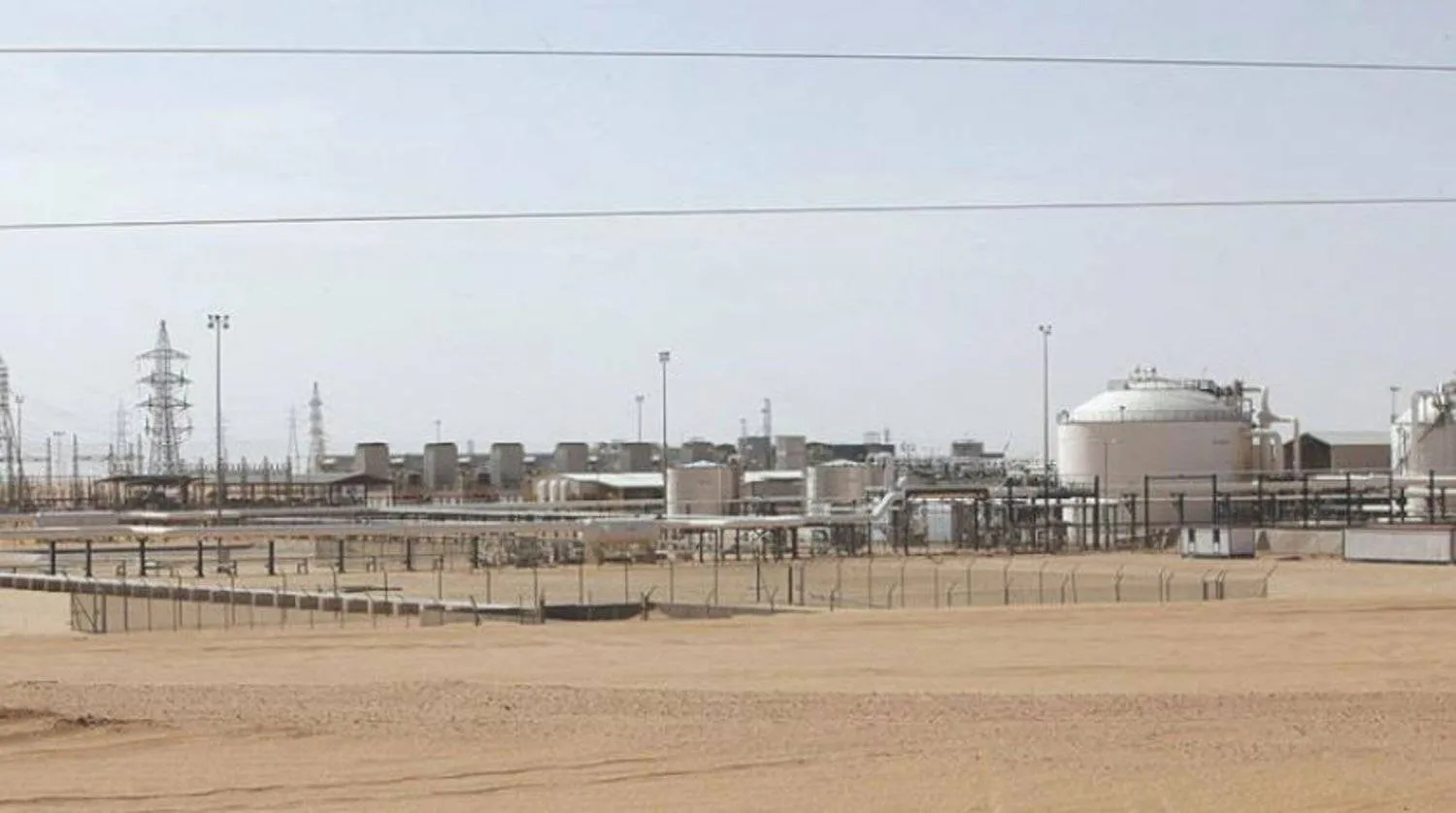
Libya’s Sharara and El Feel Oilfields Have Resumed Saturday Evening

Libyan oilfield AAWSAT AR
TT

Libya’s Sharara and El Feel Oilfields Have Resumed Saturday Evening

Libyan oilfield AAWSAT AR

Production at Libya's Sharara and El Feel oilfields, which were shut on Thursday following the abduction of a former finance minister, has resumed on Saturday evening, four oil engineers and oil ministry said.

Sharara has partially resumed at 30,000 barrels per day out of its usual 290,000, two engineers said. Production will return to normal on Sunday morning, they said, Reuters reported.

The Sharara field, one of Libya's largest production areas with a capacity of about 300,000 barrels per day, has been a frequent target for several political reasons and demands by local protesters.

The field is located in Murzuq basin in southeast Libya. It is run by the state oil firm NOC via Acacus company with Spain's Repsol (REP.MC), France's Total (TTEF.PA), Austria's OMV (OMVV.VI), and Norway's Equinor (EQNR.OL).

El Feel field, which has a capacity of 70,000 barrels per day, is operated by Mellitah Oil and Gas which is a joint venture between the state oil firm NOC and Italy's Eni (ENI.MI).

Sharara and El Feel oilfields, as well as the 108 field, were all closed in a protest by al-Zawi tribe in response to the kidnapping of former finance minister Faraj Bumatari. The 108 oilfield remains shut.

In a message to Reuters on Saturday, the tribe's leader Al-Senussi Al-ahlaiq confirmed the release of Bumatari, who was kidnapped after arriving at Mitiga airport on Tuesday.

The UN- mission in Libya said in a tweet it "reiterates its call for the immediate release of all those arbitrarily detained including civilians, civic activists, political figures & members of security service."

Libya's oil minister Mohamed Aoun told Dubai-based Asharq TV on Saturday that the oilfields' closure had cost the North African country the production of 340,000 barrels.

The oil ministry also said the closures could lead to the declaration of force majeure.

"The loss of confidence in the continuity of Libyan oil supply to the global market will result in a loss of market share for Libyan oil and decreased demand for it," the ministry said in a statement.

Libyan oil output has been subjected to repeated closures for different political reasons and local protesters' demands during the chaotic decade since the 2011 NATO-backed uprising against Muammar Gaddafi.


Charity Kitchen Closures Threaten Thousands of Families with Hunger in Khartoum

Women line up ahead of a food distribution (Asharq Al-Awsat). 
TT

Charity Kitchen Closures Threaten Thousands of Families with Hunger in Khartoum

Women line up ahead of a food distribution (Asharq Al-Awsat). 

Thousands of displaced people in Sudan’s capital, Khartoum, are struggling to secure a daily meal as dozens of charity kitchens have closed or scaled back operations because of funding shortages, leaving growing numbers of families at risk of hunger.

Al-Sadiq Siddiq, who supervises a charity kitchen in Omdurman, said dwindling donations had forced organizers to reduce the number of meals provided to families.

“We are facing growing difficulties because of a shortage of financial support from donors and benefactors,” he said, warning that conditions were deteriorating as hunger spread among poor and vulnerable communities.

The scramble for food had reached distressing levels, he added, with some people resorting to physical fights over portions of beans or lentils.

“These conditions are pushing more families into hunger and leaving them unable to secure even the minimum amount of food they need,” he stated.

One Meal a Day

Abbas Mahjoub, a supervisor at a charity kitchen in the East Nile area, noted that the facility had served more than 800 families before it closed. Many residents now survive on a single meal a day, unable to meet their basic food needs.

Al-Bukhari Ishaq, who supervised a kitchen in eastern Al-Jarif, said it had shut down more than eight months ago after funding from the East Nile Emergency Response Room, which provided grants to charity kitchens, declined.

Ishaq told Asharq Al-Awsat that dwindling donations and reduced contributions from aid organizations, including the World Food Program (WFP) and the United Nations Children’s Fund (UNICEF), had severely undermined the kitchen’s operations.

The facility had provided daily meals to around 400 families, he explained, and its closure deprived hundreds of households of an essential source of food amid worsening living conditions.

Altouma al-Jak, who supports a family of nine, told Asharq Al-Awsat that her grandchildren had dropped out of school because she could no longer afford breakfast, transportation or school supplies, including clothes, shoes, books and notebooks.

“Sometimes days go by when my children don’t have enough to eat,” she said sadly.

Her family had depended on a charity kitchen for food, and its closure amounted to “a slow death,” she explained, particularly as soaring prices had put basic food supplies beyond the reach of many households.

She expressed hope that the war would end and peace would return to Sudan, allowing people to live with dignity.

Hunger Deepens

Salwa Abdullah Adam lost her husband during the war when he was struck by a shell, leaving her solely responsible for seven children, the youngest a nine-month-old baby.

Standing in a long line outside a charity kitchen to collect a simple meal for her children, she described the mounting hardship.

“Life is getting harder day by day,” she remarked.

Her children go to school without spending money and return home to eat whatever corn porridge is available, while the family struggles to meet their daily needs.

Healthcare is another challenge. Adam said charitable doctors sometimes help her obtain medicines for her children from pharmacies, but when adults fall ill, they have little choice but to endure their illnesses and take painkillers.

A Lifeline for Families

Ali Abdullah Youssef faces similar difficulties to other families relying on charity kitchens, locally known as takaya, for their only daily meal.

“Conditions are extremely difficult. Without this charity kitchen, we wouldn’t be able to get food,” he said.

He warned that the closure of such kitchens would leave his family in a desperate situation, with no source of income and living costs continuing to rise.

Accounts from beneficiaries illustrate the hardship caused by the closures, particularly among families that have lost their livelihoods and now depend on meals distributed by charitable initiatives.

The struggle to obtain food comes amid mounting international warnings over Sudan’s worsening food crisis.

On October 26, dozens of countries, including the United States and major European nations, expressed concern over the continued deterioration of food security in Sudan and called on both parties to the conflict to remove all obstacles to humanitarian aid deliveries.

In June, the Integrated Food Security Phase Classification (IPC) reported that approximately 5.1 million people in Sudan were facing acute hunger.

The crisis has been compounded by the war that erupted in 2023, which has damaged the agricultural sector and hampered farmers’ ability to harvest their crops, alongside a recent drought.


Gaza Turns Rubble into Power with Homemade Wind Turbines

In war-ravaged Gaza, where shortages are constant, every watt counts. Eyad BABA / AFP
TT

Gaza Turns Rubble into Power with Homemade Wind Turbines

In war-ravaged Gaza, where shortages are constant, every watt counts. Eyad BABA / AFP

Above a maze of tents in a crowded displacement camp in Gaza, homemade wind turbines made from scrap metal and salvaged debris spin in the sea breeze, bringing electricity to struggling Palestinians.

In the southern Khan Yunis camp, Kamal Al-Dabary, a former engineering student, has put his skills to work for families who, like most Gazans, live in displacement with no direct access to the tiny territory's shattered power grid.

According to the World Bank, more than 90 percent of Gaza's power generation and distribution capacity was destroyed in April 2026, much of it in Israeli strikes that devastated homes and infrastructure, AFP reported.

Sitting on the ground, Dabary tinkered with electrical wires, metal parts and basic tools on a plastic table.

After carefully twisting cables together and testing them with a multimeter, a small bulb flickered on, then another, signaling that the current was flowing.

"When solar panels were still relatively affordable, we bought one and kept moving it around to follow the sun," the 60-year-old, displaced by the fighting between Israel and Hamas, told AFP.

The war was triggered by the Palestinian movement's deadly October 7, 2023 attack on Israel.

But after three years of war, prices have soared as aid and commercial supplies trickled into Gaza through crossings tightly controlled by Israel.

A single solar panel now costs at least 15,000 shekels (nearly $5,000), putting it out of reach for most Gazans, Dabary said.

- 'Changed everything' -

"We haven't had work or income for three years," he added.

"That's when the idea of a wind turbine came to mind. Why not harness the wind? So we salvaged parts from the rubble."

The turbines are built from scooter motors and old water tanks cut into blades.

As the wind turns the blades, they drive a motor that generates electricity. The power then passes through circuits assembled from parts recovered from destroyed homes before being stored in batteries.

This provides enough electricity to charge phones and run lights, fans and even electric razors, small comforts that have become a luxury for families still living in tents and shelters.

Nearly all of Gaza's residents were displaced at least once during the war, and most now live in a small area still under Hamas rule, while Israel controls more than 60 percent of the territory along its perimeter.

"They help us hold on... until God delivers us from this ordeal and we can return home," said Dabary, known locally as Abu Ayman.

The output remains modest. But in a camp where shortages are constant, every watt counts.

The system "has changed everything," said 50-year-old Saleh ben Hasan.

With healthcare and medication hard to access in Gaza, the power can also help keep medical equipment running.

"If a child needs a nebulizer (a device used to inhale medicine) in the middle of the night, who else can we turn to?" he said.

"Electricity is needed... So we turn to our brother Abu Ayman."


Egypt Offers Israel Fresh Assurances over Sinai Development Projects

The Minister of Transport inspects the railway line in Sinai (Egyptian Ministry of Transport)
TT

Egypt Offers Israel Fresh Assurances over Sinai Development Projects

The Minister of Transport inspects the railway line in Sinai (Egyptian Ministry of Transport)

Egypt issued fresh assurances to Israel over its development projects in the Sinai Peninsula, amid Israeli media reports expressing concern about the projects.

Experts told Asharq Al-Awsat that Egypt's reassurances were intended to underscore that developing Sinai was an irreversible national security priority, and that Cairo would not be swayed by Israeli claims or reservations, stressing that its development plans were an entirely domestic matter.

Egyptian Transport Minister Kamel al-Wazir said the 500-km Arish-Taba railway was primarily a development project, dismissing concerns over its purpose. He said the railway, along with plans to build villages and factories, would encourage Egyptians to settle in Sinai, describing this as essential to national security.

Israeli media reports have raised concerns about the railway's potential "strategic and military implications", arguing that it could facilitate the rapid movement of large quantities of equipment, goods and personnel across the peninsula.

Al-Wazir, speaking during a visit to North Sinai, said the railway was intended to support peaceful development and settlement, adding that there was no reason for concern.

The project forms part of a wider transport network linking the Suez Canal cities with Sinai, connecting the ports of Arish and Taba through railways, highways and logistics zones.

Military and strategic expert Major General Ayman Abdel Mohsen said the minister's remarks highlighted the role of development in national security, arguing that securing Sinai went beyond military measures and required encouraging people to settle there.

He told Asharq Al-Awsat that Egypt would press ahead with infrastructure projects in Sinai regardless of Israeli objections, rejecting concerns raised in Israeli media over the railway and logistics corridors.

Major General Adel al-Omda, an adviser at the Military Academy for Postgraduate and Strategic Studies, said the remarks followed Israeli statements about Sinai and reflected Egypt's commitment to implementing its development and security plans. He said Egypt aimed to settle between three million and eight million people in the peninsula by 2030.

Al-Omda said President Abdel Fattah al-Sisi had outlined a three-pronged plan to develop and secure Sinai, covering security, development and public awareness. He said security operations had been carried out, while new cities, including New Rafah, New Ismailia and New Port Said, had been built in and around the peninsula and connected through road and transport networks. Awareness campaigns, lectures, and seminars were also being held in Sinai.

Egypt has continued to pursue development projects across the peninsula, with the government reporting significant progress in recent years. In late 2023, Prime Minister Mostafa Madbouly said the government had spent more than 600 billion Egyptian pounds ($11.6 billion) on Sinai development over the previous decade, funding projects in infrastructure, roads, housing, water and tunnels.