

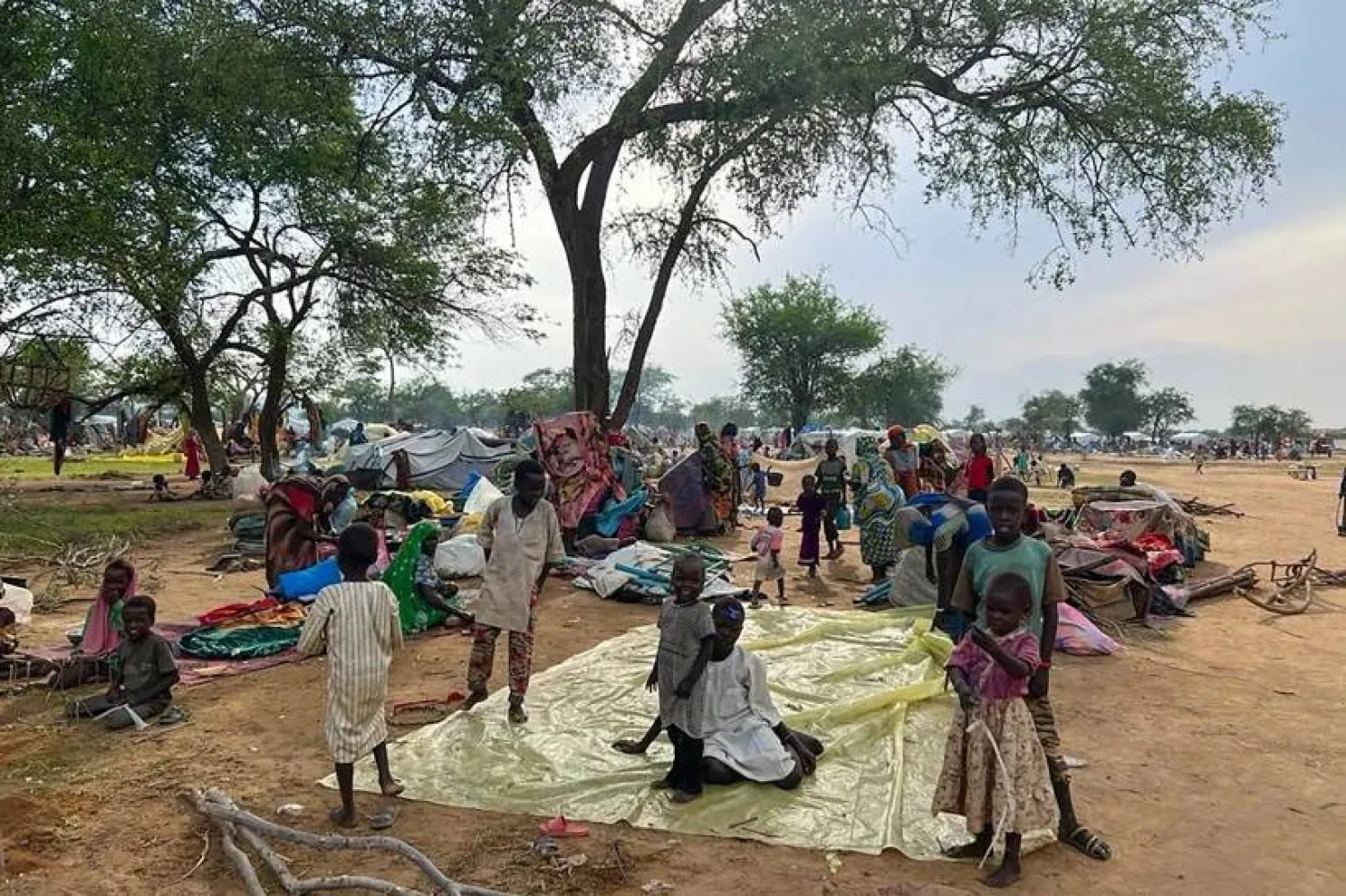

Sudan Conflict Brings New Atrocities to Darfur

File - Sudanese refugees who fled the conflict in Sudan gather Monday, July 10, 2023, at the Zabout refugee Camp in Goz Beida, Chad. (Pierre Honnorat/WFP via AP, File)
TT

Sudan Conflict Brings New Atrocities to Darfur

File - Sudanese refugees who fled the conflict in Sudan gather Monday, July 10, 2023, at the Zabout refugee Camp in Goz Beida, Chad. (Pierre Honnorat/WFP via AP, File)

Amna al-Nour narrowly escaped death twice. The first was when militias torched her family’s home in Sudan’s Darfur region. The second was two months later when paramilitary fighters stopped her and others trying to escape as they tried to reach the border with neighboring Chad, according to a report by The Associated Press.

“They massacred us like sheep,” the 32-year-old teacher said of the attack in late April on her home city Geneina. “They want to uproot us all.”

Al-Nour and her three children now live in a school-turned-refugee housing inside Chad, among more than 260,000 Sudanese, mostly women and children, who have fled what survivors and rights groups say is a new explosion of atrocities in the large western region of Sudan.

Two decades ago, Darfur became synonymous with genocide and war crimes, particularly by the notorious Janjaweed.

Fears are mounting that that legacy is returning with reports of widespread killings, rapes and destruction of villages in Darfur amid a nationwide power struggle between Sudan’s military and the Rapid Support Forces.

“This spiraling violence bears terrifying similarity with the war crimes and crimes against humanity perpetrated in Darfur since 2003,” said Tigere Chagutah, a regional director with Amnesty International. “Even those seeking safety are not being spared.”

Fighting erupted in the capital, Khartoum, in mid-April between the military and the RSF after years of growing tensions. It spread to other parts of the country, but in Darfur it took on a different form -– brutal attacks by the RSF and its allied militias on civilians, survivors and rights workers say.

During the second week of fighting in Khartoum, the RSF and militias stormed Geneina, the capital of West Darfur state, located near the Chad border. In that and two other assaults since, the fighters went on a rampage of burning and killing that reduced large parts of the city of more than half a million people to wreckage, according to videos shared by activists.

“What happened in Geneina is indescribable,” said Sultan Saad Abdel-Rahman Bahr, the leader of the Dar Masalit sultanate, which represents Darfur’s Masalit ethnic community. “Everywhere (in the city) there was a massacre. All was planned and systemic.”

The sultanate said in a report that more than 5,000 people were killed and 8,000 others were wounded in Geneina alone in attacks until June 12 by members wearing the RSF and the militias costumes.

The report detailed three main waves of attacks on Geneina and surrounding areas in April, May, and June, which it said aimed at “ethnically cleansing and committing genocide against African civilians.”

The RSF was born out of the Janjaweed militias that during the conflict in the 2000s were accused of mass killings, rapes and other atrocities against Darfur’s African communities. Former President Omar al-Bashir later formed the RSF out of Janjaweed fighters and put it under the command of Gen. Mohammed Hamdan Dagalo, who hails from Darfur’s Arab Rizeigat tribe.

The RSF didn’t respond to repeated requests by The Associated Press for comment on the allegations concerning the recent violence, including rapes.

In interviews with the AP, more than three dozen people and activists gave similar descriptions of waves of attacks by the RSF on Geneina and other towns in West Darfur. Fighters stormed houses, driving out residents, taking men away and burning their homes, they said.

In some cases, they would kill the men and rape women and often shot people fleeing in the streets, al-Nour and other survivors said. Almost all interviewees said the military and other groups in the region failed to provide protection to civilians.

“They were looking for men. They want to eliminate us,” said Malek Harun, a 62-year-old farmer who survived an attack in May on his village of Misterei, near Geneina. He said gunmen attacked the village from all directions. They looted homes and detained or killed the men.

His wife was killed when she was shot by fighters firing in the village market, he said. He buried her in his home’s yard. Arab neighbors then helped him escape and he arrived in Chad on June 5.

On July 13, the UN Human Rights Office said a mass grave was found outside Geneina with at least 87 bodies, citing credible information. The international group Human Rights Watch said it also documented atrocities including summary executions and mass graves in Misterei.

The Sudanese Unit for Combating Violence against Women, a government organization, said it documented 46 rape cases in Darfur, including 21 in Geneina and 25 in Nyala, the capital of South Darfur, as well as 51 in Khartoum.

The true number of cases of sexual violence are likely in the thousands, said Sulima Ishaq Sharif, head of the unit.

“There is an emerging pattern of large-scale targeted attacks against civilians based on their ethnic identities,” said Volker Perthes, the UN envoy in Sudan. The International Criminal Court’s prosecutor, Karim Khan, told the UN Security Council last week they were investigating alleged new war crimes and crimes against humanity in Darfur.

Al-Nour, whose husband was killed in a bout of tribal clashes in early 2020, said assailants stormed her district of Jamarek in Geneina in late April and burned down dozens of houses, including hers. “They forced people to get out of their homes, then shot at them,” she said, speaking by phone from the Chadian border town of Adre.

She and her children — aged 4, 7 and 10 — escaped with the aid of Arab neighbors. They kept moving from town to town amid clashes.

In mid-June, she and a group of 40 men, women, and children started on foot down the 20-kilometer (12-mile) highway to the border, planning to escape to Chad. They were soon stopped at an RSF checkpoint, she said.

Holding the group at gunpoint, the fighters asked about their ethnicity. Two of the 14 men in the group were Arab, with fairer skin. The fighters abused and beat the others, who had Masalit accents.

“You want to escape? You will die here,” one fighter told the Masalit. They whipped everyone in the group, men and women. They beat the men to the ground with rifle butts and clicked the triggers of their guns to frighten them. One man was shot in the head and died immediately, al-Nour said.

They took away the remaining men along with four women in their 20s, she said. She does not know what happened to them but fears the women were raped. They allowed the rest of the women and children to continue their trip.

Other refugees in Adre reported similar violence on the road to the border.

“It was a relief to reach Chad,” said Mohammed Harun, a refugee from Misterei who arrived in Adre in early June, “but the wounds (from the war) will last forever.”



Israeli Reservist Rams Vehicle into Palestinian Man Praying in West Bank

Israeli security forces secure a street as they leave the Palestinian village of Bizariya, in the occupied West Bank, where Israeli authorities demolished the house of a Palestinian man killed in July after he and another man reportedly killed an Israeli settler on the same day, on December 24, 2025. (AFP)
TT

Israeli Reservist Rams Vehicle into Palestinian Man Praying in West Bank

Israeli security forces secure a street as they leave the Palestinian village of Bizariya, in the occupied West Bank, where Israeli authorities demolished the house of a Palestinian man killed in July after he and another man reportedly killed an Israeli settler on the same day, on December 24, 2025. (AFP)

An Israeli reservist soldier rammed his vehicle into a Palestinian man as he prayed on a roadside in ​the occupied West Bank on Thursday, after earlier firing shots in the area, the Israeli military said.

"Footage was received of an armed individual running over a Palestinian individual," it said in a statement, adding the individual was a reservist ‌and his ‌military service had ‌been terminated.

The ⁠reservist ​acted "in severe ‌violation of his authority" and his weapon had been confiscated, the military said.

Israeli media reported that he was being held under house arrest.

The Israeli police did not immediately respond to a Reuters request for comment.

The ⁠Palestinian man went to hospital for checks after ‌the attack, but was unhurt ‍and is now ‍at home.

Video which aired on Palestinian ‍TV shows a man in civilian clothing with a gun slung over his shoulder driving an off-road vehicle into a man praying on ​the side of the road.

This year ​was one of the most violent on ⁠record for Israeli civilian attacks against Palestinians in the West Bank, according to United Nations data that shows more than 750 injuries.

More than a thousand Palestinians were killed in the West Bank between October 7, 2023 and October 17, 2025, mostly in operations by security forces and some by settler violence, according to the UN In ‌the same period, 57 Israelis were killed in Palestinian attacks.


Deadly Blast Hits Mosque in Syria’s Homs, Saraya Ansar al-Sunna Claims Responsibility

Syrian security forces stand inside a damaged mosque after several people were killed in an explosion at a mosque as the Syrian Arab News Agency (SANA) said, in Homs, Syria December 26, 2025. REUTERS/Ali Ahmed al-Najjar
TT

Deadly Blast Hits Mosque in Syria’s Homs, Saraya Ansar al-Sunna Claims Responsibility

Syrian security forces stand inside a damaged mosque after several people were killed in an explosion at a mosque as the Syrian Arab News Agency (SANA) said, in Homs, Syria December 26, 2025. REUTERS/Ali Ahmed al-Najjar

A bombing at a mosque in Syria during Friday prayers killed at least eight people and wounded 18 others, authorities said.

Images released by Syria’s state-run Arab News Agency showed blood on the mosque’s carpets, holes in the walls, shattered windows and fire damage. The Imam Ali bin Abi Talib Mosque is located in Homs, Syria's third-largest city.

SANA, citing a security source, said that preliminary investigations indicate that explosive devices were planted inside the mosque. Authorities were searching for the perpetrators, who have not yet been identified, and a security cordon was placed around the building, Syria’s Interior Ministry said in a statement.

In a statement on Telegram, the Saraya Ansar al-Sunna said its fighters "detonated a number of explosive devices" in the mosque.

The same group had previously claimed a suicide attack in June in which a gunman opened fire and then detonated an explosive vest inside a Greek Orthodox church in Dweil’a, on the outskirts of Damascus, killing 25 people as worshippers prayed on a Sunday.

Several countries, including Saudi Arabia, Jordan and Lebanon, condemned the attack. 


Fuel Shortage Forces Gaza Hospital to Suspend Most Services

The sun sets behind a makeshift tent camp for displaced Palestinians set up in an area of al-Bureij camp, in the central Gaza Strip, Wednesday, Dec. 24, 2025. (AP)
TT

Fuel Shortage Forces Gaza Hospital to Suspend Most Services

The sun sets behind a makeshift tent camp for displaced Palestinians set up in an area of al-Bureij camp, in the central Gaza Strip, Wednesday, Dec. 24, 2025. (AP)

A major Gaza hospital has suspended several services because of a critical fuel shortage in the devastated Palestinian territory, which continues to face a severe humanitarian crisis, it said.

Devastated by more than two years of war, the Al-Awda Hospital in the central Gaza district of Nuseirat cares for around 60 in-patients and receives nearly 1,000 people seeking medical treatment each day.

"Most services have been temporarily stopped due to a shortage of the fuel needed for the generators," said Ahmed Mehanna, a senior official involved in managing the hospital.

"Only essential departments remain operational: the emergency unit, maternity ward and pediatrics."

To keep these services running, the hospital has been forced to rent a small generator, he added.

Under normal conditions, Al-Awda Hospital consumes between 1,000 and 1,200 liters of diesel per day. At present, however, it has only 800 liters available.

"We stress that this shutdown is temporary and linked to the availability of fuel," Mehanna said, warning that a prolonged fuel shortage "would pose a direct threat to the hospital's ability to deliver basic services".

He urged local and international organizations to intervene swiftly to ensure a steady supply of fuel.

Despite a fragile truce observed since October 10, the Gaza Strip remains engulfed in a severe humanitarian crisis.

While the ceasefire agreement stipulated the entry of 600 aid trucks per day into Gaza, only 100 to 300 carrying humanitarian assistance can currently enter, according to the United Nations and non-governmental organizations.

The remaining convoys largely transport commercial goods that remain inaccessible to most of Gaza's 2.2 million people.

- Health hard hit -

On a daily basis, the vast majority of Gaza's residents rely on aid from UN agencies and international NGOs for survival.

Gaza's health sector has been among the hardest hit by the war.

During the fighting, the Israeli miliary repeatedly struck hospitals and medical centers across Gaza, accusing Hamas of operating command centers there, an allegation the group denied.

International medical charity Doctors Without Borders now manages roughly one-third of Gaza's 2,300 hospital beds, while all five stabilization centers for children suffering from severe malnutrition are supported by international NGOs.

The war in Gaza was sparked on October 7, 2023, following an unprecedented Hamas attack on Israel that resulted in the deaths of 1,221 people, most of them civilians, according to an AFP tally based on official Israeli figures.

In Israel's ensuing military campaign in Gaza, at least 70,942 people - also mostly civilians - have been killed, according to the health ministry in the Hamas-run territory.