


Allawi to Asharq Al-Awsat: Saddam Was a Brave Young Man, Power Transformed Him into a Tyrant

Former Iraqi Prime Minister Iyad Allawi during his interview with Asharq Al-Awsat Editor-in-Chief Ghassan Charbel. (Asharq Al-Awsat)
TT

Allawi to Asharq Al-Awsat: Saddam Was a Brave Young Man, Power Transformed Him into a Tyrant

Former Iraqi Prime Minister Iyad Allawi during his interview with Asharq Al-Awsat Editor-in-Chief Ghassan Charbel. (Asharq Al-Awsat)

The story began in 1964. Former Iraqi Prime Minister Iyad Allawi enjoyed a friendship with a colleague named Abdul Karim Al-Shaikhli, who had returned to the College of Medicine in Baghdad after a long break, due to his involvement in the assassination attempt against Iraqi leader Abdul Karim Qasim in 1959.

One day, a skinny young man came to the college, and Al-Shaikhli introduced him to Allawi. His name was Saddam Hussein. Saddam will repeat these visits and will always ask Allawi: “Where is my twin brother?” Allawi would answer that he was attending a lecture and would come after it ended, and the two would exchange conversations over a cup of coffee, then Al-Shaikhli would join them.

A friendship developed between the three, who would later be held in the same prison in 1964. But their paths would then converge, when Saddam became the undisputed master of the Baath party and the country.

In 1978, Saddam attacked Allawi with an axe, but he luckily escaped with his life. However, hostility did not prevent him from acknowledging his opponent’s qualities and characteristics. I asked him to describe Saddam during the first half of the 1960s, he replied: “When we met for the first time, he did not have an important role in the party. But he was a man of nobility and strong will, and was considered one of the party’s fighters and committed to its ideology.”

Allawi admitted that after the fall of Saddam, his government conducted investigations “and did not find a single property in his name, including the presidential plane.” While he blamed the young man he met in medical school for the disasters and tragedies that befell Iraq, he did not deny the qualities he possessed that helped him advance in the party. But he stressed that power turned the young fighter into a tyrannical ruler without a partner or anyone to keep him in check.

Saddam’s cruelty

I asked Allawi about Saddam’s cruelty, and he told me a story:

“I have never seen cruelty like Saddam’s. Here I can mention an important incident. Among the Baathists was a person from Karrada named Hussein Hazbar, who defected and worked with the Syrian wing of the Baath Party in Iraq. One day, a group of Baathists and I were sitting having dinner in the garden of a restaurant. Saddam and Saadoun Shaker came to us. They were cheerful and laughing... They said that they had set a trap for Hazbar, on the suspension bridge, adding that the man was beaten with the butt of pistols, and that he was taken to a hospital...”

“We were appalled by the incident and formed a delegation to go to the hospital to check on the man, and acquit the party of this act, which we saw as cruel and a kind of treachery. I was not part of the delegation, but I knew that five people had attacked Hazbar. He was alone crossing the bridge, so they surrounded him and beat him.”

A feast of surprises

Allawi also recounted how Saddam’s regime dismissed Al-Shaikhli from his post as foreign minister and member of the Baath part on the same evening as his engagement. He recalled:

“The story of Al-Shaikhli’s dismissal from his position in the Ministry of Foreign Affairs deserves to be mentioned. The man proposed to a girl to marry her. Saddam invited him to dinner with his fiancée, and also invited the Minister of Interior, Vice President of the Republic, Saleh Mahdi Ammash, and his wife. During the dinner, Baghdad Radio broadcast that Al-Shaikhli and Ammash were both relieved of their positions. Al-Shaikhli called me and asked me: Have you heard the news? [...] As I was taking my fiancée to her home, my driver asked me, ‘Did you hear the news?’ I replied: What news? He said: You will be relieved of all your posts and positions in the party and the state.”

Allawi continued: “Al-Shaikhli had participated, along with Saddam, in the attempt to assassinate Qasim. They both fled the country to Egypt, where they lived like brothers. Al-Shaikhli was an Arab nationalist and held senior roles within the party. Years later, the man was put under house arrest. The regime deliberately cut off the electricity to his home under the pretext of unsettled bills. When he went to the Electricity Corporation headquarters, they shot him dead in front of his wife. That was in 1980. Unfortunately, he did not take my advice not to return to Iraq when he was outside the country.”

In prison with Saddam and his companions

Allawi recounted the circumstances of his imprisonment, along with Saddam, in 1964.

“In the fall of 1964, the party decided to launch a coup attempt to restore power. For this purpose, a special body was formed under the name of ‘Jihaz Hanin’, and was led by Saddam, Al-Shaikhli, and Mohammad Fadel. In early September, the coup attempt was uncovered and the authorities launched a massive arrest and persecution campaign. I was among those arrested at that time, along with Saddam, Al-Shaikhli, Salah Omar Al-Ali, Imad Shabib, and Hamid Jawad.”

“Saddam and Al-Shaikhli escaped from prison through a pharmacy in the Al-Saadoun area. They usually returned from court to the prison, but on that day, they claimed that they needed to buy some medicine. They entered the pharmacy with some guards and fled through another entrance, where a car was waiting for them. They laid low until Abdul Rahman Al-Bazzaz, then-prime minister, pardoned them and others, through an official decision. This helped speed up the process of rebuilding and restoring the party, and revived talks about the means to change the regime in Iraq through a military coup.”

“I graduated from medical school in the summer of 1970 and left Iraq to live in Lebanon in October 1971, determined to reach an agreement with others to modify some of the party’s paths by changing the leaders and returning the party to its true spirit. The reasons for me leaving party work were many, most importantly restrictions on freedoms...”

Among those who advised Allawi to leave Iraq was a friend named Nazim Kazar, a famous member of what was known as the “Cruelty Club.”

The man was the director of Public Security and attempted in 1973, along with others, to assassinate Ahmed Hassan al-Bakr and Saddam together at Baghdad airport, in protest against their control over the party and the state. But when Al-Bakr’s plane was late in arriving, the conspirators thought that the plan had been uncovered. Kazar fled towards the border with Iran, but the army arrested him and quickly liquidated him.

Allawi said: “Kazar was executed quickly. They shot him in the back of the head. No one could confront him even though he was detained. He is the most daring man I have ever met. He knows no such thing as fear. We worked together in the party’s student office. He had unlimited boldness and absolute commitment to the party’s goals. He was as violent as Saddam. Violent, strong and fair. There is no doubt about his integrity.”

At the conclusion of the interview, I asked Allawi about the factors that made Saddam take control of the Baath Party. He replied: “There are two main reasons: the first was his extreme audacity, and the second was the support provided to him by Ahmed Hassan al-Bakr. Later, Saddam felt that he had control over the party and turned against Al-Bakr... Saddam’s slide into dependence on the family and the Tikrit elements started two months after the Baath Party regained power.”

Allawi’s story is valuable, long and thorny. It cannot fit into a handful of pages. His narration sheds light on some of the features of that stage, especially since he had a direct relationship with the most prominent players in the “Cruelty Club.”



US Slaps Sanctions on Sudan’s RSF Commanders over El-Fasher Killings

FILE - A Sudanese child, who fled el-Fasher city with family after Sudan's RSF attacked the western Darfur region, receives treatment at a camp in Tawila, Sudan, Nov. 2, 2025. (AP Photo/Mohammed Abaker, File)
TT

US Slaps Sanctions on Sudan’s RSF Commanders over El-Fasher Killings

FILE - A Sudanese child, who fled el-Fasher city with family after Sudan's RSF attacked the western Darfur region, receives treatment at a camp in Tawila, Sudan, Nov. 2, 2025. (AP Photo/Mohammed Abaker, File)

The United States announced sanctions on Thursday on three Sudanese Rapid Support Forces (RSF) commanders over their roles in the "horrific campaign" of the siege and capture of El-Fasher.

The US Treasury said the RSF carried out "ethnic killings, torture, starvation, and sexual violence" in the operation.

Earlier Thursday, the UN's independent fact-finding mission on Sudan said the siege and seizure of the city in Darfur bore "the hallmarks of genocide."

Its investigation concluded that the seizure last October had inflicted "three days of absolute horror," and called for those responsible to be brought to justice.

"The United States calls on the Rapid Support Forces to commit to a humanitarian ceasefire immediately," US Treasury Secretary Scott Bessent said in a statement.

"We will not tolerate this ongoing campaign of terror and senseless killing in Sudan."

The Treasury noted that the three sanctioned individuals were part of the RSF's 18-month siege of and eventual capture of El-Fasher.

They are RSF Brigadier General Elfateh Abdullah Idris Adam, Major General Gedo Hamdan Ahmed Mohamed and field commander Tijani Ibrahim Moussa Mohamed.

Bessent warned that Sudan's civil war risks further destabilizing the region, "creating conditions for terrorist groups to grow and threaten the safety and interests of the United States."

The UN probe into the takeover of El-Fasher -- after the 18-month siege -- concluded that thousands of people, particularly from the Zaghawa ethnic group, "were killed, raped or disappeared."


Israel's Netanyahu Says No Reconstruction of Gaza before Demilitarization

Israel’s Prime Minister Benjamin Netanyahu - File Photo/AFP
TT

Israel's Netanyahu Says No Reconstruction of Gaza before Demilitarization

Israel’s Prime Minister Benjamin Netanyahu - File Photo/AFP

Israeli Prime Minister Benjamin Netanyahu said on Thursday there would be no reconstruction of war-shattered Gaza before the disarmament of Hamas, as the "Board of Peace" convened for its inaugural meeting in Washington.

Around two dozen world leaders and senior officials met for the first meeting of the board, which was set up after the United States, Qatar and Egypt negotiated a ceasefire in October to halt two years of war in the Gaza Strip.

"We agreed with our ally the US there will be no reconstruction of Gaza before the demilitarization of Gaza," Netanyahu said during a televised speech at a military ceremony on Thursday, AFP reported.

The meeting in Washington will also look at how to launch the International Stabilization Force (ISF) that will ensure security in Gaza.

One of the most sensitive issues before the board is the future of the Islamist movement Hamas, which fought the war with Israel and still exerts influence in the territory.

Disarmament of the group is a central Israeli demand and a key point in negotiations over the ceasefire's next stage.

US officials including Steve Witkoff, Trump's friend and roving negotiator, have insisted that solid progress is being made and that Hamas is feeling pressure to give up weapons.

Israel has suggested sweeping restrictions including seizing small personal rifles from Hamas.

It remains unclear whether, or how, the Palestinian technocratic committee formed to handle day-to-day governance of Gaza will address the issue of demilitarization.

The 15-member National Committee for the Administration of Gaza (NCAG) will operate under the supervision of the "Board of Peace", and its head, Ali Shaath, is attending the meeting in Washington on Thursday.


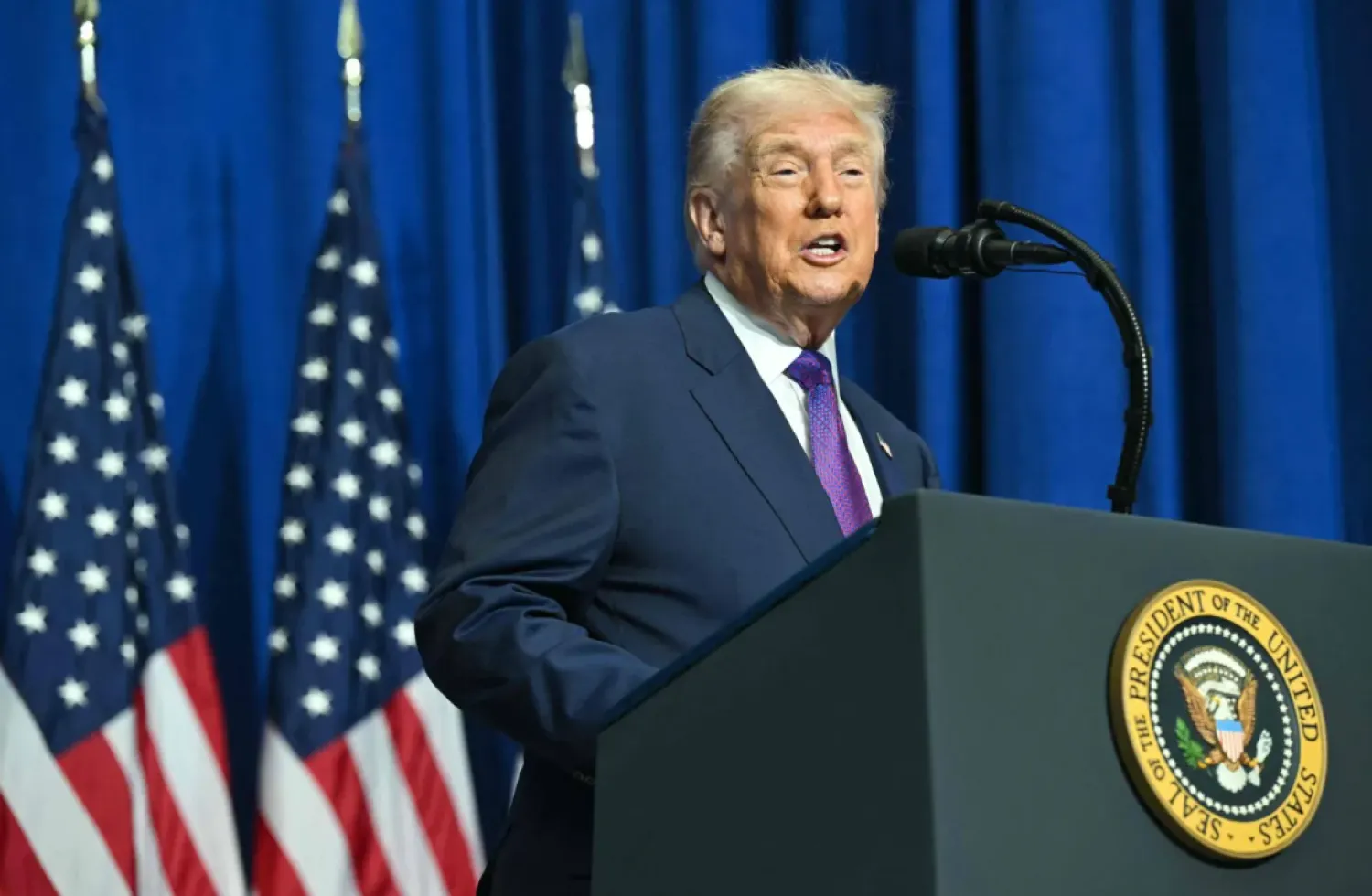
Trump Tells First Meeting of Board of Peace that $7 billion Raised for Gaza

US President Donald Trump speaking in Washington - AFP
TT

Trump Tells First Meeting of Board of Peace that $7 billion Raised for Gaza

US President Donald Trump speaking in Washington - AFP

US President Donald Trump told the first meeting of his Board of Peace on Thursday that $7 billion has been contributed to a Gaza reconstruction fund that aims to rebuild the enclave once Hamas disarms, an objective that is far from becoming a reality.

The disarmament of Hamas militants and accompanying withdrawal of Israeli troops, the size of the reconstruction fund and the flow of humanitarian aid to the war-battered populace of Gaza are among the major questions likely to test the effectiveness of the board in the weeks and months ahead.

In a flurry of announcements at the end of a long, winding speech, Trump said the United States will make a contribution of $10 billion to the Board of Peace. He said contributing nations had raised $7 billion as an initial down payment for Gaza reconstruction.

Trump first proposed the board last September when he announced his plan to end Israel's war in Gaza. He later made clear the board's remit would be expanded beyond Gaza to tackle other conflicts worldwide.

Trump also said FIFA will raise $75 million for soccer-related projects in Gaza and that the United Nations will chip in $2 billion for humanitarian assistance.

TRUMP SAYS ANY IRAN DEAL MUST BE MEANINGFUL, PROSPECTS SHOULD BE CLEAR IN 10 DAYS

The Board of Peace includes Israel but not Palestinian representatives and Trump's suggestion that the Board could eventually address challenges beyond Gaza has stirred anxiety that it could undermine the UN's role as the main platform for global diplomacy and conflict resolution.

"We're going to strengthen the United Nations," Trump said, trying to assuage his critics. "It's really very important."

The meeting came as Trump threatens war against Iran and has embarked on a massive military buildup in the region in case Tehran refuses to give up its nuclear program.

Trump said he should know in 10 days whether a deal is possible. "We have to have a meaningful deal," he said.

The event had the feel of a Trump campaign rally, with music blaring from his eclectic playlist from Elvis Presley to the Beach Boys. Red Trump hats were given to participants.

Senior US officials said Trump will also announce that several nations are planning to send thousands of troops to participate in an International Stabilization Force that will help keep the peace in Gaza when it eventually deploys.

Hamas, fearful of Israeli reprisals, has been reluctant to hand over weaponry as part of Trump's 20-point Gaza plan that brought about a fragile ceasefire last October in the two-year Gaza war.

Trump said he hoped use of force to disarm Hamas would not be necessary. He said Hamas had promised to disarm and it "looks like they're going to be doing that, but we'll have to find out."