Lebanon’s Central Bank: No Funding for the State, Neither in LBP nor in USD

Economic, Social and Environmental Council in Beirut
TT

Lebanon’s Central Bank: No Funding for the State, Neither in LBP nor in USD

Economic, Social and Environmental Council in Beirut

Acting Governor of Banque du Liban (BDL), Dr. Wassim Mansouri, said that the policy of the central bank would not change, reiterating that there would be no funding for the state, “neither in Lebanese pounds nor in US dollars.”

He also called for holding a joint workshop to respond to the citizens’ inquiries about their deposits in US dollars.

Mansouri was speaking during a meeting at the Economic, Social and Environmental Council (ESC), where he outlined the BDL’s financial and monetary policies.

Mansouri assumed the position of acting governor of the BDL on the first of August, after the expiry of the term of Governor Riad Salameh.

Since the beginning of his duty, he has refused to use the Central Bank’s reserve funds, and has refrained from disbursing amounts to cover major government expenses, if legal cover was not available for them.
Mansouri stressed that the state would continue to pay public sector salaries in US dollars.

“We, as the Central Bank of Lebanon, agree to this mechanism from a purely monetary standpoint. This ensures living and social stability for about 400,000 families,” he stated.

However, the acting governor noted that these amounts were entirely derived from the revenues of the Lebanese state, not from the Central Bank. He explained that not a single dollar has been paid by the BDL since the beginning of August to finance the state.

Mansouri called for the holding of a joint workshop that includes representatives from the government, Parliament, the central bank, and the Economic Council, to give answers to the citizens regarding their stranded bank deposits in US dollars.

“The Central Bank is a strong institution and has capabilities. Diligent work is underway to improve all its governance mechanisms,” he said, calling on the Lebanese people to “trust the institution.”

In response to a question about whether more Lebanese pounds would be printed to maintain monetary stability, Mansouri stressed that there would be no change in the Central Bank’s policy.

“There will be no funding for the state, neither in lira nor in dollars, which means that, in principle, there’s stability, and the impact is more on the state than on the central bank...” he remarked.

For his part, the president of the Economic, Social and Environmental Council, Charles Arbid, emphasized that monetary stability was one of the priorities of the council’s work.

He called on the political forces in Lebanon to expedite the election of a new president and form a capable and reliable government, stressing that political matters “have a fundamental impact on the monetary and economic situation and the social reality.”


Tehran Strikes Iranian Kurdish Base in Iraq with Drones

A Kurdish peshmerga fighter affiliated with the Iranian Kurdistan Democratic Party (KDP-Iran) stands guard on a building following an Iranian cross-border attack in the town of Koye (Koysinjaq), 100 km east of Erbil, the capital of the autonomous Kurdish region of northern Iraq on October 1, 2022. (AFP)
TT

Tehran Strikes Iranian Kurdish Base in Iraq with Drones

A Kurdish peshmerga fighter affiliated with the Iranian Kurdistan Democratic Party (KDP-Iran) stands guard on a building following an Iranian cross-border attack in the town of Koye (Koysinjaq), 100 km east of Erbil, the capital of the autonomous Kurdish region of northern Iraq on October 1, 2022. (AFP)

Iran's armed forces attacked bases belonging to an Iranian Kurdish opposition group in Iraq's Kurdistan region using drones, a media outlet in Tehran reported on Sunday.

"As part of a drone operation carried out by the Revolutionary Guards' ground forces, the headquarters of the terrorist and separatist group Komala, located in the Balisan region, was targeted last night," the Mehr news agency said.

The semi-autonomous region hosts camps and bases belonging to several groups of Iranian Kurdish militants, which Iran has targeted repeatedly since the start of the Middle East war in February.

The Revolutionary Guards have not immediately claimed responsibility for the strikes on these fighters, whom Iran accuses of being supported by Israel, its sworn enemy.

In the most deadly recent attack, nine Komala members were killed on July 17 near the city of Sulaymaniyah.


Iraq to Rehabilitate Border Crossing with Saudi Arabia

The al-Jamima border crossing with Saudi Arabia. (INA)
TT

Iraq to Rehabilitate Border Crossing with Saudi Arabia

The al-Jamima border crossing with Saudi Arabia. (INA)

Iraqi Prime Minister Ali al-Zaidi has approved funding for the construction of facilities and buildings at the al-Jamima border crossing with Saudi Arabia. The move aims to complete the requirements for its expected opening in 2027 and boost trade ties between the two neighbors.

In a statement on Saturday, Governor of Al-Muthanna Tawfiq Al-Hassani said that rehabilitating the highway linking the city of Samawah to the border crossing with Saudi Arabia, alongside the construction of its facilities, will help stimulate trade activity and boost the local economy.

The project will also enable the governorate to benefit from border crossing revenues in accordance with established legal frameworks, he added.

The local government, in cooperation with the provincial council, is working to complete the requirements necessary to operate the crossing, he said, noting its economic and developmental significance for al-Muthanna.

Former MP Haider al-Mulla said the move reflects the Iraqi government's efforts to build economic relations with neighboring Arab and non-Arab countries through trade, energy, and transportation.

Al-Mulla added that developing relations with Saudi Arabia, Türkiye, and Syria through economic cooperation and energy transit serves Iraq's interests.

Iraq and Saudi Arabia are linked through the Arar border crossing, located within the boundaries of al-Anbar Governorate, which was reopened in 2020 after a closure lasting about 29 years. Al-Jamima crossing, located in the desert of al-Muthanna Governorate, is historically considered one of the main pilgrimage routes.

In a related context, a local official in the Najaf Governorate announced that the security situation in the border areas with Saudi Arabia is stable, saying that no breaches have been recorded along the border fence.

In an interview with state television on Friday, PM al-Zaidi said that Baghdad is keen to "establish good relations with Saudi Arabia and Gulf countries."


Houthi Attacks on Taiz Leave Bloody Toll on Civilians

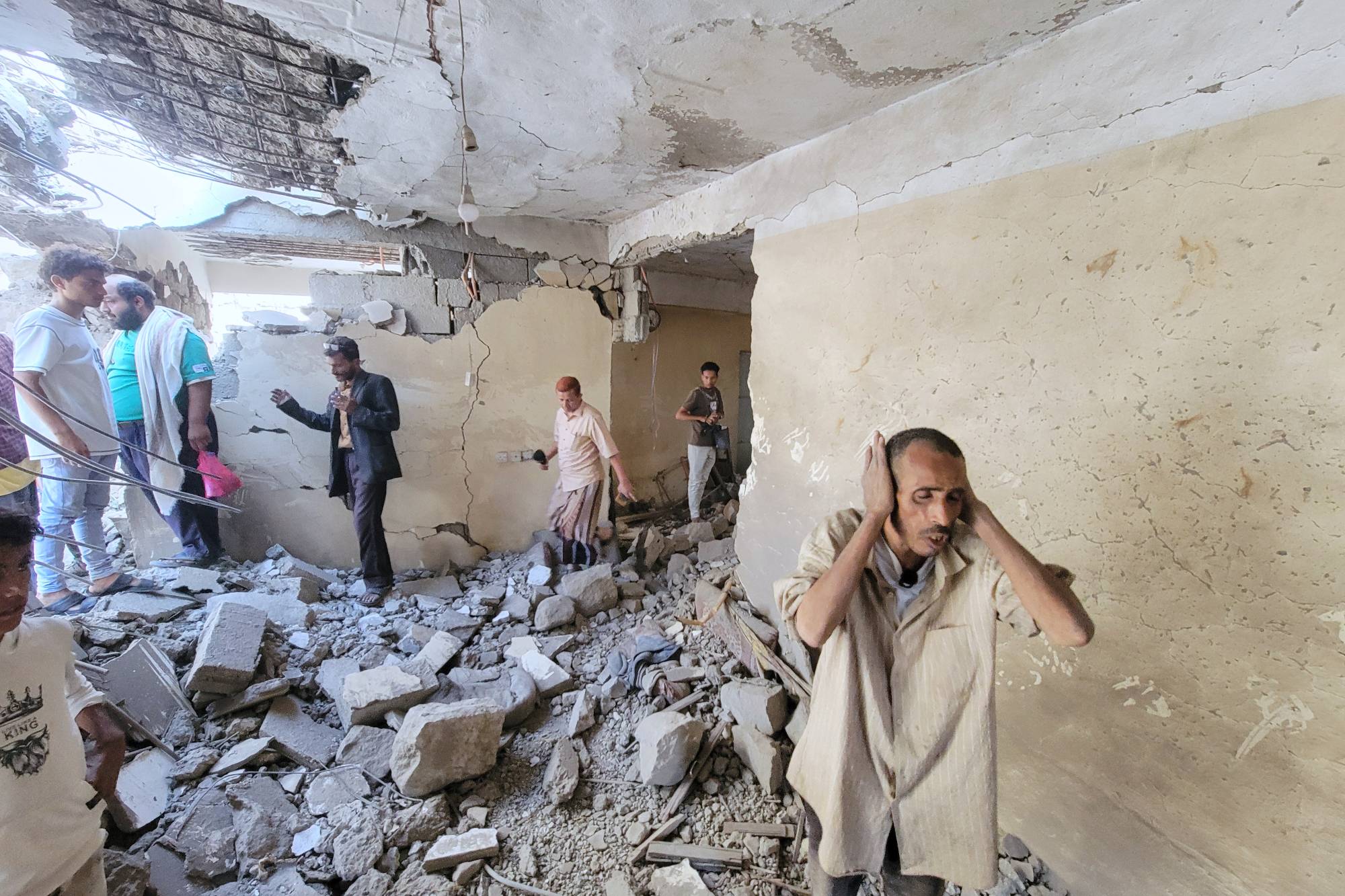
Residents walk amid debris from their homes after a missile strike in Seina, Taiz, Yemen, Tuesday, Oct. 20, 2026. (AP)
TT

Houthi Attacks on Taiz Leave Bloody Toll on Civilians

Residents walk amid debris from their homes after a missile strike in Seina, Taiz, Yemen, Tuesday, Oct. 20, 2026. (AP)

Yemen's Taiz governorate is facing a relentless Houthi military escalation that continues to deepen the suffering of its residents. Ongoing shelling targets residential neighborhoods and villages, while tightening restrictions choke civilian movement and block essential supplies.

Human rights reports documented hundreds of civilian casualties and abductions, and widespread damage to homes and vehicles.

The Yemeni Network for Rights and Freedoms documented 1,891 crimes and violations committed by the Iran-backed Houthi group against civilians and civilian objects in the governorate from September 1 to October 22.

This toll coincided with the network monitoring 21 additional crimes and violations within a 24-hour period, along with the firing of around 213 projectiles into residential areas.

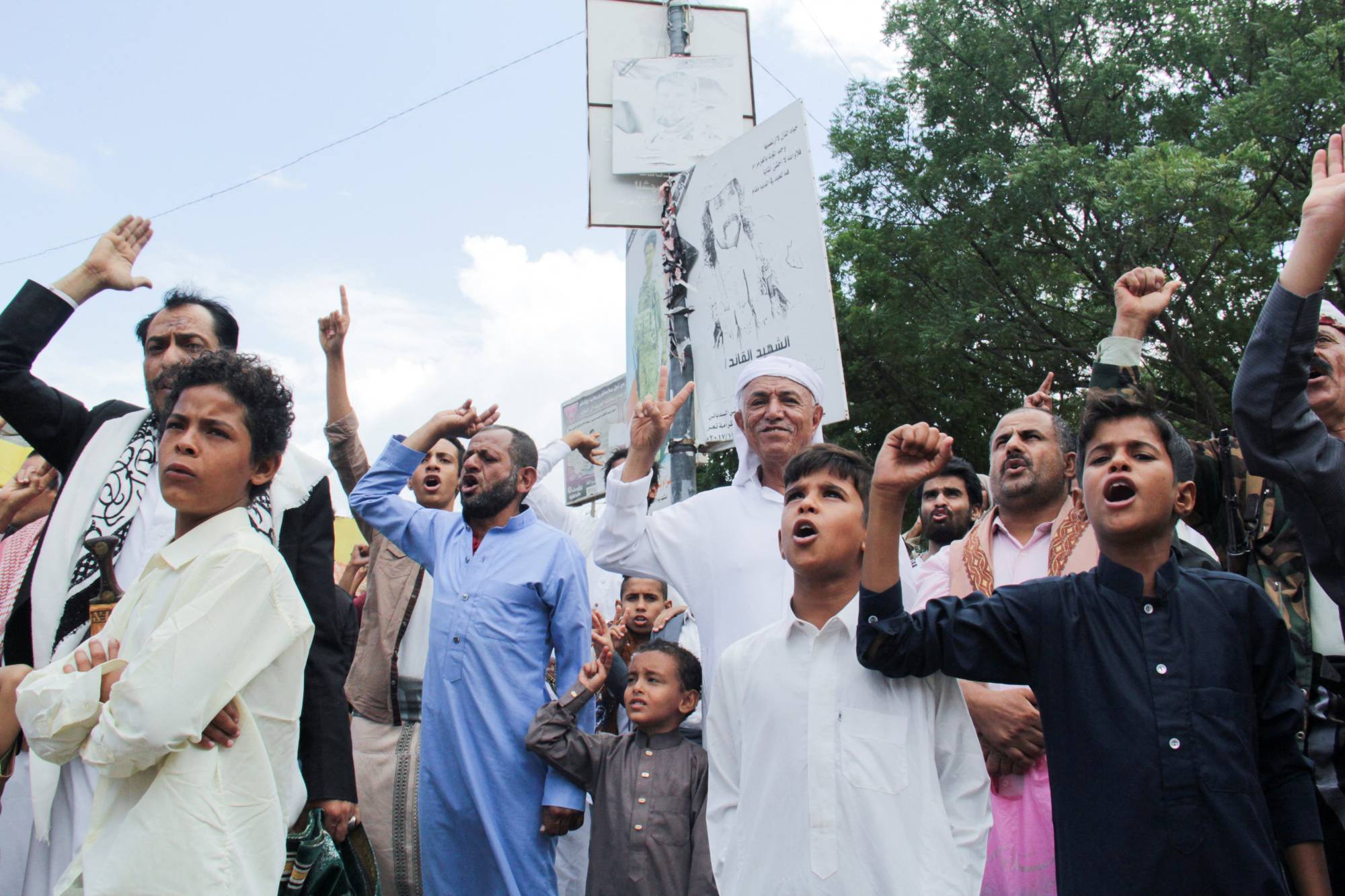
People chant slogans after they performed the Friday weekly prayer at the Freedom Square in the southwestern city of Taiz, Yemen October 23, 2026. (Reuters)

In its report, "Taiz... Bloody Invasion and Systematic Killing," the monitor said the violations resulted in the killing of 212 civilians, including 38 children - seven of whom were infants - and 27 women, as well as the wounding of 319 civilians, including 29 children and 46 women.

The report documented 23 cases of field executions, five massacres, and 314 instances of abduction and enforced disappearance, including 14 children held hostage to pressure their families. Additionally, 516 homes were raided in search of individuals suspected of being linked to government forces.

Residents walk on debris of their homes at Seina district in Taiz, Yemen, after a missile strike, Tuesday, Oct. 20, 2026. (AP)

Houthi attacks damaged 356 homes, including 98 that were completely destroyed, while three others were blown up.

According to the report, Houthi shelling and sniper fire extended to the villages of Kahlan and al-Shaqb, the old airport neighborhood.

The repercussions are not limited to casualties and destruction; the network said the Houthis fired around 9,876 projectiles during the period covered by its report, tightened the siege on the governorate since September 3, and established 26 illegal checkpoints and barriers.

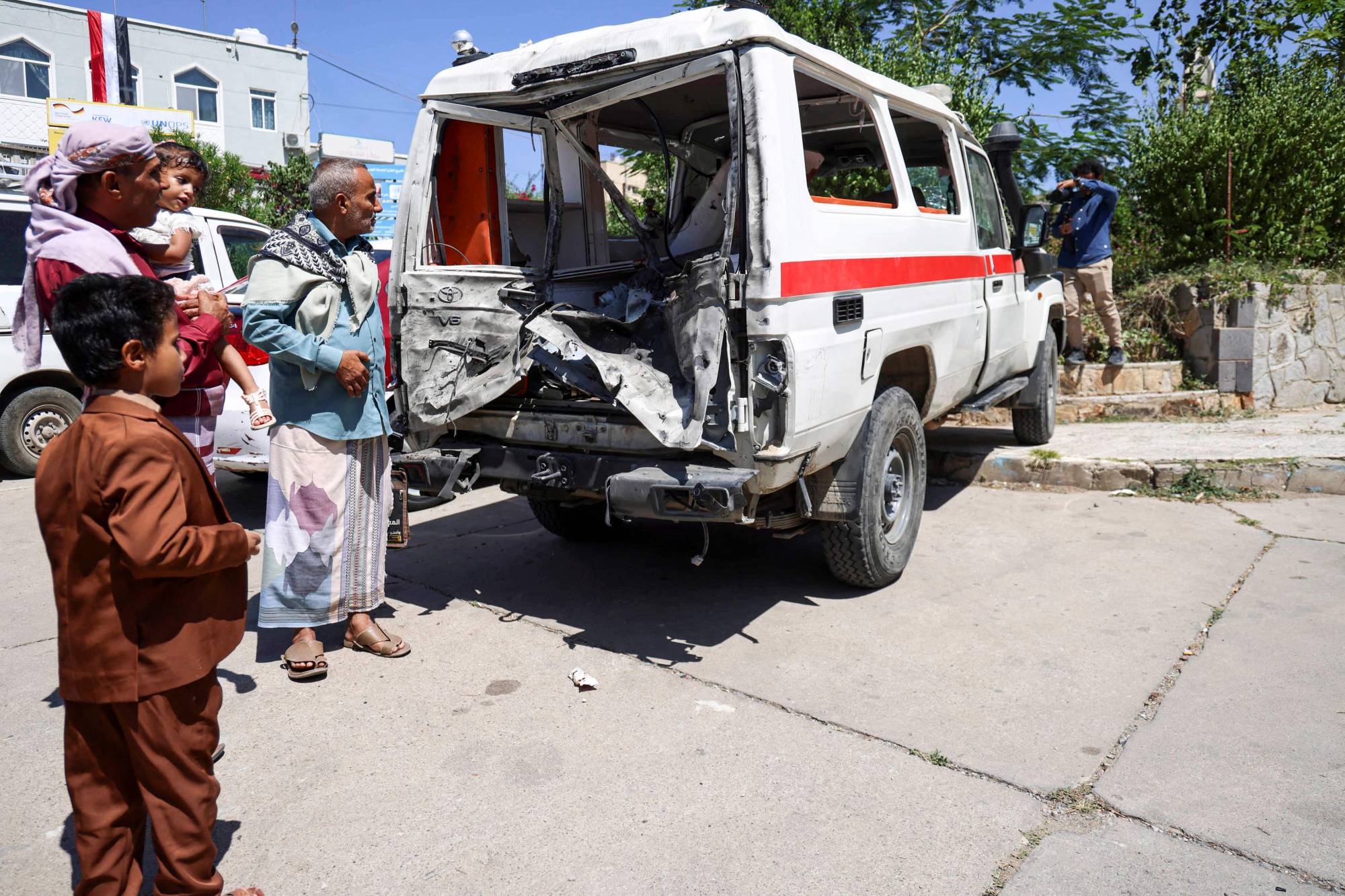
Yemeni people inspect a damaged ambulance in front of Al-Thawra General Hospital in Taiz on October 22, 2026. (AFP)

The report accused the group of obstructing the entry of food, medicine, fuel, oxygen cylinders, and drinking water, as well as blocking relief convoys and commercial supplies, including chronic disease medications and child vaccines.

It warned that blocking the fuel required to operate generators for hospitals, cancer treatment centers, and kidney dialysis units threatens patients' lives, noting that the escalation has caused the displacement of around 280,000 people from the governorate.

The network said the Houthis also turned five schools into operations rooms and detention centers.

It demanded that Taiz be declared a disaster city, calling for an end to the attacks, the lifting of the siege, the opening of roads, and guaranteed access to aid.