


Israel Says Doesn’t Plan Long-Term Control of Gaza after War with Hamas

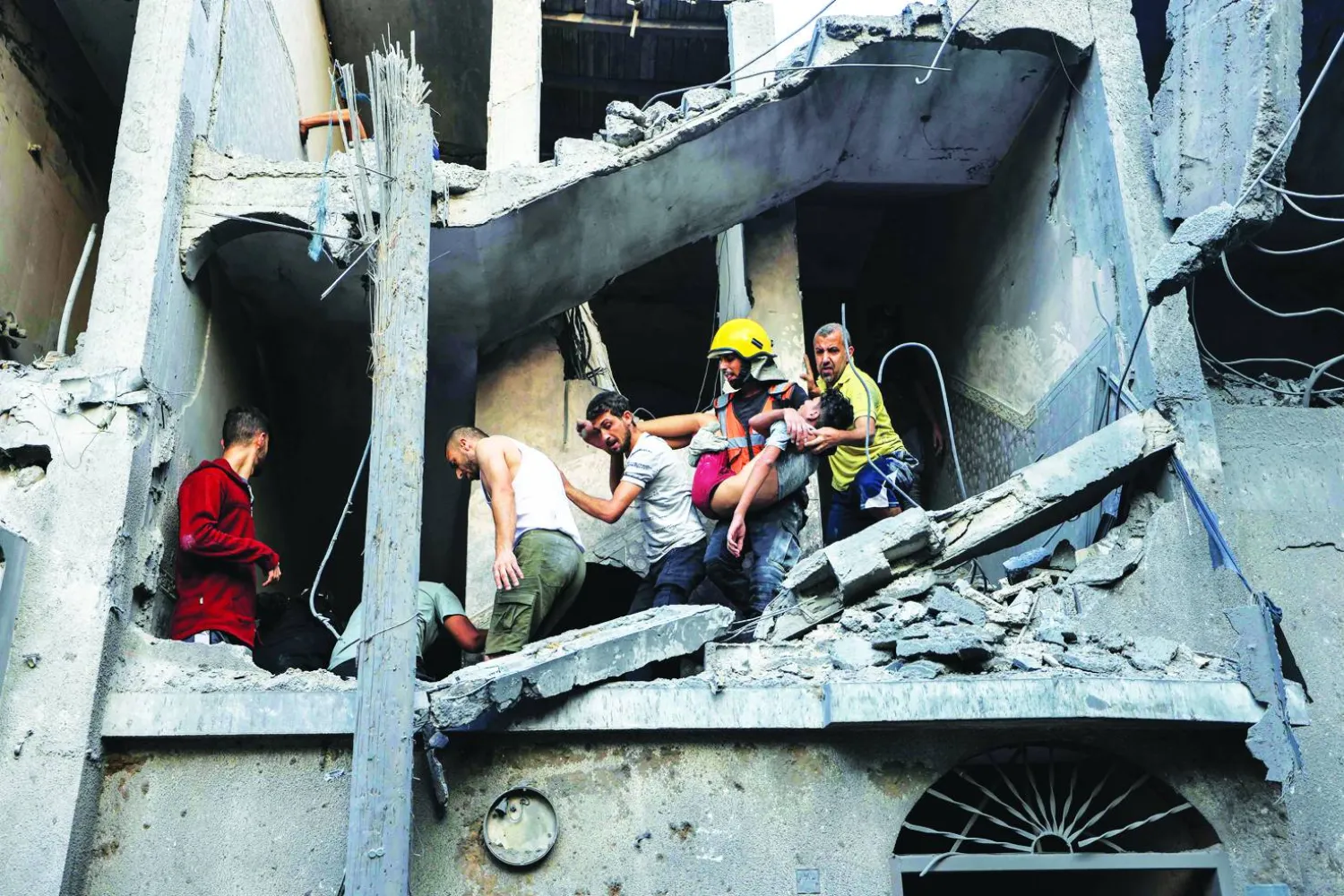
Palestinian civil defense members and others carry a youth on a stretcher after being rescued from a building hit by Israeli bombardment in Khan Yunis on the southern Gaza Strip on October 19, 2023. (Photo by Mahmud HAMS / AFP)
TT

Israel Says Doesn’t Plan Long-Term Control of Gaza after War with Hamas

Palestinian civil defense members and others carry a youth on a stretcher after being rescued from a building hit by Israeli bombardment in Khan Yunis on the southern Gaza Strip on October 19, 2023. (Photo by Mahmud HAMS / AFP)

Israel said Friday it does not plan to take long-term control over the Gaza Strip after an expected ground offensive to root out Hamas militants that rule the territory. The Israeli military punished Gaza with airstrikes, authorities inched closer to bringing aid to desperate families and hospitals, and Muslims around the world protested in solidarity with Palestinians.

Israel bombed areas in southern Gaza where Palestinians had been told to seek safety while it tries to destroy Hamas in retaliation for its brutal rampage in Israel two weeks ago. Fighting between Israel and militants in neighboring Lebanon also raged, prompting evacuations of Lebanese and Israeli border towns as fears of a widening conflict grew.

Speaking to lawmakers about Israel’s long-term plans for Gaza, Defense Minister Yoav Gallant laid out a three-stage plan that seemed to suggest that Israel did not intend to reoccupy the territory it left in 2005.

First, Israeli airstrikes and “maneuvering” — a presumed reference to a ground attack — would aim to root out Hamas. Next will come a lower intensity fight to defeat remaining pockets of resistance. And, finally, “the removal of Israel’s responsibility for life in the Gaza Strip,” Gallant said.

Gallant did not say who Israel expected to run Gaza if Hamas is toppled.

Israel occupied Gaza from 1967 until 2005, when it pulled up settlements and withdrew soldiers. Two years later, Hamas took over. Some Israelis blame the withdrawal from Gaza for the sporadic violence that has persisted since then.

More than 1,400 people in Israel have been killed since Hamas attacked on Oct. 7 — mostly civilians slain during the incursion that shattered Israelis sense of security and resulted in 203 hostages taken into Gaza.

The Health Ministry run by Hamas says more than 4,100 people have been killed in Gaza since the war began. That includes a disputed number of people who died in a hospital explosion earlier this week.

As the humanitarian crisis worsened for Gaza's 2.3 million civilians, workers along its border with Egypt repaired the border crossing in a first step to getting aid to besieged Palestinians, who were running out of fuel, food, water and medicine.

Over a million people have been displaced in Gaza. Many heeded Israel’s orders to evacuate the northern part of the sealed-off enclave on the coast of the Mediterranean Sea. Although Prime Minister Benjamin Netanyahu called areas in southern Gaza “safe zones” earlier this week, Israeli military spokesman Nir Dinar said Friday: “There are no safe zones.”

UN officials said that with the bombings across all of Gaza, some Palestinians who had fled the north appeared to be going back.

“The strikes, coupled with extremely difficult living conditions in the south, appear to have pushed some to return to the north, despite the continuing heavy bombing there,” Ravina Shamdasani, spokesperson for the UN human rights office, said.

Gaza’s overwhelmed hospitals were rationing their dwindling resources, as authorities worked out logistics for a desperately needed aid delivery from Egypt.

Generators in Shifa Hospital, Gaza’s largest, were operating at the lowest setting to conserve fuel while providing power to vital departments such as intensive care, hospital director Mohammed Abu Selmia said. Others worked in darkness.

“I don’t know how long (the fuel) will last. Every day we evaluate the situation,” he said.

The lack of medical supplies and water are making it difficult to treat the mass of victims from the Israeli strikes, he said.

The deal to get aid into Gaza through the territory’s only entry point not controlled by Israel remained fragile. Israel said the supplies could only go to civilians and that it would “thwart” any diversions by Hamas. It was unclear if fuel for the hospital generators would be allowed to enter.

Work continued Friday to repair the road at the Rafah border between Egypt and Gaza that had been damaged in airstrikes. Trucks unloaded gravel, and bulldozers and other equipment were used to fill in large craters.

A US official who spoke on condition of anonymity to discuss a rapidly changing situation said aid had been delayed because of ongoing road repairs, and that it was expected to move across the border Saturday. More than 200 trucks and some 3,000 tons of aid were positioned near the crossing.

UN Secretary-General Antonio Guterres visited the crossing Friday and appealed for the quick movement of aid into Gaza, calling it “the difference between life and death.”

Israel has evacuated its own communities near Gaza and Lebanon, putting residents up in hotels elsewhere in the country. The Defense Ministry announced evacuation plans Friday for Kiryat Shmona, a town of more than 20,000 residents near the Lebanese border. Three Israelis including a 5-year-old girl were wounded in a rocket attack there Thursday, according to Israeli health services.

Lebanon’s Hezbollah militant group, which has a large arsenal of long-range rockets, has traded fire with Israel along the border on a near-daily basis and hinted it might join the war if Israel seeks to annihilate Hamas. Iran supports both armed groups.

The violence in Gaza has also sparked protests across the region, including in Arab countries allied with the US.

Palestinians in Gaza reported heavy airstrikes in Khan Younis, a town in the territory’s south, and ambulances carrying men, women and children streamed into the local Nasser Hospital.

Late Thursday, an Israeli airstrike hit a Greek Orthodox church in Gaza City housing displaced Palestinians. The military said it had targeted a Hamas command center nearby, causing damage to a church wall. Gaza’s Hamas-run Health Ministry said 16 Palestinian Christians were killed.

The Greek Orthodox Patriarchy of Jerusalem condemned the attack and said it would “not abandon its religious and humanitarian duty” to provide assistance.

Palestinian militants have launched unrelenting rocket attacks into Israel — more than 6,900 since Oct. 7, according to Israel — and tensions have flared in the Israeli-occupied West Bank.

Thirteen Palestinians, including five minors, were killed Thursday during a battle with Israeli troops in which Israel called in an airstrike, according to the Palestinian Health Ministry. An Israeli border police officer was killed in the fighting, Israel said. More than 80 Palestinians have been killed in the West Bank over the past two weeks.

An unclassified US intelligence assessment estimated casualties in an explosion at a Gaza City hospital this week on the “low end” of 100 to 300 deaths. It said intelligence officials were still assessing the evidence and the casualty estimate may evolve.

The report echoed earlier assessments by US officials that the massive blast at the al-Ahli hospital was not caused by an Israeli airstrike, as Hamas has reported. Israel has presented video, audio and other evidence it says proves the blast was caused by a rocket misfired by Palestinian militants.

The AP has not independently verified any of the claims or evidence released by the parties.


Israel Military Says Soldier Killed in Gaza 

A drone view shows the destruction in a residential neighborhood, after the withdrawal of the Israeli forces from the area, amid a ceasefire between Israel and Hamas in Gaza, in Gaza City, October 21, 2025. (Reuters)
TT

Israel Military Says Soldier Killed in Gaza 

A drone view shows the destruction in a residential neighborhood, after the withdrawal of the Israeli forces from the area, amid a ceasefire between Israel and Hamas in Gaza, in Gaza City, October 21, 2025. (Reuters)

The Israeli military announced that one of its soldiers had been killed in combat in southern Gaza on Wednesday, but a security source said the death appeared to have been caused by "friendly fire".

"Staff Sergeant Ofri Yafe, aged 21, from HaYogev, a soldier in the Paratroopers Reconnaissance Unit, fell during combat in the southern Gaza Strip," the military said in a statement.

A security source, however, told AFP that the soldier appeared to have been "killed by friendly fire", without providing further details.

"The incident is still under investigation," the source added.

The death brings to five the number of Israeli soldiers killed in Gaza since a ceasefire took effect on October 10.


Syria: SDF’s Mazloum Abdi Says Implementation of Integration Deal May Take Time

People sit outdoors surrounded by nature, with the Tigris river flowing in the background, following a long atmospheric depression, near the Syrian-Turkish border in Derik, Syria, February 16, 2026 REUTERS/Orhan Qereman
TT

Syria: SDF’s Mazloum Abdi Says Implementation of Integration Deal May Take Time

People sit outdoors surrounded by nature, with the Tigris river flowing in the background, following a long atmospheric depression, near the Syrian-Turkish border in Derik, Syria, February 16, 2026 REUTERS/Orhan Qereman

Mazloum Abdi, commander of the Syrian Democratic Forces, said the process of merging the SDF with Syrian government forces “may take some time,” despite expressing confidence in the eventual success of the agreement.

His remarks came after earlier comments in which he acknowledged differences with Damascus over the concept of “decentralization.”

Speaking at a tribal conference in the northeastern city of Hasakah on Tuesday, Abdi said the issue of integration would not be resolved quickly, but stressed that the agreement remains on track.

He said the deal reached last month stipulates that three Syrian army brigades will be created out of the SDF.

Abdi added that all SDF military units have withdrawn to their barracks in an effort to preserve stability and continue implementing the announced integration agreement with the Syrian state.

He also emphasized the need for armed forces to withdraw from the vicinity of the city of Ayn al-Arab (Kobani), to be replaced by security forces tasked with maintaining order.


Israeli Far-Right Minister to Push for ‘Migration’ of West Bank, Gaza Palestinians 

A Palestinian man checks leather belts as people prepare for Ramadan, in the old city of Hebron in the Israeli-occupied West Bank, February 17,2026. (Reuters)
TT

Israeli Far-Right Minister to Push for ‘Migration’ of West Bank, Gaza Palestinians 

A Palestinian man checks leather belts as people prepare for Ramadan, in the old city of Hebron in the Israeli-occupied West Bank, February 17,2026. (Reuters)

Israel's far-right Finance Minister Bezalel Smotrich said he would pursue a policy of "encouraging the migration" of Palestinians from the occupied West Bank and Gaza Strip, Israeli media reported Wednesday.

"We will eliminate the idea of an Arab terror state," said Smotrich, speaking at an event organized by his Religious Zionism Party late on Tuesday.

"We will finally, formally, and in practical terms nullify the cursed Oslo Accords and embark on a path toward sovereignty, while encouraging emigration from both Gaza and Judea and Samaria.

"There is no other long-term solution," added Smotrich, who himself lives in a settlement in the West Bank.

Since last week, Israel has approved a series of measures backed by far-right ministers to tighten control over the West Bank, including in areas administered by the Palestinian Authority under the Oslo Accords, in place since the 1990s.

The measures include a process to register land in the West Bank as "state property" and facilitate direct purchases of land by Jewish Israelis.

The measures have triggered widespread international outrage.

On Tuesday, the UN missions of 85 countries condemned the measures, which critics say amount to de facto annexation of the Palestinian territory.

"We strongly condemn unilateral Israeli decisions and measures aimed at expanding Israel's unlawful presence in the West Bank," they said in a statement.

"Such decisions are contrary to Israel's obligations under international law and must be immediately reversed.

"We underline in this regard our strong opposition to any form of annexation."

UN Secretary-General Antonio Guterres on Monday called on Israel to reverse its land registration policy, calling it "destabilizing" and "unlawful".

The West Bank would form the largest part of any future Palestinian state. Many on Israel's religious right view it as Israeli land.

Israeli NGOs have also raised the alarm over a settlement plan signed by the government which they say would mark the first expansion of Jerusalem's borders into the occupied West Bank since 1967.

The planned development, announced by Israel's Ministry of Construction and Housing, is formally a westward expansion of the Geva Binyamin, or Adam, settlement situated northeast of Jerusalem in the West Bank.

The current Israeli government has fast-tracked settlement expansion, approving a record 52 settlements in 2025.

Excluding Israeli-annexed east Jerusalem, more than 500,000 Israelis live in West Bank settlements and outposts, which are illegal under international law.
