


Israel Says Troops Push into ‘Heart of Gaza City’

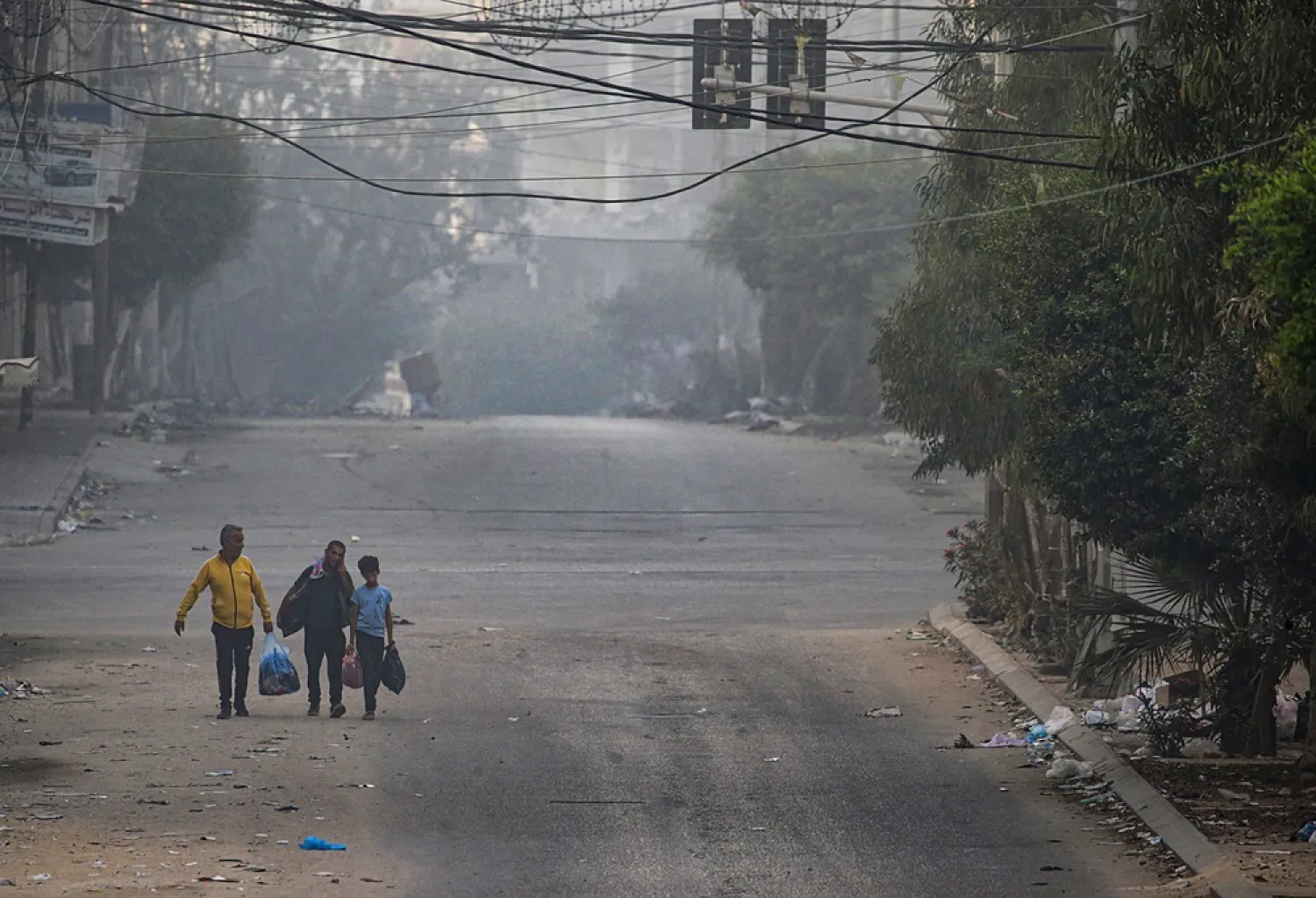
Residents evacuate Gaza City on foot during increased military operations in the northern Gaza Strip on 07 November 2023. (EPA)
TT

Israel Says Troops Push into ‘Heart of Gaza City’

Residents evacuate Gaza City on foot during increased military operations in the northern Gaza Strip on 07 November 2023. (EPA)

Israel said on Tuesday its forces were pushing deep into Gaza City, where residents said tanks were positioned on the outskirts for a potential storming of Gaza's urban heartland.

"For the first time in decades, IDF is fighting in the heart of Gaza City. At the heart of terrorism," Major General Yaron Finkelman, commanding officer of the Southern Command of the Israeli Defense Forces, told reporters near the Gaza border.

"Every day and every hour the forces are killing militants, exposing tunnels and destroying weapons and continuing onward to enemy centers."

Israel previously said it had surrounded Gaza City, home to around a third of the Gaza Strip's 2.3 million people, and would soon attack it to annihilate Hamas fighters who assaulted Israeli towns across the border one month ago.

There was no indication on the ground that Israeli forces had thrust en masse further into the city, but a spokesperson for the military, Richard Hecht, suggested that the encircling troops could be making raids inside.

Asked whether such raids had taken place, he said: "I'm not going to talk about how we are operationally acting from within our encirclement around Gaza City. You are in the right direction, that's all I can say."

The military wing of Hamas said its fighters were inflicting heavy losses and damage on advancing Israeli forces.

It was not possible to verify the battlefield claims of either side.

Month of carnage

War began on Oct. 7 when Hamas fighters burst across the fence enclosing Gaza and killed 1,400 Israelis, mostly civilians, and abducted more than 200, according to Israeli tallies. Since then, Israel has unrelentingly bombarded Hamas-run Gaza, killing more than 10,000 people, around 40 percent of them children, according to tallies by health officials there.

"It has been one full month of carnage, of incessant suffering, bloodshed, destruction, outrage and despair," UN Human Rights Commissioner Volcker Turk said in a statement at the start of a trip to the region, during which he will visit the Rafah crossing from Egypt, the sole route for aid.

Israel gave residents a window from 10 a.m. to 2 p.m. to leave Gaza City. Residents say Israeli tanks have been moving mostly at night, with Israeli forces largely relying on air and artillery strikes to clear a path for their ground advance.

"For your safety, take this next opportunity to move south beyond Wadi Gaza," the military announced, referring to the wetlands that bisect the narrow, coastal territory.

Gaza's interior ministry says 900,000 Palestinians are still sheltering in northern Gaza including Gaza City.

"The most dangerous trip in my life. We saw the tanks from point blank (range). We saw decomposed body parts. We saw death," resident Adam Fayez Zeyara posted with a selfie of himself on the road out of Gaza City.

While Israel's military operation is focused on the northern half of Gaza, the south has also come under attack. Palestinian health officials said at least 23 people were killed in two separate Israeli air strikes early on Tuesday in the southern Gaza cities of Khan Younis and Rafah.

"We are civilians," said Ahmed Ayesh, who was rescued from the rubble of a house in Khan Younis where health officials said 11 people had been killed. "This is the bravery of the so-called Israel - they show their might and power against civilians, babies inside, kids inside, and elderly."

As he spoke, rescuers at the house used their hands to try to free a girl buried up to her waist in debris.

Israel seeks ‘indefinite period’ of control

Israel has so far been vague about its long-term plans for Gaza, should it succeed in its operation to vanquish Hamas. In some of the first direct comments on the subject, Prime Minister Benjamin Netanyahu said Israel would seek to have security responsibility for Gaza "for an indefinite period".

"We've seen what happens when we don't have that security responsibility," he told US television's ABC News.

Israel pulled its troops and settlers from the Gaza Strip in 2005, and two years later, Hamas took power there, defeating the Palestinian Authority which exercises limited self-rule in a separate, Israeli-occupied territory, the West Bank.

Simcha Rothman, a lawmaker in Netanyahu's religious-nationalist coalition, said in a social media post: "Our forces must not shed blood to give the Gaza Strip to the Palestinian Authority wrapped in a bow.... Only full Israeli control and a complete demilitarization of the strip will restore security."

But White House spokesman John Kirby said US President Joe Biden opposed Israeli reoccupation: "It's not good for Israel, it's not good for the Israeli people," Kirby told CNN.

Secretary of State Antony Blinken had spoken with leaders in the region about what governance of Gaza could look like after the war, Kirby said: "Whatever it is, it can't be what it was on Oct. 6. It can't be Hamas."

The leader of Israel's opposition Labor Party, Merav Michaeli, said Israel needed to work with the United States, Arab countries and the PA on a plan for a "political victory" in Gaza to make Israel safe once Hamas is defeated militarily.

Both Israel and Hamas have rebuffed calls for a halt in fighting. Israel says hostages should be freed first. Hamas says it will not free them or stop fighting while Gaza is under attack. Washington has backed Israel's position that a ceasefire would help Hamas.

‘My kids ... have done nothing wrong’

Unrelenting horror stories of civilian suffering on both sides have polarized world opinion over the past month.

In Shefayim, Israel, Avihai Brodutch described 31 days of agony after Hamas abducted his wife and three children from Kfar Aza, a kibbutz about three km (2 miles) from Gaza.

"My kids, they're so young, and they've done nothing wrong to anybody," he said of his 10-year-old daughter Ofri and sons Yuval, eight, and Uriah, four.

Since last week, hundreds of Gazans who hold foreign passports have been permitted to exit through the Rafah crossing into Egypt. But the overwhelming majority are trapped inside the strip, and those who have been able to escape describe their torment at leaving loved-ones behind.

"It's just a horror movie that keeps putting on repeat," Suzan Beseiso, 31, a Palestinian-American who managed to leave Gaza for Egypt last week, told Reuters in Cairo. "No sleep. No food. No water. You keep evacuating from one place to another."



Lebanon Judge Issues Warrants for Five Detained Hezbollah Members

A Hezbollah supporter holds up a Hezbollah flag in Beirut, Lebanon, on July 26, 2025. (AP)
TT

Lebanon Judge Issues Warrants for Five Detained Hezbollah Members

A Hezbollah supporter holds up a Hezbollah flag in Beirut, Lebanon, on July 26, 2025. (AP)

A Lebanese judge on Wednesday issued arrest warrants for five Hezbollah members detained this month in the country's north and ordered three others to be brought in for questioning, a judicial official told AFP.

The move came as pressure mounts on the Iran-backed group to surrender its weapons, after it was weakened by two wars with Israel in recent years.

Lebanon's government decided last year to disarm the group after a November 2024 Israel-Hezbollah ceasefire. An Israel-Lebanon deal agreed this year after the latest war erupted also involves the group's disarmament.

The judicial source said that a judge on Wednesday questioned the five men for several hours, issued formal "arrest warrants against them" and ordered security forces to bring "three Hezbollah members connected with this cell" in for questioning.

Security forces had detained the five in a mountainous area between Batroun and Bsharre in northern Lebanon, a region far from Hezbollah's main strongholds, in possession of "maps and documents", a judicial official had previously told AFP.

Judicial proceedings were subsequently launched against them for allegedly "forming an armed group, recruiting members, equipping them and supplying them with weapons".

On Tuesday, Hezbollah lawmaker Hussein al-Hajj Hassan said that the five, and others arrested over a truckload of explosives seized last month, had been "unjustly and forcibly detained", accusing authorities of "committing grave and dangerous errors against their people".

In October, authorities seized half a ton of explosives that Hezbollah subsequently said "belong to the resistance" against Israel, demanding that the shipment be returned.


Boulos to Asharq Al-Awsat: US Efforts Have Achieved Tangible Progress Between Libyan Parties

Massad Boulos, senior advisor to US President Donald Trump for Arab and African affairs. (AP file)
TT

Boulos to Asharq Al-Awsat: US Efforts Have Achieved Tangible Progress Between Libyan Parties

Massad Boulos, senior advisor to US President Donald Trump for Arab and African affairs. (AP file)

Massad Boulos, senior advisor to US President Donald Trump for Arab and African affairs, said diplomatic efforts led by Washington to unify Libyan institutions and reach a political settlement to the crisis have achieved “tangible: progress, stressing his country's support for a Libyan-led political track culminating in unified governance and credible elections.

In remarks to Asharq Al-Awsat, Boulos reiterated that the US is seeking to establish a unified Libyan executive authority capable of administering all Libyan territory, providing security and economic stability for the population, and paving a credible path toward holding successful national elections.

US efforts have succeeded in narrowing many gaps of disagreement between the Libyan parties over more than a year, he added, without providing details on the nature of the understandings reached or whether they are tied to a timeline for forming a unified executive authority.

Boulos’s remarks come amid renewed diplomatic activity on the Libyan crisis, as political and institutional division persists between the east- and west-based governments, military and security centers of influence remain fragmented, and efforts to organize national elections to end the transitional phase continue to falter.

In recent months, media reports have circulated details of a US initiative to unify authority in Libya, under which Saddam Haftar, deputy commander of the Libyan National Army (LNA), would assume the presidency of the Presidential Council, while Government of National Unity (GNU) Prime Minister Abdul Hamid al-Dbeibah would head a unified government.

Boulos did not disclose details regarding this formula in his remarks.

He stressed that the work of the United Nations Support Mission in Libya complements the US initiative and efforts aimed at enabling the country to reach a unified executive authority capable of extending state sovereignty.

He signaled continued coordination between Washington and the UN on the political track.

However, Boulos’s remarks did not include a direct stance on the recent naval attacks targeting the port of Benghazi, or on their potential repercussions for Libya's security and sovereignty, amid fears that the fallout of the Russia-Ukraine war could spill over into Libya, and concerns over the country being drawn into international and regional conflicts.

He also did not clarify Washington's position on the demand by the parliament-designated government for an international investigation into the attacks, or on the UN mission's call to open an immediate, independent inquiry to uncover the circumstances and determine responsibility.

Amid ongoing Libyan division, the attacks raise questions about the ability of security and military institutions to handle external threats, as well as the extent to which international developments affect the country's sovereign interests at a time when US efforts are focused on unifying political, economic, and security institutions.

On Monday, the US State Department renewed its call for forming a unified Libyan government and holding credible elections, affirming that Washington supports the establishment of an executive authority capable of extending its control over all Libyan territory.


Iraq’s Top Court Says Baghdad Can Deploy Troops to Secure Borders in Kurdistan Region

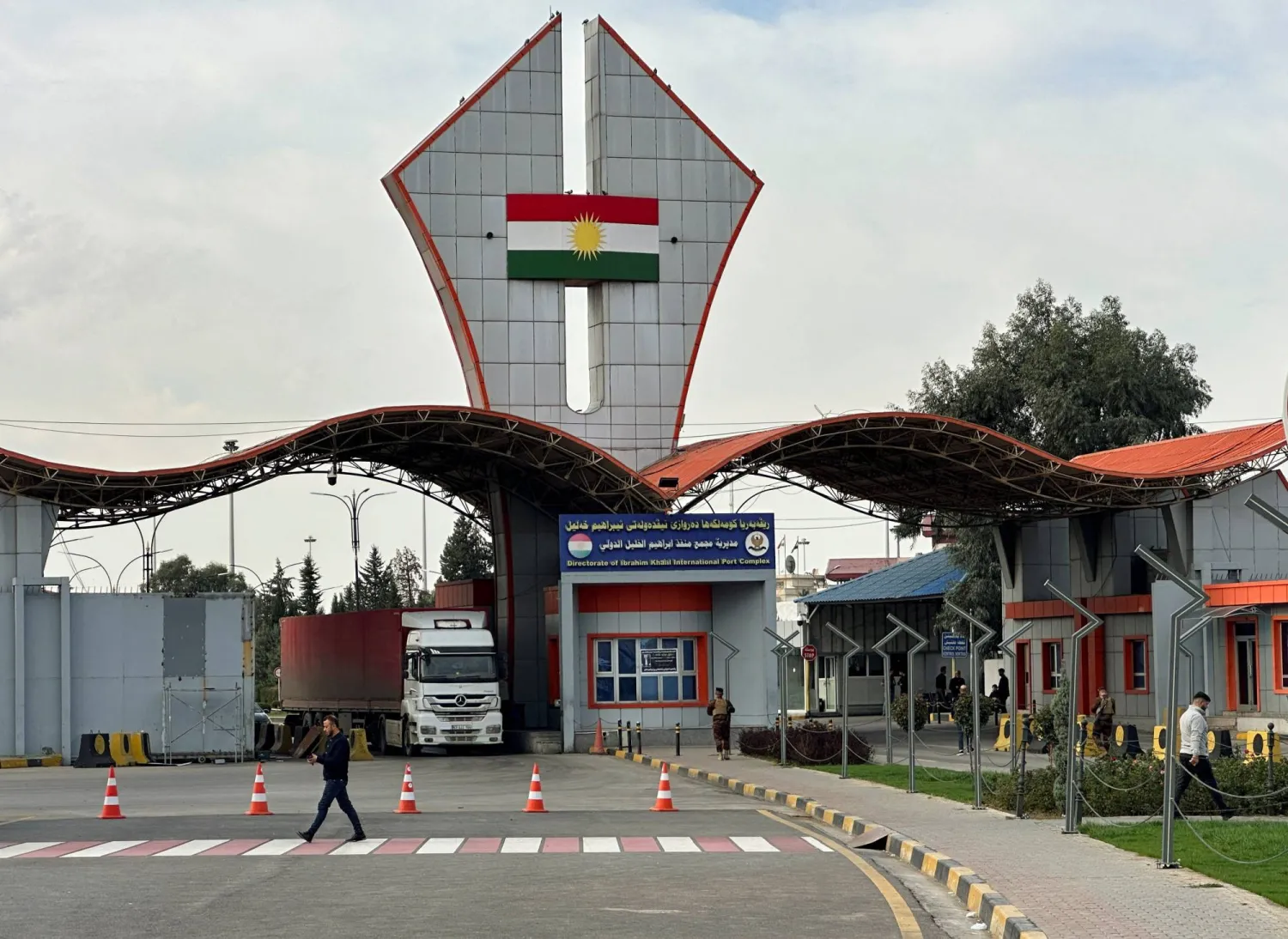
The Ibrahim Khalil border crossing between Iraq and Türkiye, on the outskirts of Zakho, in Duhok province, Iraq, November 24, 2026. (Reuters)
TT

Iraq’s Top Court Says Baghdad Can Deploy Troops to Secure Borders in Kurdistan Region

The Ibrahim Khalil border crossing between Iraq and Türkiye, on the outskirts of Zakho, in Duhok province, Iraq, November 24, 2026. (Reuters)

Iraq's highest court ruled on Wednesday that Baghdad can deploy federal forces along all international borders, including in the semi-autonomous Kurdistan region, backing Prime Minister Ali al-Zaidi's push to assert more central control. 

Al-Zaidi ordered federal authorities on Tuesday to take over border crossings run by the Kurdistan Regional Government, and has also demanded authority over oil fields controlled by Kurdish security forces, following a probe into smuggling at the state-run North Oil Company. 

The moves escalate tensions with the Kurdish authorities, and have been seen as part of a two-pronged pitch to assert central government authority, just a week after he also took on Kataib Hezbollah, a powerful armed faction aligned with Iran. 

The court decision, reported by Iraqi state TV, appears to be a victory for al-Zaidi, a 41-year-old multimillionaire businessman and political novice who came to power in a compromise just six ‌months ago. 

But political ‌analysts say it may yet prove difficult to implement moves that challenge the interests of ‌factions ⁠that have accrued substantial ⁠power over decades of ethnic and sectarian warfare, such as the Kurds and heavily armed factions loyal to Iran. 

London-based Renad Mansour, Deputy Director of the Middle East and North Africa Program and Director of the Iraq Initiative at Chatham House, said al-Zaidi is trying to establish a centralized political order. 

“Iraq's judiciary is very much supportive of the government's campaign... And the judiciary is important because if you look at the decisions being made, most of them come down to legal definitions. Most of them come down to corruption, illegality, sovereignty. These are hugely legal terms...,” he said. 

“So what this drive is about is the Iraqi government trying to reclaim some sovereignty... because it's such a fragmented state ⁠where there isn't a center.” 

A senior Shiite politician close to al-Zaidi told Reuters the prime ‌minister is focused on dismantling the model of a state within a state ‌that has prevailed in Iraq, a major global oil producer. 

Al-Zaidi’s strategy seeks to restrain armed factions who operate ‌above state authority and draw clearer limits on the Kurdistan region's independent exercise of authority over strategic economic and security matters, ‌the politician said. 

KURDISTAN REJECTS 'THREATS' 

The Federal Supreme Court ruled that federal authorities could oversee agencies operating at all border crossings, including those in the Kurdistan region, though they must coordinate with regional and provincial governments on customs administration, state television reported. 

The court said the federal oil ministry can also oversee and audit oil and gas fields, while Baghdad shares responsibility for managing the oil and gas they produce with regional governments and producing provinces, ‌state TV reported. 

Al-Zaidi has directed the federal oil ministry to manage oil fields under Kurdish security control in Kirkuk, Nineveh, Diyala and Salahuddin provinces, all of which are outside the ⁠Kurdistan region but have seen areas ⁠come under Kurdish forces' authority. 

The Kurdistan Regional Government on Wednesday rejected what it called "military language and threats" in a statement from the spokesman for the Iraqi military announcing the new measures. It said it was working with federal authorities to combat corruption and called for an end to oil smuggling across Iraq. 

Iraq's state news agency, citing what it said was an Iraqi government intelligence report, said oil belonging to the state-owned North Oil Company was being diverted and smuggled from Kirkuk, as well as from Sulaymaniyah inside Kurdistan, to Iran and onward to Afghanistan. 

A senior Iraqi security source close to recent military and security developments told Reuters a direct military confrontation with Kurdish regional forces was not an option for Baghdad, but the coming days could witness the deployment of additional federal forces in the vicinity of oilfields the government wants brought under central control. 

Oil smuggling allegations were also behind al-Zaidi's confrontation last week with Kataib Hezbollah. 

He ordered troops to stand by to enter the city of Jurf al-Sakhar in the Euphrates valley south of Baghdad, a Kataib Hezbollah stronghold. The group initially responded with defiance but allowed soldiers into the city under a compromise brokered by Shiite politicians.