


Palestinians Call for Evacuating Gaza’s Largest Hospital as Israel and Hamas Battle Just Outside

This picture taken on November 13, 2023 from a position along the border with the Gaza Strip in southern Israel shows a smoke plume erupting during Israeli bombardment on the Palestinian enclave amid ongoing battles. (Photo by FADEL SENNA / AFP)
TT

Palestinians Call for Evacuating Gaza’s Largest Hospital as Israel and Hamas Battle Just Outside

This picture taken on November 13, 2023 from a position along the border with the Gaza Strip in southern Israel shows a smoke plume erupting during Israeli bombardment on the Palestinian enclave amid ongoing battles. (Photo by FADEL SENNA / AFP)

Palestinian authorities on Tuesday called for a ceasefire to evacuate three dozen newborns and other patients trapped inside Gaza’s biggest hospital as Israeli forces battle Hamas in the streets just outside and seize more ground across northern Gaza.

For days, the Israeli army has encircled Shifa Hospital, determined to seize the facility it says Hamas hides in, and beneath, to use civilians as shields for its main command base. Hospital staff and Hamas deny the claim.  

Meanwhile, hundreds of patients, staff and displaced people are trapped inside, with supplies dwindling and without electricity to run incubators and other life-saving equipment. With refrigeration out for days, staff on Tuesday were digging a mass grave in the yard for more than 120 bodies in the morgue, health officials said.

Six weeks into the war, the standoff at al-Shifa and other hospitals comes as Israeli forces control larger swaths of Gaza City and the surrounding northern part of the Gaza Strip, saying they are driving out and killing Hamas fighters.

Israel has vowed to crush Hamas rule in Gaza after the militants' Oct. 7 surprise attack into Israel in which they killed some 1,200 people and dragged roughly 240 hostages back to Gaza. But even as its troops control more of a devastated north Gaza, the Israeli government has acknowledged it doesn’t know what it will do with the territory after Hamas’ defeat.

The onslaught – one of the world's deadliest and most intense bombardments this century -- has been disastrous for Gaza’s 2.3 million Palestinians.

More than 11,000 people, two-thirds of them women and minors, have been killed, according to the Health Ministry of the Hamas-run territory — which has been unable to update its figures since Friday, citing the difficulty of collecting information. About 2,700 people have been reported missing. The ministry’s count does not differentiate between civilian and militant deaths.

Almost the entire population of Gaza has squeezed into the southern two-thirds of the tiny territory, where conditions have been deteriorating even as bombardment there continues. About 200,000 fled the north in recent days amid the intensifying fighting, the UN humanitarian office said Tuesday. Tens of thousands are believed to remain in the north.

Hamas released a video late Monday showing one of the hostages, who identifies herself as 19-year-old Noa Marciano, before and after she was killed in what Hamas said was an Israeli strike. The military later declared her a fallen soldier, without identifying a cause of death.

She is the first hostage confirmed to have died in captivity. Four were released by Hamas and a fifth was rescued by Israeli forces.

PLIGHT OF HOSPITALS Fighting has raged for days around al-Shifa Hospital, a complex several city blocks across at the center of Gaza City that has now “turned into a cemetery,” its director said in a statement.

The Health Ministry said 40 patients, including three babies, have died since al-Shifa’s emergency generator ran out of fuel Saturday. Another 36 babies are at risk of dying because there is no power for incubators, according to the ministry.

The Israeli military said it had started an effort to transfer incubators to al-Shifa. But they would be useless without electricity, said Christian Lindmeier, a spokesman for the World Health Organization. He said the only way to save the newborns was to move them out of Gaza.

“Another hospital under siege or under attack is not a viable solution. Nowhere is safe in Gaza right now,” he told The Associated Press. He said an evacuation would require specialized equipment and a ceasefire along the route.

The Health Ministry has proposed evacuating the hospital with the supervision of the International Committee of the Red Cross and transferring the patients to hospitals in Egypt, but has not received any response, ministry spokesman Ashraf al-Qidra said.

While Israel says it is willing to allow staff and patients to evacuate, some Palestinians who have made it out say Israeli forces have fired at evacuees. UN and Palestinian health officials say it is too dangerous to move the most vulnerable patients without proper ambulances and equipment.

Israel says its claims of a Hamas command center in and beneath al-Shifa are based on intelligence but has not provided visual evidence to support them. Denying the claims, the Gaza Health Ministry says it has invited international organizations to investigate the facility.

On Monday, the military released footage of a children’s hospital in Gaza City that its forces entered over the weekend, showing weapons it said it found inside, as well as rooms in the basement where it believes militants were holding hostages. The video showed what appeared to be a hastily installed toilet and ventilation system in the basement.

The Health Ministry rejected the allegations, saying the area had been turned into a shelter for displaced people.

BATTLE IN GAZA CITY Independent accounts of the fighting in Gaza City have been nearly impossible to gather, as communications to the north have largely collapsed.

Videos released by the Israeli military show troops moving through the city, firing into buildings. Bulldozers push down structures as tanks roll through streets surrounded by rubble and partially collapsed towers.

The videos portray a battle where troops are rooting out pockets of Hamas fighters and tearing down wherever they find them. The military says it is also gradually dismantling the group's tunnel network.

Israel says it has killed several thousand fighters, including important mid-level commanders, while 46 of its own soldiers have been killed in Gaza. The military says Hamas has lost control in the north, and in recent days Hamas rocket fire into Israel — constant throughout the war — has waned. Details of the Israeli account and the extent of Hamas losses, however, could not be independently confirmed.

One Israeli commander in Gaza, identified only as Lt. Col. Gilad, said in a video that his forces near al-Shifa Hospital had been seizing government buildings, schools and residential buildings where they found weapons and eliminated fighters. After each was cleared, “the location was demolished,” he said.

The army said it had captured Gaza’s legislature building — about two blocks from al-Shifa — the Hamas police headquarters and a compound housing Hamas’ military intelligence headquarters. The captured buildings carry high symbolic value, though it was unclear what their strategic value is. Hamas fighters are believed to be positioned in underground bunkers.

Israeli news sites showed pictures of soldiers holding up the Israeli flag and military flags in celebration inside some of the buildings.

DETERIORATING CONDITIONS IN THE SOUTH Israel has urged civilians in the north to flee south, but southern Gaza is not much safer. Israel carries out frequent airstrikes throughout Gaza, hitting what it says are militant targets but often killing women and children.

Some 1.5 million Palestinians, more than two thirds of Gaza’s population, have fled their homes, and UN-run shelters in the south are severely overcrowded.

People stand in line for hours for scarce bread and brackish water. Trash is piling up, sewage is flooding the streets and taps run dry because there is no way to power water systems. Israel has barred fuel imports since the start of the war, saying Hamas would use it for military purposes.

At a tent camp outside a hospital in the central town of Deir al-Balah, people trudged through mud as they stretched plastic tarps over flimsy tents.

“All of these tents collapsed because of the rain,” said Iqbal Abu Saud, who had fled Gaza City with 30 of her relatives. “How many days will we have to deal with this?”

The UN agency for Palestinian refugees, which is struggling to provide basic services to over 600,000 people sheltering in schools and other facilities in the south, said it may run out of fuel by Wednesday, forcing it to halt most aid operations. It said it could no longer import limited supplies of food and medicine through Egypt’s Rafah crossing, Gaza’s only link to the outside world.



Libya PM Undergoes 'Successful' Treatment at Heart Hospital

Head of Libya's Government of National Unity (GNU) Abdulhamid Dbeibah. (GNU)
TT

Libya PM Undergoes 'Successful' Treatment at Heart Hospital

Head of Libya's Government of National Unity (GNU) Abdulhamid Dbeibah. (GNU)

Libya's Prime Minister Abdulhamid Dbeibah has undergone "successful" treatment at a heart hospital, his office said Saturday, but his specific ailment was not disclosed.

"I assure you that I am fine, by God's grace," said a statement posted on social media overnight.

The treatment was carried out at a facility in the northwestern Libyan city of Misrata on an undisclosed date, said AFP.

Dbeibah said he later travelled abroad for "additional medical checkups for reassurance", though this was not the primary reason for his trip.

Italian media outlets previously reported he had been admitted to a leading cardiac facility in Milan on Thursday for a general check-up.

"The matter is simply that I underwent some additional medical checkups for reassurance while I was abroad due to a prior external commitment," he said.

"The results confirmed the success of the treatment I received in Libya, praise be to God."

The prime minister leads a UN-recognized government based in Tripoli that controls western Libya, while the country's east is run by another administration backed by military strongman Khalifa Haftar.

Libya has remained divided since chaos erupted following the 2011 Arab Spring uprising that toppled longtime leader Muammar Gaddafi.


Eight Hezbollah Members Killed in Israel’s Friday Strikes on Lebanon

A bulldozer clears debris near heavily-damaged buildings in the village of Bednayel in Lebanon's eastern Bekaa Valley region on February 21, 2026, following Israeli strikes. (AFP)
TT

Eight Hezbollah Members Killed in Israel’s Friday Strikes on Lebanon

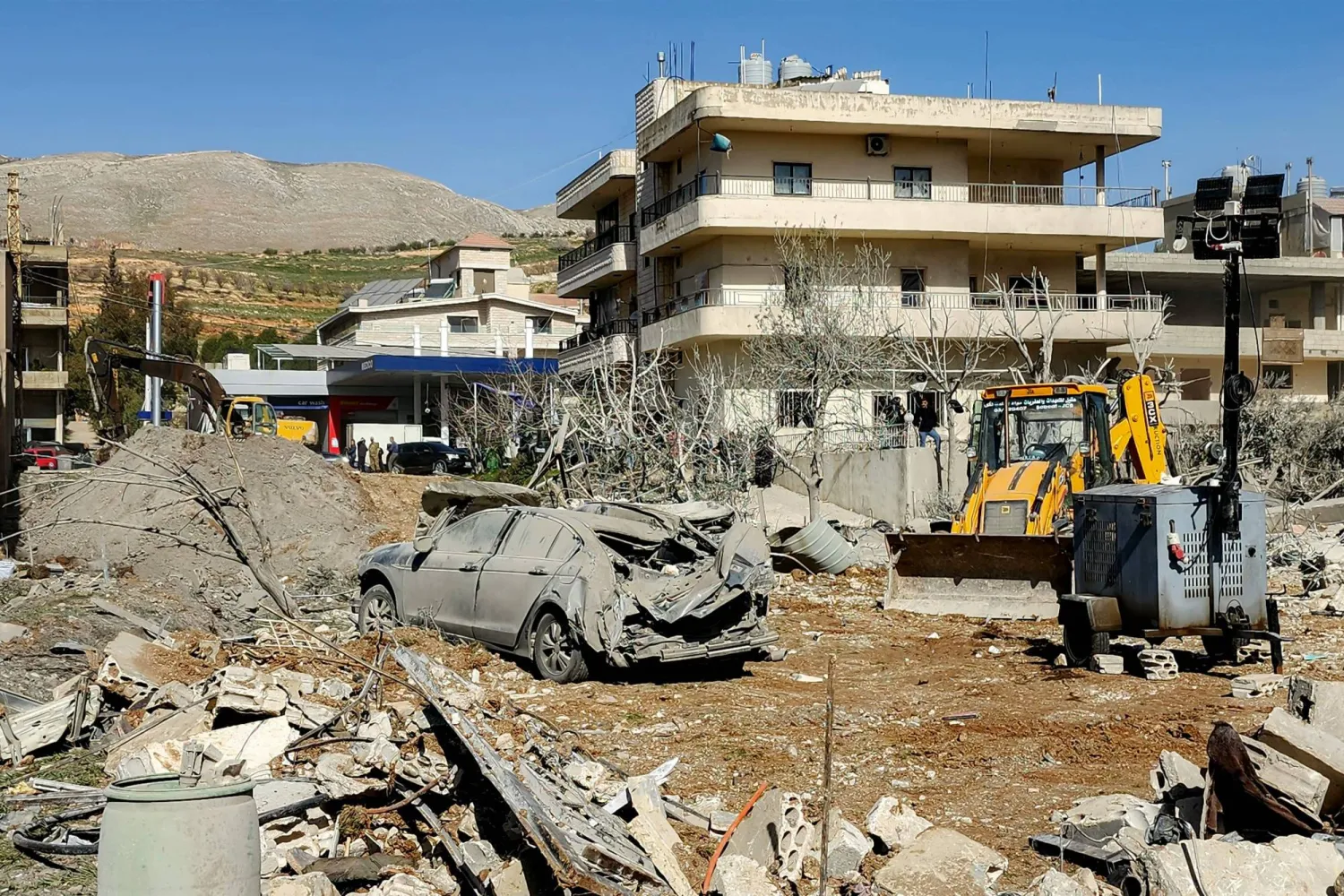
A bulldozer clears debris near heavily-damaged buildings in the village of Bednayel in Lebanon's eastern Bekaa Valley region on February 21, 2026, following Israeli strikes. (AFP)

Attacks carried out by Israel on Friday in eastern Lebanon killed eight members of Hezbollah, an official from the group told AFP on Saturday.

Lebanon's health ministry said Friday that a total of 10 people were killed in strikes that hit the eastern Bekaa region.

The Israeli military said it targeted "several terrorists of Hezbollah's missile array in three different command centers in the Baalbek area".

Lebanon's president on Saturday condemned the attacks, the latest despite a ceasefire with Hezbollah.

In a statement, Joseph Aoun called the attacks "a blatant act of aggression aimed at thwarting diplomatic efforts" by the United States and other nations to establish stability.

A lawmaker from Hezbollah called on Beirut to suspend meetings of a multinational committee tasked with monitoring the truce.

Washington is one of five members on the committee overseeing the ceasefire implemented in November 2024, with the body scheduled to meet again next week.

Israel has repeatedly bombed Lebanon despite the ceasefire, usually saying it is targeting Hezbollah but occasionally also the group's Palestinian ally Hamas.

The Friday attacks on southern and eastern Lebanon killed 12 people, according to the health ministry, 10 of them in the east of the country.

Israel's military said it struck "several terrorists of Hezbollah's missile array in three different command centers in the Baalbek area".

Hezbollah said a commander was killed in the raids. Its lawmaker Rami Abu Hamdan said on Saturday the group "will not accept the authorities acting as mere political analysts, dismissing these as Israeli strikes we have grown accustomed to before every meeting of the committee".

He called on Beirut to "suspend the committee's meetings until the enemy ceases its attacks".

Hezbollah, while weakened following war with Israel, remains a strong political force in Lebanon represented in parliament.

Lebanon's government last year committed to disarming the Iran-backed group, with the army saying last month it had completed the first phase of the plan covering the area near the Israeli border.

Israel, which accuses Hezbollah of rearming since the war, has called the Lebanese army's progress on disarming the group insufficient.


Ramadan’s First Friday Prayers Are Held at Jerusalem’s Al-Aqsa Mosque

Palestinians worshippers gather at Al-Aqsa Mosque compound for the first Friday prayers during the holy month of Ramadan, in the Old City of Jerusalem, 20 February 2026. (EPA)
TT

Ramadan’s First Friday Prayers Are Held at Jerusalem’s Al-Aqsa Mosque

Palestinians worshippers gather at Al-Aqsa Mosque compound for the first Friday prayers during the holy month of Ramadan, in the Old City of Jerusalem, 20 February 2026. (EPA)

Tens of thousands of Palestinians gathered under heavy Israeli restrictions at Jerusalem's Al-Aqsa Mosque compound for the first Friday prayers of the Muslim holy month of Ramadan, including some who were allowed to enter from the occupied West Bank.

The Ramadan prayers at Al-Aqsa took place for the first time since a shaky ceasefire deal between Israel and Hamas went into effect in October. It was the first opportunity many had to leave the West Bank and pray at the site in Jerusalem’s Old City since Ramadan last year.

Israel restricted the number of Palestinians allowed to enter from the West Bank to 10,000 on Friday, and only allowed men over 55 and women over 50 as well as children up to 12. It has imposed similar restrictions in the past, citing security concerns.

The hilltop, which Jews refer to as the Temple Mount, is the holiest site in Judaism and was home to the ancient biblical temples. Muslims call the site the Noble Sanctuary. Today it is home to Al-Aqsa Mosque, the third-holiest site in Islam.

It has frequently been a flashpoint in the Israeli-Palestinian conflict.

Israeli police said more than 3,000 police were deployed across Jerusalem. They said their presence was not meant to show aggression or force but was aimed at providing help in case of an emergency.

Many Palestinians view the heightened Israeli security presence, and increasing visits by religious and nationalist Israeli Jews, as a provocation. They fear that Israel intends to take over or partition the compound. The Israeli government denies having any such plans.

Jerusalem’s Islamic Waqf, the Jordanian religious authority that administers the compound, said there were 80,000 in attendance. In normal times, Ramadan Friday prayers at Al-Aqsa can draw up to 200,000.

Ezaldeen Mustafah, a Palestinian from the West Bank, was among those lamenting the restrictions.

“We need more people than this,” he said.

Some Palestinians from the West Bank on Friday said they were turned away from crossing into Jerusalem even though they had permits. Jihad Bisharat said he was told his permit had been canceled and was sent back. Israel's army didn't immediately respond to a request for comment.

The Old City, home to major religious sites sacred to Jews, Christians and Muslims, is in east Jerusalem, which Israel captured in the 1967 Mideast war, along with the West Bank and the Gaza Strip. The Palestinians want all three territories for a future state with its capital in east Jerusalem. Israel annexed east Jerusalem, a move not recognized by most of the international community, and considers the entire city to be its capital.

Ramadan in Gaza

Many Palestinians said the month’s typically festive spirit is eluding them as they struggle with grief and losses following two years of conflict in Gaza sparked by Hamas' Oct. 7, 2023, attack into Israel.

“All the mosques have been bombed,” said Ramiz Firwana, a Gaza resident who gathered with other worshippers for a Friday sermon and prayers held in schoolyard.

On Thursday evening, families sat amid the rubble and destruction for iftar, the meal held at the end of the daily dawn-to-dusk fast.

“Despite the displacement, the pain and the destruction, we want to rejoice and live,” said Mohammad Kollab, from Khan Younis. “We are not a people destined only for destruction and killing."

Israel’s military offensive has killed more than 72,000 Palestinians, according to Gaza’s Health Ministry, and caused widespread destruction and displaced most of the territory’s residents. Israel launched the offensive after Hamas-led militants killed some 1,200 people, mostly civilians, and took another 251 hostage in the initial attack.

The Oct. 10 US-brokered ceasefire deal has brought an end to major military operations and the release of the remaining hostages. But Palestinians, including many civilians, are still being killed in near-daily strikes that Israel says are aimed at militants who threaten or attack its forces.