Lebanon's Palestinian Refugees Fear for their Families in Gaza

Hayat Shehadeh's daughter is in Gaza, and she has not spoken to her for a week. ANWAR AMRO / AFP
TT

Lebanon's Palestinian Refugees Fear for their Families in Gaza

Hayat Shehadeh's daughter is in Gaza, and she has not spoken to her for a week. ANWAR AMRO / AFP

In a ramshackle Palestinian refugee camp in Lebanon, Hayat Shehadeh wrings her hands as she watches the Israel-Hamas war. Her daughter is in Gaza, and she has not spoken to her for a week.
"I can't sleep. I get up at 3:00 am... I go to watch the television," said the 69-year-old from her dark flat in south Beirut's Burj al-Barajneh Palestinian camp.
"Sometimes she writes to me, 'I'm fine'. She doesn't write more than that" because she has no way to recharge her phone battery, said the elderly woman, a baby grandchild playing with a Palestinian flag on the floor nearby.
Gaza-based Hamas militants attacked southern Israel on October 7, killing 1,200 people, most of them civilians, and taking about 240 hostage, according to Israeli officials.
Israel has since carried out a relentless air and ground offensive in Gaza that the Hamas government says has killed some 12,000 people, including thousands of women and children.
With pain in her voice but trying to maintain her composure, Shehadeh said her daughter had separated her three children, sending them away with different relatives.
"She was crying, she said 'I split up the kids'," her mother said, so that "if someone dies, they don't all die."
The Burj al-Barajneh camp is a labyrinth of alleyways, some bearing pictures of former Palestinian leader Yasser Arafat, or stencils and posters in support of Hamas and other Palestinian groups, some glorifying the October 7 attacks.
Lebanon hosts an estimated 250,000 Palestinian refugees, many living in the country's 12 official camps, according to the United Nations agency for Palestinian refugees (UNRWA).
'Dear to me'
Shehadeh said her daughter, aged in her thirties, had been living in Lebanon in recent years but a few months ago "her husband came and took her" back to Gaza.
"She's moving around... I don't know what area she's in now," Shehadeh said, requesting the young woman not be identified by name.
More than 1.5 million people have been internally displaced in Gaza, and UN agencies have warned of rapidly deteriorating conditions.
UNRWA chief Philippe Lazzarini has described children sheltering at a UN school "pleading for a sip of water or for a loaf of bread".
On Friday, network provider Paltel group said communications with Gaza were severed due to a lack of fuel.
Shehadeh's family came to Lebanon from the Acre area, now in northern Israel, survivors of what Palestinians call the Nakba, or the "catastrophe", when more than 760,000 Palestinians fled or were forced from their homes by the 1948 war over Israel's creation.
She said the family had feared for their lives, including after Jewish paramilitary groups massacred more than 100 Palestinian villagers at Deir Yassin, near Jerusalem, in April that year.
The elderly woman said if she could talk to her daughter, she would tell her not to cry.
"I want to tell her that her tears are dear to me," she said.
'Nothing left'
Beirut's dilapidated Burj al-Barajneh camp was partially destroyed in Israel's 1982 invasion of Beirut and during Lebanon's 15-year-long civil war, according to UNRWA.
In her small flat in the camp, Palestinian Fatima al-Ashwah, 61, is also glued to the television, praying her family members in Gaza are not among those being pulled dead from the rubble, or hoping to get a glimpse of them in footage of displaced people at shelters.
Originally from Al-Kabri, now in northern Israel, Ashwah has some 70 extended family members in Gaza, including her cousins and their families, the eldest in their seventies, the youngest just one year old.
They used to live in northern Gaza's Beit Hanoun, near the Erez crossing with Israel, Ashwah said, but now "their houses are all gone... because they're on the front lines. There's nothing left."
Israel has for more than a month been calling on the population in northern Gaza to evacuate south as it pushes ahead with its war against Hamas.
Ashwah's relatives have fled from place to place, with some now sheltering in schools near Gaza's southern Rafah crossing with Egypt.
She said sometimes she had been able to hear bombing during short telephone calls.
Her relatives have told her: "'We're hungry, we're afraid, the children are afraid, they're terrified'," she said.
"The situation breaks your heart," she said. "I can't stand the sound of crying and screaming anymore".
Fighting back tears, she recounted how she had visited Gaza in July, and how the family greeted her and another relative with drums and dancing in celebration at the Rafah crossing.
"God willing it will be over and Gaza will go back to how it was before," she said.



Hamas Mourns Iran’s Khamenei, Condemns ‘Heinous’ US-Israel Attack

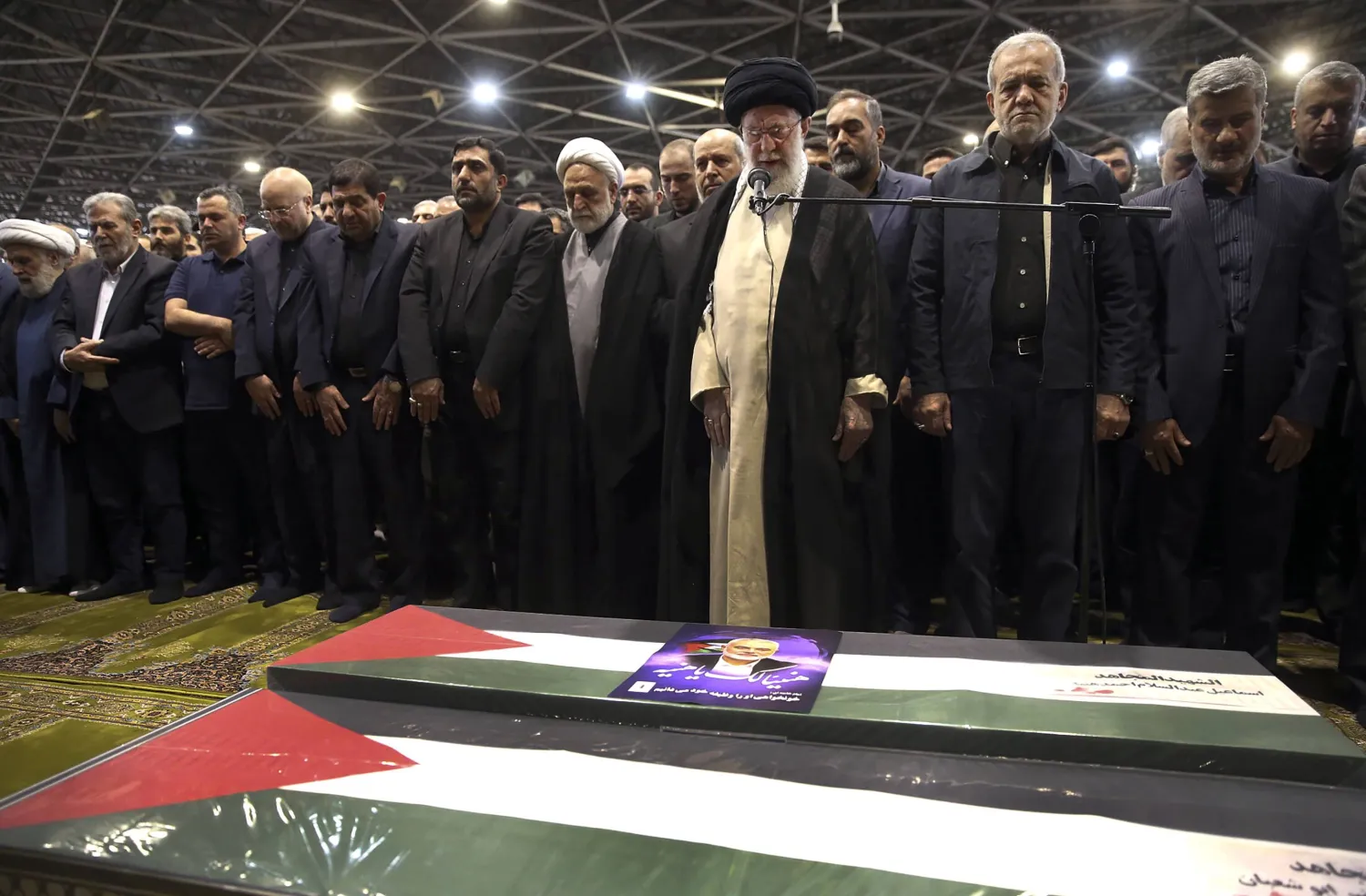
In this photo released by the official website of the office of the Iranian supreme leader, Supreme Leader Ali Khamenei, third right, leads a prayer over the coffins of Hamas leader Ismail Haniyeh and his bodyguard who were killed in an assassination blamed on Israel on Wednesday, during their funeral ceremony at the Tehran University campus, in Tehran, Iran, Aug. 1, 2024. (Office of the Iranian Supreme Leader via AP, File)
TT

Hamas Mourns Iran’s Khamenei, Condemns ‘Heinous’ US-Israel Attack

In this photo released by the official website of the office of the Iranian supreme leader, Supreme Leader Ali Khamenei, third right, leads a prayer over the coffins of Hamas leader Ismail Haniyeh and his bodyguard who were killed in an assassination blamed on Israel on Wednesday, during their funeral ceremony at the Tehran University campus, in Tehran, Iran, Aug. 1, 2024. (Office of the Iranian Supreme Leader via AP, File)

Hamas on Sunday mourned Iran's supreme leader Ali Khamenei after his death in what it described as a "heinous" US-Israeli attack.

"We in Hamas mourn the passing of Ali Khamenei. He provided all forms of political, diplomatic and military support to our people, our cause, and our resistance," the Palestinian movement said in a statement.

"The US and the fascist occupation government bear full responsibility for this blatant aggression and heinous crime against the sovereignty of Iran, as well as for its serious repercussions on the security and stability of the region."


Thai PM Says Preparing Evacuation of Citizens in Middle East

A projectile lights up the night sky over Tel Aviv, Israel, 01 March 2026. (EPA)
TT

Thai PM Says Preparing Evacuation of Citizens in Middle East

A projectile lights up the night sky over Tel Aviv, Israel, 01 March 2026. (EPA)

Thailand is readying to evacuate its citizens from the Middle East by military or charter flights, Prime Minister Anutin Charnvirakul said Sunday, after the US and Israel attacked Iran -- which answered with its own missile strikes.

The government has "coordinated with the Royal Thai Air Force to prepare aircraft to evacuate Thai citizens, prioritizing those in Iran", Anutin told reporters in Bangkok, adding that charter flights were also under consideration.

"We have to check the closure of airspace, whether we need to evacuate them to the third country first," he added.

Anutin said there were tens of thousands of Thai workers in the region, citing the labor ministry.

Nearly 59,000 Thais were registered with Thailand's labor office in Israel, and more than 11,000 were registered with Thailand's labor office in Abu Dhabi -- which covers the United Arab Emirates, Qatar, Oman and Iran, according to the ministry.

"The Thai government will do everything to bring Thai citizens back safely. If they want to return, we will take them back," Anutin said.

The United States and Israel began launching waves of strikes against Iran on Saturday, sparking swift retaliation by Tehran.

US President Donald Trump has vowed to continue striking Iran until its government falls.

Iranian state television confirmed the death of Iran's supreme leader Ali Khamenei on Sunday, after Trump said he had been killed.

Fresh explosions were heard in Doha, Dubai and Manama on Sunday.

Amid the bombardments, Iran, Iraq, Kuwait, Syria, the UAE and Israel all have closed their airspaces to civilian traffic, at least in part, and multiple airlines cancelled flights to and from the region.


Iraq’s Sistani Urges Iranian Unity After Khamenei Death

A person washes his face with a soft drink bottle after riot police deployed irritants to disperse protesters supporting Iraqi Shiite armed groups gathered near the entrance of the Green Zone and attempted to move toward the US embassy after the killing of Iran's Supreme Leader Ali Khamenei, in Baghdad, Iraq, March 1, 2026. (Reuters)
TT

Iraq’s Sistani Urges Iranian Unity After Khamenei Death

A person washes his face with a soft drink bottle after riot police deployed irritants to disperse protesters supporting Iraqi Shiite armed groups gathered near the entrance of the Green Zone and attempted to move toward the US embassy after the killing of Iran's Supreme Leader Ali Khamenei, in Baghdad, Iraq, March 1, 2026. (Reuters)

Iraq's top Shiite Muslim cleric on Sunday urged Iranians to remain united as Iraqis mourned supreme leader Ali Khamenei following his death in US and Israeli strikes. 

Baghdad announced a three-day mourning period for Khamenei, who had been Iran's hardline spiritual guide and top political authority since 1989. 

"With deep sorrow, I extend my condolences to the noble Iranian people and all Muslims on the martyrdom" of Khamenei, whose "unique role in leading the Islamic Republic of Iran for many years is evident to all", said Ali Sistani, himself born in Iran. 

"Through his martyrdom and the large-scale military assault on Iran, the enemies sought to inflict immense damage on this beloved country. 

"The great Iranian people are expected to maintain their unity, to stand firm and thwart the aggressors' sinister goals," Sistani added in a statement. 

Khamenei's death was met with anger in Baghdad, where hundreds of protesters have tried since the early hours of Sunday to storm the fortified Green Zone where the US embassy is located. 

Iran wields significant influence in Iraqi politics, and also backs armed groups whose power has grown both politically and financially. 

Iraq has for decades been a proxy battleground between the US and Iran. 

Government spokesman Bassem al-Awadi said in a statement that "with deep sorrow, we extend our condolences to the noble people of Iran and the entire Muslim world" after "a blatant act of aggression" that killed Khamenei. 

He said the government had announced three days of mourning, while urging an immediate cessation of military operations that "are driving the region to unprecedented levels of violence". 

The Coordination Framework, a ruling coalition of Shiite groups with varying degrees of links to Iran, said "with deep sorrow and profound grief, we mourn the passing of the martyred leader, Ali Khamenei". 

His "blood will remain a guiding light for all generations" and "the curse will continue to haunt the murderous Zionists for all time", the coalition added. 

Influential cleric Moqtada Sadr meanwhile said in a statement that "we extend our condolences to the Islamic world", and also declared a three-day period of mourning.