


Sudan Forces Trade Fire Across Nile As Atrocities Reported In Darfur

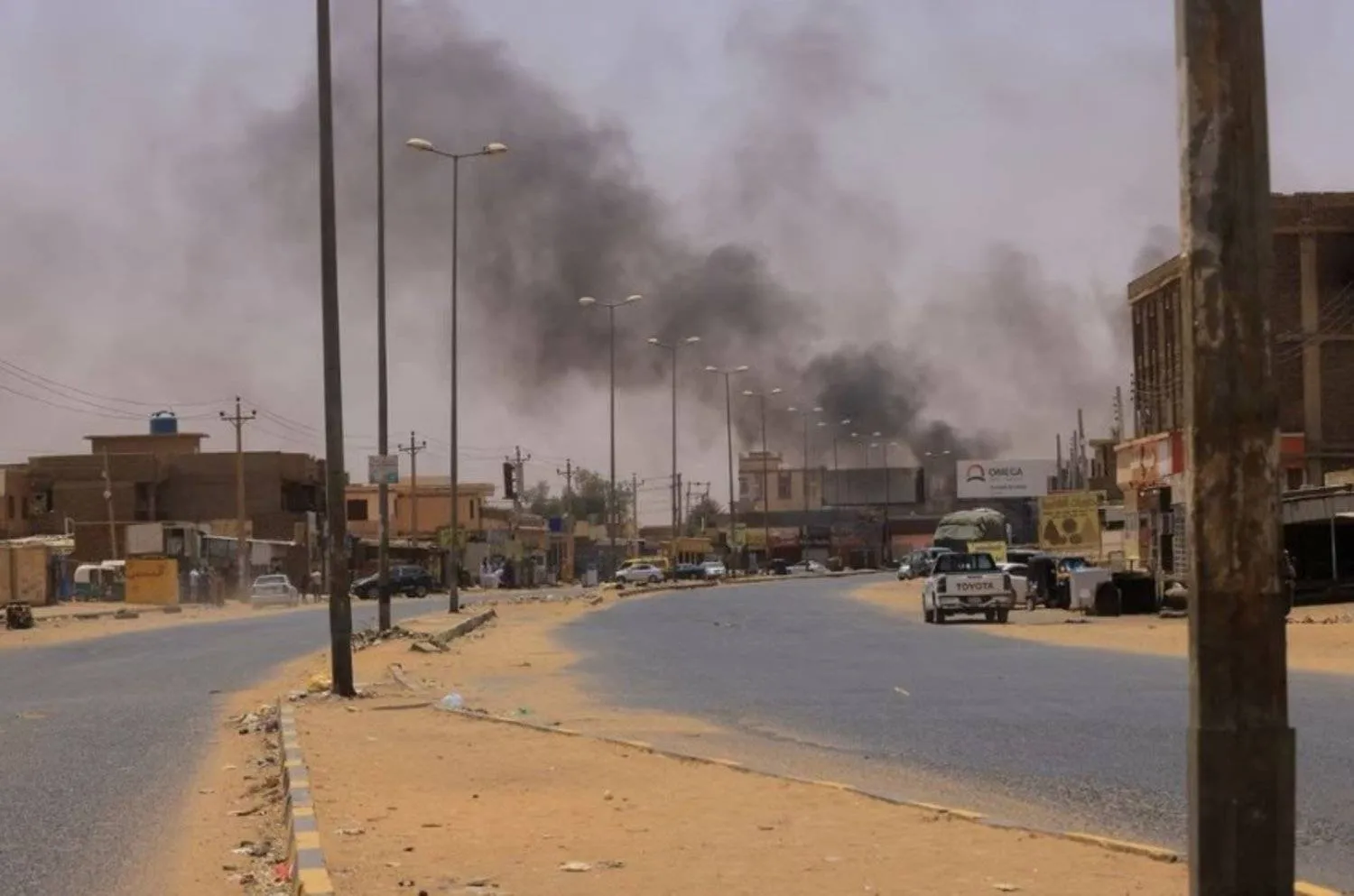
Smoke rises in Omdurman, near Halfaya Bridge, during clashes between the Rapid Support Forces and the army as seen from Khartoum North, Sudan April 15, 2023. REUTERS/Mohamed Nureldin Abdallah
TT

Sudan Forces Trade Fire Across Nile As Atrocities Reported In Darfur

Smoke rises in Omdurman, near Halfaya Bridge, during clashes between the Rapid Support Forces and the army as seen from Khartoum North, Sudan April 15, 2023. REUTERS/Mohamed Nureldin Abdallah

The Sudanese army and paramilitary forces traded fire Monday across the Nile River in the capital Khartoum, witnesses said, in the eighth month of a war rights groups say has been rife with atrocities.

Artillery and rocket fire criss-crossed over the river between "the army in Omdurman, on the west bank, and the Rapid Support Forces (RSF) in Khartoum North on the east bank," a witness told AFP.

The fighting was corroborated by other residents, including local activists who say the shelling landing in civilian homes has killed dozens in recent weeks.

Since April, brutal urban warfare has raged between the army, led by Sudan's de facto leader Abdel Fattah al-Burhan, and the paramilitary RSF, commanded by Burhan's former deputy Mohamed Hamdan Daglo.

Over 10,000 people have been killed, according to a conservative estimate from the Armed Conflict and Event Data Project, and the United Nations says 6.3 million more have been forced to flee their homes, AFP reported.

Paramilitary "forces attacked the Wadi Seidna (air) base", a strategic facility just north of Khartoum, an RSF spokesman said Monday, adding they had destroyed "a C130 military transport plane and an ammunition depot".

Over 800 kilometres (around 500 miles) southwest, witnesses in the town of Muglad in West Kordofan state reported army troops withdrawing from a base after an RSF attack on the oil-rich area.

The army, which has maintained its monopoly on the skies, sent fighter jets to bomb RSF clusters in Babanusa, 35 kilometres north of Muglad, witnesses told AFP.

But army retreats from bases have been reported repeatedly in recent weeks, as the RSF has gained territory across the vast western region of Darfur.

Most recently, the paramilitary force claimed control of the East Darfur state capital of El Daein last week, leaving El Fasher in North Darfur as the last state capital in Darfur under army control.

Experts, aid workers, and the United States have warned El Fasher will be attacked next, as rights groups have reported mass ethnic killing in RSF-controlled areas of Darfur -- already scarred by decades of ethnic violence.

In a report released Sunday, Human Rights Watch (HRW) said the UN Security Council must act to prevent further atrocities, after the murder of hundreds of civilians in West Darfur.

"The Rapid Support Forces' latest episode of ethnically targeted killings in West Darfur has the hallmarks of an organized campaign of atrocities against Massalit civilians," said HRW's Mohamed Osman, referring to an ethnic group repeatedly targeted by the RSF and its allied militias.

"The UN Security Council needs to stop ignoring the desperate need to protect Darfur civilians."



Explosion at Mosque in Syria’s Homs Kills Three, Says Local Official

A Syrian flag waves in Damascus. (Getty Images/AFP)
TT

Explosion at Mosque in Syria’s Homs Kills Three, Says Local Official

A Syrian flag waves in Damascus. (Getty Images/AFP)

Three people were ​killed and five injured when an explosion struck a mosque ‌the ⁠Syrian ​province ‌of Homs on Friday, a local official said.

Syrian state media said ⁠security forces had ‌imposed a ‍cordon around ‍the area ‍and were investigating.

Local officials told Reuters it ​may have been caused by ⁠a suicide bomber or explosives placed there.


Fuel Shortage Forces Gaza Hospital to Suspend Most Services

The sun sets behind a makeshift tent camp for displaced Palestinians set up in an area of al-Bureij camp, in the central Gaza Strip, Wednesday, Dec. 24, 2025. (AP)
TT

Fuel Shortage Forces Gaza Hospital to Suspend Most Services

The sun sets behind a makeshift tent camp for displaced Palestinians set up in an area of al-Bureij camp, in the central Gaza Strip, Wednesday, Dec. 24, 2025. (AP)

A major Gaza hospital has suspended several services because of a critical fuel shortage in the devastated Palestinian territory, which continues to face a severe humanitarian crisis, it said.

Devastated by more than two years of war, the Al-Awda Hospital in the central Gaza district of Nuseirat cares for around 60 in-patients and receives nearly 1,000 people seeking medical treatment each day.

"Most services have been temporarily stopped due to a shortage of the fuel needed for the generators," said Ahmed Mehanna, a senior official involved in managing the hospital.

"Only essential departments remain operational: the emergency unit, maternity ward and pediatrics."

To keep these services running, the hospital has been forced to rent a small generator, he added.

Under normal conditions, Al-Awda Hospital consumes between 1,000 and 1,200 liters of diesel per day. At present, however, it has only 800 liters available.

"We stress that this shutdown is temporary and linked to the availability of fuel," Mehanna said, warning that a prolonged fuel shortage "would pose a direct threat to the hospital's ability to deliver basic services".

He urged local and international organizations to intervene swiftly to ensure a steady supply of fuel.

Despite a fragile truce observed since October 10, the Gaza Strip remains engulfed in a severe humanitarian crisis.

While the ceasefire agreement stipulated the entry of 600 aid trucks per day into Gaza, only 100 to 300 carrying humanitarian assistance can currently enter, according to the United Nations and non-governmental organizations.

The remaining convoys largely transport commercial goods that remain inaccessible to most of Gaza's 2.2 million people.

- Health hard hit -

On a daily basis, the vast majority of Gaza's residents rely on aid from UN agencies and international NGOs for survival.

Gaza's health sector has been among the hardest hit by the war.

During the fighting, the Israeli miliary repeatedly struck hospitals and medical centers across Gaza, accusing Hamas of operating command centers there, an allegation the group denied.

International medical charity Doctors Without Borders now manages roughly one-third of Gaza's 2,300 hospital beds, while all five stabilization centers for children suffering from severe malnutrition are supported by international NGOs.

The war in Gaza was sparked on October 7, 2023, following an unprecedented Hamas attack on Israel that resulted in the deaths of 1,221 people, most of them civilians, according to an AFP tally based on official Israeli figures.

In Israel's ensuing military campaign in Gaza, at least 70,942 people - also mostly civilians - have been killed, according to the health ministry in the Hamas-run territory.


Israel Army Says Striking Hezbollah Targets in Lebanon

FILED - 27 November 2025, Lebanon, Mahmoudieh: Smoke billows after Israeli air raids on Hezbollah positions in the southern Lebanese village of Mahmoudieh. Photo: Stringer/dpa
TT

Israel Army Says Striking Hezbollah Targets in Lebanon

FILED - 27 November 2025, Lebanon, Mahmoudieh: Smoke billows after Israeli air raids on Hezbollah positions in the southern Lebanese village of Mahmoudieh. Photo: Stringer/dpa

The Israeli military announced a series of strikes on Hezbollah targets in Lebanon on Friday, including weapons depots and a training complex. 

"A number of weapons storage facilities and terrorist infrastructure sites were struck, which were used by Hezbollah to advance terror attacks against the state of Israel," a military statement said. 

Lebanon's National News Agency (NNA) reported a "series of airstrikes" by Israeli aircraft on mountainous areas in Nabatiyeh and Jezzine districts in the south, and the Hermel district in the east of the country. 

Despite a November 2024 ceasefire that was supposed to end more than a year of hostilities between Israel and the Iran-backed Hezbollah group, Israel has continued to strike in Lebanon and has maintained troops in five areas it deems strategic. 

More than 340 people have been killed by Israeli fire in Lebanon since the ceasefire, according to an AFP tally of Lebanese health ministry reports. 

The strikes on Friday come a day after similar Israeli attacks near the Syrian border and in southern Lebanon left three people dead. 

The Israeli military had reported on Thursday it had killed a member of arch-foe Iran's elite Quds Force in a strike in Lebanon. 

On Friday, the military said it had struck several military structures of Hezbollah, warning it would "remove any threat posed to the state of Israel". 

Under heavy US pressure and fears of expanded Israeli strikes, Lebanon has committed to disarming Hezbollah, starting in the south of the country near the frontier. 

Lebanon's army plans to complete the disarmament south of the Litani River -- about 30 kilometers (19 miles) from the border with Israel -- by year's end. 

Israel has questioned the Lebanese military's effectiveness and has accused Hezbollah of rearming, while the group itself has rejected calls to surrender its weapons.