


2 Attacks Launched by Houthis in Yemen Strike Container Ships in Vital Red Sea Corridor

A Houthi militant walks through the beach with the Galaxy Leader cargo ship in the background, seized by the Houthis offshore of the Al-Salif port on the Red Sea in the province of Hodeidah, Yemen, 05 December 2023. (EPA)
TT

2 Attacks Launched by Houthis in Yemen Strike Container Ships in Vital Red Sea Corridor

A Houthi militant walks through the beach with the Galaxy Leader cargo ship in the background, seized by the Houthis offshore of the Al-Salif port on the Red Sea in the province of Hodeidah, Yemen, 05 December 2023. (EPA)

A ballistic missile fired by the Iran-backed Houthi militias in Yemen slammed into a cargo ship Friday in the Red Sea near the strategic Bab al-Mandeb Strait, following another attack only hours earlier that struck a separate vessel, authorities said.

The missile attack on the MSC Palatium III and the earlier assault on the Al Jasrah escalate a maritime campaign by the Houthis. The attacks also endanger ships traveling through a vital corridor for cargo and energy shipments for both Europe and Asia from the Suez Canal out to the Indian Ocean.

The Houthis say their attacks aim to end the pounding Israeli air-and-ground offensive targeting the Gaza Strip amid that country's war on Hamas. However, the links to the ships targeted in the militias’ assaults have grown more tenuous as the attacks continue.

“The Yemeni armed forces confirm they will continue to prevent all ships heading to Israeli ports from navigating in the (Red Sea) until they bring in the food and medicine that our steadfast brothers in the Gaza Strip need,” the Houthi military spokesman, Brig. Gen. Yahya Saree, said in a statement claiming responsibility for Friday's attacks.

The recent attacks led Maersk, the world’s biggest shipping company, to announce Friday that it’s told all of its vessels planning to pass through the Bab al-Mandeb Strait to “pause their journey until further notice.” German-based shipper Hapag-Lloyd that was operating the Al Jasrah also said it was pausing all its container ship traffic through the Red Sea until Monday.

Meanwhile, hijackers, likely from Somalia, separately seized a Bulgarian ship in the Arabian Sea.

A US defense official and the private intelligence firm Ambrey said the MSC Palatium III, a Liberian-flagged container ship, caught fire after the strike. It wasn't immediately clear if anyone on board the vessel had been hurt.

Two missiles were fired in the attack, likely trying to hit the Al Jasrah, the US official said. One went wide and splashed down in the water, the other slammed into the Palatium, the official said.

The Palatium turned around after the attack and was now trying to head south, tracking data analyzed by The Associated Press showed.

The Switzerland-based MSC, or Mediterranean Shipping Co., earlier had another vessel, the MSC Alanya, warned by the Houthis around the Bab al-Mandeb, Ambrey said. “The parent company had cooperated with Israel, and this was likely the reason why she was threatened.”

The official spoke on condition of anonymity to discuss intelligence matters. MSC did not immediately respond to a request for comment.

In the earlier Al Jasrah attack, it remained unclear if it was a missile or drone that hit the vessel, the official said. Ambrey and the British military’s United Kingdom Maritime Trade Operations, which monitors Mideast shipping lanes, also confirmed that attack.

“The projectile reportedly hit the port side of the vessel and one container fell overboard due to the impact,” Ambrey said. “The projectile caused a ‘fire on deck’ which was broadcast via” radio.

Shipper Hapag-Lloyd said no crew member had been hurt in the attack. It later announced that it was also pausing its ships through the Red Sea until Monday and “will decide for the period thereafter.”

Ambrey noted that Hapag-Lloyd “is known to have offices in the Israeli ports of Ashdod, Haifa and Tel Aviv.”

In his statement, military spokesman Saree claimed the Houthis targeted the Palatium III and the Alanya — not the Al Jasrah. It wasn't immediately clear why he erroneously identified the second ship.

The attacks Friday further escalate a campaign by the Houthi rebels, who have claimed responsibility for a series of missile assaults in recent days that just missed shipping in the Red Sea and its strategic Bab al-Mandeb Strait.

On Thursday, the Houthis fired a ballistic missile that missed a container ship traveling through the strait.

The day before that, two missiles fired from Houthi-held territory missed a commercial tanker loaded with Indian-manufactured jet fuel near Bab al-Mandeb. Also near the strait, a missile fired by Houthis on Monday night slammed into a Norwegian-flagged tanker in the Red Sea.

Global shipping has increasingly been targeted as the Israel-Hamas war threatens to become a wider regional conflict — even during a brief pause in fighting during which Hamas exchanged hostages for Palestinian prisoners held by Israel. The collapse of the truce has raised the risk of more sea attacks.

The Bab ea-Mandeb Strait is only 29 kilometers (18 miles) wide at its narrowest point, limiting traffic to two channels for inbound and outbound shipments, according to the US Energy Information Administration. Nearly 10% of all oil traded at sea passes through it. An estimated $1 trillion in goods pass through the strait annually.

In November, Houthis seized a vehicle transport ship linked to Israel in the Red Sea off Yemen. The militias still hold the vessel near the port city of Hodeidah. Separately, a container ship owned by an Israeli billionaire came under attack by a suspected Iranian drone in the Indian Ocean.

Also Thursday, unknown attackers boarded the Malta-flagged bulk carrier Ruen, managed by Navigation Maritime Bulgare, in the Arabian Sea off the Yemeni island of Socotra, Ambrey and the UKMTO said. Bulgarian authorities said the ship’s 18-member crew hailed from Angola, Bulgaria and Myanmar.

“The necessary steps have been taken to pass the information on to all foreign partners and institutions that we will count on to provide assistance,” Bulgarian Foreign Minister Maria Gabriel told reporters Friday.

No group immediately claimed responsibility for the assault. However, suspicion immediately fell on pirates from Somalia.  

Somali piracy had dropped in recent years, but there has been growing concern it could resume amid the wider chaos of the Houthi attacks and the political uncertainty gripping the east African nation.

On Friday, the UKMTO issued a warning to shippers saying the security manager for the Ruen “believes the crew no longer has control of the vessel” and that it is heading toward Somalia.  

The European Union’s anti-piracy force in the region said the Spanish frigate Victoria was on its way to intercept the “alleged pirate-hijacked vessel.”



Indonesia Slams 'Unacceptable' Peacekeeper Casualties in Lebanon

FILE PHOTO: UNIFIL vehicles drive on a main road in Qlayaa, amid escalating hostilities between Israel and Hezbollah, as the US-Israel conflict with Iran continues, in Qlayaa, southern Lebanon, March 27, 2026. REUTERS/Karamallah Daher/File Photo
TT

Indonesia Slams 'Unacceptable' Peacekeeper Casualties in Lebanon

FILE PHOTO: UNIFIL vehicles drive on a main road in Qlayaa, amid escalating hostilities between Israel and Hezbollah, as the US-Israel conflict with Iran continues, in Qlayaa, southern Lebanon, March 27, 2026. REUTERS/Karamallah Daher/File Photo

The Indonesian government on Saturday slammed as "unacceptable" an explosion that injured three of its peacekeepers in Lebanon within days of three other blue helmets from the Southeast Asian nation being killed.

The United Nations Interim Force in Lebanon (UNIFIL) said three peacekeepers were wounded in a blast that occurred inside a UN facility near Adaisseh on Friday afternoon, and rushed to hospital.

Two were seriously wounded.

The UN Information Center in Jakarta said the "origin of the explosion" was unknown but identified the injured soldiers as Indonesian.

"Repeated attacks or incidents of this kind are unacceptable," the Indonesian foreign ministry said in a statement.

"Regardless of their cause, these events underscore the urgent need to strengthen protection for UN peacekeeping forces amid an increasingly dangerous conflict situation."

The government urged the UN Security Council to investigate the events and "to immediately convene a meeting of troop-contributing countries to UNIFIL to conduct a review and take measures to enhance the protection of personnel serving with UNIFIL".

Friday's incident came just days after an Indonesian peacekeeper died when a projectile exploded on March 29 in southern Lebanon, where Israel and Hezbollah have been fighting since Lebanon was drawn into the Middle East war.

A UN security source told AFP on condition of anonymity Tuesday that fire from an Israeli tank was responsible for that attack.

A day later, two more Indonesian peacekeepers died after an explosion struck a UNIFIL logistics convoy, also in southern Lebanon.

The father of one of the two fallen soldiers, 33-year-old Zulmi Aditya Iskandar, said this week he was shocked that peacekeepers were losing their lives in the conflict.

"We were really sad and regretful, because this is a UN troop, a peacekeeping troop, not deployed for war," 60-year-old Iskandarudin told reporters at his house in West Java province.

The bodies of the three peacekeepers are scheduled to arrive in Jakarta on Saturday evening, according to the military.

The Indonesian National Armed Forces has said it will deploy more than 750 personnel to Lebanon next month as part of the scheduled UNIFIL peacekeeping troop rotation.


Strike Kills One Iraqi Fighter near Syria Border

Mourners attend the funeral of members of Iraq's Hashed al-Shaabi, who were killed in an airstrike in the town of al‑Qaim near the Syrian border, amid heightened regional tensions due to the US-Israel conflict with Iran, in Baghdad, Iraq, March 12, 2026. REUTERS/Stringer
TT

Strike Kills One Iraqi Fighter near Syria Border

Mourners attend the funeral of members of Iraq's Hashed al-Shaabi, who were killed in an airstrike in the town of al‑Qaim near the Syrian border, amid heightened regional tensions due to the US-Israel conflict with Iran, in Baghdad, Iraq, March 12, 2026. REUTERS/Stringer

An attack killed one fighter from the former paramilitary coalition Hashed al-Shaabi on Saturday, the alliance said, blaming the US and Israel.

Iraq has been dragged into the war between the United States, Israel and Iran, with strikes targeting both US interests and pro-Iran groups in the country, reported AFP.

"This treacherous attack resulted in the martyrdom of one PMF fighter and the wounding of four others, as well as a member of the ministry of defense," said a short statement from the group, which is also known as the Popular Mobilization Forces (PMF), adding it was a "Zionist-American attack".

The PMF is a coalition of armed groups -- formed in 2014 to fight extremists-- that is now part of Iraq's regular army, but also contains pro-Iran factions who have a reputation for acting independently.

PMF positions have been repeatedly targeted since the outbreak of war, with the group consistently blaming the attacks on the US and Israel.

According to the group's statement, the latest attack targeted a position in western Anbar province of the 45th Brigade, which belongs to the US-blacklisted, pro-Iran Kataeb Hezbollah group.

Kataeb Hezbollah is part of the umbrella movement known as the Islamic Resistance in Iraq, which has been claiming daily attacks since the start of the war on US interests in Iraq and the region.

The Pentagon has said helicopters have carried out strikes against pro-Iran armed groups in Iraq during the war.

Washington has strongly denied claims it has targeted Iraqi security forces.


Houthis Threaten ‘Gradual Escalation’ after Fourth Attack on Israel

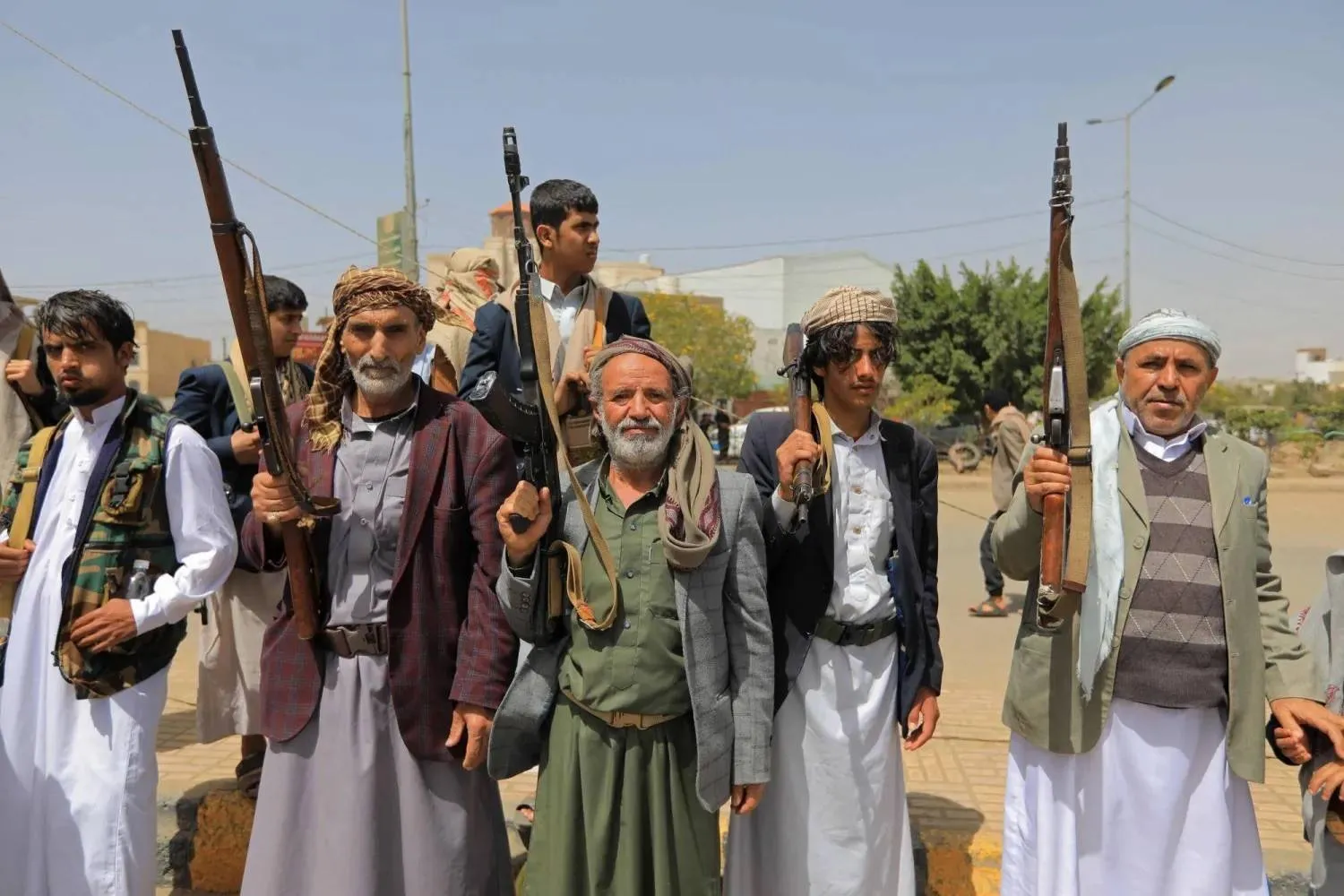
Houthi gunmen during a rally in Sanaa called by their leader (AFP) 
TT

Houthis Threaten ‘Gradual Escalation’ after Fourth Attack on Israel

Houthi gunmen during a rally in Sanaa called by their leader (AFP) 

Yemen’s Houthi group has threatened “gradual escalation” after claiming a fourth attack on Israel, about a week after entering the war alongside Iran as part of the Tehran-led “axis of resistance.”

The move comes as Yemen’s internationally recognized government steps up rhetoric, saying a decisive battle to retake the state from Houthi control is nearing. Israel, for its part, said it is consulting Washington on how to respond to the Houthi attacks, despite their limited impact compared with sustained fire from Iran and Hezbollah.

In a televised statement late Thursday, Houthi military spokesman Yahya Saree said the group launched “a salvo of ballistic missiles” at “vital Israeli targets in the occupied Jaffa area.” He claimed the operation was carried out in coordination with Iran and Hezbollah and had “successfully achieved its objectives.”

The Houthis said their intervention in what they described as a “major and exceptional battle” would be incremental, adding they would adjust their actions depending on “the enemy’s escalation or de-escalation.”

The latest strike marks the fourth since the group announced direct involvement in the regional confrontation, underscoring growing coordination among Iran-backed actors, including Hezbollah and armed Iraqi factions.

Limited effect

The Houthis had claimed a third attack a day earlier. The Israeli military said it intercepted a missile launched from Yemen “without casualties or damage,” adding early detection allowed it to neutralize the threat.

Analysts say such attacks are unlikely to do more than stretch Israel’s air defenses, already under pressure from multiple fronts, including Iran and Hezbollah.

In his first appearance since announcing the escalation, Houthi leader Abdul Malik al-Houthi said the group had shifted from political and media backing of Iran to “direct operational engagement.”

He framed the attacks as part of “joint operations of the axis of resistance,” describing the confrontation as “a duty that transcends geographical borders.” He also defended joining the war, saying neutrality “is not an option,” despite growing concern inside Yemen over the economic and security risks.

Al-Houthi urged supporters to maintain weekly pro-Iran rallies and step up mobilization, including sending school students to summer camps—long used by the group for recruitment.

Government signals offensive

Tareq Saleh, a member of Yemen’s Presidential Leadership Council, said “the battle to end the Houthi coup is approaching,” adding national forces would act “as one team.”

State media reported his remarks during a visit to forces on Yemen’s west coast, where he praised troops as “a safety valve for the republic,” signaling confidence in their ability to regain the initiative.

Saleh also pointed to the regional dimension, saying Iranian actions against Gulf states and Jordan show Tehran’s project is “destructive” and “has never truly been directed at Israel.”

Rejecting Houthi claims, he said the group “pretends to confront Israel” while using that narrative to justify violence against Yemenis, noting the conflict with the Houthis dates back to 2004, well before current regional tensions.