


Gaza Death Toll Exceeds 20,000 as Israel Expands Ground War against Hamas

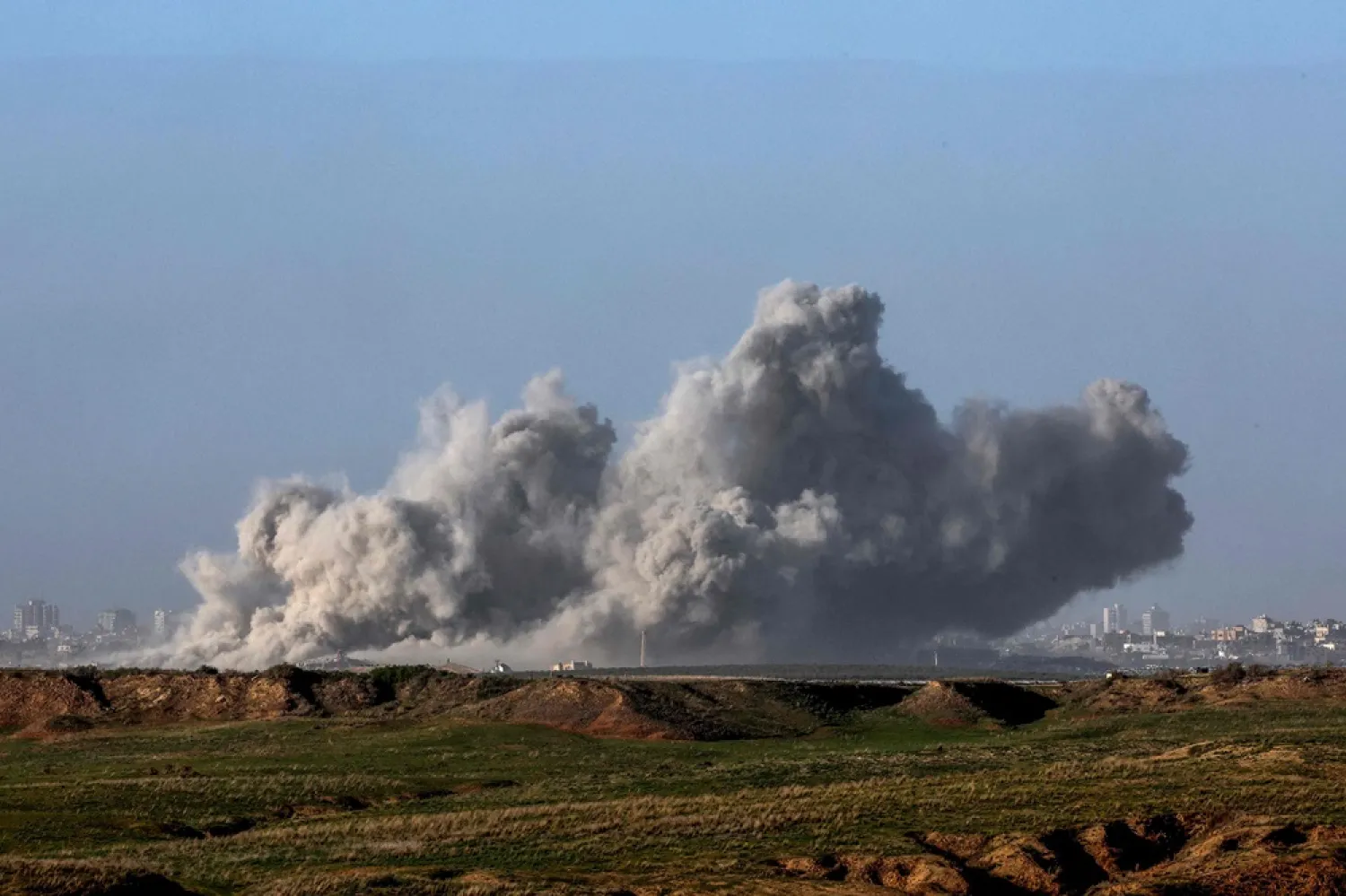
A picture taken from southern Israel bordering the Gaza Strip on December 22, 2023, shows smoke billowing following Israeli bombardment in the Palestinian territory amid ongoing battles with the Hamas militant group. (AFP)
TT

Gaza Death Toll Exceeds 20,000 as Israel Expands Ground War against Hamas

A picture taken from southern Israel bordering the Gaza Strip on December 22, 2023, shows smoke billowing following Israeli bombardment in the Palestinian territory amid ongoing battles with the Hamas militant group. (AFP)

More than 20,000 Palestinians have died in Gaza during Israel’s war against Hamas, health officials said Friday, the latest indication of the staggering cost of the conflict as Israel expands its ground offensive and orders tens of thousands more people to leave their homes.

The deaths amount to nearly 1% of the territory’s prewar population.

The 11-week conflict has displaced nearly 85% of Gaza’s people and leveled wide swaths of the tiny coastal enclave. And more than half a million people in Gaza — a quarter of the population — are starving, according to a report Thursday from the United Nations and other agencies.

Israel has vowed to continue the war until Hamas is removed from power in Gaza and all the hostages taken during its Oct. 7 cross-border attack are freed.

Despite the humanitarian emergency, a UN Security Council vote on aid deliveries and terms for a ceasefire was delayed again late Thursday, after days of high-level negotiations.

The United States, which has veto power, has pushed back against calls for an immediate ceasefire and giving the UN sole responsibility for inspecting aid deliveries. Israel, citing security grounds, insists it needs to be able to screen goods entering Gaza.

The US said it would back a revised resolution that calls for “creating the conditions” for a ceasefire, rather than an immediate end to fighting. Other countries support a stronger text and said diplomats would need to consult their governments before a vote, which is expected Friday.

Martin Griffiths, the UN humanitarian affairs chief, lamented the world’s inaction.

“That such a brutal conflict has been allowed to continue and for this long — despite the widespread condemnation, the physical and mental toll and the massive destruction — is an indelible stain on our collective conscience,” he wrote on the social media platform X.

ISRAEL VOWS TO KEEP UP PRESSURE ON HAMAS Israel, shielded by the United States, has resisted international pressure to scale back its offensive and has said it would press on until Hamas, the militant group that has ruled Gaza for 16 years, has been destroyed.

The military has said that months of fighting lie ahead in southern Gaza, an area packed with the vast majority of the enclave's 2.3 million people, many of whom were ordered to flee combat in the north earlier in the war.

Since then, evacuation orders have pushed displaced civilians into ever-smaller areas of the south as troops focus on the city of Khan Younis, Gaza’s second-largest.

The military said late Thursday that it is sending more ground forces, including combat engineers, to Khan Younis to target Hamas militants above ground and in tunnels. On Friday, it ordered tens of thousands of residents to leave their homes in Burej, an urban refugee camp, and surrounding communities, also in the south.

In the city of Rafah, on the border with Egypt, an airstrike on a house killed six people, according to Associated Press journalists who saw the bodies at a hospital. Among the dead were a blind man, his wife and their 4-month-old child, said the infant's grandfather, Anwar Dhair.

Rafah is one of the few places in Gaza not under evacuation orders, but has been targeted in Israeli strikes almost every day.

The air and ground campaign also continued in the north, even as Israel says it is in the final stages of clearing out Hamas militants there.

Mustafa Abu Taha, a Palestinian farm worker, said many areas of his hard-hit Gaza City neighborhood of Shijaiyah have become inaccessible because of massive destruction from airstrikes.

“They are hitting anything moving,” he said of Israeli forces.

RISING DEATH TOLL AND HUNGER Gaza’s Health Ministry said Friday that it has documented 20,057 deaths in the fighting and more than 50,000 wounded. It does not differentiate between combatant and civilian deaths. It has previously said that roughly two-thirds of the dead were women or minors.

Israel blames Hamas for the high civilian death toll during its intense air and ground campaign, citing the group’s use of crowded residential areas for military purposes.

Israel declared war after Hamas militants stormed across its border and killed some 1,200 people and kidnapped 240 others. Israel’s military says 139 of its soldiers have been killed in the ground offensive. It says it has killed thousands of Hamas militants, including about 2,000 in the past three weeks, but it has not presented any evidence to back up the claim.

Meanwhile, phone and internet services were gradually being restored late Thursday, after the latest communications blackout of 35 hours.

Repeated cuts in communications have hampered aid deliveries, which cover only a fraction of the unprecedented humanitarian needs in Gaza.

The hunger eclipsed even the near-famines of recent years in Afghanistan and Yemen, according to Thursday’s report, which warned that the risk of famine is “increasing each day,” blaming the hunger on insufficient aid entering Gaza.

An Israeli liaison officer with Gaza claimed there is no food shortage in Gaza, saying sufficient aid is getting through.

“The reserves in Gaza Strip are sufficient for the near term,” Col. Moshe Tetro, a defense official, said from the Kerem Shalom cargo crossing, opened by Israel several days ago amid international demands to improve the flow of aid. Tetro did not elaborate.

The war has also pushed Gaza’s health sector into collapse.

Only nine of its 36 health facilities are still partially functioning, all located in the south, according to the World Health Organization.

The agency reported soaring rates of diseases in Gaza, including a five-fold rise in diarrhea and increases in cases of meningitis, skin rashes and scabies.




Israeli Settlers Forcibly Enter Palestinian Home and Kill Sheep in Latest West Bank Attack

 This picture shows sheep grazing on a field in Kafr al-Labad with the Israeli settlement of Avnei Hefetz seen in the background, near the city of Tulkarem in the occupied West Bank on December 18, 2025. (AFP)
This picture shows sheep grazing on a field in Kafr al-Labad with the Israeli settlement of Avnei Hefetz seen in the background, near the city of Tulkarem in the occupied West Bank on December 18, 2025. (AFP)
TT

Israeli Settlers Forcibly Enter Palestinian Home and Kill Sheep in Latest West Bank Attack

 This picture shows sheep grazing on a field in Kafr al-Labad with the Israeli settlement of Avnei Hefetz seen in the background, near the city of Tulkarem in the occupied West Bank on December 18, 2025. (AFP)
This picture shows sheep grazing on a field in Kafr al-Labad with the Israeli settlement of Avnei Hefetz seen in the background, near the city of Tulkarem in the occupied West Bank on December 18, 2025. (AFP)

Israeli settlers attacked a Palestinian home in the south of the Israeli-occupied West Bank overnight, breaking in and killing sheep, a Palestinian official said Tuesday. It was the latest in a surge of attacks by settlers against Palestinians in the territory in recent months.

Israeli police said they arrested five settlers.

The settlers killed three sheep and injured four more, smashed a door and a window of the home, and fired tear gas inside, sending three Palestinian children under the age of 4 to the hospital, said Amir Dawood, who directs an office documenting such attacks within a Palestinian governmental body called the Wall and Settlement Resistance Commission.

Police said they arrested the five settlers on suspicion of trespassing onto Palestinian land, damaging property and dispensing pepper spray, not tear gas. They said they are investigating.

CCTV video from the attack in the town of As Samu’, shared by the commission, showed five masked settlers in dark clothing, some with batons, approaching the home and appearing to enter. Sounds of smashing are heard, as well as animal noises. Another video from inside shows masked figures appearing to strike sheep in the stable.

Photos of the aftermath, also shared by the commission, show smashed car windows and a shattered front door. Bloodied sheep lie dead as others stand with blood staining their wool. Inside the home, photos show broken glass and the furniture ransacked.

Dawood said it was the second settler attack on the family in less than two months. He called it “part of a systematic and ongoing pattern of settler violence targeting Palestinian civilians, their property and their means of livelihood, carried out with impunity under the protection of the Israeli occupation.”

During October’s olive harvest, settlers across the territory launched an average of eight attacks daily, the most since the United Nations humanitarian office began collecting data in 2006. The attacks continued in November, with the UN recording at least 136 by Nov. 24.

Israel captured the West Bank, east Jerusalem and Gaza — areas claimed by the Palestinians for a future state — in the 1967 war. It has settled over 500,000 Jews in the West Bank, in addition to over 200,000 in contested east Jerusalem.

Israel’s government is dominated by far-right proponents of the settler movement, including Finance Minister Bezalel Smotrich and Cabinet Minister Itamar Ben-Gvir, who oversees the nation’s police force. Earlier this week, Smotrich said the Israeli cabinet had approved a proposal for 19 new Jewish settlements, another blow to the possibility of a Palestinian state.


Palestinian Authority Says Israel Tightening Control Over West Bank with New Settlements

Israeli bulldozers level land at the evacuated Israeli settlement of Sanur, near the West Bank city of Jenin, 23 December 2025. (EPA)
TT

Palestinian Authority Says Israel Tightening Control Over West Bank with New Settlements

Israeli bulldozers level land at the evacuated Israeli settlement of Sanur, near the West Bank city of Jenin, 23 December 2025. (EPA)

The Palestinian Authority condemned on Tuesday Israel's recent approval of 19 settlements in the occupied West Bank, accusing it of tightening its control over Palestinian land.

On Sunday, Israel's far-right Finance Minister Bezalel Smotrich announced the authorities had greenlit the settlements, saying the move was aimed at preventing the establishment of a Palestinian state.

The Ramallah-based Palestinian foreign ministry decried the approval as a "dangerous step aimed at tightening colonial control over the entirety of Palestinian land", calling it a continuation of "apartheid, settlement, and annexation policies that undermine the inalienable rights of the Palestinian people".

"The decision provides political cover for accelerating the plunder of Palestinian lands, expanding settlement infrastructure... alongside an escalating pace of settler terrorism against members of our people and their properties," it said in a statement.

The latest move brings the total number of settlements approved over the past three years to 69, Smotrich's office said.

Excluding east Jerusalem, which was occupied and annexed by Israel in 1967, more than 500,000 Israelis live in the West Bank, along with about three million Palestinian residents.

Smotrich's office said the 19 newly approved settlements were located in what it described as "highly strategic" areas, adding that two of them -- Ganim and Kadim in the northern West Bank -- would be re-established after being dismantled two decades ago.

Five of the 19 settlements already existed but had not previously been granted legal status under Israeli law, the statement said.

Israel's decision came days after the United Nations said the expansion of Israeli settlements in the West Bank -- all of which are illegal under international law -- had reached its highest level since at least 2017.

US President Donald Trump recently warned that Israel "would lose all of its support from the United States" if it annexed the West Bank.

Israel has occupied the territory since 1967, and violence there has surged following the outbreak of the Gaza war in October 2023 with Hamas's attack on Israel.

Israeli troops or settlers have killed at least 1,028 Palestinians in the West Bank -- both fighters and civilians -- since the start of the fighting in Gaza, according to an AFP tally based on Palestinian health ministry figures.

At least 44 Israelis have been killed in the West Bank in Palestinian attacks or Israeli military operations during the same period, according to Israeli data.


Germany Deports Man to Syria for First Time Since 2011

People attend a protest against reelection of Syria's president Bashar al-Assad, near Syria's embassy, Berlin, Germany May 26, 2021. (Reuters)
TT

Germany Deports Man to Syria for First Time Since 2011

People attend a protest against reelection of Syria's president Bashar al-Assad, near Syria's embassy, Berlin, Germany May 26, 2021. (Reuters)

Germany deported a man to Syria for the first time since the civil war began in that country in 2011, the interior ministry in Berlin announced on Tuesday.

A Syrian immigrant previously convicted of criminal offences in Germany was flown to Damascus and handed over to Syrian authorities on Tuesday morning, the ministry said.