US Military Strikes another Houthi-controlled Site after Warning Ships to Avoid Parts of Red Sea

In this 2008 image released by the US Navy Visual News Service the guided-missile destroyer USS Mason steams through the Atlantic Ocean. (Photo by Katrina PARKER / US NAVY VISUAL NEWS SERVICE / AFP)
TT

US Military Strikes another Houthi-controlled Site after Warning Ships to Avoid Parts of Red Sea

In this 2008 image released by the US Navy Visual News Service the guided-missile destroyer USS Mason steams through the Atlantic Ocean. (Photo by Katrina PARKER / US NAVY VISUAL NEWS SERVICE / AFP)

The US military early Saturday struck another Houthi-controlled site in Yemen that it had determined was putting commercial vessels in the Red Sea at risk, a day after the US and Britain launched multiple airstrikes targeting Houthi rebels.
Associated Press journalists in Sanaa, Yemen’s capital, heard one loud explosion.
US Central Command said the "follow-on action" early Saturday local time against a Houthi radar site was conducted by the Navy destroyer USS Carney using Tomahawk land attack missiles.
The first day of strikes Friday hit 28 locations and struck more than 60 targets. President Joe Biden had warned Friday that the Houthis could face further strikes.
The latest strike came after the US Navy on Friday warned American-flagged vessels to steer clear of areas around Yemen in the Red Sea and the Gulf of Aden for the next 72 hours after the initial airstrikes. The warning came as Yemen’s Houthis vowed fierce retaliation, further raising the prospect of a wider conflict in a region already beset by Israel's war in Gaza.
US military and White House officials said they expected the Houthis to try to strike back.
The US-led bombardment — launched in response to a recent campaign of drone and missile attacks on commercial ships in the vital Red Sea — killed at least five people and wounded six, the Houthis said. The US said the strikes, in two waves, took aim at targets in 28 different locations across Houthi-controlled areas of Yemen.
“We will make sure that we respond to the Houthis if they continue this outrageous behavior along with our allies," Biden told reporters during a stop in Emmaus, Pennsylvania.
Asked if he believes the Houthis are a terrorist group, Biden responded, “I think they are.” The president in a later exchange with reporters during a stop in Allentown, Pennsylvania, said whether the Houthis are redesignated as such was “irrelevant.”
Biden also pushed back against some lawmakers, both Democrats and Republicans, who said he should have sought congressional authorization before carrying out the strikes.
“They’re wrong, and I sent up this morning when the strikes occurred exactly what happened," Biden said.
The Pentagon said Defense Secretary Lloyd Austin ordered the military action from the hospital where he is recovering from complications following prostate cancer surgery.
The White House said in November that it was considering redesignating the Houthis as a terrorist organization after they began their targeting of civilian vessels. The administration formally delisted the Houthis as a “foreign terrorist organization” and “specially designated global terrorists” in 2021, undoing a move by President Donald Trump
Lt. Gen. Douglas Sims, director of the Joint Chiefs of Staff, said Friday's US strikes were largely in low-populated areas, and the number of those killed would not be high. He said the strikes hit weapons, radar and targeting sites, including in remote mountain areas.
As the bombing lit the predawn sky over multiple sites held by the Iranian-backed rebels, it forced the world to again focus on Yemen's yearslong war, which began when the Houthis seized the country's capital.
Since November, the rebels have repeatedly targeted ships in the Red Sea, saying they were avenging Israel's offensive in Gaza against Hamas. But they have frequently targeted vessels with tenuous or no clear links to Israel, imperiling shipping in a key route for global trade and energy shipments.
The Houthis’ military spokesman, Brig. Gen. Yahya Saree, said in a recorded address that the US strikes would “not go unanswered or unpunished.”
Though the Biden administration and its allies have tried to calm tensions in the Middle East for weeks and prevent any wider conflict, the strikes threatened to ignite one.
It remained unclear how extensive the damage was from Friday's strikes, though the Houthis said at least five sites, including airfields, had been attacked. The White House said the US military was still assessing the extent the militants' capabilities might have been degraded.
US Air Forces Central Command said the strikes focused on the Houthi's command and control nodes, munition depots, launching systems, production facilities and air defense radar systems. The strikes involved more than 150 precision-guided munitions including air-launched missiles by F/A-18 Super Hornets based on the USS Dwight D. Eisenhower, and Tomahawk missiles from the Navy destroyers USS Gravely and USS Mason, the Navy cruiser USS Philippine Sea, and a US submarine.
The United Kingdom said strikes hit a site in Bani allegedly used by the Houthis to launch drones and an airfield in Abbs used to launch cruise missiles and drones.
In a separate development, Iran released footage of its seizure of an oil tanker in the Gulf of Oman that once had been at the center of a dispute between Tehran and Washington.
In the footage, a helicopter hovers over the deck of the St. Nikolas. Iran’s navy seized the vessel Thursday. The vessel had been known earlier as the Suez Rajan. The US seized 1 million barrels of sanctioned Iranian oil off the vessel last year.
In Yemen, Hussein al-Ezzi, a Houthi official in their Foreign Ministry, said, “America and Britain will undoubtedly have to prepare to pay a heavy price and bear all the dire consequences of this blatant aggression.”
The Red Sea route is a crucial waterway, and attacks there have caused severe disruptions to global trade. Benchmark Brent crude oil traded up some 4% Friday at over $80 a barrel. Tesla, meanwhile, said it would temporarily halt most production at its German factory because of attacks in the Red Sea.
In Saada, the Houthis' stronghold in northwest Yemen, hundreds gathered for a rally Friday, denouncing the US and Israel. Another drew thousands in Sanaa, the capital.
Houthis now control territory that is home to some two-thirds of Yemen’s population of 34 million. War and misgovernment have made Yemen one of the poorest countries in the Arab world, and the World Food Program considers the vast majority of Yemen’s people as food-insecure.
Yemen has been targeted by US military action over the last four American presidencies. A campaign of drone strikes began under President George W. Bush to target the local affiliate of al-Qaeda, attacks that have continued under the Biden administration. Meanwhile, the US has launched raids and other military operations amid the ongoing war in Yemen.
Iran condemned Friday's attack in a statement from Foreign Ministry spokesperson Nasser Kanaani. “Arbitrary attacks will have no result other than fueling insecurity and instability in the region," he said.
At an emergency meeting of the UN Security Council late Friday, Russian Ambassador Vassily Nebenzia accused the US, UK and allies of “blatant armed aggression” against Yemen and warned “if the escalation continues, the entire Middle East could encounter a catastrophe.”
US Ambassador Linda Thomas-Greenfield and UK Ambassador Barbara Woodward insisted the attacks were in self-defense. “So de-escalation needs to happen," Thomas-Greenfield said. "It needs to happen from the Houthis who are putting all of our shipping lines in jeopardy.”



Israel Targets Top Hamas Leader in Deadly Gaza Strike on Anniversary

Palestinians inspect the rubble of a residential apartment following an Israeli air strike in the west of Gaza City on 03 October 2026. (EPA)
TT

Israel Targets Top Hamas Leader in Deadly Gaza Strike on Anniversary

Palestinians inspect the rubble of a residential apartment following an Israeli air strike in the west of Gaza City on 03 October 2026. (EPA)

Israel said on Saturday that it attempted to kill Hamas's top leader in the Gaza Strip in an airstrike on an apartment that local officials said killed five people, four of them women.

The pre-dawn strike came on the anniversary according to the Jewish calendar of the October 7, 2023 attack, the deadliest-ever day for Israel which retaliated with a devastating offensive in Gaza.

The Israeli military said it aimed to kill Ali al-Amoudi, describing him as the "right-hand man" of slain Hamas chief Yahya Sinwar and saying he was involved in planning the October 7 attack.

Israel said it was reviewing whether it killed or injured him.

It said it targeted him after learning that he was inside an apartment building, saying it showed that Hamas was using civilians as human shields.

"Today, al-Amoudi is the most senior Hamas figure in the Gaza Strip and is directly involved in Hamas's terror activities and in rebuilding the organization for war. The terrorist was struck in order to remove the threat," a military statement said.

"Steps were taken to mitigate harm to civilians, including the use of precise munitions," the military said, adding it "regrets any harm caused to uninvolved individuals".

Israel killed Sinwar in Gaza in October 2024, in what many Israelis saw as a major symbolic victory, although Israel has vowed to keep destroying Hamas even since a US-brokered ceasefire was declared a year ago.

Amoudi is considered Hamas's top person in the Gaza Strip. The movement's leader Khalil al-Haya lives in Qatar and has tried to maneuver diplomatically to Hamas's advantage.

Haya agreed in July to a US plan for Hamas to give up its weapons, in what President Donald Trump hailed as a breakthrough but Israeli Prime Minister Benjamin Netanyahu dismissed as insincere.

An official at Gaza City's Al-Shifa hospital told AFP it received at dawn the bodies of five people and a number of injured following an airstrike in the Rimal neighborhood.

It said the dead were two women and their daughters, as well as a man.

Mahmoud Bassal, the spokesman for the civil defense agency which operates as a rescue force under Hamas authority, said two missiles directly hit the apartment, causing a fire and damaging the building.

Mourners gathered later on Saturday at the small Greek Orthodox church of Saint Porphyrius in Gaza City for the funeral of the two women, identified as 56-year-old Maysaa Abu Daoud and her 36-year-old daughter Mary Al-Najjar.

Ihab Ayad, a relative of the women, said that they had been "minding their own business" at home when Israel carried out the strike.

"We didn't hurl stones or fire rockets. If any child among us carries a stone, they call him a terrorist, a murderer. But they possess the most powerful arsenal and destroy everything," he said.

The Hamas-led October 7 attack killed 1,221 people, according to an AFP tally based on official Israeli figures.

The massive Israeli offensive in response has left most of Gaza in ruins and killed more than 74,200 people, according to Gaza's health ministry, which is under Hamas authority and whose figures are considered reliable by the United Nations.

Israeli forces have killed more than 1,440 people since the announcement of the ceasefire a year ago, according to Gaza's health ministry.

The Israeli military has identified five deaths in its ranks over the same period, as well as the death of one civilian contractor.


Yemen’s Armed Forces Say It Is Conducting Strikes Against Houthis in Sanaa

Yemen government soldiers ride in a pick-up truck near the Jabal Han front, west of the city of Taiz on October 3, 2026. (AFP)
TT

Yemen’s Armed Forces Say It Is Conducting Strikes Against Houthis in Sanaa

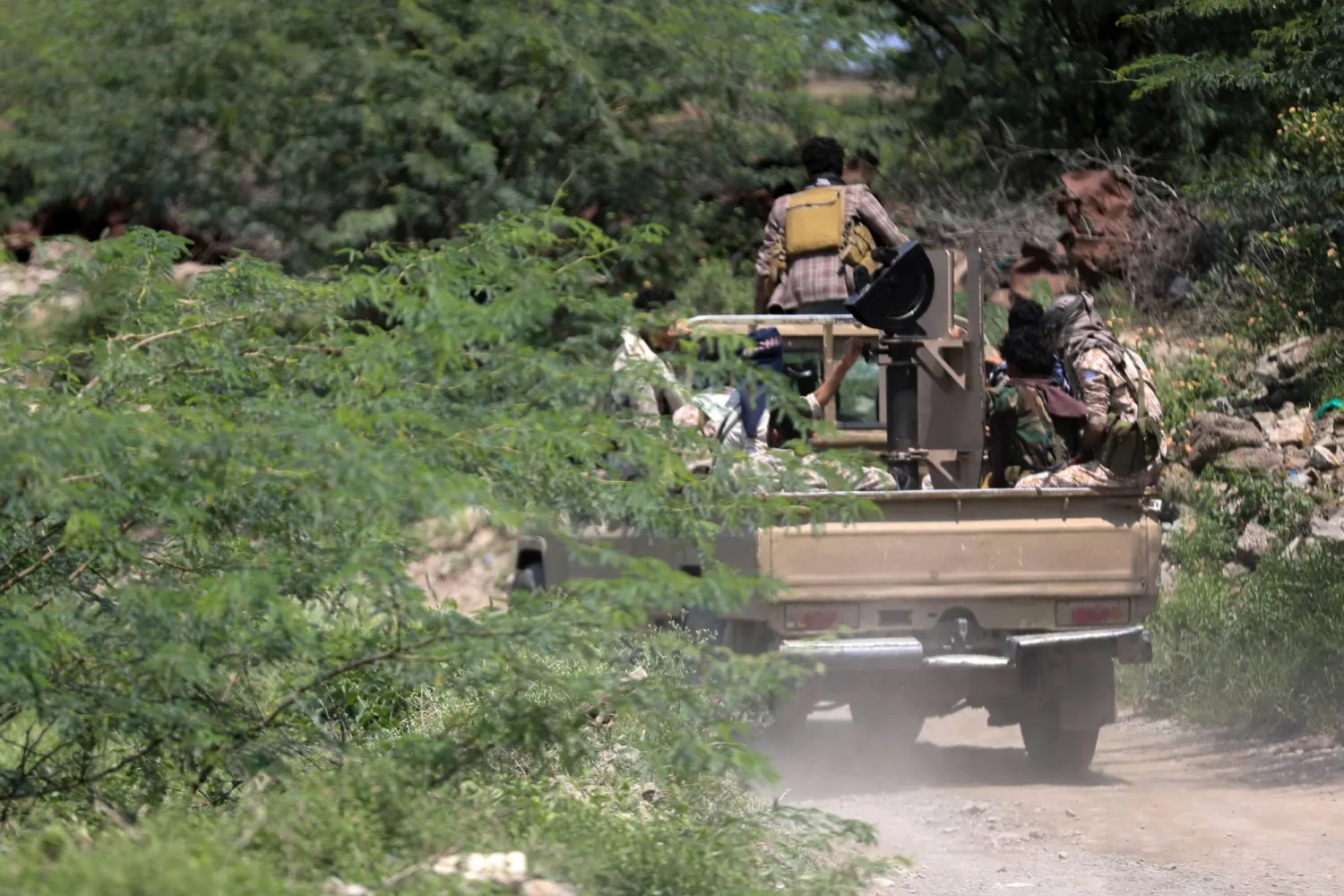
Yemen government soldiers ride in a pick-up truck near the Jabal Han front, west of the city of Taiz on October 3, 2026. (AFP)

Yemen's armed forces said early on Sunday it was conducting strikes against the Iran-aligned Houthis in the capital Sanaa and the group's stronghold Saada. 

A spokesperson for Yemen's armed forces, which ‌are aligned with ‌the legitimate government, ‌said ⁠forces were targeting "vital targets", without providing further details. 

The ‌conflict between the Iran-backed Houthis and forces aligned ‌with the government mostly ‌stopped after a 2022 truce, but fighting has broken out again in a spillover from the wider war between Iran ‌and the United States. 

Hostilities resumed this year after the ⁠Houthis ⁠escalated attacked in Yemen, making major territorial gains along the Red Sea coast. 

Earlier, government forces broke a new wave of Houthi attacks targeting the western front of the city of Taiz and forced the attackers to retreat.

This coincided with a broad escalation in air and artillery targeting operations that struck the group's positions, reinforcements, and supply lines across various fronts in the governorate.

The Iran-backed Houthi group has been exerting pressure for more than two weeks in an effort to encircle the city of Taiz from the south by seizing control of its countryside and isolating it from the liberated Yemeni regions toward Lahij and Aden.

It has also been trying to consolidate its gains in the West Coast and Bab al-Mandab regions by taking control of the highlands.

Armed Forces spokesperson Colonel Majid Al-Nuzaili said that the forces carried out 71 precise operations against Houthi gatherings, mobilizations, and reinforcements in the areas of Al-Aqrud, Samea, Al-Ahkoum, Al-Akboosh, Jabal Rasen, Jabal Jardad, Bani Omar, Bani Bakari, Al-Kaawish, and Al-Athawir.

He added that the operations resulted in the destruction of a number of hostile transport and support vehicles and the neutralization of militia elements, repelling their advance.


'National Day' Stirs Debate over Independence in Iraq

Members of the Iraqi security forces stand guard near the Victory Arch monument during preparations for Sovereignty Day celebrations, marking the withdrawal of US-led coalition forces from Iraq, in Baghdad, Iraq, October 2, 2026. (Reuters)
TT

'National Day' Stirs Debate over Independence in Iraq

Members of the Iraqi security forces stand guard near the Victory Arch monument during preparations for Sovereignty Day celebrations, marking the withdrawal of US-led coalition forces from Iraq, in Baghdad, Iraq, October 2, 2026. (Reuters)

Senior officials in Iraq celebrated the National Day on October 3, which marks the country's independence from the British mandate and its entry into the League of Nations in 1932. The day has sparked debate over conflicting occasions in the official calendar.

President Nizar Amidi said in a statement that “on this day in 1932, Iraq became an independent state and a member of the League of Nations,” noting that “Iraqis have remained committed to their homeland despite the wars, crises, challenges, and difficulties they have endured.”

Meanwhile, government spokesperson Haider Al-Aboudi stressed that “on this occasion, the government renews its pledge that the decision of Iraqis remains in their own hands, and that sovereignty is manifested in security and a dignified life.”

Judge Faiq Zidan, head of the Supreme Judicial Council, also stressed that “the judiciary will remain a guarantee for rights and a fortress for justice,” adding that “the accelerating developments at this stage and the increasing challenges facing Iraq make it capable of protecting its present and shaping its future with deeply rooted institutions and an independent judiciary.”

British King Charles III and Emperor Naruhito of Japan both sent congratulatory cables to the Iraqi government on National Day, which does not receive significant political or public attention due to legislative and political disputes.

King Charles expressed his aspiration for continued cooperation between the two countries in facing shared challenges, particularly regarding climate, environmental preservation, and working together to find effective and sustainable solutions to these challenges.

Debate over ‘National Day’

For years, cultural and political elites have been engaged in a debate over a date that could achieve consensus as the country's National Day.

The former Baath regime had designated July 17 to commemorate its 1968 coup against the rule of the late Prime Minister Abdul Karim Qasim, while leftist factions used to celebrate the fall of the monarchy on July 14, 1958.

After 2003, leaders of opposition parties to the regime of the late President Saddam Hussein attempted to designate the day of his regime's fall, April 9, as a national holiday. The suggestion was rejected by the American civil administrator, Paul Bremer, according to Nabil al-Musawi, a leader in the Iraqi National Congress led by Ahmad Chalabi.

Later, during the government of former Prime Minister Mustafa al-Kadhimi, it was agreed to designate October 3, 1932, as Iraq's National Day.

In a statement on Saturday, Kadhimi said that when his government chose October 3 as a national day to commemorate Iraq's accession to the League of Nations in 1932, he did not want it “to be just an occasion on the nation's calendar, but rather a day where Iraqis gather in love for their homeland and pride in their unifying national identity.”

Some Iraqi historians disagreed with the government, stating that October 3 should not be the National Day because, in their view, independence from the British mandate in 1932 was not complete.

Legal expert Ali al-Tamimi told Asharq Al-Awsat that October 3 is the only date that has a binding legal basis to serve as the country's National Day.

Al-Tamimi added that the legal philosophy behind this day is that it serves as international recognition of the completion of the components of the modern Iraqi state, including an independent government, fixed borders, financial resources, an independent judiciary, and international commitment, making Iraq the first Arab country to join the League of Nations.