
Gaza Combat Surges Anew as Israeli Tanks Storm Back into Areas They Left

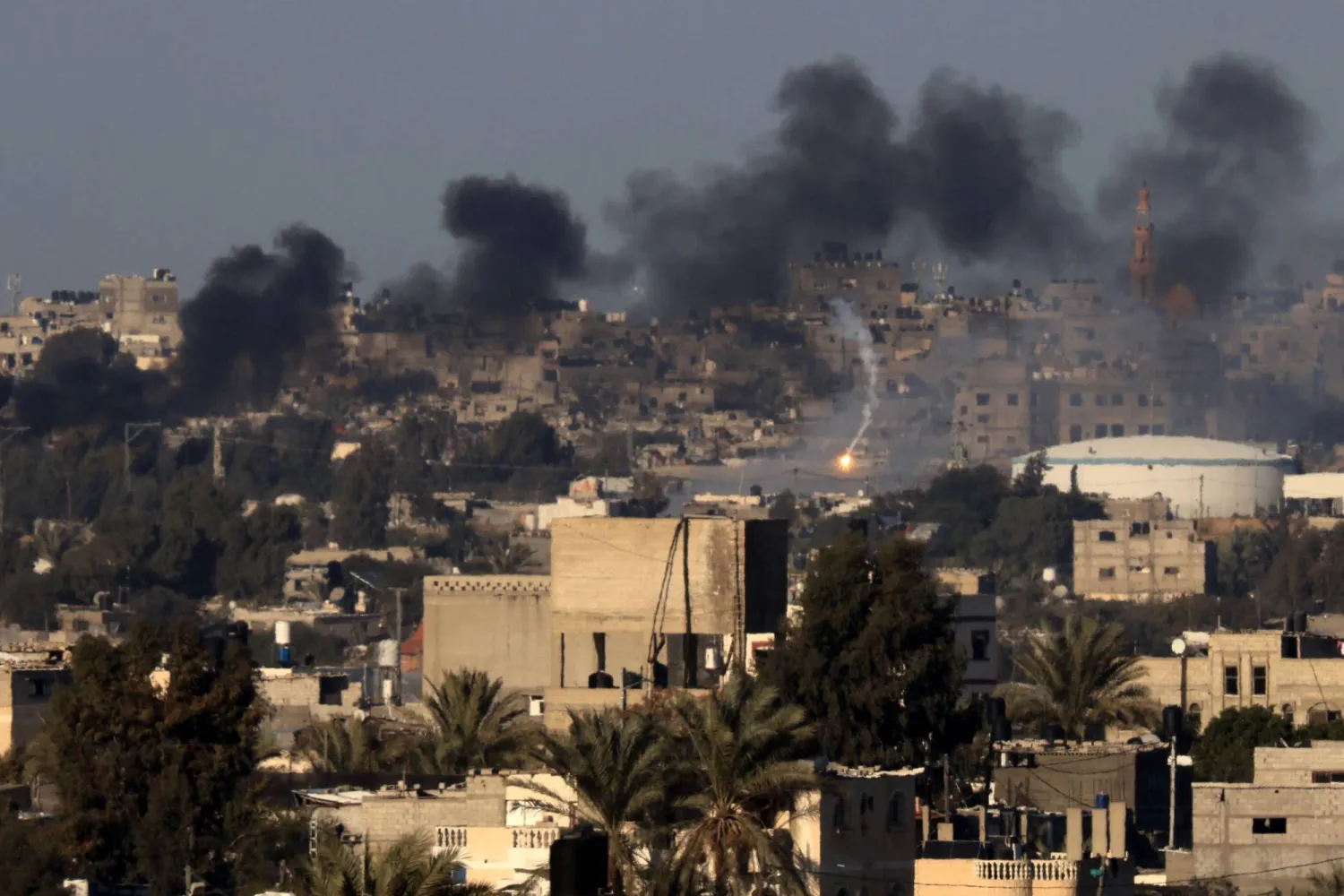
This photograph taken on January 15, 2024 from Rafah shows a flare and smoke billowing over Khan Yunis in the southern Gaza Strip during Israeli bombardment, amid ongoing battles between Israel and the Palestinian group Hamas. (Photo by AFP)
TT

Gaza Combat Surges Anew as Israeli Tanks Storm Back into Areas They Left

This photograph taken on January 15, 2024 from Rafah shows a flare and smoke billowing over Khan Yunis in the southern Gaza Strip during Israeli bombardment, amid ongoing battles between Israel and the Palestinian group Hamas. (Photo by AFP)

Israeli tanks stormed back into parts of the northern Gaza Strip they had left last week, residents said on Tuesday, reigniting some of the most intense fighting since the New Year when Israel announced it was scaling back its operations there.

Massive explosions could be seen over northern areas of Gaza from across the border with Israel - a rarity over the past two weeks after Israel announced a drawdown of forces in the north as part of a transition to smaller, targeted operations.

The rattle of gunfire reverberated across the border through the night. In the morning, contrails snaked through the sky as Israel's Iron Dome defenses shot down rockets fired by militants across the fence, proof they retain the capability to launch them despite more than 100 days of war.

Israel said its forces had killed dozens of Hamas fighters overnight in clashes in Beit Lahiya on Gaza's northern edge. Gaza health authorities said the last 24 hours of Israeli bombing had killed 158 people in the Palestinian enclave, raising their toll for the war, now in its fourth month, to 24,285, with thousands more bodies feared lost in the rubble.

Israel launched the war to eradicate Hamas after militants stormed across the border fence on Oct. 7, killing 1,200 people and capturing 240 hostages. The war has driven nearly all Gazans from their homes, some several times, and caused a humanitarian crisis, with food, fuel and medical supplies running low.

Under US pressure to reduce civilian casualties, Israel had said it was transitioning from a full-scale ground assault to targeted operations against the Hamas militants that control the enclave.

It began that shift with a pullback in the north. Defense Minister Yoav Gallant also said on Monday that the more recent ground assault in the south was drawing to a close.

But any path toward de-escalating the war still seems remote, with Israel saying it will not rest until Hamas is destroyed, and the militants showing no sign of losing the ability to resist.

Israel Ziv, a retired general who formerly commanded Israeli forces in Gaza, told Reuters that 10-15% of Hamas' pre-war rocketry corps of some 1,000 personnel were believed to be still alive, with some 2,000 rockets left to be fired.

However, Ziv said, Israeli forces had by now established "extensive control" in Gaza, meaning they could "maneuver freely", except in Rafah, Deir al-Balah and Nusseirat, the launch point of Tuesday's rocket salvo.

Change of plans

Some of the hundreds of thousands of residents who fled the north earlier in the war had begun returning last week to bombed-out areas where the Israelis had withdrawn. But residents who spoke to Reuters on Tuesday said the abrupt resurgence of fighting in the north would now halt plans to try to go home.

"We almost planned to return to our house in Nazla, east of Jabalia, but thank God we didn't. This morning people living nearby arrived here and told us the tanks pushed back there," said Abu Khaled, 43, a father of three now living with relatives in severely damaged Gaza City.

"The sounds of bombing from the tanks, from the planes didn't stop all night. It reminded us of the first day of the ground incursion."

Israeli forces have fought their way to the center of Gaza's main southern city of Khan Younis, and into towns north and east of the central city of Deir al-Balah.

Israeli commando forces carried out targeted raids in Khan Younis to take out militant infrastructure, including offices of several senior regional Hamas commanders, the military said.

The Gaza war has inflamed tensions across the region, including in the Red Sea, where the Iran-aligned Houthi militias in Yemen have been attacking commercial ships. The route is used by 15% of world shipping. The militias say they are targeting vessels linked to Israel in solidarity with Gaza.

The United States and Britain responded by bombing Yemen to prevent what they called a threat to global commerce.

The latest ship to be attacked, a Malta-flagged, Greek-owned bulk carrier, sustained minor damage on Tuesday when it was hit with a missile in the Red Sea. No injuries were reported.

‘Forgive me, my son, I could not protect you’

Defense Minister Gallant's announcement on Monday that the major ground offensive in the south would end soon raises the question of whether the Israelis will still try to advance into remaining areas they have yet to enter.

Most of Gaza's 2.3 million people are now crowded into those few areas, including Deir al-Balah and Rafah, which is located on the southern edge of the Strip bordering Egypt.

In Khan Younis, Zaher Abu Zarifa wept and cradled a black plastic body bag holding his seven-year-old son Saif, one of at least 11 bodies brought out at a hospital morgue.

The boy was killed by a missile while playing on a bicycle by a school gate, his father said.

Later, by a small freshly dug grave, a gravedigger unzipped the bag so the father could kiss the boy's face, then zipped it back up, took the boy and gently laid him in the ground.

"Forgive me, my son. I could not protect you," the father repeated. "Forgive me, my son. I could not protect you."


Palestinian President’s Advisor: Board of Peace, Related Entities Are a ‘Temporary Arrangement’

Palestinian President Mahmoud Abbas’ advisor Dr. Mahmoud Al-Habbash. WAFA
TT

Palestinian President’s Advisor: Board of Peace, Related Entities Are a ‘Temporary Arrangement’

Palestinian President Mahmoud Abbas’ advisor Dr. Mahmoud Al-Habbash. WAFA

Palestinian President Mahmoud Abbas’ advisor Dr. Mahmoud Al-Habbash said that the situation in the Gaza Strip, along with the formation of the Board of Peace and its related entities is not a Palestinian choice.

This is “a temporary arrangement (mandated by the UN Security Council) that the Palestinian leadership rejects under any circumstances... but it is the lesser of two evils,” Al-Habbash told Asharq Al-Awsat.

Speaking from Ramallah, Al-Habbash said that the Palestinian leadership “chose this arrangement to stop the massacre and open a potential window ... leading to a Palestinian state.”

US President Donald Trump announced last week the formation of the Board of Peace, a new body of world leaders meant to oversee next steps in Gaza.

The White House said there would be a main board, chaired by Trump himself, a Palestinian committee of technocrats meant to govern the war-wracked territory, and a second "executive board" that appears designed to have a more advisory role.

“Our clear and firm position is that we did not create this reality,” said Al-Habbash. “Rather, it is a reality imposed on us for two reasons: First, Israel’s aggression ... and second, the reckless adventure carried out by Hamas movement, which whetted Israel’s appetite to liquidate the Palestinian cause.”

According to Al-Habbash, “this transitional arrangement is the least harmful to the Palestinian cause,” because it ensures that Palestinians remain in the Gaza Strip and prevents displacement.


UN Human Rights Commissioner Calls for Accountability for Atrocity Crimes in Sudan

UN Human Rights commissioner Volker Turk 
TT

UN Human Rights Commissioner Calls for Accountability for Atrocity Crimes in Sudan

UN Human Rights commissioner Volker Turk 

UN Human Rights commissioner Volker Turk said on Sunday he is alarmed by the increasing militarization of society by all parties to the conflict in Sudan, also expressing his worries that the atrocity crimes committed during and after the takeover of El Fasher would be repeated in the Kordofan region.

Speaking at a press conference in Port Sudan, where the government had been operating as a temporary capital since the conflict began, the UN envoy said the proliferation of advanced military equipment, in particular drones, across Sudan has enhanced the military capabilities of both the Sudanese army (SAF) and the Rapid Support Forces (RSF), prolonging hostilities and deepening the crisis for civilians.

“I am deeply alarmed by the increasing militarization of society by all parties to the conflict, including through the arming of civilians and recruitment and use of children,” Turk noted.

The envoy said that during his visit to refugee camps in north Sudan, he heard accounts of widespread summary executions by RSF during the offensive on El Fasher, the capital of North Darfur region – for revenge, for suspected affiliation with the Sudanese Army or its allied Joint Forces.

He added, “I am very worried that the atrocity crimes committed during and after the takeover of El Fasher are at grave risk of repeating themselves in the Kordofan region, where the conflict has been rapidly escalating since late October.”

Horror and Hell

Turk also said the Sudanese population had endured “horror and hell,” especially with the expansion of the fighting in Kordofan.

“The Kordofan states are extremely volatile, with relentless military engagements, heavy shelling, drone bombardments and airstrikes causing widespread destruction and collapse of essential services,” he warned.

Since the end of October, and after taking control of El Fasher in Darfur, the RSF attacks have expanded into the neighboring Kordofan region, resulting in a continued displacement of civilians from the besieged city – all in the context of extreme food insecurity, with famine conditions confirmed in Kadugli, and risk of famine in other areas including Dilling, according to Turk.

The latest UN figures show that more than 65,000 people have been displaced since October.

At his press conference at Port Sudan airport, the envoy said that during his four-day visit to Port Sudan, Dongola, Ad Dabba and Merowe, he has met with those who have been hardest hit by brutal violence and injustice in this war.

“The terrifying experiences of these survivors must provoke action to end this conflict, and to make sure they can access what they need: medical care, psychosocial care, justice and support to pursue education and a livelihood”.

End This Madness

Turk and his UN team had visited the Al Afad site for internally displaced people (IDPs) in Ad Dabba, where they met with a large number of displaced people from the regions of Darfur and Kordofan.

“In my meetings with more than 50 local and international organizations in Dongola and Port Sudan, I heard appeals directed to those waging this war and the international community to end this madness,” he said.

“And to allow NGOs, journalists, lawyers and humanitarian actors to do their essential work without undue restrictions and reprisals,” Turk added.

He said the RSF and the Sudanese army must cease intolerable attacks against civilian objects that are indispensable to the civilian population, including markets, health facilities, schools and shelters.

“Attacks on critical civilian infrastructure are serious violations that can amount to war crimes,” Turk affirmed.

The UN envoy said the international community must ensure that the perpetrators of the horrific violations in Sudan face justice, regardless of their affiliation.

My Office, he said, is working to document and report on these violations and abuses to pave the way for accountability.

Turk described as “despicable” the fact that large sums of money are being spent on procuring increasingly advanced weaponry – funds he said that should be used to alleviate the suffering of the population.

Protection of Civilians

The envoy then called on all parties to the conflict to ensure the protection of civilians and civilian infrastructure, to guarantee safe passage for civilians to leave areas of active conflict – including Kadugli and Dilling – and for humanitarian aid to enter where it is needed.

He also repeated his call from three years ago, when he last visited Sudan, urging all those involved to set aside entrenched positions, power games, and personal interests, and to focus on the common interests of the Sudanese people.

The envoy then left Sudan with a plea that human rights be central to building confidence and bringing this war to an end, to resuming the difficult task of building a sustainable peace.

“It is difficult, but certainly not impossible, with the resilience and power of the Sudanese people,” he affirmed.


Syrian Government Announces Ceasefire with Kurdish-led SDF

Syrian President Ahmed al-Sharaa after signing an agreement at the presidential palace in Damascus on January 18, 2026. (EPA)
TT

Syrian Government Announces Ceasefire with Kurdish-led SDF

Syrian President Ahmed al-Sharaa after signing an agreement at the presidential palace in Damascus on January 18, 2026. (EPA)

The Syrian government Sunday announced a ceasefire with the Syrian Democratic Forces, taking almost full control of the country and dismantling the Kurdish-led forces that controlled the northeast for over a decade.

The announcement comes as tensions between government forces and the SDF boiled over earlier this month, eventually resulting in a major push by government forces toward the east. The SDF appeared to have largely retreated after initial clashes on a tense front line area in eastern Aleppo province.

Hours after the government announced the deal, SDF leader Mazloum Abdi confirmed it in a video statement, saying the group had accepted the agreement, which stipulates their withdrawal from Raqqa and Deir Ezzor provinces “to stop the bloodshed.”

“We will explain the terms of the agreement to our people in the coming days,” he said.

Syria’s Defense Ministry said it ordered the fighting to halt on the front lines after the agreement was announced.

Syria’s new leaders, since toppling Bashar al-Assad in December 2024, have struggled to assert their full authority over the war-torn country. An agreement was reached in March that would merge the SDF with Damascus, but it didn't gain traction as both sides accused each other of violating the deal.

Since the push, the government has largely asserted control of the Deir Ezzor and Raqqa provinces, critical areas under the SDF that include oil and gas fields, river dams along the Euphrates, and border crossings.

Syria’s state-run news agency SANA showed President Ahmed al-Sharaa signing and holding the agreement. Abdi, who was scheduled to meet with the president in Damascus was not seen, though his signature appeared on the document.

Sharaa told journalists that Abdi could not travel due to bad weather and will visit Damascus on Monday.

“It’s a victory for all Syrians of all backgrounds,” Sharaa told journalists in Damascus after signing the agreement. “Hopefully Syria will end its state of division and move to a state of unity and progress.”

US Envoy Tom Barrack met with Sharaa earlier Sunday as government forces were sweeping into the city of Raqqa and across Deir Ezzor. Abdi reportedly joined the meeting over the phone.

Barrack praised the agreement, saying it will lead to “renewed dialogue and cooperation toward a unified Syria,” ahead of working on the details of implementing the integration.

“This agreement and ceasefire represent a pivotal inflection point, where former adversaries embrace partnership over division,” said Barrack in a post on X.

The agreement includes dismantling the SDF and having its forces join Syria’s military and security forces, while senior military and civilian officials would be given high-ranking positions in state institutions.

The SDF would have to give up the Raqqa and Deir Ezzor provinces — both Arab-majority areas — to the Syrian military and government, as well as its border crossings and oil and gas fields.

Hassakah province, the heartland of the Kurdish population, is only expected to give its civilian administration back to Damascus, while the Kurdish-led agencies that handled prisons and sprawling camps with thousands of detained ISIS group fighters and families would be handed over to Damascus.

Agreement will be implemented gradually

There was no clear timeline on when and how the different elements of the agreement will take effect. Sharaa told journalists that it will be gradually implemented, beginning with the cessation of hostilities.

It appeared that tensions following clashes in Aleppo earlier this month had calmed after Abdi announced that his troops will withdraw east of the Euphrates River, and Sharaa issued a presidential decree that would strengthen Kurdish rights in the country.

Initially the withdrawal appeared to be going as planned, but then new clashes broke out and the Syrian military seized Tabqa, continuing into Raqqa province.

A senior Syrian government official who spoke on condition of anonymity because he was not authorized to speak publicly said government forces pushed eastward because the SDF despite saying they will withdraw east of the Euphrates by 7 a.m. did not do so.

Armed Arab clans in Raqqa and Deir Ezzor that largely do not support the SDF backed Damascus. By Sunday evening, the SDF lost control of large swaths of its territory and infrastructure, including dams and oil and gas fields.

The SDF took Raqqa from the ISIS group in 2017 as part of its military campaign to take down the group’s so-called "caliphate", which at its peak stretched across large parts of Syria and Iraq.

An Associated Press reporter in the area said that large military convoys swept into Raqqa city Sunday evening and were greeted by residents. It appeared that the SDF had withdrawn.

Raqqa celebrates

Crowds in Raqqa celebrated in the streets late into the evening, waving Syrian flags and setting off fireworks, while some fired into the air.

“Today, everyone is born anew,” said Yahya Al Ahmad, who was among the revelers.

A couple of thousand Kurdish families who lived in the areas captured by government forces fled to the SDF-controlled city of Qamishli amid the offensive. Many of them had previously been displaced from other areas multiple times during Syria’s 14-year civil war and were living in tents camps. A cultural center in the city was turned into a temporary shelter for them.

Residents of Qamishli expressed both hope and skepticism about the deal.

“The Kurds have become victims of international agreements and international deception,” said Goran Ibrahim, a doctor. But he said, “With regards to this agreement, the positive part is the end of the fighting in the region.”

Syria's ambassador to the UN, Ibrahim Olabi, told the AP, “Really this is now a moment to show that Syrians are able to put differences aside and move ahead...It’s a victory for Syria.”