


Israel Escalates Gaza Strikes after Medicine-for-Aid Deal

Destruction in Gaza caused by Israeli airstrikes (AP)
TT

Israel Escalates Gaza Strikes after Medicine-for-Aid Deal

Destruction in Gaza caused by Israeli airstrikes (AP)

Israel stepped up strikes Wednesday on war-torn Gaza's south, where medicines were expected to be delivered for hostages in exchange for humanitarian aid under a newly brokered deal.

But nearly 24 hours after the deal was announced, a top Hamas official set new conditions for providing the drugs, insisting Israel must not inspect the trucks carrying them.

Air strikes and artillery fire targeted Khan Younis throughout the night, said an AFP correspondent in the southern Gaza Strip's biggest city.

"It was the most difficult and intense night in Khan Younis since the start of the war," said Gaza's Hamas government, whose health ministry reported 81 deaths across the Palestinian territory.

Fighting has ravaged Gaza since Hamas's unprecedented October 7 attacks on Israel that resulted in the death of about 1,140 people, mostly civilians, according to an AFP tally based on official Israeli figures.

At least 24,448 Palestinians, about 70 percent of them women, young children and adolescents, have been killed in Israeli bombardments and ground assaults, according to the Gaza health ministry's latest figures.  

Hamas and other militants seized about 250 hostages during the October 7 attacks, and around 132 remain in Gaza, including at least 27 believed to have been killed.  

The fate of those still in captivity has gripped Israeli society, while a broader humanitarian crisis in Gaza marked by the threat of famine and disease has fueled international calls for a ceasefire.

Medicine for hostages

The agreement announced by Qatar on Tuesday following French and Qatari mediation will allow medicines to reach the hostages and aid to enter the besieged Palestinian territory.

The International Committee of the Red Cross welcomed the deal, under which 45 hostages are expected to receive medication, as "a much-needed moment of relief".

A security source in Egypt said a Qatari plane carrying medicines had arrived on Wednesday at El-Arish near the Rafah border crossing with Gaza.  

France said the drugs would be sent to a hospital in Rafah, given to the Red Cross and divided into batches before being transferred to the hostages.  

A top Hamas official announced new conditions for the deal on Wednesday, however.  

Writing on X, formerly Twitter, Musa Abu Marzuk demanded 1,000 boxes of aid for Gaza for every one going to the hostages and that a country Hamas trusts, not France, supply the medicine.  

'Why are they doing this?'  

At the Abu Yussef Al-Najjar hospital in Rafah, Palestinians stood in front of bodies wrapped in shrouds, mourning the loss of loved ones killed in an overnight Israeli strike.

"Why are they doing this? They are destroying us," Umm Muhammad Abu Odeh, a woman displaced from the north Gaza town of Beit Hanun, told AFP.  

The Israelis "told us to go south, and we came here... but there is no safe place in Gaza".  

The United Nations says the war has displaced roughly 85 percent of Gaza's 2.4 million people, many of whom have been forced to crowd into shelters and struggle to get food, water, fuel and medical care.  

In Rafah, Safa Fethi Hamad has been anxiously waiting for more than a month to cross the border to Egypt.  

"We are all going to die. Food is very limited, we have no protection," she told AFP.  

The Israeli public has kept up intense pressure on Prime Minister Benjamin Netanyahu's government to return the hostages, with officials insisting military pressure is necessary to strike any deal.  

At Nir Oz kibbutz, where about one in four residents was killed or kidnapped, Yossi Schneider is clinging to hope for his baby relative Kfir Bibas despite Hamas announcing his death.  

The youngest hostage kidnapped by Hamas was less than nine months old on October 7 and would be celebrating his birthday this week.  

"We are thinking about them every day, every second, every minute," Schneider said of Bibas and his missing brother and mother.

West Bank violence  

Violence has also surged in the Israeli-occupied West Bank since October 7 to a level not seen since the second Palestinian intifada, or uprising, between 2000 and 2005.  

Israeli army raids and attacks by settlers have killed around 350 people in the territory, according to an AFP tally based on sources from both sides.

The Palestinian Red Crescent said an Israeli strike on Wednesday killed four people in Tulkarem refugee camp, in the north of the Palestinian territory.  

The Israeli military confirmed an air strike that killed "a number of terrorists".  

Al-Aqsa Martyrs' Brigades, the armed wing of Palestinian President Mahmoud Abbas's Fatah party, said five of its fighters died in a strike east of the city of Nablus.  

The Israeli army said it killed a Palestinian militant to avert an "imminent terrorist attack" he had been planning.  

Fears are mounting that the Israel-Hamas conflict will trigger an all-out war across the Middle East, with growing violence involving allies of the Iran-backed Hamas.  

The US military said it carried out fresh strikes in Yemen on Tuesday after the country's Iran-backed Houthi militias claimed another missile attack on a cargo ship in the Red Sea.

It came just days after the United States and Britain bombed scores of targets inside Houthi-controlled Yemen in response to attacks by the militias, who say they are targeting Israeli-linked shipping in solidarity with Gaza.

Israel's army has exchanged regular cross-border fire with Lebanon's Hamas-aligned Hezbollah since the start of the war.

UN chief Antonio Guterres told the World Economic Forum in Switzerland on Wednesday that a "full-fledged confrontation" in Lebanon "would be a total disaster" to avoid at all costs.

Meanwhile, Iran -- which backs the Houthis and Hezbollah -- carried out a missile attack in Iraq's Kurdistan region against what its Revolutionary Guards alleged was an Israeli spy headquarters and a "gathering of anti-Iranian terrorist groups".



Israeli Druze Leader Says Syrian Community 'Besieged' Months after Clashes

Sheikh Mowafaq Tarif, the spiritual leader of the Druze community in Israel, during an interview in the village of Julis on February 15, 2026 (AFP)
TT

Israeli Druze Leader Says Syrian Community 'Besieged' Months after Clashes

Sheikh Mowafaq Tarif, the spiritual leader of the Druze community in Israel, during an interview in the village of Julis on February 15, 2026 (AFP)

Seven months after deadly clashes between Syria's Druze minority and government-backed forces, the spiritual leader of Druze in neighboring Israel said members of the community across the border remained in peril.

"They're still besieged -- completely encircled. They aren't allowed to bring in any humanitarian aid, including the aid we're trying to deliver," Sheikh Mowafaq Tarif told AFP in an interview this week.

The cleric spoke in Julis, a quiet Druze village in northern Israel, where the community has set up an "emergency room" to coordinate aid efforts for Druze in Syria.

Israeli and Druze flags hang on the walls of the room, alongside posters in Hebrew and Arabic calling for an end to the killing of Syrian Druze.

The Druze spread across parts of Syria, Israel, Lebanon and the Israeli-occupied Golan Heights.

Clashes erupted last July in southern Syria between Druze fighters and Bedouin tribes.

The Syrian authorities said their forces intervened to stop the clashes.

Israel bombed Syria during the violence, saying it was acting to defend the minority group.

The UN Office for the Coordination of Humanitarian Affairs estimated that some 187,000 people were displaced by the violence.

- 'Why not let them return?' -

"There are still more than 120,000 people displaced from their homes," Sheikh Tarif said.

"Thirty-eight villages have been captured, and residents aren't allowed to return. There are more than 300 captives, including children and women."

AFP was unable to verify those claims.

Although a ceasefire was reached in July, access to Sweida remains difficult.

Residents accuse the government of imposing a blockade on the province, which Damascus denies. Several aid convoys have entered since then.

"Why not let them return to their villages? We're in the depths of winter and that is a mountainous area. It's very cold," Tarif said.

With Syria's government and Kurdish-led forces agreeing last month to integrate Kurdish fighters and civil institutions into state structures, Sweida is the last major area outside Damascus's control.

Tarif said the community did not need government security forces in the region.

"The Druze have forces capable of defending themselves and maintaining order," he said.

Nevertheless, Israel and Syria, which have no official diplomatic ties, have held several rounds of direct talks in recent months.

Following negotiations in January, and under US pressure, both sides agreed to set up an intelligence-sharing mechanism as they moved toward a security agreement.

One issue under discussion is the possibility of Syrian Druze working in Israel.

Sheikh Tarif confirmed "that is something we have heard" and added that he wished any Syrian could come to work as a daily laborer "because the (economic) situation in Syria is very difficult".

He also called for Druze across the Middle East to be able to visit their religious sites in neighboring countries, "just as our Christian and Muslim brothers visit their holy places" in states with which they may not have diplomatic relations.

"The Druze also deserve to access and pray at our holy sites in Syria and Lebanon and for them to come visit our holy places" in Israel, he said.


US Calls on Sudan Parties to Immediately Accept Humanitarian Truce

US Senior Advisor for Arab and African Affairs Massad Boulos addresses the UN Security Council. (US Senior Advisor for Arab and African Affairs Massad Boulos on X)
TT

US Calls on Sudan Parties to Immediately Accept Humanitarian Truce

US Senior Advisor for Arab and African Affairs Massad Boulos addresses the UN Security Council. (US Senior Advisor for Arab and African Affairs Massad Boulos on X)

US Senior Advisor for Arab and African Affairs Massad Boulos revealed on Friday that the US had called on all Sudanese parties to immediately and unconditionally accept a humanitarian truce backed by the United Nations mechanism.

Boulos took part in several diplomatic meetings on the sidelines of a UN Security Council meeting on Sudan.

The US calls on all parties to accept the truce so that lifesaving aid can be delivered to civilians and so that dialogue can kick off, he stressed.

He said the US continues to work with its partners towards achieving fair and permanent peace in Sudan. He underlined their commitment to holding those responsible for genocide in Sudan to account.

They also back the trusted transition towards civilian rule, he added.

The Sudanese people deserve to live in security, dignity and without fear, Boulos said.

He joined other world leaders at the Security Council “to address the dire crisis in Sudan and the urgent need to end more than 1,000 days of needless conflict,” he wrote on X.

“The Council delivered a clear and unified message: there is no military solution to this conflict, and the time to end the fighting is now,” he added.

“The suffering of the Sudanese people has been devastating — with widespread displacement, food insecurity, and atrocities that demand both global attention and action. I reaffirmed that achieving durable peace in Sudan remains a priority for US President Donald Trump and underscored America’s commitment to helping bring this war to an end,” Boulos stated.

He outlined “five key pillars for international alignment: an immediate humanitarian truce; sustained humanitarian access and protection of civilians; a permanent ceasefire and credible security arrangements; an inclusive, civilian-led political transition; and a long-term path toward recovery and reconstruction that restores stability and opportunity for the Sudanese people.”

“The United States will continue working closely with allies and partners, including our Quad partners, the UK, and others to press for a humanitarian truce and expand life-saving assistance,” he vowed.

“We will also continue holding accountable those responsible for atrocities, even as we push urgently for the peace the Sudanese people deserve,” he declared.


Somalia Moves to Contain Public Criticism Over Türkiye Ties

Turkish President and his Somali counterpart Hassan Sheikh Mohamud (Somali National News Agency)
TT

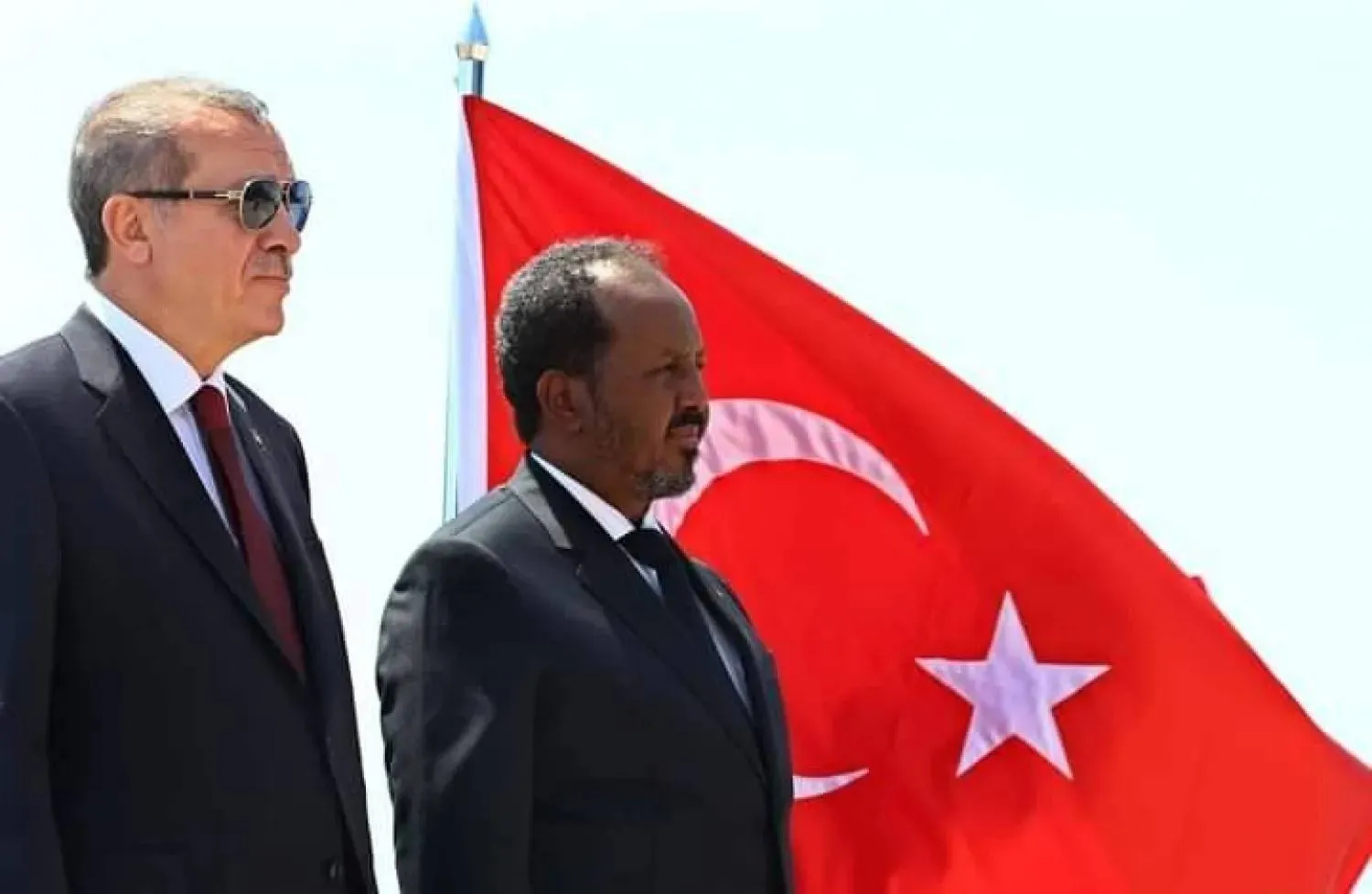
Somalia Moves to Contain Public Criticism Over Türkiye Ties

Turkish President and his Somali counterpart Hassan Sheikh Mohamud (Somali National News Agency)

Growing cooperation between Mogadishu and Ankara has drawn domestic criticism in Somalia over what some describe as a “one-sided benefit” for Türkiye, prompting Somali authorities to stress that the country’s sovereignty and the rights of its people remain unaffected.

The official denial issued on Friday comes amid tensions between the government and the opposition ahead of pivotal elections later this year.

A Somali affairs expert told Asharq Al-Awsat the move was aimed at containing any potential crisis with Türkiye, which he described as a strategic ally that Mogadishu needs.

He said Ankara was likely to understand the situation and continue its presence in Somalia, given its strategic interests in the Horn of Africa.

Cooperation between Mogadishu and Ankara has appeared more active against the backdrop of the Somali government’s internal disputes with the opposition and following Israel’s recognition of the breakaway region of Somaliland in December.

Somali denial

The Somali National News Agency reported on Friday, citing official sources, that “some social media accounts circulated claims alleging that the Turkish government is unilaterally benefiting from Somalia’s natural and energy resources, particularly the oil sector.”

It added that “these allegations are baseless and fall within disinformation campaigns aimed at distorting facts and undermining the existing cooperation between the two countries.”

Official Somali sources clarified that the joint agreement signed between Turkish Petroleum Corporation (TPAO) and the Somali Petroleum Authority explicitly stipulates that natural resources belong to the Somali people, and that exploration and production operations are conducted in accordance with national legal frameworks and in a manner that safeguards the state’s sovereign interests.

Officials from both the Somali and Turkish sides also stressed that the energy partnership is based on transparency, mutual respect and the preservation of Somalia’s sovereignty.

The remarks come amid a political crisis between the government and the opposition ahead of direct elections this year, a key point of contention.

Less than a week ago, the vessel “Cagri Bey” departed from Türkiye for Somalia, where it will begin offshore oil exploration as part of the implementation of economic and defense cooperation agreements signed by the two governments, the agency reported on Feb. 15.

Somali political analyst Abdulweli Beri said criticism portraying the trajectory of relations between Mogadishu and Ankara as “one-sided” is “not entirely new, but has intensified now for several political and economic reasons.”

He noted that agreements related to oil, gas and minerals are always highly sensitive in any developing country because they concern sovereignty and future wealth. “In the Somali case, any perception that an external party may obtain a large share or long-term privileges automatically raises concerns among elites and the opposition,” he said.

Political polarization

The current debate, Beri said, comes amid political polarization ahead of the elections. “The opposition tends to scrutinize any strategic agreements concluded by the government, which remains more vulnerable to criticism. In the absence of full clarity on some details, this information gap is often filled by political narratives or public concerns.”

He said the official Somali clarifications were intended to contain the accusations and prevent them from affecting cooperation projects, given the need for a strategic alliance with Türkiye.

The statements come amid growing bilateral ties between Somalia and Türkiye, spanning infrastructure, social services, security and investment, within a framework of partnership between two independent states linked by close friendship and cooperation, the Somali National News Agency reported on Friday.

Expanding partnership

Turkish-Somali cooperation is not limited to the energy sector. On Feb. 18, Interior Security Minister Gen. Abdullahi Sheikh Ismail received military equipment for the national police from the Turkish ambassador to Somalia, according to the agency.

On Feb. 10, the Somali Communications Authority signed a memorandum of understanding with Türkiye’s Information and Communication Technologies Authority to enhance cooperation in the field of electronic communications, the same source said.

On Jan. 28, Somalia and Türkiye marked the 60th anniversary of diplomatic relations at a ceremony organized by the Embassy of the Federal Republic of Somalia in Ankara, the Turkish capital.

Beri said Somalia would remain keen to preserve and continue this cooperation and to provide ongoing clarifications, though they should be more detailed to dispel the accusations. He added that Ankara was likely to understand this and maintain its presence in Somalia, viewing it as strategic to its interests in the Horn of Africa.