Israeli Forces Storm Hospital as Khan Younis Hit by Bloodiest Fighting of 2024

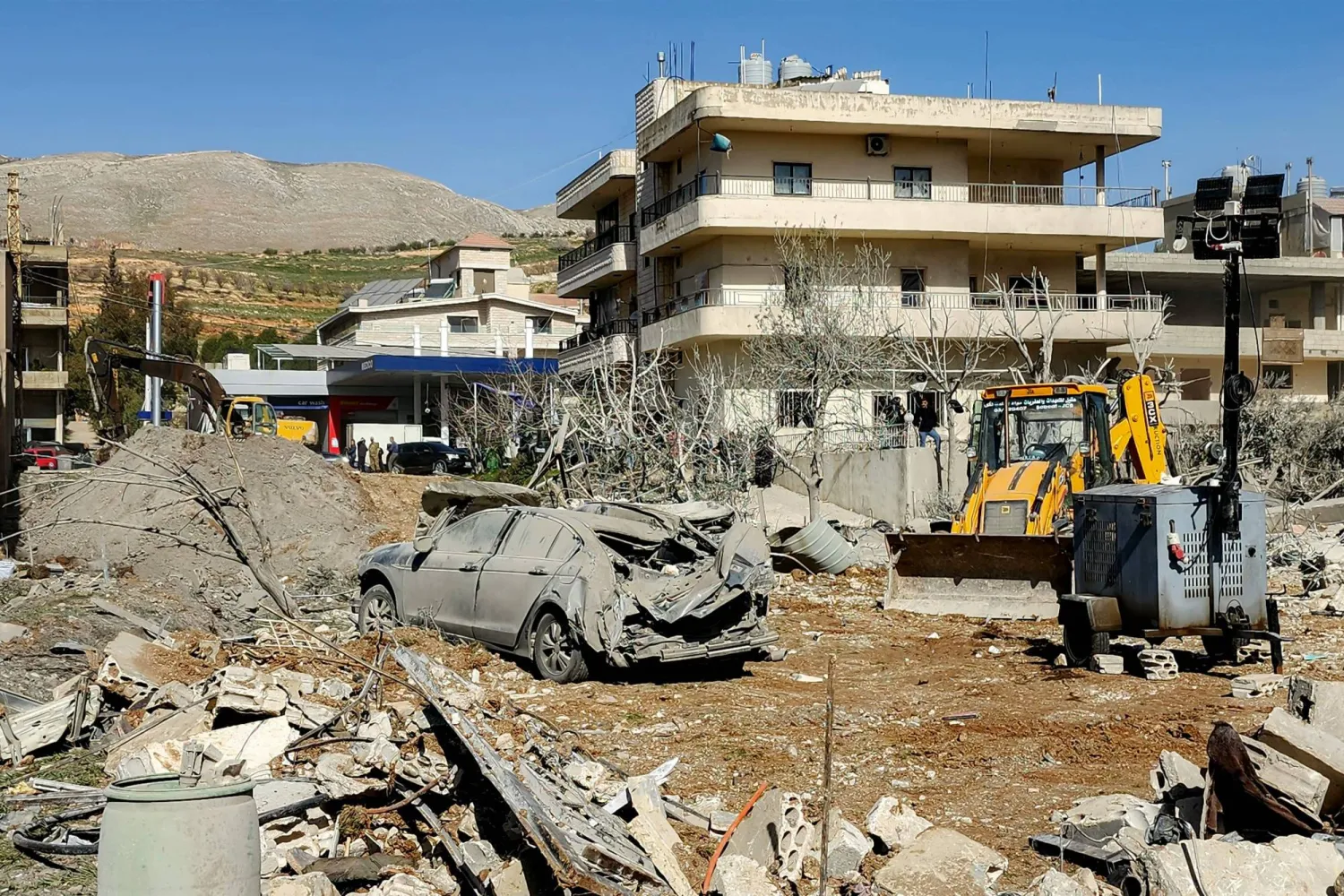
Destroyed buildings caused by Israeli bombing on the Zuwaida area in the central Gaza Strip (AFP)
TT

Israeli Forces Storm Hospital as Khan Younis Hit by Bloodiest Fighting of 2024

Destroyed buildings caused by Israeli bombing on the Zuwaida area in the central Gaza Strip (AFP)

Israeli forces, advancing deep into western Khan Younis in Gaza's bloodiest fighting so far in January, stormed one hospital and put another under siege on Monday, cutting the wounded off from trauma care, Palestinian officials said.

Troops advanced for the first time into the al-Mawasi district near the Mediterranean Coast, west of Khan Younis, the main city in southern Gaza. There, they stormed the Al-Khair hospital and were arresting medical staff, Gaza health ministry spokesman Ashraf al Qidra told Reuters.

There was no immediate word from Israel on the situation at the hospital. The military spokesperson's office had no comment.

Qidra said at least 50 people were killed overnight in Khan Younis, while the sieges of medical facilities meant dozens of dead and wounded were beyond the reach of rescuers.

"The Israeli occupation is preventing ambulance vehicles from moving to recover bodies of martyrs and the wounded from western Khan Younis," he said.

The Palestinian Red Crescent said tanks had surrounded another Khan Younis hospital, al-Amal, headquarters of the rescue agency, which had lost contact with staff there.

"We are deeply worried about what is happening around our hospital," said Tommaso Della Longa, spokesperson for the International Federation of Red Cross and Red Crescent Societies.

"Ambulances cannot go in or out and we cannot provide any emergency health care to people in the area."

Israel says Hamas fighters operate from in and around hospitals, which Hamas and medical staff deny.

"Hamas embeds its operation within and under hospitals and other medical facilities," said Elad Goren of COGAT, the Israeli defense ministry branch that coordinates with the Palestinians. "A particular effort led by a dedicated team has been put on making sure that civilians have access to medical care."

Residents said the bombardment from air, land and sea was the most intense in the southern sector of Gaza since the war began in October.

Video filmed from afar showed scattered civilians wandering around a ghost city, crowded with tents with abandoned laundry flapping on lines, as gunfire rattled and smoke rose into the sky.

Israel launched an offensive last week to capture Khan Younis, which it now says is the principal headquarters of the Hamas militants responsible for the Oct. 7 attacks on southern Israel that killed 1,200 people, according to Israeli tallies.

The newest phase of the war has brought fighting deep into the last corners of the enclave now packed with those who fled bombardment. At least 25,295 Gazans have been killed since Oct. 7, Gaza health authorities said in an update on Monday.

The majority of Gaza's 2.3 million residents are now penned into Rafah just south of Khan Younis and Deir al-Balah just north of it, crammed into public buildings and camps of tents made from plastic sheets lashed to wooden frames.

Lines of cars and donkey carts piled high with belongings pushed south as Gazans sought to flee the bombardments.

"This is the seventh time I get displaced," said Gazan Mariam Abu-Haleeb, weeping in a car surrounded by her possessions.

Ahmad Abu-Shaweesh, a boy, described having taken shelter in the Al-Aqsa University only to find the institution coming under attack.

"We hardly made it out of the university under the shelling. We didn't expect the tanks at the university's gates."

Buried in hospital grounds

At Nasser Hospital, the only major hospital still accessible in Khan Younis and the largest still functioning in Gaza, video showed the trauma ward overwhelmed with wounded being treated on a floor splashed with blood.

Ahmed Abu Mustafa, an emergency doctor, said he hadn't slept for 30 hours and was treating 10-11 patients in an intensive care unit with four beds.

Outside, men dug graves within the hospital grounds because it was not safe to venture out to the cemetery. Authorities said 40 people were buried there.

In Brussels, Palestinian Authority Foreign Minister Riyad al-Malki told reporters the situation in Gaza was out of control and asked the European Union to call for a ceasefire.

"The health system has collapsed. There is no way for injured Palestinians to be treated in the Gaza strip and they are not able to leave Gaza for treatment outside."

Israel says it will not stop fighting until it annihilates Hamas. But Palestinians and some Western military experts say that objective may be unachievable given the group's diffuse structure and deep roots in Gaza, which it has ruled since 2007.

Though Israelis overwhelmingly support the war, a growing number led by relatives of the remaining hostages say the government should do more to reach a deal to free them, even if that means reining in its offensive.

About 20 relatives of hostages stormed a parliamentary committee session in Jerusalem on Monday, demanding the lawmakers do more to help free their loved ones.

Israeli Prime Minister Benjamin Netanyahu told a group of relatives there was no truth to reports of a deal to free hostages in a ceasefire.

"I am saying this as clearly as I can because there are so many incorrect statements which are certainly agonizing for you," Netanyahu's office quoted him as telling them.

Sami al-Zuhri, head of Hamas' political unit in exile, told Reuters on Monday Hamas was open to "all initiatives and proposals, but any agreement must be based on ending the aggression and the occupation's complete withdrawal" from Gaza. 


Parliamentary Elections Preparations Kick off in Lebanon Despite Doubts They Will Be Held

Head of the Lebanese Forces Samir Geagea announces the launch of its electoral campaign in Bcharre. (National News Agency)
TT

Parliamentary Elections Preparations Kick off in Lebanon Despite Doubts They Will Be Held

Head of the Lebanese Forces Samir Geagea announces the launch of its electoral campaign in Bcharre. (National News Agency)

Political forces in Lebanon have kicked off their preparations for the upcoming parliamentary elections in May despite doubts that they may not be held. No more than ten candidates have so far submitted their nominations as the political powers work on postponing the elections while still preparing to run in them.

Shiite duo

Parliament Speaker Nabih Berri has repeatedly said that the elections will be held on time.

He received on Friday a delegation from Hezbollah’s Loyalty to the Resistance bloc headed by MP Mohammed Raad. Talks focused on political developments and the elections.

Berri’s Amal movement and Hezbollah are allies that form the so-called “Shiite duo”.

Following the meeting, Raad said both sides share the same views and that their alliance still stands.

“Together, they will form national unity against all challenges,” he declared. “We will run in the elections together.”

It remains to be seen what other alliances the Shiite duo will manage to forge.

The Free Patriotic Movement (FPM), headed by MP Jebran Bassil, had previously ended its alliance with Hezbollah, but reports have said the two sides may hold negotiations related to the elections.

Geagea: Elections are critical

Samir Geagea’s Lebanese Forces launched on Friday the party’s electoral campaign from Bcharre, announcing the nomination of MP Setrida Tawk Geagea and former MP Joseph Ishak, who will both run in the province.

More candidates will be announced within a week, leading LF sources told Asharq Al-Awsat.

Samir Geagea described the elections as a “pivotal juncture in reclaiming the state and consolidating its sovereignty,” calling for a large turnout.

Sources from the LF acknowledged that the elections may be postponed, but until that happens, the party will operate as though they are going to be held on time.

The FPM had last week cited “negative” signals that may impede the elections given the ongoing dispute over the voting of expatriates and other differences.

The LF sources told Asharq Al-Awsat that preparations for the elections are taking place “on all levels” and “covering all of their aspects.”

The remaining candidates will be announced within days, they revealed.

“For us, the main question is why and how will the current parliament’s term be extended and who will dare to even suggest it?” they said.

“We are therefore convinced that the elections will be held. We are making our preparations based on the firm conviction that the elections need to be held. There really is no reason to delay them, and we will stand against anyone who tries to do so,” they added.

The Interior Ministry had announced that candidates have between February 10 and March 10 to submit their nominations.


US Makes Plans to Reopen Embassy in Syria after 14 Years

This handout picture released by the Syrian Presidency's Telegram page, shows Syria's President Ahmed al-Sharaa (R) shaking hands with US envoy Tom Barrack at the Presidential Palace in Damascus on January 18, 2026. (Photo by Handout / Syrian Presidency Telegram Page / AFP)
TT

US Makes Plans to Reopen Embassy in Syria after 14 Years

This handout picture released by the Syrian Presidency's Telegram page, shows Syria's President Ahmed al-Sharaa (R) shaking hands with US envoy Tom Barrack at the Presidential Palace in Damascus on January 18, 2026. (Photo by Handout / Syrian Presidency Telegram Page / AFP)

The Trump administration has informed Congress that it intends to proceed with planning for a potential re-opening of the US Embassy in Damascus, Syria, which was shuttered in 2012 during the country’s civil war.

A notice to congressional committees earlier this month, which was obtained by The Associated Press, informed lawmakers of the State Department’s “intent to implement a phased approach to potentially resume embassy operations in Syria.”

The Feb. 10 notification said that spending on the plans would begin in 15 days, or next week, although there was no timeline offered for when they would be complete or when US personnel might return to Damascus on a full-time basis.

The administration has been considering re-opening the embassy since last year, shortly after longtime strongman Bashar Assad was ousted in December 2024, and it has been a priority for President Donald Trump's ambassador to Türkiye and special envoy for Syria, Tom Barrack.

Barrack has pushed for a deep rapprochement with Syria and its new leadership under Ahmad al-Sharaa and has successfully advocated for the lifting of US sanctions and a reintegration of Syria into the regional and international communities. Last May, Barrack visited Damascus and raised the US flag at the embassy compound, although the embassy was not yet re-opened.

The same day the congressional notification was sent, Barrack lauded Syria's decision to participate in the coalition that is combating the ISIS militant group, even as the US military has withdrawn from a small, but important, base in the southeast and there remain significant issues between the government and the Kurdish minority.

“Regional solutions, shared responsibility. Syria’s participation in the D-ISIS Coalition meeting in Riyadh marks a new chapter in collective security,” Barrack said.

The embassy re-opening plans are classified and the State Department declined to comment on details beyond confirming that the congressional notification was sent.

However, the department has taken a similar “phased” approach in its plans to re-open the US Embassy in Caracas, Venezuela, following the US military operation that ousted former President Nicolás Maduro in January, with the deployment of temporary staffers who would live in and work out of interim facilities.


Israeli Druze Leader Says Syrian Community 'Besieged' Months after Clashes

Sheikh Mowafaq Tarif, the spiritual leader of the Druze community in Israel, during an interview in the village of Julis on February 15, 2026 (AFP)
TT

Israeli Druze Leader Says Syrian Community 'Besieged' Months after Clashes

Sheikh Mowafaq Tarif, the spiritual leader of the Druze community in Israel, during an interview in the village of Julis on February 15, 2026 (AFP)

Seven months after deadly clashes between Syria's Druze minority and government-backed forces, the spiritual leader of Druze in neighboring Israel said members of the community across the border remained in peril.

"They're still besieged -- completely encircled. They aren't allowed to bring in any humanitarian aid, including the aid we're trying to deliver," Sheikh Mowafaq Tarif told AFP in an interview this week.

The cleric spoke in Julis, a quiet Druze village in northern Israel, where the community has set up an "emergency room" to coordinate aid efforts for Druze in Syria.

Israeli and Druze flags hang on the walls of the room, alongside posters in Hebrew and Arabic calling for an end to the killing of Syrian Druze.

The Druze spread across parts of Syria, Israel, Lebanon and the Israeli-occupied Golan Heights.

Clashes erupted last July in southern Syria between Druze fighters and Bedouin tribes.

The Syrian authorities said their forces intervened to stop the clashes.

Israel bombed Syria during the violence, saying it was acting to defend the minority group.

The UN Office for the Coordination of Humanitarian Affairs estimated that some 187,000 people were displaced by the violence.

- 'Why not let them return?' -

"There are still more than 120,000 people displaced from their homes," Sheikh Tarif said.

"Thirty-eight villages have been captured, and residents aren't allowed to return. There are more than 300 captives, including children and women."

AFP was unable to verify those claims.

Although a ceasefire was reached in July, access to Sweida remains difficult.

Residents accuse the government of imposing a blockade on the province, which Damascus denies. Several aid convoys have entered since then.

"Why not let them return to their villages? We're in the depths of winter and that is a mountainous area. It's very cold," Tarif said.

With Syria's government and Kurdish-led forces agreeing last month to integrate Kurdish fighters and civil institutions into state structures, Sweida is the last major area outside Damascus's control.

Tarif said the community did not need government security forces in the region.

"The Druze have forces capable of defending themselves and maintaining order," he said.

Nevertheless, Israel and Syria, which have no official diplomatic ties, have held several rounds of direct talks in recent months.

Following negotiations in January, and under US pressure, both sides agreed to set up an intelligence-sharing mechanism as they moved toward a security agreement.

One issue under discussion is the possibility of Syrian Druze working in Israel.

Sheikh Tarif confirmed "that is something we have heard" and added that he wished any Syrian could come to work as a daily laborer "because the (economic) situation in Syria is very difficult".

He also called for Druze across the Middle East to be able to visit their religious sites in neighboring countries, "just as our Christian and Muslim brothers visit their holy places" in states with which they may not have diplomatic relations.

"The Druze also deserve to access and pray at our holy sites in Syria and Lebanon and for them to come visit our holy places" in Israel, he said.