US, Britain Wage Strikes against Iran-linked Houthis in Yemen

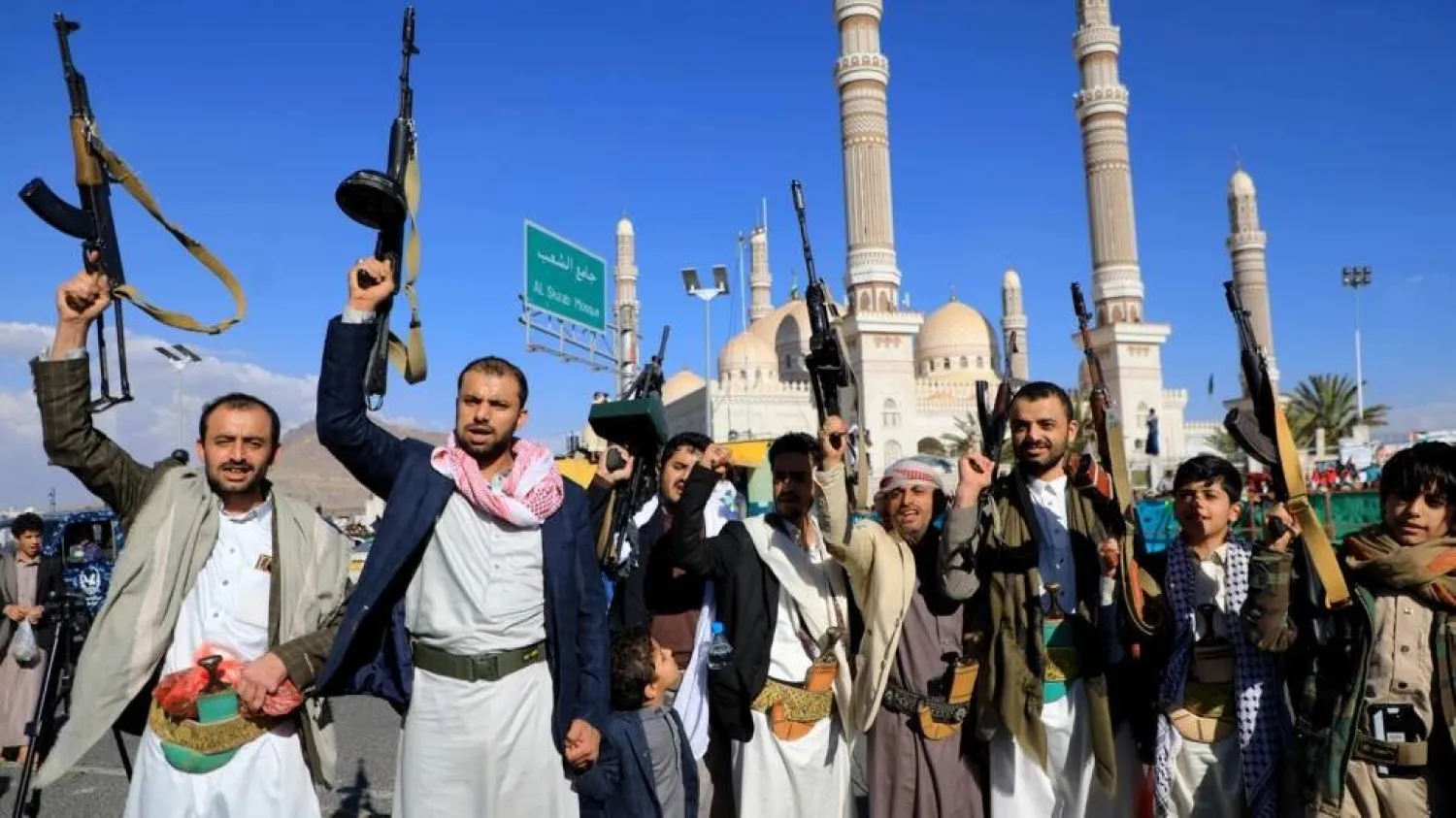
Armed Yemeni demonstrators take to the streets of the Houthi-controlled capital Sanaa, to show their support to Palestinians in the Gaza Strip on February 2, 2024. MOHAMMED HUWAIS / AFP
TT

US, Britain Wage Strikes against Iran-linked Houthis in Yemen

Armed Yemeni demonstrators take to the streets of the Houthi-controlled capital Sanaa, to show their support to Palestinians in the Gaza Strip on February 2, 2024. MOHAMMED HUWAIS / AFP

The United States and Britain launched strikes against 36 Houthi targets in Yemen on Saturday, in the second day of major US operations against Iran-linked groups following a deadly attack on American troops last weekend.
The strikes hit buried weapons storage facilities, missile systems, launchers and other capabilities the Houthis have used to attack Red Sea shipping, the Pentagon said, adding it targeted 13 locations across the country, said Reuters.
It was the latest sign of spreading conflict in the Middle East since war erupted between Israel and Hamas after the Palestinian group's deadly assault on Israel on Oct.7.
"This collective action sends a clear message to the Houthis that they will continue to bear further consequences if they do not end their illegal attacks on international shipping and naval vessels," US Defense Secretary Lloyd Austin said.
Houthi military spokesperson Yahya Sarea said the US strikes "will not pass without a response and consequences."
The Yemen strikes are running parallel to an unfolding US campaign of military retaliation over the killing of three American soldiers in a drone strike by Iran-backed militants on an outpost in Jordan.
On Friday, the US carried out the first wave of that retaliation, striking in Iraq and Syria against more than 85 targets linked to Iran's Revolutionary Guard Corps (IRGC) and militias it backs, reportedly killing nearly 40 people.
While Washington accuses Iran-backed militias of attacking US troops at bases in Iraq, Syria and Jordan, Yemen's Iran-linked Houthis have been regularly targeting commercial ships and warships in the Red Sea.
The Houthis, who control the most populous parts of Yemen, say their attacks are in solidarity with Palestinians as Israel strikes Gaza. But the US and its allies characterize them as indiscriminate and a menace to global trade.
Faced with mounting Red Sea violence, major shipping lines have largely abandoned the critical trade route for longer routes around Africa. This has increased costs, feeding worries about global inflation while sapping Egypt of crucial foreign revenue from shippers sailing the Suez Canal to or from the Red Sea.
Biden's emerging strategy on Yemen aims to weaken the Houthi militants but stops well short of trying to defeat the group or directly attack Iran, the Houthis' main sponsor, experts say.
The strategy blends limited military strikes and sanctions, and appears aimed at punishing the Houthis while attempting to limit the risk of a broad Middle East conflict.
The US has carried out more than a dozen strikes against Houthi targets in the past several weeks, but these have failed to stop attacks by the group.
Sarea, the Houthi military spokesperson, suggested in a statement on social media that the group's intervention in the Red Sea would continue.
"These attacks will not deter us from our ethical, religious and humanitarian stance in support of the resilient Palestinian people in the Gaza Strip," Sarea said.
Just hours before the latest major wave of strikes from the sea and air, the US military's Central Command issued statements detailing other, more limited strikes in the past day that included hitting six cruise missiles the Houthis were preparing to launch against ships in the Red Sea.
Around 4 a.m. in Yemen (0100 GMT), the US military also struck a Houthi anti-ship cruise missile that was poised to launch.
"This is not an escalation," said British Defence Minister Grant Shapps. "We have already successfully targeted launchers and storage sites involved in Houthi attacks, and I am confident that our latest strikes have further degraded the Houthis’ capabilities."
The United States said Sunday's strikes had support from Australia, Bahrain, Canada, Denmark, the Netherlands and New Zealand. US Central Command said that beyond missile capabilities, the strikes targeted drone storage and operations sites, radars and helicopters.
Despite the strikes against Iran-linked groups, the Pentagon has said it does not want war with Iran and does not believe Tehran wants war either. US Republicans have been ratcheting up pressure on President Joe Biden, a Democrat, to deal a blow to Iran directly.
It was unclear how Tehran would respond to the strikes, which do not directly target Iran but degrade groups it backs.
Iran's foreign ministry spokesperson Nasser Kanaani said in a statement the attacks in Iraq and Syria represented "another adventurous and strategic mistake by the United States that will result only in increased tension and instability".
Iraq summoned the US charge d'affaires in Baghdad to deliver a formal protest after strikes in that country.
The Houthi military said in its statement that the United States and Britain carried out a total of 48 airstrikes on Yemen, with 13 of them in the capital Sanaa and Sanaa Governorate. Another 11 strikes were on Taiz Governorate and nine were on Hodeidah Governorate.



Israel Permits 10,000 West Bank Palestinians for Friday Prayers at Al Aqsa

Palestinians attend Friday prayers in a mosque following an attack that local Palestinians said was carried out by Israeli settlers, in the village of Deir Istiya near Salfit in the Israeli-occupied West Bank November 14, 2025. REUTERS/Sinan Abu Mayzer
TT

Israel Permits 10,000 West Bank Palestinians for Friday Prayers at Al Aqsa

Palestinians attend Friday prayers in a mosque following an attack that local Palestinians said was carried out by Israeli settlers, in the village of Deir Istiya near Salfit in the Israeli-occupied West Bank November 14, 2025. REUTERS/Sinan Abu Mayzer

Israel announced that it will cap the number of Palestinian worshippers from the occupied West Bank attending weekly Friday prayers at the Al-Aqsa Mosque in east Jerusalem at 10,000 during the holy month of Ramadan, which began Wednesday.

Israeli authorities also imposed age restrictions on West Bank Palestinians, permitting entry only to men aged 55 and older, women aged 50 and older, and children up to age 12.

"Ten thousand Palestinian worshippers will be permitted to enter the Temple Mount for Friday prayers throughout the month of Ramadan, subject to obtaining a dedicated daily permit in advance," COGAT, the Israeli defense ministry agency in charge of civilian matters in the Palestinian territories, said in a statement, AFP reported.

"Entry for men will be permitted from age 55, for women from age 50, and for children up to age 12 when accompanied by a first-degree relative."

COGAT told AFP that the restrictions apply only to Palestinians travelling from the West Bank, which Israel has occupied since the 1967 Arab-Israeli war.

"It is emphasised that all permits are conditional upon prior security approval by the relevant security authorities," COGAT said.

"In addition, residents travelling to prayers at the Temple Mount will be required to undergo digital documentation at the crossings upon their return to the areas of Judea and Samaria at the conclusion of the prayer day," it said, using the Biblical term for the West Bank.

During Ramadan, hundreds of thousands of Palestinians traditionally attend prayers at Al-Aqsa, Islam's third holiest site, located in east Jerusalem, which Israel captured in 1967 and later annexed in a move that is not internationally recognized.

Since the war in Gaza broke out in October 2023, the attendance of worshippers has declined due to security concerns and Israeli restrictions.

The Palestinian Jerusalem Governorate said this week that Israeli authorities had prevented the Islamic Waqf -- the Jordanian-run body that administers the site -- from carrying out routine preparations ahead of Ramadan, including installing shade structures and setting up temporary medical clinics.

A senior imam of the Al-Aqsa Mosque, Sheikh Muhammad al-Abbasi, told AFP that he, too, had been barred from entering the compound.

"I have been barred from the mosque for a week, and the order can be renewed," he said.

Abbasi said he was not informed of the reason for the ban, which came into effect on Monday.

Under longstanding arrangements, Jews may visit the Al-Aqsa compound -- which they revere as the site of the first and second Jewish temples -- but they are not permitted to pray there.

Israel says it is committed to upholding this status quo, though Palestinians fear it is being eroded.

In recent years, a growing number of Jewish ultranationalists have challenged the prayer ban, including far-right politician Itamar Ben Gvir, who prayed at the site while serving as national security minister in 2024 and 2025.


EU Exploring Support for New Gaza Administration Committee, Document Says

Palestinians push a cart past the rubble of residential buildings destroyed during the two-year Israeli offensives, in Gaza City, February 17, 2026. REUTERS/Mahmoud Issa
TT

EU Exploring Support for New Gaza Administration Committee, Document Says

Palestinians push a cart past the rubble of residential buildings destroyed during the two-year Israeli offensives, in Gaza City, February 17, 2026. REUTERS/Mahmoud Issa

The European Union is exploring possible support for a new committee established to take over the civil administration of Gaza, according to a document produced by the bloc's diplomatic arm and seen by Reuters.

"The EU is engaging with the newly established transitional governance structures for Gaza," the European External Action Service wrote in a document circulated to member states on Tuesday.

"The EU is also exploring possible support to the National Committee for the Administration of Gaza," it added.

European foreign ministers will discuss the situation in Gaza during a meeting in Brussels on February 23.


Israel Military Says Soldier Killed in Gaza 

A drone view shows the destruction in a residential neighborhood, after the withdrawal of the Israeli forces from the area, amid a ceasefire between Israel and Hamas in Gaza, in Gaza City, October 21, 2025. (Reuters)
TT

Israel Military Says Soldier Killed in Gaza 

A drone view shows the destruction in a residential neighborhood, after the withdrawal of the Israeli forces from the area, amid a ceasefire between Israel and Hamas in Gaza, in Gaza City, October 21, 2025. (Reuters)

The Israeli military announced that one of its soldiers had been killed in combat in southern Gaza on Wednesday, but a security source said the death appeared to have been caused by "friendly fire".

"Staff Sergeant Ofri Yafe, aged 21, from HaYogev, a soldier in the Paratroopers Reconnaissance Unit, fell during combat in the southern Gaza Strip," the military said in a statement.

A security source, however, told AFP that the soldier appeared to have been "killed by friendly fire", without providing further details.

"The incident is still under investigation," the source added.

The death brings to five the number of Israeli soldiers killed in Gaza since a ceasefire took effect on October 10.